Table of Contents >> Show >> Hide
- Why Continuity Is So Weird in The Simpsons
- 1. The Simpsons Movie Temporarily Renamed Moe’s Tavern
- 2. Homer’s Tombstone Misspelled “Simpson”
- 3. The Simpsons’ Address Refuses to Stay at 742 Evergreen Terrace
- 4. Carl Accidentally Speaks With Lenny’s Voice
- 5. The Classic Opening Sequence Has a Garage Continuity Error
- What These Simpsons Continuity Screwups Reveal About the Show
- Experience Section: Rewatching The Simpsons Through the Lens of Continuity Mistakes
- Conclusion
Note: This article is fully rewritten in original wording and based on real episode details, public entertainment reporting, and long-running fan documentation of The Simpsons continuity mistakes.
The Simpsons has survived bad haircuts, nuclear meltdowns, flaming drinks, angry mobs, talking coyotes, and more than three decades of viewers pausing scenes like forensic accountants with snacks. A show that began in the late 1980s and still keeps Springfield alive has earned the right to play loose with reality. Bart is still ten. Lisa is still eight. Maggie still communicates through pacifier-based Morse code. Homer should be older than several Supreme Court justices by now, but somehow he remains a middle-aged man with the metabolism of a raccoon in a donut factory.
Still, even in a cartoon universe where logic takes lunch breaks, some mistakes stand out. These are not emotional retcons, alternate futures, Halloween episodes, or jokes that knowingly break the fourth wall. These are the little visual and story glitches that slip through the cracks: a sign that changes names, a house that can’t hold still, a character speaking with the wrong voice, and even an opening sequence that accidentally turns the Simpson garage into a magic trick.
The phrase “a wizard did it” has become fan shorthand for shrugging off impossible continuity errors. But the following five Simpsons continuity screwups are too specific, too funny, and too visible to send straight to the Department of Wizards. Let’s grab a Squishee, put on our most judgmental Comic Book Guy voice, and investigate.
Why Continuity Is So Weird in The Simpsons
Before pointing at Springfield’s mistakes like Nelson Muntz spotting fresh humiliation, it is worth remembering that The Simpsons was never designed like a prestige streaming drama with a corkboard full of timelines. It is a sitcom, a satire machine, and a joke delivery system. The series often treats continuity as flexible because the characters need to stay recognizable while the culture around them keeps changing.
That flexibility is part of the show’s charm. Homer and Marge have met in different eras depending on what the story needs. Springfield has mountains, beaches, deserts, monorails, mansions, farms, factories, and whatever else the writers require by act two. The town is less a real place than a comedy junk drawer labeled “America.”
But that does not mean every inconsistency is intentional. Some The Simpsons mistakes are plainly production goofs. They are not complex canon debates. They are not secret clues. They are the animated equivalent of walking into a room and forgetting why you came in, except the room is watched by millions of people forever.
1. The Simpsons Movie Temporarily Renamed Moe’s Tavern
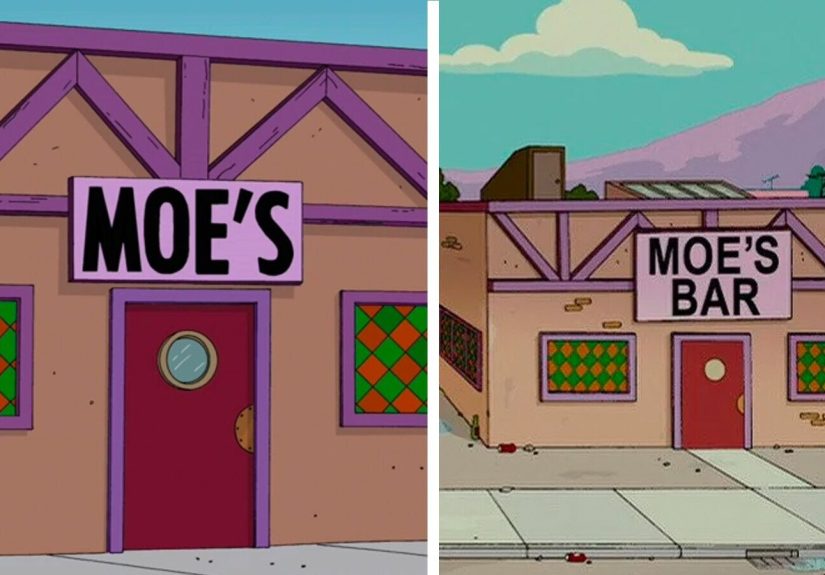
Moe Szyslak’s bar is one of the most familiar locations in Springfield. Fans know it as Moe’s Tavern, the dimly lit home of prank calls, pickled eggs, and men who have considered beer a food group since before nutrition labels got bossy. In most versions, the sign outside keeps things simple: “Moe’s.” The establishment has had joke-based variations over the years, but Moe’s Tavern is the core identity.
Then came The Simpsons Movie in 2007. The film had a bigger budget, a wider audience, and enough Spider-Pig energy to power a small county. Yet in one exterior shot, the familiar watering hole is labeled “Moe’s Bar.”
Why This Continuity Error Feels So Odd
Calling it “Moe’s Bar” is not technically impossible. Moe does run a bar. This is not like labeling the nuclear plant “Lenny’s Pancake Barn.” But it still feels wrong because The Simpsons has trained viewers to recognize certain Springfield landmarks instantly. Moe’s is Moe’s. The name has rhythm. It has grime. It smells like old peanuts and poor decisions.
The likely explanation is simple: the movie needed to communicate quickly to casual viewers that the building was a bar. For longtime fans, however, that tiny label change lands like a misplaced saxophone solo. It is not a plot-destroying error, but it is exactly the kind of detail that makes obsessive fans sit upright and whisper, “Wait a minute.”
2. Homer’s Tombstone Misspelled “Simpson”
The episode “Mother Simpson” is one of the show’s most memorable emotional stories. Homer reconnects with his long-lost mother, Mona, and the episode balances comedy with genuine melancholy. It also includes a grim gag: Homer fakes his own death, and Patty and Selma arrive with a tombstone already prepared. Because of course they do. Those two would keep a backup insult in a safety deposit box.
But in one version of the tombstone design, Homer’s last name appears as “Simson” instead of “Simpson.” The mistake was reportedly noticed and corrected, yet the misspelled version can still be spotted in at least one shot.
Why the Misspelling Works Accidentally
The funniest part is that the error almost fits the characters. Patty and Selma dislike Homer so intensely that misspelling his name on a grave marker would not even be their worst act of sisterly hostility. It could have been a joke. It feels like a joke. Unfortunately, that is what makes the screwup so sneaky: the audience can almost rationalize it.
Still, in continuity terms, it is a classic visual mistake. Homer J. Simpson is one of the most famous names in television. Dropping the “p” from Simpson is like printing “Mickey Moue” on a Disney sign. Maybe nobody in Springfield would notice, but viewers certainly did.
3. The Simpsons’ Address Refuses to Stay at 742 Evergreen Terrace
The Simpson family’s official home is famously located at 742 Evergreen Terrace. It is the house with the orange couch, the questionable structural integrity, the treehouse, the garage, and the mysterious ability to contain whatever room the story requires. In pop culture terms, it is as recognizable as the Batcave, except with more pork chops.
However, early episodes and related scenes have given the Simpson home several different addresses. At different points, the house has been associated with numbers such as 94, 59, 723, 1094, and even 430 Spalding Way. To make matters stranger, one episode uses 742 Evergreen Terrace for a different house entirely.
Why the Address Problem Is Bigger Than a Typo
A changing address might sound minor, but it is one of the clearest examples of Simpsons continuity errors because the family home is supposed to be the stable center of the series. Jobs change, side characters vanish, and Krusty launches products that probably violate six federal regulations, but the Simpson house is the anchor.
That anchor, unfortunately, has drifted. The best explanation is that the early production years had not fully locked down every recurring detail. Once 742 Evergreen Terrace became the recognized address, it stuck. But the older numbers remain in the record like Springfield’s own paper trail of confusion.
Of all the show’s continuity screwups, this one might be the most on-brand. Springfield itself is geographically impossible, so perhaps the house number changing is just the town expressing itself. Still, a house that can move addresses without moving streets is not a home. It is a real estate cryptid.
4. Carl Accidentally Speaks With Lenny’s Voice
Lenny Leonard and Carl Carlson are one of Springfield’s great supporting duos. They are Homer’s coworkers, drinking buddies, and occasional evidence that the nuclear plant’s hiring standards were written on a napkin during happy hour. Over time, their personalities became distinct: Lenny is soft-spoken, oddly beloved, and often injured; Carl is more direct, cool, and dry.
But in the Season 2 episode “Brush with Greatness,” Carl opens his mouth and the voice that comes out is unmistakably Lenny’s. It is not a subtle character choice. It is an audio mismatch.
Why This Mistake Is So Easy to Miss
Early Simpsons episodes were still shaping many supporting characters. Voices, designs, and personalities were not always fully settled. Carl and Lenny had not yet become the iconic pair they would later become, so a voice mix-up may have seemed less obvious during production.
Today, though, the error jumps out. Fans know these characters too well. Hearing Lenny’s voice come from Carl is like watching Mr. Burns speak with Barney’s belch. The brain rejects it instantly.
This is one of the cleanest examples of a Simpsons production mistake. It is not a retcon, not a joke, not an alternate timeline. It is a character speaking with the wrong character’s sound. Somewhere in Springfield, a voice track slipped on a banana peel.
5. The Classic Opening Sequence Has a Garage Continuity Error
The opening sequence of The Simpsons is practically sacred television ritual. Bart writes on the chalkboard. Homer mishandles radioactive material. Marge shops with Maggie. Lisa gets thrown out of band practice for being too jazzy for the system. Then everyone races home to the couch, because family bonding is more dramatic when traffic laws are optional.
Yet even that iconic opening contains a continuity mistake. In the garage sequence, objects such as boxes, a bicycle, and a rake appear in one shot and then vanish or shift in the next. The mismatch is tied to how parts of the opening were updated and reused across seasons.
Why the Opening Error Is the Perfect Simpsons Screwup
This mistake is beautiful because it has been hiding in plain sight. Fans have watched the opening hundreds of times, sometimes thousands, and the garage still gets away with a tiny vanishing act. It is like the show dared viewers to notice and then waited decades with its hands folded.
Unlike a one-time background typo, this error repeats whenever that opening version plays. It becomes part of the ritual. The same way fans anticipate the couch gag, sharp-eyed viewers can anticipate the garage briefly abandoning the laws of physical space.
Can we blame a wizard? Technically, yes, but that would be lazy. The real culprit is more interesting: animation reuse, updated shots, and the practical demands of television production. In other words, not magic. Just show business wearing yellow paint.
What These Simpsons Continuity Screwups Reveal About the Show
These mistakes matter because they expose the strange relationship fans have with The Simpsons. Viewers love the show partly because it is chaotic, elastic, and impossible to pin down. At the same time, fans know Springfield so well that even small errors feel personal. We know Moe’s sign. We know the house. We know Carl’s voice. We know that if Homer’s grave says “Simson,” something has gone delightfully wrong.
The best Simpsons continuity screwups do not ruin the show. They make it more human. Animation may be drawn, recorded, edited, and polished, but it is still made by people. People miss things. People reuse assets. People accidentally let Lenny possess Carl for one line. That does not diminish the series. If anything, it gives fans another layer of comedy to enjoy.
Springfield is not a perfectly engineered fictional universe. It is a comedy ecosystem. Its rules bend. Its geography mutates. Its characters stay the same age while real viewers grow up, get jobs, pay bills, and eventually understand why Homer screams so much. The mistakes are part of the texture.
Experience Section: Rewatching The Simpsons Through the Lens of Continuity Mistakes
Watching The Simpsons for continuity errors is a completely different experience from watching it for jokes. The first time through, most viewers are following the story: Homer is panicking, Bart is causing trouble, Lisa is being morally correct in a way that annoys everyone, and Marge is trying to keep the household from collapsing into a pile of unpaid bills and saxophone reeds. But on a rewatch, the eye starts drifting to the background. Suddenly the wall pictures, street numbers, shop signs, and garage props become part of the entertainment.
That is when the show becomes a treasure hunt. A casual viewer sees Moe’s. A continuity hunter sees the sign and asks whether it says Moe’s Tavern, Moe’s, Moe’s Bar, or something created after Moe briefly decided branding was cheaper than therapy. A casual viewer hears Carl deliver a line. A continuity hunter freezes, rewinds, and realizes the voice sounds suspiciously like Lenny wandered into the wrong mouth. This kind of viewing turns every episode into a comedy museum where some labels have been placed on the wrong exhibits.
The experience is especially funny because The Simpsons has always mocked the exact kind of person who notices these things. The show understands obsessive fans because it helped invent modern obsessive TV fandom. Comic Book Guy is a parody, but he is also a warning label. When someone spends ten minutes arguing about whether 742 Evergreen Terrace was always the correct address, the show is practically standing behind them whispering, “Worst. Debate. Ever.”
Yet there is affection in that attention. Fans do not track The Simpsons continuity errors because they hate the series. They do it because Springfield feels familiar enough to inspect. The Simpson house feels like a real place. Moe’s feels like a real bar. The opening sequence feels like a route viewers have driven in their heads. When those details shift, fans notice because the world has become part of their memory.
There is also something comforting about these screwups. Modern entertainment often treats continuity like sacred architecture. Franchises build timelines, multiverses, charts, and explainers until every coffee mug needs a backstory. The Simpsons comes from a looser tradition. It asks, “Is the joke funny?” before it asks, “Does this align with episode 4F12?” That looseness can create contradictions, but it also keeps the show alive. A perfect Springfield might be impressive, but an imperfect Springfield is funnier.
Rewatching the series with these mistakes in mind adds another layer of pleasure. You laugh at the jokes, then laugh again at the accidental jokes. You appreciate the craft, then appreciate the little cracks in the craft. The vanishing garage objects, the wandering address, the misspelled tombstone, and the wrong voice are not reasons to dismiss the show. They are reasons to revisit it. After all, only a series as huge and beloved as The Simpsons could turn its own errors into part of the fan experience.
Conclusion
The funniest thing about these five Simpsons continuity screwups is that none of them truly damages the show. Moe’s is still Moe’s. Homer is still a Simpson, even when a tombstone briefly disagrees. The family home still belongs at 742 Evergreen Terrace, even if the paperwork looks like it was filed by Chief Wiggum. Carl is still Carl, even if Lenny briefly escapes through his vocal cords. And the opening sequence remains iconic, disappearing garage clutter and all.
Continuity errors are not always failures. In a long-running comedy like The Simpsons, they become part of the legend. They remind us that Springfield is not a museum sealed behind glass. It is a messy, evolving, joke-powered town where anything can happen, including mistakes. And honestly, if a wizard really were responsible, he would probably be drinking at Moe’s under the wrong sign.