Table of Contents >> Show >> Hide
- Why playground gear feels so brutal (and why it still matters)
- The 8 “Geneva Convention” offenders
- 1) Monkey bars (aka “Overhead Regret Ladders”)
- 2) Swings (aka “The Flying Backhand”)
- 3) Merry-go-rounds (aka “Spin Class, But With Whiplash”)
- 4) Seesaws (aka “The Sudden-Impact Negotiation Tool”)
- 5) Roller slides (aka “The Finger-Pinch Express”)
- 6) Climbing nets, cargo ropes, and “cool” rope bridges
- 7) Trapeze bars and hanging rings (aka “Upper-Body Auditions”)
- 8) Metal slides (aka “The Solar-Powered Branding Iron”)
- How to “legalize” the chaos: practical playground safety moves
- These Things Gave Us Character: of Playground “Experience” You’ll Recognize
- Conclusion: keep the thrill, lose the trauma
Let’s be clear: this title is a joke. No international tribunal is going to kick down the gates of your local park.
But if you’ve ever watched a kid ragdoll off a set of monkey barsor experienced the emotional damage of a metal slide
that’s been slow-roasting in July sunyou understand the vibe.
The truth is, “dangerous playground equipment” usually isn’t one evil object plotting against children. It’s a combo platter:
height + speed + hard landings + poor spacing + loose clothing + the occasional “helpful” DIY rope someone tied on
like they were auditioning for a disaster documentary.
Why playground gear feels so brutal (and why it still matters)
Playground injuries aren’t rare, and the patterns are boringly consistent: falls lead the parade, and the most common
outcomes include fractures, bruises, cuts, and sprains. The equipment itself isn’t always the villainsometimes it’s the
ground. Sometimes it’s crowding. Sometimes it’s the fact that kids can turn any object into a physics experiment in under
three seconds.
Modern guidance focuses on predictable hazards: fall heights, impact-absorbing surfacing, “use zones” (the space around
equipment where collisions and falls happen), and avoiding entanglement/strangulation risks from cords, ropes, and certain
clothing. Translation: it’s not about making play boringit’s about making injuries less likely (and less severe) when play
goes sideways.
The 8 “Geneva Convention” offenders
Below are eight classics that have earned their dramatic reputation. For each, you’ll get:
what makes it feel unhinged, what safety best practices focus on, and how to keep the fun without turning recess into a
highlight reel of urgent care visits.
1) Monkey bars (aka “Overhead Regret Ladders”)
Monkey bars are the undefeated champions of playground bravado: kids line up to launch themselves into the air using
nothing but grip strength and questionable judgment.
Why they feel like a war crime: the most common failure mode is simplehands slip, bodies drop, arms go out,
and wrists/elbows take the hit. The landing may be soft-looking, but “soft-looking” and “impact-absorbing” are not the same
thing.
- Common hazard: falls from height, especially when kids jump from the middle or try to “skip” rungs.
- Safety focus: age-appropriate height, good grip surfaces, and truly protective surfacing that’s maintained (not compacted into decorative dirt).
- Parent move: if the surfacing is thin, matted down, or missing where kids land, treat the monkey bars like a museum exhibit: look, don’t climb.
2) Swings (aka “The Flying Backhand”)
Swings are fun because they’re basically a pendulum you can ride. Swings are dangerous because they’re basically a pendulum you can ride.
Why they feel like a war crime: “struck-by” injuries. A moving swing can hit a child like a padded wrecking ball
and sometimes it’s not even padded.
- Common hazards: kids running in front of active swings; swing seats colliding; overcrowded swing bays.
- Safety focus: sufficient clearance around swings, and seats made of softer materials (not rigid wood/metal).
- Parent move: teach the “no run zone” rule: if someone’s swinging, you walk aroundnever across the arc.
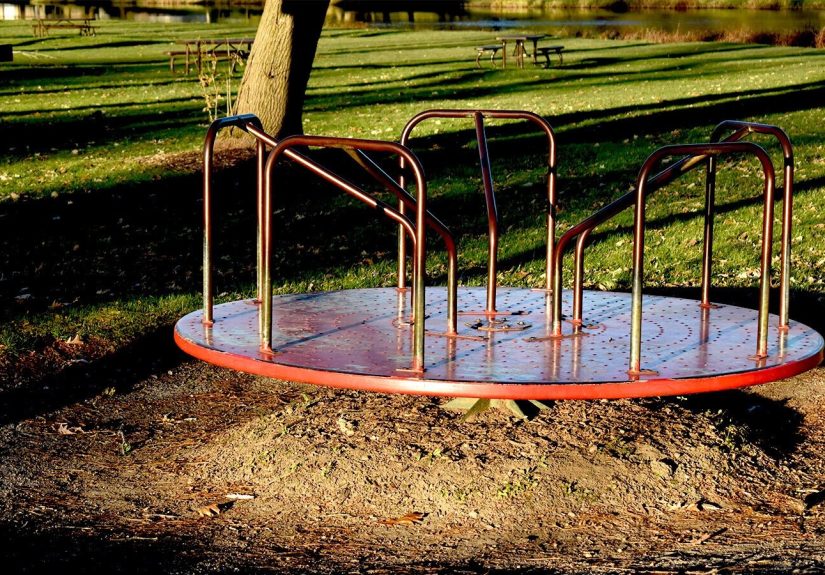
3) Merry-go-rounds (aka “Spin Class, But With Whiplash”)
The merry-go-round is a social experiment: one kid screams “FASTER,” another kid clings on for dear life, and a third kid
decides now is the perfect time to try getting on while it’s already moving.
Why they feel like a war crime: spinning equipment creates unpredictable exits. Centrifugal force doesn’t care about
anyone’s dental plan.
- Common hazards: falls off the edge; getting clothes caught; kids getting knocked down by the rotating platform.
- Safety focus: limiting fall height, keeping the platform low, and preserving a clear “use zone” around it so a thrown kid doesn’t become a human bowling ball.
- Parent move: if the platform is high, the handholds are sketchy, or the landing zone is hard, call it: “This one’s a no today.”
4) Seesaws (aka “The Sudden-Impact Negotiation Tool”)
Seesaws are adorable in theory. In practice, they’re two kids conducting a bilateral treaty negotiation with their tailbones.
Why they feel like a war crime: when one kid jumps off, the other kid meets gravity at speed. Also, the pivot area
can become a pinch/crush zone for fingers and feet.
- Common hazards: sudden drops; impact injuries; pinched fingers; feet getting trapped under a descending seat.
- Safety focus: designs that cushion the landing and reduce crush points.
- Parent move: if kids can’t reliably coordinate (common for younger ages), steer them toward equipment that doesn’t require cooperation to be safe.
5) Roller slides (aka “The Finger-Pinch Express”)
Roller slides look like harmless noveltyuntil you remember that rollers create gaps, gaps create pinch points, and pinch points
create screaming.
Why they feel like a war crime: missing rollers or broken bearings can turn a smooth glide into a sudden stop, plus
gaps can snag fingers, clothing, or shoe edges.
- Common hazards: pinches; snagging; abrupt stops; falls when kids try to stand mid-slide (because of course they do).
- Safety focus: tight spacing between rollers and frequent inspections to ensure rollers are intact and rolling.
- Parent move: do a quick look: if rollers are missing, cracked, or uneven, pick a different slide.
6) Climbing nets, cargo ropes, and “cool” rope bridges
Rope climbing equipment is fantastic for coordination, strength, and confidence. It’s also fantastic at creating opportunities
for fallsand, if poorly designed or modified, entanglement hazards.
Why they feel like a war crime: ropes flex and sway. That’s the fun. That’s also why kids can lose footing and swing
into structures or land awkwardly.
- Common hazards: falls; collisions; entanglement if there are loops, loose ends, or added cords.
- Safety focus: ropes and nets should be properly installed, maintained, and free of improvised add-ons.
- Parent move: if you see extra cords/ropes tied on (jump ropes, leashes, “training ropes”), treat it as a hard stop and choose another structure.
7) Trapeze bars and hanging rings (aka “Upper-Body Auditions”)
Hanging rings and trapeze bars invite kids to swing, flip, and launch. The problem: the equipment is built for motion,
but the landing area may not be built for outcomes.
Why they feel like a war crime: the natural urge is to build speed. Speed increases fall distance and impact force.
Also, kids love dropping from the top like they’re in an action movie with a stunt double.
- Common hazards: falls; “missed dismounts”; collisions with nearby equipment when the area is crowded.
- Safety focus: adequate clearance, clear “use zones,” and surfacing that actually absorbs impact (and is maintained at the right depth/condition).
- Parent move: if the rings hang over hard ground or thin surfacing, the rings become “look-only art.”
8) Metal slides (aka “The Solar-Powered Branding Iron”)
Metal slides can be incredibly durable. They can also become dangerously hot in direct sun, which is a polite way of saying:
“Touch it and you’ll learn a new kind of respect.”
Why they feel like a war crime: thermal injury risk. Kids don’t always notice heat until it’s too late, and exposed skin
can burn quickly on overheated surfaces.
- Common hazards: burns on legs/hands; slips due to sweating/heat; kids “sticking” and then scooting unpredictably.
- Safety focus: checking surface temperature before play, using footwear, and favoring shaded equipment when it’s hot out.
- Parent move: do the back-of-the-hand test. If you can’t hold your hand on the slide comfortably, a child shouldn’t be sitting on it.
How to “legalize” the chaos: practical playground safety moves
You don’t need to be a safety inspector to reduce risk. You just need a 30-second scan and a few non-negotiables.
Do a fast “walk-by” check
- Surfacing: is there impact-absorbing material under and around equipment, and is it deep/usable (not packed flat)?
- Spacing: do swings and moving equipment have enough clear space?
- Hardware: look for sharp edges, protruding bolts, and open hooks/links that can snag clothing.
- Openings: beware gaps that could trap a head/neck or catch clothing.
- Heat: in hot weather, check slides/platforms for temperature.
Dress like you’re going to playnot like you’re going to get tangled
- Avoid clothing with drawstrings, long scarves, or dangling jewelry.
- Keep loose cords (jump ropes, leashes) away from play structures.
- Remove bike helmets before climbing/swinging (straps can snag).
Match equipment to age and skill
One reason injuries happen: kids attempt equipment built for older, taller, stronger bodies. Age-appropriate zones and
supervision aren’t “helicoptering”they’re just reality-based.
These Things Gave Us Character: of Playground “Experience” You’ll Recognize
If you grew up around old-school playground equipment, you probably have at least one story that begins with
“I was fine until I wasn’t.” Not because you were reckless (okay, maybe a little), but because playgrounds are where kids
learn their first lessons in momentum, gravity, and social peer pressure.
Take the monkey bars: there’s always that one kid who doesn’t just cross themhe performs them. One hand. Two-rung
skips. A mid-air pause that says, “Witness me.” The crowd gasps. A smaller kid tries the same move five minutes later,
because playground logic is simple: if someone else did it, it must be possible for me. That’s the moment you discover
that “possible” and “wise” are not synonyms.
Swings have their own culture. There’s the swing philosopher who stares at the sky like they’re processing taxes. There’s
the swing engineer who can pump to the height of a second-story window. And then there’s the swing traffic accident:
the kid who decides the shortest path to the slide is directly through the swing lane, at the exact moment someone is at
maximum speed. It’s a lesson in situational awareness delivered by physicsfree of charge.
The merry-go-round is where friendships are tested. Someone yells “faster!” Someone else is quietly bargaining with the
universe. A third kid tries to hop on while it’s spinning, like they’re catching a moving train in an old movie. When it
goes well, you get laughter. When it doesn’t, you get a shoe that flies off and becomes a local legend.
Seesaws are basically a teamwork tutorial with surprise pop quizzes. If both kids cooperate, it’s magical. If one kid hops
off without warning, it becomes a sudden solo performance titled “Why Is the Ground So Close?” Meanwhile, the kid on
the other end learns the ancient truth: never trust an opponent who can simply walk away.
Roller slides are the prankster cousin of normal slides. They look smooth until you realize your body is vibrating like an
old smartphone on a washing machine. Then you notice the gaps and think, “Huh, that seems… unfriendly to fingers.”
And you would be correct. They’re fun when maintained. They’re a menace when not.
Rope bridges and climbing nets are where kids discover both courage and humility. You step on, you wobble, your brain
calculates risk in real time, and you either conquer itor you decide the ground is actually a very respectable place to be.
It’s character building! It’s also exactly why decent surfacing and good spacing matter: confidence grows best when the
penalty for failure isn’t catastrophic.
And finally, the metal slide in summer: the original “touch grass” experience. You approach it optimistically. You place one
hand on it. Your soul leaves your body. You learn to test surfaces first, to favor shade, and to appreciate modern materials.
It’s a rite of passage… but it’s one we can safely retire.
Conclusion: keep the thrill, lose the trauma
The goal isn’t to bubble-wrap childhood. The goal is to keep “playground adventure” from becoming “playground incident report.”
With decent surfacing, proper spacing, clothing that won’t snag, and a quick inspection mindset, even the most notorious
playground classics can stay funand a whole lot less painful.