Table of Contents >> Show >> Hide
- Why Emailing a Professor Well Matters
- Before You Write: A 2-Minute Prep That Saves You 2 Days
- The Anatomy of a Great Professor Email
- Step 1: Write a subject line that does real work
- Step 2: Use a respectful greeting (yes, it matters)
- Step 3: Identify yourself like a helpful human
- Step 4: Put the purpose up front (no suspense novels)
- Step 5: Make a specific, reasonable ask
- Step 6: Keep it readable (short paragraphs, normal punctuation)
- Step 7: Close politely and sign your name
- Professor Email Examples for Common Situations
- Timing, Response Expectations, and Follow-Ups
- Common Mistakes to Avoid (A.K.A. How to Not Become “That Email”)
- A Quick Checklist Before You Hit Send
- Conclusion: Clear, Polite, and Easy to Answer Wins
Emailing a professor shouldn’t feel like approaching a dragon guarding a pile of graded essays. Professors are people,
not mythological creaturesjust busy, inbox-buried people who appreciate messages that are clear, polite, and easy to answer.
The good news: writing a strong email is a learnable skill. The even better news: once you learn it, you’ll use it everywhere
(internships, scholarships, job recruiters, landlords, your future HOA… okay, maybe don’t think about that yet).
In this guide, you’ll learn how to email a professor with confidencewhat to say, how to structure it, what
subject lines actually work, and how to avoid the classic mistakes that make professors sigh, sip coffee, and whisper,
“Not another one.”
Why Emailing a Professor Well Matters
A professor might be teaching multiple classes, advising students, running a lab, attending meetings, grading, and answering
emailoften all in the same hour. A well-written email helps them quickly understand:
who you are, what you need, and what you’re asking them to do.
That usually means you get a faster, more helpful response.
Email is also part of your professional reputation. You don’t need to sound like a 19th-century novelist, but you do want to
sound like someone who takes school seriously and respects the other person’s time.
Before You Write: A 2-Minute Prep That Saves You 2 Days
1) Check the syllabus, LMS, and announcements first
If your question is already answered in the syllabus, assignment sheet, rubric, or class announcements, emailing can backfire.
(Professors can usually tell when you didn’t read the instructionslike how parents can tell when you’re “cleaning your room”
by shoving everything into the closet.)
2) Know what you’re asking forone email, one main purpose
Keep the email focused. If you have three unrelated topics, consider sending separate emails or clearly labeling each request.
A single, specific ask is easier to answer than a “life story + five questions + two attachments + a surprise plot twist.”
3) Use the right account and a recognizable name
If you have a school email, use it. It helps your professor identify you and reduces the chance your message gets filtered.
Also, make sure your display name is your real name (or at least includes it). “xX_SwagPanda69_Xx” is iconic in a group chat,
but it’s not your brand in a faculty inbox.
The Anatomy of a Great Professor Email
Most effective academic emails follow a simple structure:
Subject line → Greeting → Identification → Reason for writing
→ The ask → Thanks → Sign-off.
This isn’t about being stiffit’s about being easy to help.
Step 1: Write a subject line that does real work
Your subject line should be brief, specific, and (when relevant) include the course and topic. Think of it as a label that helps
your professor prioritize and find your email later.
- Good: “BIO 101: Question about Lab Report Sources”
- Good: “ENG 204: Office Hours Meeting Request (Wed/Thu)”
- Good: “PSY 210: Clarification on Assignment 2 Rubric”
- Not great: “Help”
- Not great: “Important!!!”
- Not great: “Hi” (that’s a greeting, not a subject)
Step 2: Use a respectful greeting (yes, it matters)
Start with “Dear” or “Hello,” followed by their title and last name. If you’re unsure whether to use “Dr.” or “Professor,”
“Professor [Last Name]” is usually a safe choice. If they’ve signed emails with “Best, Sam,” you can match that tone
laterbut don’t begin with “Yo” unless you enjoy unnecessary risk.
- Dear Professor Nguyen,
- Hello Dr. Martinez,
- Good afternoon Professor Johnson,
Step 3: Identify yourself like a helpful human
If your professor teaches many students, your name alone may not be enough. In the first sentence (or two), include your
full name, class and section (if applicable), and any useful identifier (lab day/time, program, etc.).
This is especially important if it’s your first email or a large class.
Example: “My name is Jordan Lee, and I’m in your CHEM 120 section on Tuesdays at 10:00 a.m.”
Step 4: Put the purpose up front (no suspense novels)
Professors appreciate clarity early. Instead of making them hunt for the point, state your reason for writing in the first
couple of lines. If you have a request, make it obvious.
Example: “I’m writing to ask for clarification about the citation requirements for the research summary due Friday.”
Step 5: Make a specific, reasonable ask
A good request is concrete and answerable. “Can you help?” is vague. “Can you confirm whether peer-reviewed sources are required
for Assignment 2?” is clear. If you’re requesting time, offer options.
- Clear question: “Should we include the methods section in the lab report outline?”
- Meeting request: “Are you available Wednesday 2–4 p.m. or Thursday 10–11 a.m.?”
- Recommendation request: “Would you be willing to write a strong letter of recommendation for my scholarship application?”
Step 6: Keep it readable (short paragraphs, normal punctuation)
Use short paragraphs and standard capitalization. Avoid text-speak (“u,” “idk,” “pls respond asap”). This isn’t about being fancy;
it’s about being understood quickly. Also: don’t write your entire message in ALL CAPS unless you want your email to feel like it’s yelling.
Step 7: Close politely and sign your name
End with a simple thank-you and a professional sign-off. Include your full name and, if helpful, your course/section again.
- Thank you for your time,
- Best regards,
- Sincerely,
Professor Email Examples for Common Situations
Below are practical examples you can adapt. Don’t copy-paste blindlyadjust details so the email matches your situation and sounds like you.
Your goal is to be clear, polite, and easy to answer.
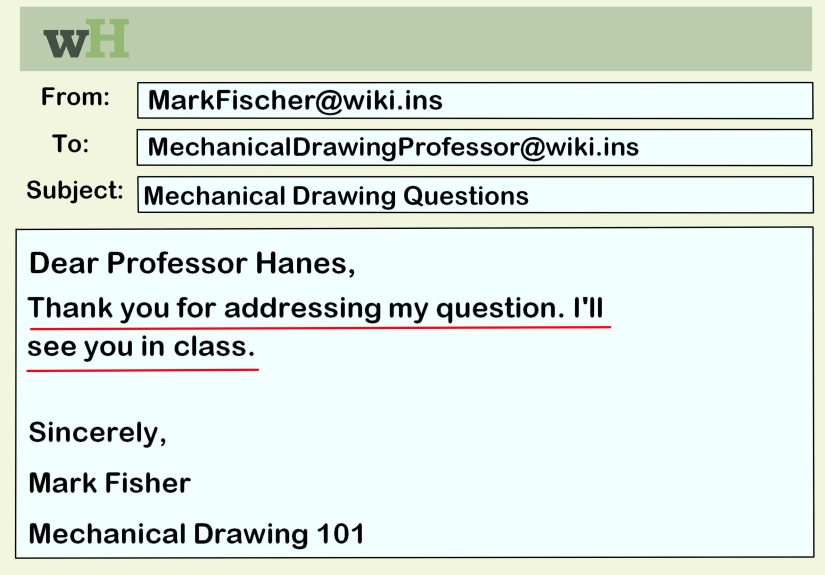
Example 1: Asking a question about an assignment
Example 2: Requesting office hours or a meeting
Example 3: Asking for an extension (do this early, and be honest)
Example 4: Requesting a letter of recommendation
A recommendation request works best when you ask respectfully, give plenty of lead time, and provide the materials your professor needs
(resume, program details, deadlines, what you’re applying for, and what you hope they can speak to).
Example 5: Cold emailing a professor about research opportunities
Keep this short and specific: show you know what they study, explain why you’re interested, and ask for a small next step (like a brief meeting).
Avoid mass-email vibes.
Timing, Response Expectations, and Follow-Ups
When to send
If possible, send emails during normal working hours. Messages sent late at night aren’t “bad,” but they can create urgency vibes
if you’re asking for something due the next morning. If you’re emailing about a deadline, earlier is almost always better.
How long to wait
A common guideline is to allow 24–48 business hours for a response. Weekends, holidays, and busy academic periods can slow replies.
If your question is urgent because of a deadline, say so (calmly) and email as early as you can.
How to follow up without being annoying
If you haven’t heard back after a reasonable amount of time, send a brief follow-up and reply to your original email thread so the context stays together.
Common Mistakes to Avoid (A.K.A. How to Not Become “That Email”)
- No subject line: It looks incomplete and is easier to overlook.
- No greeting or name: Starting with “I need…” can sound abrupt.
- Being too vague: “I don’t get it” doesn’t tell them what you’re stuck on.
- Sounding demanding: “Respond ASAP” is rarely a good move.
- Asking what you missed without trying first: Check notes, classmates, and the course site before emailing.
- Emotional grade emails: If you’re upset, draft it, save it, and reread later. Calm emails get better outcomes.
A Quick Checklist Before You Hit Send
- Does my subject line say what this is about?
- Did I address the professor with an appropriate title and last name?
- Did I identify myself (full name + course/section)?
- Is my request clear and reasonable?
- Is it short enough to read quickly?
- Did I proofread for spelling, tone, and missing details?
- Did I include attachments only if they’re neededand name them clearly?
Conclusion: Clear, Polite, and Easy to Answer Wins
If you remember nothing else, remember this: the best professor emails are the ones that make it simple to help you.
A specific subject line, a respectful greeting, a quick introduction, and a clear request will take you further than panic,
punctuation storms, or a desperate “pls.”
Experiences From the Inbox: 5 Real-Life Email Lessons (About )
Students often tell me the hardest part of emailing a professor is the feeling that they’re “bothering” someone important.
In practice, most professors aren’t bothered by respectful questionsthey’re bothered by confusing emails that require five
follow-up questions just to figure out what the student needs. One common experience is sending a long, anxious message late at night,
then spending the next morning refreshing your inbox like it’s a sport. The fix is almost always the same: move the purpose to the top,
make one clear request, and give a reasonable time window for a reply.
Another classic student experience: writing an email that says, “I don’t understand anything from class. Can you explain?”
It feels honest, but it’s also impossible to answer in a helpful way. Students who get the best responses usually narrow the question:
“I’m stuck on how to set up the equation in problem 4am I supposed to use the conservation formula from Tuesday’s lecture?”
That kind of email signals effort, points to a specific problem, and gives the professor something concrete to respond to.
Extensions are another big one. Students who wait until the night something is due often discover that even a kind professor can’t always
bend a policy at the last minute. The students who have better outcomes are usually the ones who email earlier, briefly explain the situation
without oversharing, and suggest a realistic plan: “If it’s possible, could I submit by Sunday evening?” Even when the answer is “no,”
professors tend to appreciate the responsibility and the advance notice.
Recommendation letters come with their own learning curve. Many students’ first attempt is a short email that basically says,
“Can you write me a letter?” with no deadline, no context, and no materials. The more successful approach (and the one students later say
felt surprisingly respectful) is asking if the professor can write a strong letter, giving plenty of lead time, and making it easy:
resume, program details, deadlines, and a sentence about what you hope they can highlight. This doesn’t just help the professorit often
boosts the quality of the letter because the professor has the right information.
Finally, students often learn the “tone matching” lesson. If your professor is formal in class and signs emails with “Sincerely,” mirror that.
If they write short, friendly emails and sign “Best,” it’s okay to be warm and straightforward. What’s almost never a win is being overly casual
too soon (“Heyyyy,” “What’s up,” emoji-heavy openings) or overly dramatic (“This is urgent and my future depends on it!!!”). The sweet spot is
professional, human, and clearbecause professors don’t need you to be perfect; they need you to be understandable.