Table of Contents >> Show >> Hide
- Who Is “Britain’s Most Tattooed Woman”?
- The Viral Bored Panda Feature: Before $42k of Ink
- Why Spend $42,000 on Tattoos?
- From Everyday Woman to Walking Artwork
- Life, Work, and Motherhood With 95% of Your Body Tattooed
- Why People Are So Obsessed With Her “Before” Picture
- Tattoos, Judgment, and the Internet Comment Section
- Lessons From a $42k Tattoo Journey
- Extra : Experiences and Takeaways From Britain’s Most Tattooed Woman’s Viral Story
- Conclusion
The internet loves a dramatic “before and after,” but usually it’s about weight loss, home makeovers, or a shocking haircut.
In this case, it’s one woman, thousands of hours under the needle, and roughly $42,000 worth of ink.
When Bored Panda shared photos of “Britain’s most tattooed woman” before she covered 95% of her skin in tattoos, the reaction was instant:
people could not stop scrolling, staring, and commenting.
That woman is Becky Holt, a model and media personality who turned her body into a living art project.
The viral story shows her as a fresh-faced young model with bright red hair in the “before” photo and then as the fully tattooed icon you now see all over social media.
It’s not just a transformation; it’s a full-on rebrand.
So why did this particular tattoo journey captivate people so much?
It’s not only about the shock value of seeing someone almost completely covered in ink.
It’s about self-expression, judgment, money, motherhood, and what it means to live in a body that you’ve intentionally turned into a canvas.
Who Is “Britain’s Most Tattooed Woman”?
Becky Holt is a British tattoo model and influencer from Cheshire, often described by the media as “Britain’s most tattooed woman.”
She reportedly got her first tattoo as a teenager and slowly escalated from “just a little design” to full sleeves, torso pieces, facial tattoos, and intricate details on nearly every part of her body.
Over the years, she has invested an estimated £35,000–£37,000 (around $42,000–$47,000 depending on exchange rates) in her tattoos, with roughly 95% of her body now covered in ink.
That includes her neck, chest, hands, and parts of her faceareas that most people think twice, three times, and then a fourth time about before committing.
Holt has appeared in UK media, on daytime TV shows, and in features for outlets like Men’s Health and other lifestyle publications, where she talks about her tattoo journey, plastic surgery experiences, and daily life as a mom with a very visible look.
She’s also highly active on Instagram, where she shares everything from glam shots to behind-the-scenes moments with her daughter.
The Viral Bored Panda Feature: Before $42k of Ink
Bored Panda’s piece that set social media buzzing centers on a simple but powerful contrast:
what Becky looked like before her tattoo “bodysuit,” and how she looks now that she’s nearly completely covered.
One of the widely shared images shows a throwback modeling shotsmooth, bare skin, bold red hair, and a more conventional glamour look.
Side-by-side with current photos, the difference is dramatic.
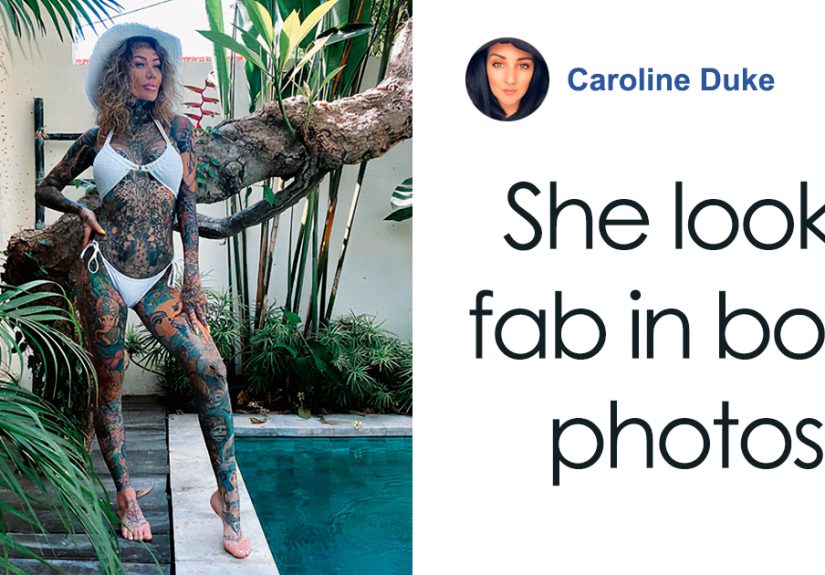
In recent images, her body is a dense collage of black and gray patterns mixed with colorful pieces.
Her chest and neck feature an ornate design that flows into her shoulders and arms, while her legs are packed with portraits, graphics, and layered motifs.
For many people, the fascination lies in the idea of choices over time.
Most of us can look back at old photos and cringe at a hairstyle or a questionable fashion phase.
Becky can look back and say, “That was me before I turned my entire body into a gallery.”
Why Spend $42,000 on Tattoos?
To someone who doesn’t love tattoos, $42,000 sounds like a house down payment, a luxury car, or a lifetime supply of iced coffee.
For Becky, it’s the price of a long-term creative projecther body as a canvas.
Professional tattoo work on large areas of the body is expensive for good reason.
You’re paying for the artist’s skill, design time, sterile equipment, high-quality ink, and often many hours of detailed line work and shading.
Multiply that by full sleeves, torso, legs, hands, neck, and face, and the math adds up quickly.
Becky has said that she loves the artistry and the statement that comes with her tattoos.
Each piece is part of a larger “bodysuit,” so instead of individual random designs, she’s created an integrated, layered look that feels like a single flowing artwork.
It’s not a weekend decision; it’s a lifestyle.
From Everyday Woman to Walking Artwork
A Full-Body Transformation
One of the reasons this story resonates is that the “before” photo doesn’t look unusual at all.
She looks like a typical young model from a fashion portfoliopolished, pretty, but not someone you’d necessarily recognize on the street.
The “after” version is unforgettable.
She stands out in every room, every photo, every frame of video.
Her tattoos are visually loud in the best possible way: bold lines on her face, detailed chest pieces, and colorful imagery up and down her legs.
That level of transformation forces people to think about identity.
Are you more “yourself” when you look like everyone else, or when you look exactly how you’ve choseneven if that choice shocks other people?
The Makeup Experiment: Covering the Ink
In another viral twist, Becky once took part in a project where her tattoos were covered with makeup so viewers could see what she might look like without them.
The result was almost uncanny: the same facial structure, the same features, but a completely different impression.
Fans reacted with comments like, “You’re beautiful both ways,” and “You look so different without tattoos!”
Others insisted that the ink made her unique and amplified her natural beauty.
The experiment showed just how much tattoos can change not only how others see us, but how we see ourselves.
Life, Work, and Motherhood With 95% of Your Body Tattooed
For people who assume heavily tattooed individuals live on the fringes, Becky’s everyday life can come as a surprise.
She is a mother, a partner, and has been involved in “regular” jobs, including working with adults who have special needs and learning British Sign Language to communicate more effectively.
Her story pushes back against outdated stereotypes that tattoos automatically equal rebellion, irresponsibility, or a lack of professionalism.
You can have intricate facial tattoos and still be a loving parent, a reliable employee, or a thoughtful advocate.
Of course, she does face judgment.
She’s described being stared at in public, hearing rude comments, and feeling how quickly people make assumptions based on her appearance.
Yet she’s also built a loyal online following of fans who see her as confident, expressive, and unapologetically herself.
Why People Are So Obsessed With Her “Before” Picture
Scroll through posts and comments about Becky Holt and you’ll see a pattern:
“She was so pretty before,” “She ruined her face,” “The tattoos are amazing,” “Both versions of her are beautiful.”
The conversation keeps circling back to that old modeling shot.
Part of the fascination is rooted in our complicated relationship with change.
Society loves the idea of personal growthbut only as long as the “after” fits mainstream beauty norms.
Fuller hair? Great. Whiter teeth? Fantastic.
A full-body tattoo bodysuit that covers your neck and forehead? Suddenly everyone has an opinion.
The viral angle also taps into deeper questions:
- How much control do we really have over how other people perceive us?
- Is beauty something fixed we’re supposed to protect, or something we’re allowed to reinvent?
- And who gets to decide what counts as “too far”?
Tattoos, Judgment, and the Internet Comment Section
The Bored Panda feature opened the floodgates for commentary, and those comment sections are like a live anthropology study.
You’ll find every viewpoint: admiration, concern, curiosity, judgment, and some classic internet-level bluntness.
On one side, there are tattoo enthusiasts who see Becky as an aspirational figuresomeone who had the courage (and pain tolerance) to take body art to the extreme.
On the other side, critics insist she “looked better before,” as if there were a single correct version of her face and body that she should have preserved forever.
What’s interesting is how many people land in the middle.
A lot of comments sound like: “I’d never do that myself, but it’s her body,” or “Not my taste, but I respect her commitment.”
That middle ground is where conversations about body autonomy actually move forward.
Lessons From a $42k Tattoo Journey
1. Extreme Ink Is Still About Everyday Choices
The dramatic photos can make it seem like Becky woke up one day and ordered the “full coverage” package.
In reality, her transformation happened over many years, session by session.
That mirrors how we all changejust in less visible ways.
Tattoos are decisions you wear, and in her case, those decisions are impossible to hide.
That level of visibility forces a kind of honesty: she can’t be one person at home and a totally different person at work or in public.
Her appearance announces her choices before she says a word.
2. Body Autonomy Means Letting People Go “Too Far” for Your Taste
You don’t have to want facial tattoos to respect someone else’s right to get them.
Body autonomy doesn’t stop where your personal comfort level ends.
If anything, her story is a good reminder that “I wouldn’t do it” and “She shouldn’t do it” are two very different statements.
3. The “Before” Photo Doesn’t Cancel the “After”
Many people treat Becky’s old modeling images as proof that she “threw away” her natural beauty.
But beauty isn’t a limited resource you spend and never see again.
Both versions of her exist in time: the clean-skin redhead and the tattooed mother and advocate.
The viral comparison isn’t really asking, “Which is prettier?”
It’s asking, “How much are you willing to change yourself to feel like you?”
For Becky, the answer seems to be: quite a lotand she’s okay with that.
Extra : Experiences and Takeaways From Britain’s Most Tattooed Woman’s Viral Story
Stories like Becky Holt’s don’t go viral just because of visuals.
They stick because they touch on experiences many people quietly wrestle with:
the fear of standing out, the pressure to stay “normal,” and the curiosity about what might happen if we stopped playing it safe with our self-expression.
How Her Story Echoes Everyday Tattoo Experiences
If you talk to people with multiple tattooseven those with only a few visible piecesyou’ll hear familiar themes that echo Becky’s experience, just on a smaller scale:
-
The first visible tattoo changes everything.
For a lot of people, the moment they ink their hands, neck, or face, they notice a shift in how the world responds.
Becky simply lives that shift at full volume. -
People feel strangely entitled to comment on your body.
From strangers asking, “What will you look like when you’re old?” to coworkers assuming tattoos equal unprofessionalism,
inked people constantly navigate unsolicited feedback. -
Supportive communities matter.
Tattoo shops, online forums, and social media followings can become safe spaces where people celebrate their artwork instead of criticizing it.
Becky’s experience, amplified by media coverage, is basically those everyday tattoo stories with a megaphone attached.
She gets the same questionsjust from millions of people instead of a handful.
The Parenting Piece: Tattoos and Role Models
One interesting layer in her story is motherhood.
Many commentators worry about what it’s like for her child to have a heavily tattooed parent.
But kids tend to normalize whatever they see at home quicker than adults expect.
To a child who grows up seeing tattoos daily, they’re not “shocking”they’re just what Mom looks like.
What matters more than whether a parent has tattoos is how they behave:
Are they kind? Are they present? Are they supportive?
If the answer is yes, then the ink becomes background decoration, not a core parenting issue.
The Workplace Question
Another big talking point around Becky’s story is work.
People still imagine that visible tattoos automatically close doors.
While discrimination absolutely exists, the world is slowly getting more flexible.
Creative industries, hospitality, tech, and certain healthcare or support roles are increasingly accepting of visible ink.
Becky has worked in media, modeling, and care roles, and her visibility actually helps start conversations about not judging people purely by appearance.
Her story gives employers and coworkers a real-life example that “heavily tattooed” and “professional” are not mutually exclusive labels.
What Regular Readers Can Take Away
You don’t needor wantto spend $42k on tattoos to learn something from her journey.
Maybe your version of bold self-expression is:
- Dyeing your hair a color you actually like, not just what looks “office-friendly.”
- Wearing clothes that match your personality instead of blending in at every event.
- Finally booking the appointment for a small tattoo that has meant something to you for years.
- Or, honestly, deciding that you love your bare skin and don’t want a single dot of inkand owning that choice too.
The real message behind the viral Bored Panda article is less about counting tattoo sessions and more about embracing agency.
Becky chose her body art, knowing it would permanently affect how the world sees her.
That doesn’t mean everyone has to follow her path; it simply means each of us has the right to define our own version of “too much” or “just enough” when it comes to our bodies.
In the end, the before-and-after photos are snapshots of a long story still being written.
Today, she’s known as “Britain’s most tattooed woman.”
Ten years from now, that title might belong to someone elsebut the broader conversation she helped spark about self-expression, autonomy, and judgment will still be relevant.
Whether you love her tattoos, prefer her pre-ink look, or simply enjoy watching the debate from the sidelines,
her transformation offers a powerful reminder: your body is one of the few things in life you truly get to customize.
Some people stick to stock settings. Others, like Becky Holt, happily install the full custom skin.
Conclusion
“Britain’s most tattooed woman” and her $42k of ink have become a kind of cultural Rorschach test.
Some people see a cautionary tale; others see a fearless act of artistry.
But beneath the headlines, the throwback photos, and the viral comments, there’s a simple truth:
one woman chose to turn her body into a story she loves living in.
You don’t need to agree with her choices to respect them.
You don’t have to get tattoos to appreciate the courage it takes to visually stand out in a world that constantly nudges us to blend in.
And the next time a before-and-after photo appears on your feed, you might find yourself asking not just “Which looks better?” but “Which looks more like the person they chose to become?”