Table of Contents >> Show >> Hide
- From Working Building to Weekend Refuge
- The Design Moves That Make the House Sing
- What This Stable Conversion Gets Right About Adaptive Reuse
- Lessons for Anyone Dreaming of a Barn or Stable Conversion
- Why Rural Norfolk Is Such a Powerful Setting
- A House That Still Remembers the Horses
- The Experience: What It Feels Like to Spend Time in a Stable Reborn in Rural Norfolk
Note: Body-only HTML for easy publishing; SEO JSON is included at the end.
Some homes arrive in the world with a trumpet blast. Others clear their throat politely, open an oak door, and let the old masonry do the talking. A Stable Reborn in Rural Norfolk belongs firmly to the second camp. It is not flashy in the usual “look at my imported marble and emotionally unavailable sofa” way. Instead, it offers something far more interesting: proof that a humble agricultural building can become a deeply modern home without losing the grit, dignity, and memory that made it worth saving in the first place.
At the center of this story is a ruined 19th-century stable block in Norfolk that became Stable Acre, a retreat designed by architect David Kohn for gallerist Stuart Shave. The genius of the project is not that it turns an old stable into a house. People have done that before, sometimes beautifully, sometimes with the subtlety of a chandelier in a tractor shed. What makes this one stand out is the restraint. The long, narrow footprint remains legible. The building still reads like an outbuilding shaped by work, weather, and routine. Yet inside, it feels calm, warm, bright, and unmistakably livable.
That balance is the real lesson here. Great adaptive reuse is not about cosplay. A stable does not need to pretend it was born as a luxury residence, and a modern home does not have to scrub away every mark of rural life to feel refined. This project understands that character is not clutter, patina is not decay, and modern comfort does not require historical amnesia. In an age when too many renovations either freeze buildings in amber or sand them down into blandness, this Norfolk conversion manages the harder trick: it respects the past without moving into it permanently.
From Working Building to Weekend Refuge
The original stable block gave the house its logic. Rather than treating the old structure as a cute shell to be filled with generic open-plan lifestyle content, the design keeps the building’s linear discipline. Stable Acre was built on the footprint of the earlier structure, and that matters more than it might seem. Footprints are memory. They preserve how a building met the land, how it organized movement, how it admitted light, and how it served daily use.
Here, the plan is split broadly into living and sleeping zones, and rooms open directly to the south-facing garden and the surrounding landscape. That direct relationship between interior and exterior feels especially right in a rural Norfolk setting, where the sky is big, the weather has opinions, and the horizon is part of the decor whether you like it or not. The home does not stand apart from the countryside like a precious object placed under glass. It sits in conversation with fields, garden, path, and season.
That is one of the reasons the project feels authentic. Historic agricultural buildings were practical, site-responsive structures. They were shaped by use, wind, materials, and labor. When designers preserve that practical DNA, the resulting home usually feels better than one built around trend forecasts and social-media angles. You can sense it in the circulation, in the long hallway, in the simple openings, and in the fact that this place still seems to understand mud, rain, cold mornings, and the need to move from inside to outside without theatrical fuss.
Why the old plan still matters
Preservation experts often stress that the most meaningful parts of a historic building are not just decorative details, but also its setting, layout, materials, and character-defining features. That idea is visible all over this project. The conversion does not flatten the stable’s identity into one giant loft just because open plans are fashionable. Instead, it keeps the long orthogonal structure legible and lets the domestic program settle into it naturally. That choice gives the house a quiet authority. You are not just in a pretty room. You are in a building with a remembered purpose.
The Design Moves That Make the House Sing
Let us talk about the details, because this is where the project stops being merely admirable and becomes genuinely memorable.
Old bones, clearly visible
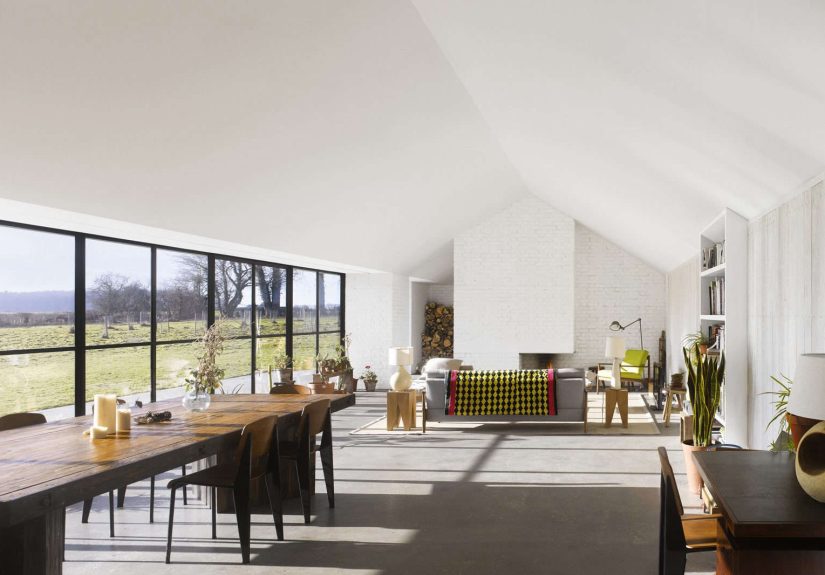
The exterior and interior palette is a smart lesson in material honesty. Reclaimed purpleheart cladding from a Thames pier appears on the outside, while the interior combines white-painted brick, wood paneling, concrete flooring, and custom steel windows and doors. That mix sounds simple on paper, and that is exactly why it works. The materials do not fight for attention. They do not arrive in a parade waving tiny flags. They sit next to each other with the relaxed confidence of people who know they were invited for a reason.
The polished concrete floors are especially effective because they echo the building’s former utility. They do not sentimentalize the stable’s past; they quietly recall it. Likewise, the heavy oak stable doors are not treated as novelty props. They still perform, especially in colder weather, which is far more charming than any sign reading “formerly a stable” ever could be.
Light used like a scalpel, not a spotlight
One of the easiest ways to ruin a rural conversion is to attack it with oversized glazing and turn it into a showroom that happens to have sheep nearby. This project is much more disciplined. Light enters where it should and where it feels earned. A narrow skylight filters illumination into the kitchen. Steel-framed windows and doors pull daylight through the long hallway. Openings frame the garden and broader landscape without dissolving the building into glassy weightlessness.
The result is atmosphere rather than spectacle. The house feels bright, but not exposed; open, but not overblown. That is harder to do than it sounds. It requires understanding that light in a historic conversion should reveal texture, depth, and proportion, not wipe them out.
Rustic and modern, without the usual identity crisis
The interior styling leans into a rustic-modern balance that many homes aim for and few land successfully. The kitchen, for example, pairs stark white brick with simple wood cabinetry and a farmhouse sink. It is compact, useful, and warm without becoming twee. Elsewhere, midcentury furniture sits comfortably in the open-plan living area, proving that old agricultural shells and modern furnishings can get along just fine when the architecture has enough self-possession.
There are also quieter touches that keep the home from becoming austere. Rows of succulents soften the space with a greenhouse mood. Whitewashed wood paneling adds texture without heaviness. In the bedroom, the overall mood is almost monastic, but a tasseled bedspread breaks the seriousness just enough, like a wink in an otherwise very composed sentence.
What This Stable Conversion Gets Right About Adaptive Reuse
Adaptive reuse works best when it begins with a simple question: what deserves to stay? Not because it is old, but because it gives the building identity. Preservation guidance in the United States consistently returns to that principle. Historic buildings should be given compatible new uses while preserving the features, spaces, materials, and relationships that convey their character. Stable Acre feels like a practical demonstration of that philosophy.
Preservation is not the same as freezing time
A common mistake in historic renovation is confusing respect with fear. Some projects become so cautious they end up feeling museum-like. Others panic and replace everything until the building becomes a vague memory with new plumbing. Stable Acre avoids both traps. It neither embalms the stable nor erases it. The contemporary materials are unapologetically contemporary, but they are calm enough to let the older structure remain the lead character.
That approach is especially important in agricultural buildings. Barns and stables were shaped by work, and their forms often have a rugged logic that can withstand adaptation if handled intelligently. Preservation guidance for historic barns emphasizes setting, siding, structural character, and distinctive openings. Even when the use changes, the building should still feel rooted in its place. This Norfolk home does exactly that. It is domesticated, yes, but not declawed.
Sustainability with a backbone
There is also a strong environmental case for projects like this. Reusing an existing building generally saves the embodied energy already locked into its materials and reduces the waste and emissions that come with demolition and new construction. In other words, the greenest move is often not to build something shiny and self-congratulatory from scratch, but to make an older structure work harder and better.
That does not mean comfort should be sacrificed on the altar of romance. Real conversions need insulation, weather protection, heating strategies, moisture control, and durable finishes. American renovation guidance often points to approaches such as structural insulated panels, carefully layered insulation, radiant heating, and other methods that improve performance while preserving character. The larger point is that energy efficiency and historic texture do not have to be enemies. Good design acts as translator between them.
Lessons for Anyone Dreaming of a Barn or Stable Conversion
Even if you are not planning to buy a crumbling outbuilding in Norfolk tomorrow, this house offers valuable lessons for homeowners, designers, and renovation romantics.
1. Study before you sketch
Before any design move, learn the building. How did it work? What was altered over time? Which elements are original, and which are later intrusions? The best conversions begin with observation, not mood boards. Historic structure research may sound unglamorous, but it is often what separates a sensitive project from a very expensive misunderstanding.
2. Keep the setting in the story
Outbuildings belong to landscapes. A stable conversion should not feel detached from the yard, path, fields, or weather that shaped it. Stable Acre succeeds in part because each room engages the garden and wider views. Rural architecture loses something essential when it becomes inward-looking and generic.
3. Use materials that age well
Natural materials with texture and patina tend to work better than overly polished finishes in old farm buildings. Wood, brick, limey whites, steel, and concrete each bring clarity without fuss. They also allow the house to improve with time rather than merely survive it.
4. Let practicality stay attractive
A farmhouse sink, exposed plumbing in the bath, stable doors, simple cabinetry, and durable floors all remind us that usefulness can be beautiful. Rural homes should not be embarrassed by utility. Frankly, utility is half the charm.
5. Do not over-explain the concept
When a conversion is strong enough, it does not need gimmicks. You do not need horseshoe-themed light fixtures, saddle-leather bar stools, or a decorative wagon wheel trying very hard in the corner. The building itself already has a biography. Trust it.
Why Rural Norfolk Is Such a Powerful Setting
Norfolk has the kind of countryside that flatters understatement. It is not a landscape that demands grand theatrical gestures. Its pleasures are slower: open skies, long views, hedged boundaries, changing light, and the soft drama of weather crossing fields. A restored stable feels especially resonant here because the architecture and the land share the same temperament. Both reward patience. Both look better when you stop shouting at them.
That matters because architecture is never just an indoor event. A rural Norfolk home is experienced through transitions: from gravel to threshold, from wind to stillness, from gray morning to slanting afternoon light, from open field to sheltered room. Stable Acre seems designed around those transitions. It does not simply occupy the countryside; it edits the experience of moving through it.
A House That Still Remembers the Horses
Perhaps the most moving thing about this project is that the old stable has not been stripped of memory in order to become elegant. It still remembers labor, enclosure, weather, and routine. The proportions still whisper “outbuilding.” The materials still have a workmanlike directness. Yet the house now supports reading, cooking, resting, gathering, and looking out at the land. That is not a betrayal of the building’s history. It is a continuation of it.
A stable was always a place of care. It sheltered life. It organized daily rhythms. It sat close to the ground and close to necessity. Reborn as a home, it continues to do those things in a different register. That may be the deepest success of all. This is not merely a clever conversion. It is a place that has changed use without losing temperament, which is much harder, and far more beautiful.
The Experience: What It Feels Like to Spend Time in a Stable Reborn in Rural Norfolk
Imagine arriving on a damp Norfolk afternoon, the kind where the sky looks brushed on in layers of pearl and pewter. The first thing you notice is not some grand architectural flourish. It is the calm. The building sits low and long, settled into the land as if it had always intended to stay. You walk toward the door and feel, almost instantly, that satisfying shift rural buildings do so well: the world gets quieter before you even step inside.
Once indoors, the experience is all about texture and proportion. The concrete underfoot feels cool, steady, and grounding. White-painted brick catches the available light instead of bouncing it around like a disco ball. Wood paneling softens the edges. Steel-framed windows bring a fine, crisp line to the rooms, like a tailored jacket thrown over muddy boots. It is a house of contrasts, but none of them are aggressive. The softness of the garden outside meets the firmness of the materials inside. The long hallway pulls you forward, then slows you down. You do not rush through a place like this; it edits your pace without asking permission.
The kitchen is where the mood turns especially intimate. Filtered light slips in from above, touching the wood countertop, the farmhouse sink, and the white brick in a way that makes even making tea feel faintly cinematic. Not movie-set cinematic, thankfully. More like real life with better posture. You can imagine a cold morning here: kettle humming, toast burning just a little because someone got distracted looking out the window, muddy boots by the door, and a dog stationed strategically in case toast becomes available.
In the living area, the old stable’s restraint becomes a kind of luxury. There is space, but it is not wasted space. The room feels generous because the proportions are clear and the furniture is allowed to breathe. Midcentury pieces do not feel like style statements here; they feel like sensible companions to a building that appreciates good lines and dislikes nonsense. Sit down for an hour with a book, and you begin to understand the real triumph of the house: it does not perform rural life, it supports it.
At night, the experience changes again. Heavy doors, thick walls, and controlled light give the interior a protected feeling. The bedrooms lean quiet and spare, almost monastic, which makes sleep seem less like a task and more like a well-designed outcome. You hear the weather differently in a house like this. Rain feels companionable. Wind sounds less like noise and more like evidence that the building still belongs to the landscape beyond the glass.
By morning, the stable’s rebirth makes emotional sense in a way photographs never fully capture. You notice how naturally the house moves between shelter and openness, utility and comfort, history and present tense. Nothing feels forced. Nothing feels over-styled. And that, perhaps, is the experience people are really chasing when they dream of converting barns, stables, and old rural buildings. Not novelty. Not even charm, exactly. What they want is this rarer thing: a home with enough memory in its walls to make ordinary life feel slightly deeper, steadier, and more human.