Table of Contents >> Show >> Hide
- The Big Reveal (That Reveals Almost Nothing)
- What We Know for Sure About the Air Force’s New Fighter Jet
- So… What Does the Secret Plane Look Like?
- The “Secret Jet” You Didn’t See: Prototypes and Demonstrators
- Why the Air Force Keeps the Look Classified
- What Makes a Sixth-Generation Fighter Different (Even If You Can’t See It)
- The Engine Story: Why Propulsion Is Half the Plot
- Cost, Secrecy, and the Reality Check
- What the “Secret Plane” Probably Looks Like in Practice
- Experiences: What It’s Like to Live in the Era of “Secret Jets” (Extra )
- Conclusion
A secret fighter jet is basically a paradox with afterburners. The U.S. Air Force wants the world to know it’s building something new, intimidating, and next-generationwhile also ensuring the world does not know what it actually looks like. So what do we get instead? A handful of official statements, a carefully “safe for public viewing” concept image, and a lot of educated guesses from aerospace nerds who can identify an air intake from three pixels and a prayer.
Still, there’s plenty of real information to work with. The Air Force’s next crewed fighter under the Next Generation Air Dominance effort is now publicly associated with the designation F-47, and it’s meant to anchor a larger “system of systems” that includes uncrewed partner aircraft (think: drone teammates) and new engines, sensors, and networking. The truly classified bits are the details that would make an adversary’s job easier. The big picturethe “why,” the “what,” and the likely “shape-family”is fair game.
The Big Reveal (That Reveals Almost Nothing)
In March 2025, the Department of the Air Force announced a contract award for the Engineering and Manufacturing Development phase of the NGAD fighter platformpublicly tying the program to the F-47 name and showing a striking, minimalist rendering of the aircraft. It’s the kind of image that screams “future,” but also whispers “we erased the interesting parts in Photoshop.”
That’s not an accident. Modern stealth aircraft don’t just hide from radar; they hide from open-source analysis too. Even small visible cluesedge angles, inlet shapes, exhaust geometrycan help analysts make more confident estimates about radar cross-section and flight performance. So the Air Force gives the public enough to understand the strategic direction, without giving away the geometry that matters most.
What We Know for Sure About the Air Force’s New Fighter Jet
Here’s the solid groundfacts that have been publicly described in official releases and major defense reporting:
1) It’s meant to replace (or at least relieve) the F-22’s mission
The F-22 Raptor remains extremely capable, but it was built in limited numbers and is expensive to sustain. The Air Force’s next-generation fighter is intended to carry air superiority into a future where threats are more networked, more numerous, and spread across much larger distances (especially in the Indo-Pacific).
2) It’s part of NGAD, not a “single magic airplane”
NGAD is often described as a family of systems. Translation: the fighter matters, but it’s only one piece. The future fight is about sensors, communications, electronic warfare, and coordinated effectswhere the jet is as much a quarterback as it is a knife-fighter.
3) It’s built to operate with uncrewed aircraft
A major theme in public descriptions is manned-unmanned teaminga crewed fighter operating alongside uncrewed partner aircraft that can carry sensors, weapons, decoys, jammers, or extra fuel. The Air Force’s Collaborative Combat Aircraft (CCA) program has already moved into flight testing with prototype vehicles, and the service is actively scaling vendor participation for follow-on increments. The point isn’t “replace pilots tomorrow.” It’s “multiply capability per pilot.”
4) There was a strategic pausethen a public push forward
NGAD has been debated partly because of cost and priorities. The Air Force publicly acknowledged a pause and reassessment period before moving forward with a major decision. That kind of review is common when programs are expensive, transformative, and competing with other big-ticket needs.
So… What Does the Secret Plane Look Like?
Let’s be blunt: nobody outside the classified circle can honestly claim to know the final F-47 design. But we can talk about what the publicly shown shape suggestsand what it likely implies about the real aircraft’s design “family.”
The concept image: a tailless, blended silhouette
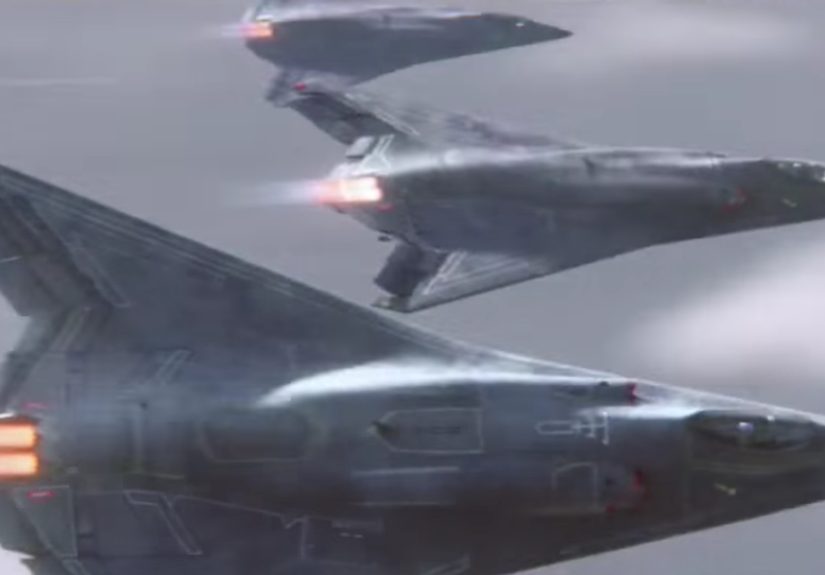
The official rendering shows a sleek, tailless aircraft with a blended body and wingmore “manta ray” than “traditional fighter.” There are no obvious vertical tails. That matters because vertical tails are great for stability and control, but they’re also radar reflectors. Eliminating them can improve stealth, especially from side angles, but it forces heavy reliance on advanced flight controls and clever aerodynamic shaping.
This isn’t science fiction. The U.S. has decades of experience with stealth shaping and fly-by-wire control laws. What changes in the sixth-generation era is how confidently designers can push toward configurations that are harder to fly but easier to hide.
Where are the inlets?
If you’re hunting for engine inlets on the official art, welcome to the club. You’ll mostly find disappointment. Many stealth designs hide or reshape intakes to block a direct radar view of compressor bladesbecause exposed compressor faces can act like a radar beacon. Some aircraft use serpentine ducts; others use carefully shaped inlet lips and diverterless designs. The rendering keeps those details vague, which is exactly the point.
What about the exhaust?
Also conveniently ambiguous. Exhaust design matters for stealth and survivability, including infrared signature reduction. Sixth-generation discussions often mention managing heat and signature across multiple sensorsnot just classic radar. Again, the public-facing art avoids the geometry that would let analysts guess too much.
Is “tailless” guaranteed?
No. The rendering is a clue, not a blueprint. It may indicate the design direction, but it could also be a deliberately simplified (or even slightly misleading) depiction. In aerospace programs, public renderings can be aspirational, sanitized, or genericespecially when the program is still evolving.
The “Secret Jet” You Didn’t See: Prototypes and Demonstrators
One reason the public conversation feels weirdly confident is that NGAD has had a long runway of behind-the-scenes experimentation. Public reporting going back to 2020 cites senior Air Force acquisition leadership saying a full-scale flight demonstrator had already flown and that the effort “broke records” in development speedwithout naming the contractor or revealing what the aircraft looked like. If you ever wondered how the Air Force can sound so serious about a next-gen fighter without showing photos, that’s part of the answer: the learning has been happening for years, mostly out of view.
Why the Air Force Keeps the Look Classified
Stealth is geometry, materials, and tactics. If a competitor learns what your aircraft looks like, they can make better assumptions about:
- Radar cross-section “hot spots” (angles and edges that reflect energy)
- Frequency vulnerabilities (how stealth holds up across radar bands)
- Engine and thermal signature characteristics (how easily sensors can track it)
- Likely mission roles based on size, shape, and carriage options
That’s why official imagery tends to be dramatic but nonspecificlike a movie trailer that refuses to show the monster clearly. “It’s out there.” That’s all you need to know.
What Makes a Sixth-Generation Fighter Different (Even If You Can’t See It)
When people say “sixth generation,” they’re not just talking about stealthier shapes. They’re talking about a new set of tradeoffs:
Range and persistence
Public discussion around NGAD repeatedly ties the program to long distances and contested environmentssituations where tankers and support aircraft may be at higher risk. More range can mean more options: different routes, fewer refueling dependencies, and the ability to stay useful even when the battlefield gets messy.
Sensor fusion and networking
Fifth-generation fighters already fuse sensor data; sixth generation pushes that further by treating the formation as the sensor. The crewed fighter becomes a node in a websharing data with drones, other aircraft, and offboard sensors to build a clearer picture faster.
Electronic warfare baked in
Instead of bolting on jammers as a separate idea, next-gen designs aim to integrate electronic warfare as a core functionbecause “seeing first” is great, but “making the other guy see nonsense” is often even better.
Uncrewed teammates: Collaborative Combat Aircraft
The CCA concept is often described as drone “wingmen,” but don’t imagine a cute little sidekick. Think of them as modular teammates. One might carry sensors. Another might carry weapons. Another might be a decoy designed to confuse enemy defenses. The Air Force has already announced and flown early CCA prototypes and is expanding the ecosystem of vendors as the program matures.
The Engine Story: Why Propulsion Is Half the Plot
If the airframe is the headline, the engine is the plot twist. New engines aren’t just about speed; they’re about range, electrical power, and thermal management. As sensors, computers, and electronic warfare systems grow hungrier for energy, propulsion has to provide more than thrust.
That’s why the Air Force has invested heavily in next-generation engine workpushing prototype programs that emphasize efficiency and adaptability. In plain English: the future fighter needs to go far, stay stealthy, and power a small city’s worth of electronics without turning itself into an infrared lighthouse.
Cost, Secrecy, and the Reality Check
Here’s the part that’s less glamorous than a blacked-out hangar photo: advanced aircraft are expensive. Public policy analysis has long noted that a high-end penetrating air dominance platform could carry a very high unit cost, which forces hard decisions about fleet size, timelines, and tradeoffs with other priorities.
That’s one reason the Air Force has emphasized concepts like pairing a highly capable crewed platform with more affordable uncrewed teammates. It’s a strategy to avoid building an all-exquisite fleet that’s too small to matter in a long fight.
What the “Secret Plane” Probably Looks Like in Practice
Put all the public hints together, and you get a reasonable “shape family” expectationwithout pretending you’ve seen the real blueprint:
- Low-observable shaping with fewer vertical surfaces
- Blended body/wing for efficiency and signature control
- Hidden or carefully treated inlets/exhaust to reduce radar and infrared cues
- Emphasis on range (bigger than it looks in simplistic art)
- Built to command a team, not fight alone
In other words, the “secret look” may not be a single iconic silhouette like the F-14 or F-15. It may be a stealthy, purpose-built platform designed to be one part of a larger systemwhere the real advantage is how everything works together.
Experiences: What It’s Like to Live in the Era of “Secret Jets” (Extra )
You don’t need a security clearance to feel the gravitational pull of a secret airplane story. For aviation fans, the experience is a little like trying to describe a dinosaur based on one footprint and a strongly worded press release. And yetpeople keep showing up for it, because the mystery is part of the fun.
Experience #1: The concept art zoom-in ritual. The moment the Air Force drops a new rendering, the internet becomes a collective magnifying glass. People circle edge angles, argue about wing sweep, and debate whether a shadow is an inlet or just… a shadow. The funniest part is that everyone knows the image is sanitized, but everyone still can’t resist. It’s like being handed a wrapped present and trying to guess the gift by shaking the box. You know the wrapping is doing its job. You shake it anyway.
Experience #2: The “how would this actually work?” conversation. If you’ve ever stood near a fighter on a museum rampor even watched one taxi on videoyou can feel how much engineering is packed into a tight space. That makes the NGAD conversation more interesting than a simple “new jet = better jet” storyline. People naturally ask: How does a tailless aircraft stay controllable at high angles of attack? How do you keep a stealth shape cool enough for infrared sensors? Where does the fuel go if you also need space for weapons and avionics? Even without classified answers, those questions build appreciation for the design challenge.
Experience #3: The shift from “ace pilot” mythology to “team captain” reality. For decades, pop culture sold the idea that air dominance is about a single hero in a single jet. Modern airpower is increasingly about coordinated teamsfighters, drones, tankers, sensors, satellites, and data links. The emotional experience for enthusiasts is a subtle change: it’s less “lone wolf,” more “orchestra conductor.” That doesn’t make it less exciting. It just changes what “cool” looks like. A pilot directing multiple aircraft and sensors in real time is still a high-stakes skilljust a different kind of high-stakes.
Experience #4: The patience game. Secret aircraft stories don’t resolve quickly. Years can pass between early prototypes and a public rollout that includes real photos. In the meantime, people learn to read the small signals: an engine contract here, a prototype flight test announcement there, a congressional brief that hints at priorities without spilling details. The experience is part detective work, part civics lesson. You start to see how acquisition, strategy, and technology all pull on the same rope.
Experience #5: The moment reality finally shows up. When a program eventually steps into the lightwhen the first official photos appear, when a real aircraft taxies into viewthe payoff is huge. Not because the public finally gets a new wallpaper image, but because a long, abstract story becomes tangible. Until then, the “secret plane” lives in a space between engineering and imagination. And that’s exactly where the Air Force prefers it to stayright up until it’s ready for the world to see.
Conclusion
The Air Force’s new fighter jet sits at the intersection of secrecy and strategy. We know it’s real. We know it’s meant to carry air superiority into a more contested future. We know it’s connected to a broader NGAD ecosystem that includes uncrewed partner aircraft, next-gen propulsion, and advanced networking. And we know the public “look” is mostly a carefully controlled silhouetteenough to communicate direction, not enough to reveal the tricks.
So if you’re asking, “What does the secret plane look like?” the honest answer is: it looks like a tailless, stealthy promiseone that’s designed to stay mysterious until the day it doesn’t have to be.