Table of Contents >> Show >> Hide
- Way #1: Drop, Cover, and Hold On (Indoors)
- Way #2: If You’re Outside or Driving, Get Out of the “Fall Zone” and Stay Put
- Way #3: When Shaking Stops, Switch to “Aftershock + Hazards” Mode
- Quick “What Would You Do?” Examples
- Common Myths That Get People Hurt (Let’s Retire These)
- Simple Prep That Makes the 3 Ways Easier
- Conclusion
- Real-World Experiences and Lessons People Commonly Share (500+ Words)
Earthquakes have a special talent: they show up uninvited, rearrange your nerves, and make even the calmest person think,
“Is the house… doing the cha-cha?” The good news is that most earthquake injuries happen from things inside the environment
(falling objects, broken glass, you tripping while sprinting like an action hero), not from the ground swallowing you whole.
So the best reaction is usually simple, repeatable, and boringin the best possible way.
This guide gives you three practical ways to react during an earthquake (and in the first moments right after),
with specific examples for common situations: at home, at school, at work, in public, and in a car. If you only remember one phrase,
make it this: Drop, Cover, and Hold On. Your future self will thank youpreferably while still standing.
Way #1: Drop, Cover, and Hold On (Indoors)
If you’re inside when shaking starts, the safest move is usually to stay inside and protect your head and neck.
Running outside sounds logical until you remember that building exteriors can shed glass, signs, bricks, and other “surprises.”
Instead, do the three-step routine that emergency experts teach because it works:
Drop to your hands and knees, Cover your head and neck under something sturdy, and Hold On
until the shaking stops.
How to do it (without overthinking it)
- DROP to hands and knees. This keeps you from being knocked over and lets you crawl if you must.
- COVER your head and neck. If possible, get under a sturdy table or desk. If not, crouch near an interior wall or next to low furniture.
- HOLD ON to the table/desk leg (or keep your arms protecting your head/neck). Furniture can shift, and you want to stay with your cover.
What “Cover” actually means in real rooms
Your goal is to shield your head and neck from falling objects. That means choosing cover that’s close and sturdynot running across the room
like you’re auditioning for a stunt role.
- In a living room: Slide under a sturdy coffee table (if it’s solid) or get low beside a couch and cover your head and neck.
- In a bedroom: If you’re in bed, stay there and use a pillow or blanket to cover your head and neck. (Beds are surprisingly decent “stay-put” zones.)
- In a classroom or office: Under a desk is ideal. Hold on to the desk leg so it doesn’t scoot away from you.
- In a kitchen: Kitchens often have heavy items that can fall. If you can safely move a few feet to get away from cabinets and glass, do it quicklythen drop and cover.
What to avoid while indoors
There are a few classic mistakes people make during earthquakes, usually because adrenaline is a very persuasive storyteller.
Try to ignore it.
- Don’t run outside while the building is shaking. The risk of falling debris and broken glass is real.
- Don’t use elevators. Power can fail, and you don’t want to be stuck mid-shake.
- Don’t stand by windows or tall furniture. Glass breaks, bookcases tip, TVs tumblegravity gets dramatic.
-
Don’t default to a doorway. “Stand in a doorway” is an old myth that doesn’t reliably protect you from falling objects.
A sturdy table or desk is usually better protection.
If you use a wheelchair or can’t get down to the floor
If you’re in a wheelchair, a practical variation is: Lock (wheels), Cover, and Hold On.
Lock your wheels, bend forward, and cover your head and neck with your arms. If you’re seated and can’t drop,
lean forward and use your arms to protect your head and neck, and hold on to something stable if possible.
Mini-drill you can practice in 30 seconds: Sit where you are right now and decide: “Where would I drop and cover if shaking started?”
You’re not being paranoidyou’re pre-loading your brain with a good reflex. (Which is basically the adult version of saving your game.)
Way #2: If You’re Outside or Driving, Get Out of the “Fall Zone” and Stay Put
Indoors, you generally shelter in place. Outdoors, your goal flips: create distance from things that can fall.
Different setting, same principleprotect your head and avoid being hit by stuff you didn’t invite into your day.
If you’re outside
Move to an open area away from buildings, exterior walls, streetlights, trees, and power lines. The most dangerous place is often
right next to buildings, where materials can drop. If you can’t get to a wide-open area, get as far as you can from anything that could fall,
then drop and protect your head and neck with your arms.
If you’re in a crowded public place (mall, stadium, theater)
- Don’t rush for exits during shaking. That’s where people pile up, and where exterior hazards may be.
- Drop and cover where you are. Protect your head and neck. If you can, get under a sturdy seat row or table.
- After the shaking stops: Follow staff instructions and move calmly. Aftershocks can happen.
If you’re driving
Driving during an earthquake is basically “keep calm and park it.” Pull over as safely as possible, avoid stopping under bridges, overpasses,
power lines, large signs, and trees. Set the parking brake and stay in the vehicle until the shaking stops.
Your car can act like a protective shell, and staying put reduces the chance of losing control.
- On a highway: Signal, slow down, pull to the side or a safe shoulder, and stop away from overhead hazards.
- Near a bridge/overpass: If you’re able, stop in a clear area away from anything overhead.
- After shaking stops: Proceed cautiously. Watch for damaged road surfaces, fallen debris, and malfunctioning traffic signals.
One more thing: if you feel a sudden jolt and you’re thinking, “Was that a pothole or a quake?”treat it like a quake
until you’re sure. Pulling over safely for a minute is always cheaper than guessing wrong.
Way #3: When Shaking Stops, Switch to “Aftershock + Hazards” Mode
The earthquake’s main shaking might last seconds to a minute (sometimes longer), but the situation doesn’t instantly become normal afterward.
Aftershocks are common, and damage can create hazards you can’t see at first glance. Way #3 is a mindset shift:
Move only when it’s safe, then check for danger.
Step 1: Pause and expect aftershocks
Aftershocks can arrive minutes, hours, or days later. If you’re still in a place that might be damaged,
stay ready to Drop, Cover, and Hold On again. If you’re in a building that looks or feels unsafe, carefully evacuate when the shaking has stopped
and you can do so without running through hazards.
Step 2: Check people first, then the space
- Check for injuries: Help if you can, and get medical help for serious injuries.
- Look for obvious hazards: Broken glass, hanging objects, fallen furniture, exposed wires, and anything unstable.
- Use shoes if possible: A lot of post-quake injuries are foot cuts from glass and debris.
Step 3: Watch for fire, gas, and electrical hazards
Earthquakes can damage utilities. If you smell gas or suspect a leak, don’t flip switches or use open flames.
If you know how and it’s safe to do so, shut off the gas at the main valve from outside. If gas is turned off, a professional usually needs to restore service.
For electrical damage, avoid downed lines and sparking areas. If you’re not sure, back away and report it.
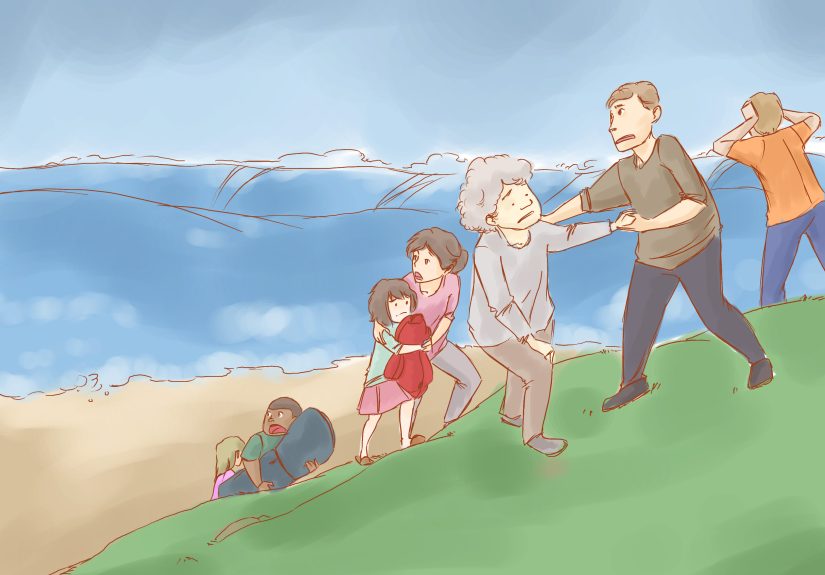
Step 4: If you’re near the coast, think “tsunami”
If you’re in a coastal area and you feel strong or long shaking, don’t wait around to see what the ocean feels like today.
Once shaking stops and you can move safely, head to higher ground or inland and follow local alerts and evacuation routes.
Tsunami danger can persist for hours, and official guidance matters more than random rumors (including the “my cousin said” variety).
Step 5: Communicate smart
- Text before calling when possible. Networks can be overloaded after disasters.
- Use official alerts and local emergency instructions for evacuation and safety updates.
- Keep roads clear for emergency response unless you truly need to drive.
Quick “What Would You Do?” Examples
You’re on the couch and the room starts shaking
Drop to your knees, cover your head and neck, and get under a sturdy table if it’s within a few feetotherwise stay low next to the couch.
Hold on and ride it out. Afterward, check for hazards (glass, fallen items), then calmly move if needed.
You’re in the shower (worst timing, obviously)
Stay inside the bathroom, drop low, and protect your head and neck with your arms. If there’s glass (like a mirror or shower door),
get low and angle away from it if you can safely shift a small distance. Don’t sprint barefoot into the hallway.
You’re in a store aisle with lots of stuff on shelves
Drop immediately, cover your head and neck, and get low next to a sturdy display base if there is one. Avoid tall shelves that can tip.
Don’t rush to the exit during shaking.
You’re driving and the car starts swaying
Signal, slow down, pull over safely away from overhead hazards, set the brake, and stay in the car until shaking stops.
Then proceed carefully, watching for damaged pavement and debris.
Common Myths That Get People Hurt (Let’s Retire These)
- Myth: “Run outside immediately.” Reality: It can be more dangerous outside during shaking because of falling debris.
- Myth: “Doorways are the safest place.” Reality: Doorways don’t reliably protect you from falling objects in modern buildings.
- Myth: “If it’s not huge, it’s not dangerous.” Reality: Even moderate shaking can knock items down and cause injuries.
Simple Prep That Makes the 3 Ways Easier
This article is about reacting during an earthquake, but here’s the secret: reactions improve when your environment is less chaotic.
A few low-effort moves can reduce what falls, breaks, or blocks your path.
- Secure heavy furniture (bookcases, TVs) so they’re less likely to tip.
- Keep heavy items low on shelves.
- Know how to shut off utilities (gas, water, electricity) if it’s safe and you’ve been instructed.
- Practice Drop, Cover, and Hold On so you don’t have to invent a plan mid-shake.
Conclusion
Earthquake safety isn’t about being fearlessit’s about being predictable. The ground may be unpredictable, but your response can be.
Remember the three ways:
(1) Drop, Cover, and Hold On indoors,
(2) move to open space if you’re outside or pull over if you’re driving,
and (3) once shaking stops, expect aftershocks and check for hazards like damage, gas leaks, and coastal tsunami risk.
It’s not glamorous, but it’s effectivelike wearing a seatbelt, except the road is the Earth and it’s having feelings.
Real-World Experiences and Lessons People Commonly Share (500+ Words)
People who’ve been through earthquakes often say the most surprising part isn’t the noise or even the motionit’s how quickly your brain tries to
negotiate with reality. Many describe a split second of denial: “Is a truck passing? Is the washing machine exploding? Did my upstairs neighbor decide
to practice tap dancing?” That tiny pause is normal. It’s also why having a simple scriptDrop, Cover, and Hold Onmatters. When your thoughts get
fuzzy, habits take over.
A common story goes like this: someone is working at a desk when shaking starts, and the first instinct is to stand up and move.
But movement is where they almost fall. People often report that the floor feels like it’s sliding sideways, or that their legs suddenly
feel “too long” to balance properly. Those who did best usually say they dropped quickly and held on to their coverbecause it stopped
the situation from becoming a sprint through falling objects.
Another shared experience is how much “small stuff” becomes dangerous. A lot of people remember books flying off shelves,
picture frames tilting, and kitchen items turning into projectiles. The earthquake itself isn’t aiming at youyour clutter is.
Afterward, many say they were grateful they had shoes nearby, because broken glass can be everywhere even after a short quake.
That’s one of those unglamorous details that makes a big difference. (Feet are great. Keep them.)
In public places, people often describe social confusion: everyone looks around to see what others are doing, and that hesitation spreads.
Those who reacted fastest usually didn’t wait for confirmation. They dropped, covered their head and neck, and stayed put.
Later, they realized that “looking calm” wasn’t the goalstaying safe was. Some also mention that exits became crowded instantly.
That’s why the advice not to rush the doors during shaking is so practical: bottlenecks plus panic plus moving ground is a messy math problem.
Drivers frequently describe a different kind of confusion: the car may sway or shimmy, and it’s easy to assume it’s a tire problem.
People who’ve experienced quakes while driving often say the best clue was noticing other cars slowing down at the same time,
or seeing streetlights and signs wobble. The lesson they share is consistent: pulling over safely and staying in the car helped them
avoid sudden braking, collisions, or stopping under risky structures.
The moment after the shaking stops is also where many people say they made their worst decisionsusually because they felt “safe” too soon.
Aftershocks can catch you while you’re walking around, checking on others, or trying to clean up. People who’ve lived through multiple earthquakes
often say they learned to keep one part of their attention on the possibility of another round of shaking. They also mention how quickly rumors spread:
“The bridge collapsed,” “There’s a tsunami coming,” “The next one will be bigger.” The calmer approachchecking official alerts and observing actual hazards
was the strategy people felt best about afterward.
If there’s one emotional lesson people repeat, it’s that you’re allowed to be scaredjust don’t let fear choose your actions.
A simple plan can do that job for you. Drop. Cover. Hold On. Then reassess. It’s the kind of routine that feels almost too basic,
until you realize that “basic” is exactly what works when the world starts shaking.