Table of Contents >> Show >> Hide
- Why the MagGo launch mattered
- What “adaptive magnetic charging” actually means (in human terms)
- The MagGo lineup at a glance
- 1) Anker 622 Magnetic Battery (MagGo): the “snap-on snack” for your iPhone
- 2) Anker 623 Magnetic Wireless Charger (MagGo): the desk stand that cleans up your life
- 3) Anker 633 Magnetic Wireless Charger (MagGo): the “stand + battery” combo meal
- 4) Anker 637 Magnetic Charging Station (MagGo): the orb that ate your power strip (in a good way)
- 5) Anker 613 Magnetic Wireless Charger (MagGo): the car mount that doesn’t hate your vents
- 6) Anker 610 Magnetic Phone Grip (MagGo): not a charger, but a confidence boost
- Charging speed: the part everyone asks about
- How to pick the right MagGo product
- MagGo’s bigger story: the road from MagSafe to Qi2
- Final thoughts
- Real-life experiences: what using MagGo feels like (the extra )
- SEO tags (JSON)
Magnetic charging is one of those ideas that feels obvious the second you try it. You snap your phone onto a charger,
it lines up perfectly, and suddenly wireless charging stops acting like a “place it carefully and pray” situation.
Back in late 2021, Anker leaned hard into that “snap-and-go” convenience with MagGoa lineup of
MagSafe-compatible accessories aimed squarely at iPhone 12 and iPhone 13 owners who wanted more options than Apple’s
small first-party ecosystem.
The promise was simple: adaptive magnetic charginga marketing-friendly way of saying the charger
and the phone use magnets to self-align so you get steadier charging, fewer interruptions, and less “Why is my phone
warmer than a slice of pizza?” drama. And because this is Anker, the lineup didn’t stop at one puck. It arrived as a
whole little magnetic universe: desk chargers, a battery pack, a car mount, a power-strip-style charging station,
and even a magnetic grip.
Why the MagGo launch mattered
In 2021, MagSafe was still “new enough” that people were experimenting, but “closed enough” that the accessory world
felt constrained. Apple’s official products were clean and well-integrated, but limited in variety and (let’s be
honest) not cheap. Anker’s move was to take the magnetic alignment benefits of MagSafe and apply them to
everyday charging scenarios people actually live in: desk work, commuting, travel, and the constant quest to keep
earbuds from dying exactly when the chorus drops.
The other big deal: design finally entered the chat. MagGo wasn’t just another black rectangle. Anker offered multiple
colors intended to pair nicely with iPhone finishes, and the products had a more “desktop decor” vibe than “office
supply closet” energy.
What “adaptive magnetic charging” actually means (in human terms)
Wireless charging works by transferring energy between coilsone in the charger and one in the phone. When those coils
aren’t aligned, efficiency drops. That can mean slower charging, more heat, or intermittent charging if your phone
shifts. Magnetic alignment helps solve that by centering the coils consistently. It’s less about magic and more about
physics behaving when it’s given a fair chance.
In MagGo’s case, “adaptive” is best understood as the charger adjusts to real-world use: you can
attach the phone in portrait or landscape, prop it up for video calls, mount it in the car, or combine it with a
battery packwithout losing alignment every time you breathe near it.
The MagGo lineup at a glance
Anker introduced six products under the MagGo banner, each built around magnetic attachment for iPhone 12/13 models.
Here’s what each one does, who it’s for, and where it fits in the “I just want my phone charged” lifestyle.
1) Anker 622 Magnetic Battery (MagGo): the “snap-on snack” for your iPhone
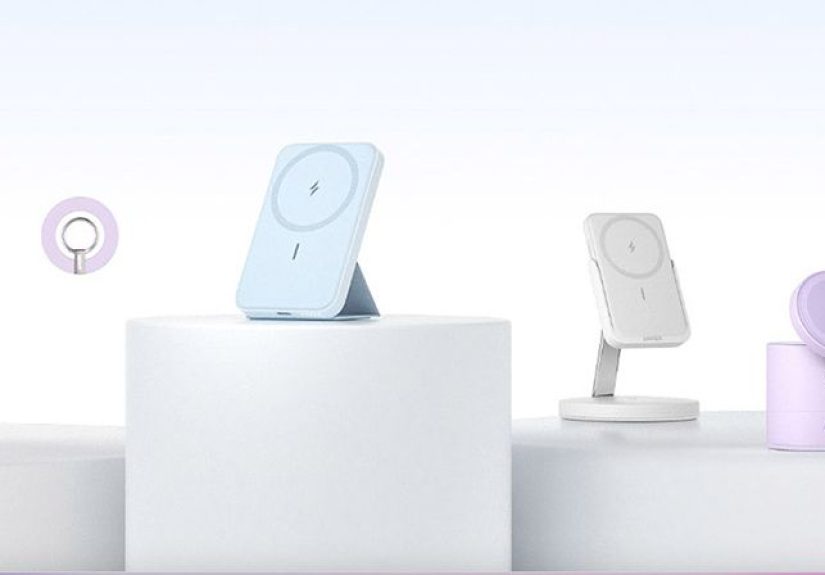
The Anker 622 Magnetic Battery is a 5,000mAh magnetic power bank that sticks to the back of your
iPhone and charges wirelessly. Its signature feature is a fold-out kickstand that lets you prop the
phone up in portrait or landscape. That means you can top up your battery while your phone plays a video, runs a timer,
or pretends to be a mini TV during lunch.
- Best for: commuting, travel days, conferences, theme parks, and anyone who “just needs 20% more.”
- Why it’s clever: the kickstand turns dead time (charging) into usable time (watching, reading, calling).
- Reality check: wireless power banks are convenient, but less efficient than plugging in a cableexpect some energy loss.
2) Anker 623 Magnetic Wireless Charger (MagGo): the desk stand that cleans up your life
The Anker 623 is a compact desktop charger with a hinged magnetic charging surface that can tilt
up to around a 60-degree viewing angle. Under the top surface is a secondary wireless charging spot designed for
earbuds. Translation: your iPhone gets the spotlight, your earbuds get the understudy role, and your desk gets fewer
cables trying to start a spaghetti-based civilization.
- Best for: desks, nightstands, kitchen countersanywhere your phone sits while you live your life.
- Why it’s practical: dual charging in a small footprint (phone + earbuds), plus adjustable viewing.
- Nice touch: a weighted base helps keep it stable when you tap your screen or grab your phone.
3) Anker 633 Magnetic Wireless Charger (MagGo): the “stand + battery” combo meal
The Anker 633 is the most “Swiss Army” of the original lineup: it’s a desktop charging stand with a
magnetic charging face that can slide out as a removable 5,000mAh battery. At home, it acts as your
charging station. When you leave, you pop the battery off and take it with you.
- Best for: people who want one setup that works on the desk and on the go.
- Why it stands out: it reduces “charger duplication”you’re not buying a stand and a separate battery pack.
- Small caution: the naming is confusing; check model numbers so you don’t accidentally buy the wrong “six-three-something.”
4) Anker 637 Magnetic Charging Station (MagGo): the orb that ate your power strip (in a good way)
The Anker 637 looks like a quirky little desktop speakeruntil you realize it’s an
8-in-1 charging station. On the front: a magnetic wireless charging pad for your iPhone. On the back:
multiple ports and outlets to power the rest of your setup. It’s built for the reality that most people don’t have one
devicethey have a device ecosystem.
- Best for: home offices, gaming desks, bedside setups, dorm rooms, and anyone tired of outlet Tetris.
- What it replaces: a wireless charger + a power strip + at least one multiport USB brick.
- Why it’s underrated: cable management gets easier when the “wired mess” stays behind the orb and the magnetic pad stays front and center.
5) Anker 613 Magnetic Wireless Charger (MagGo): the car mount that doesn’t hate your vents
Car mounts usually fall into three categories: vent clips that wobble, suction cups that eventually betray you, or
adhesive mounts that require faith. The Anker 613 went the dashboard route with a magnetic charging
pad and an adjustable arm for better viewing angles. The point is hands-free navigation without turning your air vent
into a phone-holding circus act.
- Best for: commuters, rideshare drivers, road trippers, and anyone who has yelled “WHERE’S THE TURN?!” at a map app.
- Why magnets help: one-handed attachment/removal, plus consistent alignment for charging.
- Important note: magnetic mounts work best with MagSafe-compatible iPhones or cases designed for magnetic alignment.
6) Anker 610 Magnetic Phone Grip (MagGo): not a charger, but a confidence boost
The Anker 610 Magnetic Phone Grip is a ring-style grip/stand that attaches magnetically. No charging,
no cablesjust better handling. It’s basically a “don’t drop your expensive rectangle” accessory that’s easy to remove
when you want a clean phone back.
- Best for: one-handed phone users, big phones, and anyone who has ever watched a phone tumble in slow motion.
- Why it fits MagGo: it treats the magnetic system as a modular platform, not just a charging method.
Charging speed: the part everyone asks about
Here’s the honest deal: early MagGo products were designed to be MagSafe-compatible in attachment and
alignment, but they generally didn’t deliver Apple’s top-end MagSafe wireless wattage that required
Apple certification at the time. In practical terms, that meant many of these accessories focused on convenience,
form factor, and lifestyle utility more than raw charging speed.
That doesn’t make them “bad.” It just makes them honest tools for real-world charging: topping up while you work,
staying powered in the car, or adding hours back to your day with a battery pack that doesn’t dangle a cable like a sad
tail.
How to pick the right MagGo product
If you travel a lot
Start with the Anker 622 Magnetic Battery. A magnetic power bank is the fastest way to make your phone
less dependent on wall outlets. The built-in stand is especially clutch on flights and in airportsprop your phone up,
watch something, and pretend you’re not surrounded by the soothing sounds of rolling luggage.
If you want a clean desk (and a calmer brain)
The Anker 623 is the neat-and-tidy option for phone + earbuds charging in a small footprint. If your
desk already has a laptop, monitor, lamp, and the emotional baggage of 37 open browser tabs, the 623 keeps your charging
setup simple.
If you want one system for home and away
The Anker 633 is the “I refuse to buy duplicates” solution. The removable battery concept is a smart
middle ground between a stationary stand and a portable charger. It’s the kind of product that makes you feel like you
planned ahead, even if you absolutely did not.
If you’re building a power hub setup
The Anker 637 is for people who want one central charging point for multiple devices. If your desk is
where everything livesphone, laptop, tablet, headphones, speakers, maybe a small fan because adulthood is weirdthe
637 is the “one orb to rule them all” option.
If your car is basically your second office
Go with the Anker 613. Navigation plus charging is a daily need for lots of drivers, and magnets make
mounting easier and less fussy. Just remember: magnetic car mounts are happiest when your phone/case is designed for it.
MagGo’s bigger story: the road from MagSafe to Qi2
The 2021 MagGo lineup is also interesting because it previews where wireless charging was headed. The industry later
moved toward Qi2, which brought magnetic alignment into the broader Qi standardeffectively taking the
“magnets make wireless charging better” idea and making it more universal.
Why does that matter for MagGo fans? Because it points to a future where magnetic alignment and higher wireless power
aren’t limited to one brand’s ecosystem. In other words: the convenience you liked in MagGo became a direction the
whole industry started chasing.
Final thoughts
Anker’s original MagGo “adaptive magnetic charging” lineup wasn’t just a set of chargersit was a signal that magnetic
alignment could be a platform. A battery that becomes a stand. A desk charger that handles earbuds too. A power hub that
cleans up your workspace. A car mount that doesn’t feel like a compromise.
If you’re shopping today, you’ll find newer MagGo options with updated standards and faster wireless performance. But
the 2021 release still deserves credit for pushing magnetic charging into everyday routinesmaking it less of a novelty
and more of a “why didn’t I do this earlier?” upgrade.
Real-life experiences: what using MagGo feels like (the extra )
Let’s talk about the part spec sheets never capture: the tiny daily moments where magnetic charging either makes your
life smootheror reveals exactly how chaotic your charging habits really are.
Imagine a normal weekday. You sit down at your desk with coffee and the confidence of someone who believes they will
be “caught up” by lunch (cute). Your phone is at 38%, which is the battery percentage equivalent of hearing ominous
music in a movie. With a traditional wireless pad, you’d place the phone down, glance at the charging icon, and then
later discover it stopped charging because you sneezed and the phone shifted half an inch. With a magnetic stand like
the MagGo 623, it’s more like docking a tiny spaceship. It clicks into place, lines up, and stays put while you tap,
scroll, and inevitably pick it up to check something “real quick” 700 times.
Now jump to the afternoon. You leave the house and realize you’re going to be out longer than planned. This is where
a magnetic battery like the 622 changes behavior. Instead of rationing phone use like it’s a post-apocalyptic resource,
you slap the battery on and keep going. The kickstand sounds like a small feature until you’re eating lunch alone and
your phone becomes your entertainment, your map, your payment method, and your entire personality for 20 minutes.
Propping the phone up while it charges feels oddly luxuriouslike you upgraded from “surviving” to “functioning.”
The car mount experience is its own category of satisfaction. If you’ve ever fumbled with a clamp mount at a stoplight,
you know the vibe: stress, awkward angles, and the feeling that you’re doing something illegal even when you aren’t.
With a magnetic mount, it’s a one-hand motionattach, adjust, done. The best part isn’t even the charging; it’s that
your phone stops wobbling like it’s on a trampoline when you hit a pothole. Navigation becomes calmer when your display
stays stable and readable.
Then there’s the desk hub life. People don’t buy something like the MagGo 637 because they love ports. They buy it
because their workspace has quietly become a charging zoo: laptop brick here, phone cable there, earbuds cable somehow
tied into a knot that looks like modern art. A centralized station feels like cleaning your room, but for electrons.
You still have cablesnobody escapes cables entirelybut they’re corralled. You know where power lives. Your desk looks
less like a panic spiral and more like a place where a competent adult could theoretically exist.
The funniest “experience” with MagGo products is how quickly you start expecting magnets everywhere. After a week,
plugging in a cable can feel… old-fashioned. Not badjust slightly less elegant. The snap-on habit is real. And that,
more than any wattage number, is what the MagGo lineup got right: it made charging feel frictionless enough that you
actually do it before your phone hits 3% and starts sending you into battery-anxiety monologues.