Table of Contents >> Show >> Hide
- Why Gender Role Reversal Hits So Hard
- The 8 Pics, Explained
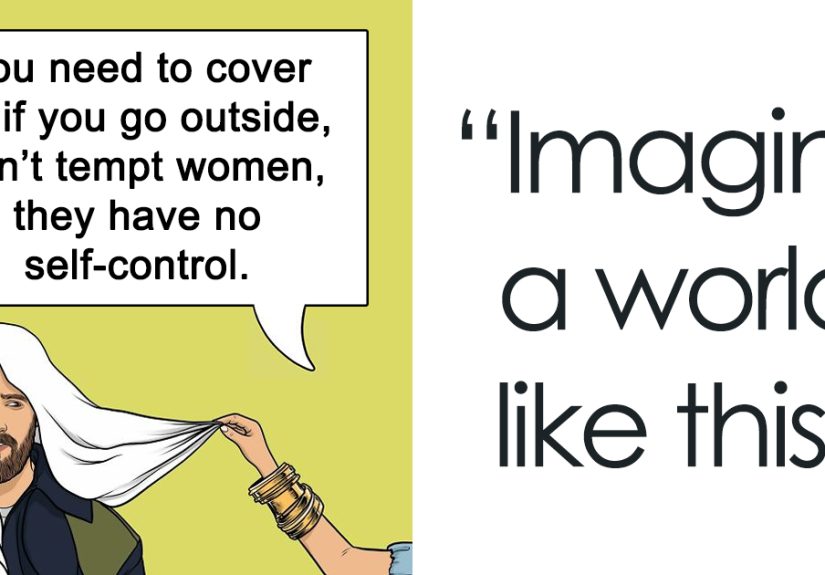
- Pic 1: “Cover updon’t tempt women.”
- Pic 2: “You’re worthlessyou’re not a virgin.”
- Pic 3: Catcallingdirected at a boy.
- Pic 4: “My intimate photos got leakedand now I’m the one being shamed.”
- Pic 5: Post-baby body shamingaimed at a dad.
- Pic 6: “What were you wearing?” and “How much did you drink?”
- Pic 7: “Thirty and unmarriedshameful.”
- Pic 8: Training boys for domestic servitudebecause it’s their “duty.”
- What These Images Reveal About “Everyday” Sexism
- So… What Do You Do With This Awareness?
- : Experiences That Echo These 8 Pics
- Conclusion: The Flip Isn’t the PointThe Mirror Is
Some art gently taps you on the shoulder. This art grabs you by the lapels, flips your worldview like a pancake, and says,
“Okaynow read that again, but pretend it’s happening to you.”
In her illustrated series often framed as “Imagine a world like this…,” artist Lainey Molnar spotlights everyday sexism
by swapping gender roles. The result is funny in the way a fire alarm is funny: the sound is unpleasant, but it’s also doing its job.
Each image is a quick, sharp thought experimenteight snapshots that take familiar comments women hear and place them on men instead,
so the double standard becomes impossible to ignore.
Why Gender Role Reversal Hits So Hard
Everyday sexism rarely arrives wearing a villain cape. It shows up as “advice,” “jokes,” “concern,” “just asking questions,”
and other socially acceptable disguises. Role-reversal art works because it strips away the disguise.
When the same logic is applied to men, the message suddenly sounds as ridiculous as it always was.
It also highlights a key truth: a lot of sexism isn’t about any one dramatic momentit’s about accumulation.
A comment here, an assumption there, a raised eyebrow at the wrong time. Over years, those tiny cuts become a map.
Molnar’s approach doesn’t require a lecture. It just hands you the map and lets you connect the dots.
The 8 Pics, Explained
Below are the eight scenarios (with plain-English takeaways). If you’re adding images to a web post, these notes also double as
caption ideas and accessibility-friendly context.
Pic 1: “Cover updon’t tempt women.”
The illustration flips a familiar script: instead of policing what women wear, it polices what a man wearsand blames his clothing
for other people’s behavior. The point is blunt: “self-control” somehow becomes optional when the target is a woman.
Dress codes and “modesty advice” often pretend to be about safety, but they can quietly teach a different lesson:
that the burden of preventing harm belongs to the person most likely to be harmed.
Pic 2: “You’re worthlessyou’re not a virgin.”
Here, a man is shamed for not meeting a purity expectation tied to marriage. The reversal exposes how often sexual history is treated
like a moral report card for womendespite being irrelevant to kindness, loyalty, or basic human value.
The image isn’t arguing that anyone should be judged this way. It’s pointing out that judgment has been normalized for women,
then calling the bluff by applying it to men.
Pic 3: Catcallingdirected at a boy.
A young boy in a school uniform gets a sexualized comment from an adult voice. The discomfort is the message.
Many women learn early that public space can come with commentarysometimes before they’re old enough to drive,
vote, or pick their own bedtime. When the target is a boy, the same behavior reads instantly as predatory and unacceptable.
The art asks: why do we downplay it when the target is a girl?
Pic 4: “My intimate photos got leakedand now I’m the one being shamed.”
The image tackles a modern version of an old habit: blaming the person harmed instead of the person who caused the harm.
When private images are shared without consent, the violation is the sharingyet public reactions often spiral into moral judgment
of the victim’s body, choices, or “reputation.” The gender flip underlines how quickly sympathy can evaporate when the victim is a woman,
replaced by questions that sound like they belong in a courtroom run by gossip.
Pic 5: Post-baby body shamingaimed at a dad.
A man holding a baby is critiqued as having “let himself go,” with an extra jab implying his partner must be unhappy.
This highlights two common pressures women face: the expectation to “bounce back” physically after childbirth and the idea that their
bodies exist to satisfy someone else. The illustration also points at a quieter insult: reducing parenting to appearance and desirability,
as if nurturing a child is a side quest to the main mission of staying attractive.
Pic 6: “What were you wearing?” and “How much did you drink?”
The infamous questions appear here with the genders reversed. Many people recognize these lines as victim-blaming when they’re aimed at men.
The image exposes how routinely they’ve been aimed at womenas if clothing or alcohol can magically turn wrongdoing into a misunderstanding.
The punchline (if you can call it that) is that the questions don’t investigate the harm; they investigate whether the victim can be disqualified
from receiving empathy.
Pic 7: “Thirty and unmarriedshameful.”
This scene flips the social pressure to “settle down” on a man. It spotlights how women are often treated like they’re on a countdown timer,
judged for being single as if partnership is proof of maturity or worth. The illustration also reveals the cruelty of “concern” that’s really control:
advice that sounds supportive but ultimately insists there’s only one acceptable timeline for a meaningful life.
Pic 8: Training boys for domestic servitudebecause it’s their “duty.”
A boy is handed domestic tools and told his purpose is serving a future wife. The reversal is intentionally absurd, because the original expectation
girls being trained early for caretaking and household laboris treated as normal in many cultures. This image calls out how gender roles can be taught
before kids even understand what they’re being signed up for. It also nudges a modern truth into the spotlight: household work isn’t “helping.”
It’s workand it should be shared.
What These Images Reveal About “Everyday” Sexism
Molnar’s series doesn’t argue that men never experience shame, harassment, or pressure. It argues that the default direction of many of these
social judgmentsespecially around bodies, sexuality, and safetylands on women more often, more publicly, and more predictably.
Notice what connects the eight scenarios:
- Control disguised as protection (what you wear, where you go, how you behave).
- Purity and respectability tests (sexual history used as “character evidence”).
- Public entitlement (commentary on bodies as if they’re community property).
- Responsibility shifted onto the target (prevent harm, avoid harm, prove you didn’t “invite” harm).
- Labor treated as natural destiny (care work and household management assumed, not negotiated).
This is why role-reversal art can be so clarifying: it reveals the hidden rules we’ve been taught not to name.
And once a rule is visible, it becomes discussablewhich is step one in changing it.
So… What Do You Do With This Awareness?
If you’re reading this and thinking, “Okay, but I’m not out there yelling at strangers,” that’s good news.
Most sexism isn’t one loud villain; it’s a lot of small permissions. Which means progress often looks like removing those permissions.
Swap “advice” for consent and agency
Instead of “Don’t wear that,” try “Do you feel comfortable?” Instead of “Be careful,” try “Do you want me to walk with you?”
The goal is safety without blame, support without control.
Challenge the “disqualifying questions”
When someone jumps to “What was she wearing?” or “Was she drinking?” redirect the focus:
“The important question is what the other person did.” You don’t need a speechjust a steering wheel.
Use low-drama bystander moves
Intervention doesn’t have to be confrontational. A simple distraction (“Hey, can you help me find…?”), checking in with the target afterward,
or delegating to someone in authority can change the dynamic without escalating it.
Make labor visible at home
If the household runs on one person’s invisible checklist, it will eventually run on one person’s burnout.
Try naming tasks, rotating responsibilities, and treating domestic work like what it is: shared infrastructure.
: Experiences That Echo These 8 Pics
Picture a regular weekno headlines, no dramatic soundtrack, just the everyday moments where sexism hides in plain sight.
A teen girl walks into a convenience store after school and gets a comment about her body from someone old enough to be her parent.
It’s “just words,” people say, but her brain starts mapping routes: which streets feel safe, which times feel risky, which outfits will attract attention,
which facial expression might reduce the chance of being noticed. Meanwhile, her brother walks the same route and mostly thinks about snacks.
Not because he’s braverbecause he hasn’t had to build the same mental navigation system.
At a family gathering, someone jokes that a woman is “picky” or “too intense” for still being single in her late twenties.
The tone is playful, but the message is heavy: your life is on a timer, and we’re all watching the clock.
Later, a male cousin admits he’s not dating seriously and gets a very different reactioncuriosity, maybe admiration,
like he’s wisely “focusing on himself.” Same situation, different social story.
In a workplace meeting, a woman shares an idea that lands quietly. Ten minutes later, a man repeats it and the room lights up.
Nobody intended harm, but intent doesn’t erase impact; she learns a lesson about volume and credibility that she never signed up for.
On the commute home, she sees a social media thread ripping apart a woman whose private photos were shared without permission.
The comments don’t focus on the person who violated consentthey focus on whether she “should have” trusted anyone in the first place,
as if having trust is a crime and betrayal is a natural disaster.
At home, a new mom is askedweeks after giving birthwhether she’s “getting her body back.”
Nobody asks whether she’s getting her sleep back, her energy back, her sense of self back. The question is framed like concern, but it’s a performance review.
The same day, her partner is praised for “babysitting” his own child for two hours, a compliment that sounds kind until you realize it quietly implies
parenting is optional for men and mandatory for women.
None of these moments are isolated. They stack. That’s the point of Molnar’s series: it takes the stack, flips the gender,
and lets the unfairness finally look as strange as it feels.
Conclusion: The Flip Isn’t the PointThe Mirror Is
“Men in women’s shoes” isn’t a game of who has it worse. It’s a mirror that helps people see the invisible scripts we’ve memorized:
who gets policed, who gets excused, who gets blamed, who gets believed, who gets to be “just a person” in public.
Molnar’s illustrations work because they’re fast and familiarand because they make the double standard loud enough to hear.
If the images make you uncomfortable, that discomfort can be useful. It can turn into better questions, better instincts, and better habits:
fewer victim-blaming jokes, more shared labor, more respect for boundaries, more support without control.
Everyday sexism survives on “normal.” Art like this reminds us that “normal” can be edited.