Table of Contents >> Show >> Hide
- What Makes It “Sicilian-Style”?
- Best Cut of Beef for Braciole
- Sicilian-Style Braciole Ingredients
- How To Make Sicilian-Style Braciole
- Serving Ideas
- Troubleshooting and Pro Tips
- Slow Cooker and Pressure Cooker Options
- Make-Ahead, Storage, and Freezing
- FAQ: Sicilian-Style Braciole
- Kitchen Stories & Real-Life Braciole Moments (Extra )
- Conclusion
If you’ve never had braciole, imagine this: thin slices of beef dressed up in a garlicky breadcrumb filling, rolled into tight little bundles, browned until they smell like “somebody’s Nonna just walked in,” then slow-braised in tomato sauce until fork-tender. It’s cozy, dramatic, and somehow always tastes like a special occasioneven if you’re wearing sweatpants (the official uniform of Sunday sauce).
This version leans Sicilian-style: a savory-sweet stuffing with toasted pine nuts and raisins, plenty of parsley, and salty cheese. The result is a rich, slightly nuanced braciole that tastes like it took all day… because it did. But don’t panic. Most of that time is hands-off simmering, which is just cooking’s way of saying, “Go live your life; I’ve got this.”
What Makes It “Sicilian-Style”?
“Braciole” (also called braciola or involtini) shows up across Italy and in Italian-American kitchens, but Sicilian-leaning braciole often features:
- Pine nuts + raisins for that signature sweet-savory contrast
- Pecorino (or a mix of cheeses) for a salty punch
- Herby breadcrumbs that soak up olive oil and tomato sauce like tiny flavor sponges
- Low-and-slow braising in tomato sauce (a.k.a. Sunday gravy / Sunday sauce vibes)
Best Cut of Beef for Braciole
You want beef that’s thin, rollable, and tough enough to benefit from braising (aka it becomes amazing after a long simmer). Great options:
- Top round (thin-sliced cutlets are common and affordable)
- Bottom round or round steak (ask the butcher to slice thin)
- Flank steak (butterflied and pounded thinner; excellent flavor)
- Sirloin tip (works well when thin-sliced)
If your slices aren’t thin enough, a meat mallet and a little stress relief will fix that. Aim for about 1/4-inch thickness so the roll stays tight and cooks evenly.
Sicilian-Style Braciole Ingredients
For the Braciole
- 2 pounds thin-sliced beef (top round cutlets or flank steak, pounded thin)
- Kosher salt and black pepper
- Kitchen twine (or toothpicks, in a pinch)
- 2–3 tablespoons olive oil (for browning)
For the Sicilian-Style Filling
- 1 cup breadcrumbs (plain or lightly seasoned; preferably not neon-orange “pizza crumbs”)
- 2/3 cup grated Pecorino Romano (or mix with Parmigiano-Reggiano)
- 1/4 cup toasted pine nuts, chopped or left whole
- 1/4 cup raisins (golden raisins are great here)
- 2 cloves garlic, minced
- 1/3 cup chopped fresh parsley
- 1 teaspoon dried oregano (or 1 tablespoon fresh)
- Pinch crushed red pepper flakes (optional, but fun)
- 3–4 tablespoons olive oil (enough to moisten the filling)
- Optional: lemon zest (1/2 teaspoon) for brightness
- Optional: thin slices of prosciutto inside each roll for extra savory depth
For the Tomato Sauce (Braising Sauce)
- 2 tablespoons olive oil
- 1 small onion, finely chopped
- 3–4 cloves garlic, sliced or minced
- 2 tablespoons tomato paste (optional, for deeper flavor)
- 1 cup dry red wine (or white wine; you’re the boss)
- 2 (28-ounce) cans crushed tomatoes (or a mix of crushed + passata)
- 1 bay leaf
- Salt, pepper, and a pinch of sugar if your tomatoes taste sharp
- Optional: a Parmesan rind for extra savory richness
How To Make Sicilian-Style Braciole
Step 1: Prep the Beef
- Lay the beef slices on a cutting board. If thick, cover with plastic wrap and pound to about 1/4 inch.
- Season both sides with salt and pepper.
Pro tip: Keep the pieces roughly the same size so they finish cooking around the same time. Uneven braciole is how you end up with one roll that’s perfect and one roll that’s still doing leg day.
Step 2: Mix the Filling
- In a bowl, combine breadcrumbs, Pecorino, pine nuts, raisins, garlic, parsley, oregano, and red pepper flakes.
- Drizzle in olive oil and mix until the filling feels like damp sand at the beachclumpy, not soggy.
If it looks dry, add a bit more olive oil. If it’s too wet, add a sprinkle more breadcrumbs. You want it spreadable, not pourable.
Step 3: Roll and Tie
- Spread filling over each beef slice, leaving a small border so it doesn’t escape during rolling.
- If using prosciutto, lay a thin slice on top of the filling.
- Roll tightly (like a sleeping bag you’re trying to cram into its original tiny sack).
- Tie with kitchen twine at 1-inch intervals or secure with toothpicks.
Step 4: Brown the Braciole
- Heat olive oil in a heavy pot or Dutch oven over medium-high heat.
- Brown braciole on all sides until a deep golden crust forms.
- Transfer to a plate.
Browning isn’t optional if you want big flavor. This step builds the foundation for that “why is this so good?” moment later.
Step 5: Build the Sauce
- Lower heat to medium. Add onion and sauté until soft, about 5 minutes.
- Add garlic and cook 30–60 seconds (until fragrant, not scorched).
- Stir in tomato paste (if using) and cook 1 minute.
- Pour in wine to deglaze, scraping up browned bits from the pot bottom.
- Add crushed tomatoes, bay leaf, and season lightly with salt and pepper.
- If using a Parmesan rind, add it now.
Step 6: Braise Low and Slow
- Nestle braciole into the sauce.
- Bring to a gentle simmer, then reduce heat to low.
- Cover and simmer 2 to 3 hours, turning occasionally, until fork-tender.
“Gentle simmer” means occasional lazy bubbles, not a rolling boil. Boiling can tighten the meat and turn your braciole into resistance training.
Step 7: Rest, Slice, Serve
- Remove braciole to a cutting board and rest 10 minutes.
- Snip and remove twine (or toothpicks).
- Slice into pinwheels and spoon sauce over top.
Serving Ideas
- Classic: Serve braciole with pasta (rigatoni, spaghetti, or ziti) and extra sauce.
- Cozy: Pair with creamy polenta or mashed potatoes.
- Sunday-feast mode: Add meatballs or sausage to the pot for a full red-sauce lineup.
- Sandwich situation: Stuff slices into crusty bread with sauce and provolone.
Troubleshooting and Pro Tips
Keep the Filling Inside the Roll
Don’t overstuff. A thin, even layer is better than a braciole that explodes like a suitcase at baggage claim. Leave a small border, roll tight, and tie securely.
Toast the Pine Nuts
Toasting takes 3–5 minutes in a dry skillet and makes pine nuts taste nuttier and more aromatic. It’s a small step with big “wow, that’s different” energy.
Adjust Sweetness Like a Grown-Up
Raisins bring sweetness, and tomatoes can be acidic. If your sauce tastes sharp, add a tiny pinch of sugarlike, “I dropped the spoon in and pulled it right back out” tiny. You’re balancing, not candy-making.
Use the Oven If You Prefer Set-It-and-Forget-It
After nestling braciole into sauce, cover the Dutch oven and braise at 300°F for about 2 to 3 hours, checking occasionally.
Slow Cooker and Pressure Cooker Options
Slow Cooker Braciole
Brown the braciole first (still worth it). Add sauce to the slow cooker, nestle in the rolls, and cook 5–6 hours on LOW (or 2–3 hours on HIGH) until tender.
Instant Pot / Pressure Cooker Braciole
Brown using sauté mode, build the sauce, then pressure cook on HIGH for about 30–40 minutes (depending on thickness). Let pressure release naturally for 10–15 minutes for best texture.
Make-Ahead, Storage, and Freezing
- Make-ahead win: Braciole often tastes even better the next day as flavors deepen.
- Refrigerate: Store in sauce, covered, up to 4 days.
- Freeze: Freeze braciole in sauce up to 3 months. Thaw overnight in the fridge and reheat gently.
- Reheat gently: Low heat on the stove prevents the meat from tightening.
FAQ: Sicilian-Style Braciole
Why is my braciole tough?
Usually one of three things: the meat needs more time, the simmer was too aggressive, or the slices were too thick. Give it time and keep the heat low. Braciole is a “slow dance,” not a sprint.
Can I skip the wine?
Yes. Deglaze with beef broth, chicken broth, or even water. Wine adds complexity, but your braciole will still be delicious without it.
Can I use pork instead of beef?
Absolutely. Braciole is a technique, not a strict rulebook. Pork cutlets can cook faster, so start checking tenderness earlier.
What’s the best pasta with braciole?
Anything that grabs sauce: rigatoni, ziti, paccheri, or spaghetti. If you want to feel extra official, serve pasta as a first course with sauce, then braciole as the second course. If you want to feel extra real, put it all on the same plate and call it “efficiency.”
Kitchen Stories & Real-Life Braciole Moments (Extra )
Braciole is one of those dishes that turns a normal day into a “something’s happening” day. It starts innocently: you buy thin beef cutlets and think, “How hard can rolling meat be?” Then the cutting board becomes your stage, the meat mallet becomes your percussion section, and your kitchen turns into a tiny Italian opera where the main character is tomato sauce and the supporting cast is garlic, parsley, and whatever spoon you keep using even though you have twelve other spoons.
The first real-life moment usually hits when you toast pine nuts. You’re standing there, feeling confident, and then boomthey go from pale to perfect to “who invited this burnt popcorn?” in about 45 seconds. The lesson: pine nuts demand attention like a toddler near a permanent marker. Toast them, stir them, and don’t answer texts until they’re off the heat.
Next comes rolling. In theory, it’s tidy. In practice, you learn how much your hands can do while trying to keep a breadcrumb filling from escaping out the sides. A little filling will fall out. That’s normal. Consider it a sacrifice to the sauce gods. You’ll scoop it up later, or it will dissolve into the tomato sauce and secretly make it richer, which feels like cheating in the best way.
Tying braciole is its own rite of passage. There’s always a first knot that looks great, and then the second knot that makes you wonder if you’ve ever seen a knot before in your life. Don’t worry. The goal isn’t to create a nautical masterpiece; it’s to keep the roll together long enough to brown it. And when you finally snip the twine after braising, it’s weirdly satisfyinglike unwrapping a present that smells like garlic and tomatoes.
The browning step is where the kitchen starts to smell like you’re “serious” about cooking. You’ll hear that sizzle, see the meat turn deeply golden, and think, “Yes, I am a person who browns things.” Then you’ll notice tiny specks of oil on your stovetop and remember: great flavor comes with great cleanup. It’s the culinary version of glitter. You’ll find it later, even if you pretend you won’t.
Once the sauce is simmering, braciole becomes a background soundtrack to the day. You might fold laundry, binge a show, or “just check” on the pot every ten minutes because the smell is too good and you’re basically hovering like a human air freshener. This is also when family members magically appear in the kitchen asking what’s for dinner. They weren’t hungry earlier, but tomato sauce has the power to summon people like it’s sending smoke signals.
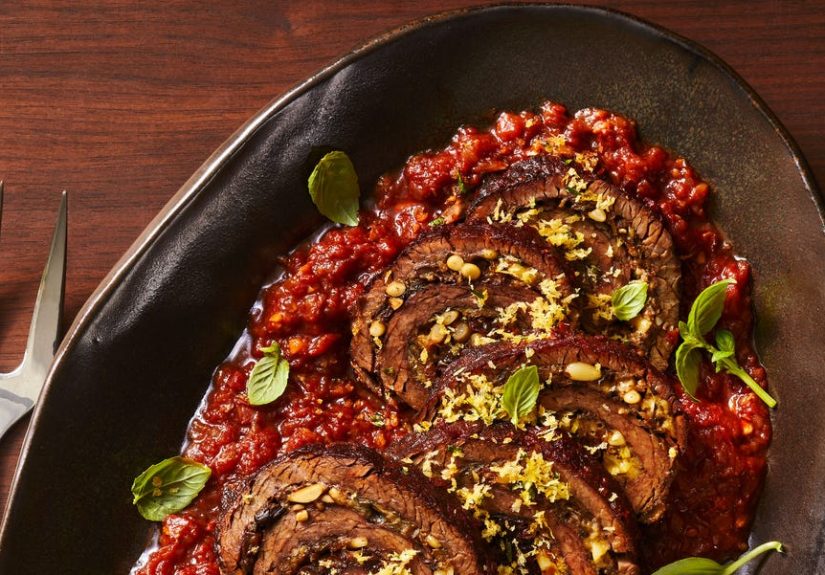
The best part is the end: slicing into those pinwheels and seeing the swirl of beef, herbs, cheese, raisins, and pine nuts. It looks fancy, but it tastes homey. And the first bite always has that moment of contrastsalty cheese, sweet raisin, nutty pine nuts, and rich saucethat makes you understand why braciole isn’t just a recipe. It’s a tradition you can taste.
Conclusion
Sicilian-style braciole is the kind of dish that rewards patience: a little pounding, a little rolling, a good sear, and a long, gentle simmer. The payoff is tender stuffed beef rolls bathing in tomato sauce that tastes like it belongs at the center of the table. Make it for a weekend dinner, a holiday spread, or any day you want your kitchen to smell like comfort. And if you end up eating a slice straight from the cutting board? Congratulationsyou’re doing it right.