Table of Contents >> Show >> Hide
- First, a quick reality check: body image “lag” vs. body dysmorphia
- Why body dysmorphia can show up after weight loss
- Signs it may be more serious (and worth professional support)
- How to manage body dysmorphia after losing weight
- 1) Use evidence-based treatment: CBT (often with exposure/response prevention)
- 2) Medication can help (when appropriate)
- 3) Make a “mirror plan” (because mirrors can become a slot machine)
- 4) Reduce checking and reassurance-seekinggradually
- 5) Upgrade your inputs: social media, “fitspo,” and the algorithm that hates peace
- 6) Focus on function (body neutrality is a power move)
- 7) Address real physical discomfort without turning it into a self-worth trial
- 8) Build scripts for body comments (so you don’t spiral in the produce aisle)
- Three specific examples (because “just be confident” is not a strategy)
- Mini FAQ
- Conclusion: You deserve a brain that lets you live in your lifenot just in your reflection
- Experiences People Commonly Describe After Weight Loss (500+ Words)
You did the thing. You lost weight. Your jeans size changed. Your knees stopped making that “snap-crackle-pop” sound on stairs. And yet… your brain is still filing complaints like it’s running Windows 95.
If you’ve ever looked in the mirror after significant weight loss and thought, “Why don’t I feel different?” or even “Why do I feel worse?”you’re not broken, you’re not vain, and you’re definitely not alone. A common experience after major body changes is a weird “body image lag,” sometimes described as feeling like you’re still in your old body even when the scale and clothing tags disagree. Some clinicians and writers have even used terms like “ghost” or “phantom” fat to describe that mismatch.
But there’s an important line between normal adjustment pains and something more intense and disruptive: Body Dysmorphic Disorder (BDD) (often called “body dysmorphia”). This article breaks down what’s going on, why it can show up after weight loss, and how to manage it with practical steps, real-world examples, and zero moral judgment.
First, a quick reality check: body image “lag” vs. body dysmorphia
Body image lag (very common)
After a big physical change, your internal “map” of your body may take time to update. You might still reach for the largest size on the rack, avoid photos, or brace yourself sideways through a doorway you now fit through easily. That’s not a character flawit’s your brain being slow at recalculating after a major transformation.
This adjustment can be especially strong if you spent years being treated differently because of your size. When your body changes, your identity, habits, and sense of safety don’t automatically change with it.
Body Dysmorphic Disorder (BDD) (more than “I feel insecure today”)
BDD is a mental health condition where a person becomes intensely preoccupied with perceived flaws in appearanceoften minor or not noticeable to othersand that preoccupation causes significant distress or interferes with daily life. People may engage in repetitive behaviors like mirror checking, excessive grooming, reassurance seeking, comparing themselves to others, or avoiding social situations altogether.
One nuance that matters after weight loss: BDD is typically about a perceived defect (or a specific feature) rather than general dissatisfaction about body weight. That distinction can help differentiate BDD from other body-image-related struggles and from eating-disorder body image concerns.
Translation: It’s one thing to think, “I’m not used to my new shape.” It’s another thing to lose hours of your day to checking, hiding, “fixing,” and ruminatingwhile life shrinks around you.
Why body dysmorphia can show up after weight loss
People often expect weight loss to deliver a clean emotional “before-and-after.” In reality, weight loss is more like renovating a house while still living in it. You’re trying to function, socialize, work, date, existwhile your body changes, your wardrobe quits, and your brain says, “New update available. Would you like to restart now?” (It will ask again in 10 minutes.)
1) Your brain may not recognize the “new” body right away
Your sense of your bodyyour mental body mapcan lag behind physical reality. That mismatch can fuel anxiety and hyper-focus. You may “know” you changed, but not feel it.
2) Excess skin, uneven changes, and new “targets” for fixation
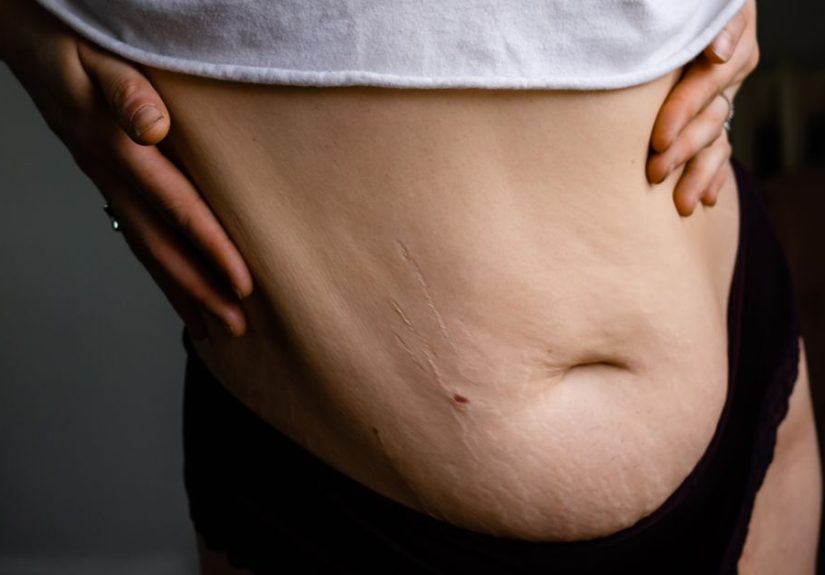
With major weight loss (including after bariatric surgery), loose or excess skin can become a major source of distress. Research on post-bariatric populations suggests that dissatisfaction and concerns about excess skin can be strongly associated with depressive symptoms and reduced quality of life. Even when weight-related health improves, appearance distress can linger or shift to new areas.
3) Social whiplash: compliments, comments, and “you look so different!”
Suddenly people comment on your body moresometimes “nicely,” sometimes not. Even positive attention can feel invasive if you’re used to being scrutinized or ignored. You might start scanning yourself the way you imagine others are scanning you.
4) Perfectionism and the myth of the finish line
Weight loss culture often sells a fantasy: get smaller and your brain will become a peaceful meadow. But if you’ve practiced self-criticism for years, your mind may simply redecorate the same old criticism with new wallpaper: “Okay, you’re smaller… but now your stomach… your arms… your face…”
5) Old wounds don’t automatically evaporate
If you experienced teasing, bullying, trauma, or long-term body shame, weight loss doesn’t delete those memories. Sometimes it can actually bring them closer to the surface because the external “problem” you were blaming everything on is goneand you’re left facing the internal story.
Signs it may be more serious (and worth professional support)
If any of the following feel familiar, consider reaching out to a qualified mental health professionalespecially one who understands BDD, OCD-spectrum concerns, eating disorders, or post-bariatric adjustment:
- Time sink: You spend hours a day obsessing about perceived flaws or “fixing” them (some resources describe many people with BDD spending multiple hours daily in preoccupation/rituals).
- Compulsions: Repeated mirror checking, body checking, skin pinching, photos-forensics, excessive grooming, changing outfits repeatedly, reassurance seeking, constant comparing.
- Avoidance: You avoid photos, mirrors, social events, intimacy, gyms, or certain lighting like it’s your sworn enemy.
- Impairment: Your distress affects work, relationships, sleep, or your willingness to leave the house.
- Low mood or hopelessness: Body distress is paired with depression, anxiety, or thoughts of self-harm.
If you’re in the U.S. and feel at risk of harming yourself, you can call/text 988 (Suicide & Crisis Lifeline). If you’re outside the U.S., use your local emergency number or crisis line.
How to manage body dysmorphia after losing weight
Let’s get practical. Managing body dysmorphia is not about “just love yourself.” It’s about changing patternsthought patterns, behavior patterns, and attention patternsso your brain stops using your body as a full-time emergency broadcast system.
1) Use evidence-based treatment: CBT (often with exposure/response prevention)
The most commonly recommended psychotherapy approach for BDD is cognitive behavioral therapy (CBT) tailored to BDD. This typically targets: distorted beliefs about appearance, the urge to perform checking/camouflaging rituals, avoidance behaviors, and the anxiety that spikes when you resist those rituals.
A key piece is often exposure and response prevention (ERP)-style work: gradually facing feared situations (mirrors, photos, social settings) while resisting compulsive “fixing” behaviors. Done with a trained clinician, this isn’t cruelit’s retraining your brain that discomfort is survivable, and you don’t need rituals to be safe.
2) Medication can help (when appropriate)
Many clinical resources describe SSRIs (a class of antidepressants) as a first-line medication option for BDD, sometimes at higher doses than those used for mild depression, and sometimes combined with therapy. Another medication sometimes used is clomipramine. Medication decisions should always be made with a licensed prescriber who can evaluate your specific situation, medical history, and side effects.
3) Make a “mirror plan” (because mirrors can become a slot machine)
Mirrors are useful tools. But for body dysmorphia, they can become a compulsive loop: check → panic → “fix” → temporary relief → check again. Try this structure:
- Limit mirror time: Set a timer for neutral grooming only (hair, teeth, basic skincare). No “inspections.”
- Use neutral lighting: Stop body-checking under overhead bathroom spotlights that make everyone look like a haunted Victorian doll.
- Practice “whole-body” viewing: If you look, look at yourself as a personnot a collection of zoomable “problem areas.”
4) Reduce checking and reassurance-seekinggradually
This is hard, because checking feels like “being responsible.” But it’s usually gasoline on the fire. Pick one behavior to reduce first: weighing yourself repeatedly, pinching skin, taking dozens of photos, asking “Do I look okay?” ten times, or comparing yourself online.
Start small: delay the ritual by 10 minutes. Then 20. Then an hour. The goal isn’t perfectionit’s building tolerance for uncertainty.
5) Upgrade your inputs: social media, “fitspo,” and the algorithm that hates peace
If your feed is a parade of “perfect” bodies, your brain will treat your body like it’s failing an exam every day. Consider:
- Mute accounts that trigger body checking (even if they’re “nice”).
- Follow creators focused on strength, function, recovery, and body neutrality.
- Stop watching “day 1 vs day 90” transformation loops like they’re a required religion.
6) Focus on function (body neutrality is a power move)
You don’t have to feel beautiful to feel okay. Try shifting your scoreboard:
- Energy levels
- Strength gains
- Bloodwork improvements (if relevant)
- Better sleep
- Mobility and endurance
- Confidence doing normal life stuff (planes, photos, dates, dancing badlyimportant)
Function-based goals help your brain stop treating appearance as the only metric of “success.”
7) Address real physical discomfort without turning it into a self-worth trial
Some post-weight-loss concerns are practical: skin irritation, chafing, discomfort during exercise, or hygiene challenges. Those deserve medical attention. You can talk to a clinician about skin care, supportive garments, physical therapy, or (in some cases) body contouring procedures.
Important note: if someone has true BDD, many clinical references caution that cosmetic procedures often don’t relieve distress long-term because the problem isn’t the body partit’s the brain’s relationship with the body part. That doesn’t mean “never do anything,” but it’s a strong reason to prioritize mental health support first.
8) Build scripts for body comments (so you don’t spiral in the produce aisle)
People say weird things. Prepare a few polite “exit ramps”:
- “I’m focusing on my health and would rather not talk about my body.”
- “Thankscomments about my appearance are complicated for me.”
- “Let’s talk about literally anything else.” (Add a smile. Or don’t. Your choice.)
Three specific examples (because “just be confident” is not a strategy)
Example 1: “I still shop like I’m my old size.”
Try a low-pressure store visit with one mission: grab three sizes on purpose (one you think, one smaller, one bigger). Let the fitting room be data, not a courtroom. If the smallest doesn’t fit, it’s fabricnot a moral verdict.
Example 2: “Loose skin makes me feel like my body is ‘wrong.’”
Start with comfort solutions: supportive athletic wear, compression garments, and clothes tailored to your current shape. Then pair that with therapy work: identify the belief (“My body is unacceptable”), challenge it, and practice showing up anywaywithout camouflaging rituals running the show.
Example 3: “The gym mirror ruins my day.”
Use graded exposure: go at a quieter time, pick a spot where mirrors are less central, and practice staying present in your workout rather than scanning your body. The win isn’t “I loved my reflection.” The win is “I finished my workout without getting hijacked.”
Mini FAQ
Is it normal to still feel “big” after losing weight?
Yesmany people report a mismatch between what they see and what they feel, especially after rapid change. If it’s mild and improving, it may be adjustment. If it’s intense, time-consuming, and disabling, it may be body dysmorphia or another treatable concern.
Will it go away on its own?
Sometimes body image lag improves with time, stability, and supportive habits. But if you’re stuck in compulsions and avoidance, structured treatment (CBT/ERP and sometimes medication) can make a big difference.
What if I’m afraid a therapist will tell me I’m “vain”?
Good clinicians won’t. BDD is not vanity. It’s distress and impairment. If you feel dismissed, seek someone with OCD-spectrum or BDD experience.
Conclusion: You deserve a brain that lets you live in your lifenot just in your reflection
Weight loss can change your body, but it doesn’t automatically retrain your mind. If you’re dealing with body dysmorphia after losing weight, the goal isn’t to “win” against your appearance. The goal is to reclaim your time, attention, and peace.
Start with small, repeatable steps: reduce checking, build a mirror plan, clean up your media inputs, focus on function, and consider evidence-based treatment like CBT (and medication if appropriate). With support, the obsession loop can loosen and your life can get bigger even if your body got smaller.
Experiences People Commonly Describe After Weight Loss (500+ Words)
The stories below are composite experiencesthe kind of patterns many people describe in support groups, therapy offices, and late-night texts to the one friend who answers. If any of this sounds like you, it doesn’t mean you’re doing weight loss “wrong.” It means you’re human, and your brain is trying to catch up.
“I thought I’d feel confident… and then I panicked in the dressing room.”
One common experience: you walk into a store feeling optimistic, grab what you think is your size, and thenboomnothing fits the way you imagined. If it’s too big, you don’t feel triumphant; you feel suspicious. If it’s too small, you feel betrayed. You stare at your reflection like it owes you answers. You start doing math: “If this brand runs small and that brand runs big, what does that mean about my actual body?” (Spoiler: it means brands are chaotic, and sizing is basically a group project no one finished.)
People describe buying the “safe size” even after losing weightbecause the emotional risk of being wrong feels too high. The helpful shift is treating clothing as information, not identity. The tag isn’t a diagnosis. The mirror isn’t a jury. The dressing room is not allowed to ruin your weekend.
“Everyone congratulated me… and somehow that made me more anxious.”
Compliments can land like pressure. Suddenly your body feels like public property. People comment in passingat work, at family dinners, at the grocery storelike your ribs are community news. Some people say they become hyper-aware in social situations: “Are they looking at my stomach? My arms? My face? Do I look ‘before’ or ‘after’ today?”
This can trigger a new form of vigilance: constant outfit changes, obsessive hair adjustments, checking photos before posting, deleting posts if the angle feels “wrong,” replaying conversations to see if anyone sounded weird. A common coping step is boundary scripts: “I’m focusing on my health and would rather not discuss my body.” Simple, polite, and quietly revolutionary.
“I keep waiting to feel like myself again.”
Many people expect a moment where they fully recognize themselveslike a movie montage ending. But the transition can feel uncanny. Your face changes, your posture changes, your movement changes. Sometimes you feel proud and disoriented at the same time. People describe catching their reflection in a window and thinking, “That person looks good,” and then realizing, “Ohwaitthat’s me,” which is both exciting and oddly scary.
This is where body neutrality helps: instead of demanding instant love, you practice acceptance and familiarity. You take photos for memory instead of proof. You buy clothes that fit now. You let your body be in the room without turning it into a project.
“Loose skin makes me feel like I traded one insecurity for another.”
People often describe loose skin as emotionally confusing: the weight loss is real, the health benefits are real, and yet the skin can feel like a constant reminder that your body went through something intense. Some worry about intimacy. Some avoid swimming or sleeveless tops. Some feel angry that nobody warned them how complicated it might feel.
Helpful steps people report: supportive garments for comfort, skincare to reduce irritation, strength training to feel more “held” in their body, and therapy to reduce the meaning assigned to the skin. For some, medical conversations about body contouring are part of the picturebut the emotional work matters either way, because self-worth can’t be surgically installed. (If it could, insurance would still probably deny it.)
The biggest shared theme in these experiences: relief comes when the focus shifts from “fix my body” to “free my life.” You don’t need to wait until you feel perfect to start living.