Table of Contents >> Show >> Hide
- The Short Answer
- Why “Clearer” Is Usually Preferred
- When “More Clear” Works
- So Which One Should You Use?
- Examples in Real-Life Contexts
- Why This Choice Matters for SEO and Readability
- Common Mistakes to Avoid
- Clearer vs. More Clear: Side-by-Side Comparison
- Better Alternatives Depending on Your Meaning
- Mini FAQ
- Final Verdict
- Experience Section: What Writers and Learners Commonly Notice About “Clearer” vs. “More Clear”
If English had a favorite hobby, it would probably be making smart people second-guess themselves over tiny word choices. One of those sneaky little debates is this: should you say clearer or more clear? If you have ever paused mid-email, stared at your screen, and wondered whether grammar judges were hiding in the walls, you are not alone.
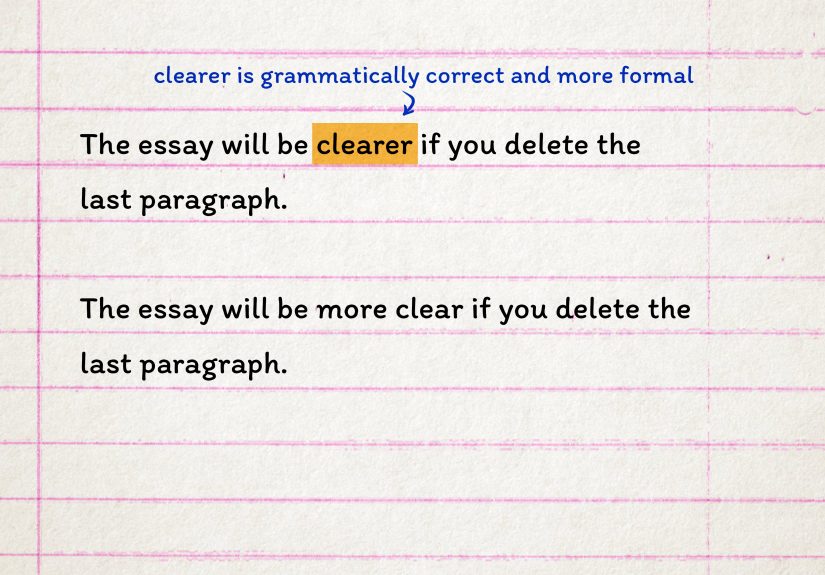
Here is the good news: both “clearer” and “more clear” are correct. That said, they are not always equal in style, tone, or natural flow. In standard American English, clearer is usually the more common, more concise, and more natural choice. More clear is still grammatical, but it can sound slightly more formal, more deliberate, or just a bit heavier depending on the sentence.
So no, this is not one of those grammar traps where one form is noble and the other is banished to the language dungeon. It is more of a usage question than a right-versus-wrong battle. And that is exactly why it confuses so many writers.
The Short Answer
If you want the quick rule, here it is:
- Clearer is the standard comparative form of clear.
- More clear is also acceptable.
- More clearer is incorrect because it uses two comparative markers at once.
In everyday writing, clearer usually sounds better:
Your explanation is clearer now.
But more clear is not wrong:
Your explanation is more clear now.
The second version works, but many readers will feel that the first one is smoother. It is the difference between showing up in sneakers and showing up in dress shoes. Both can work. One just fits the moment more naturally.
Why “Clearer” Is Usually Preferred
In English, short adjectives often form the comparative by adding -er. Think of small/smaller, bright/brighter, and cold/colder. Since clear is a short adjective, clearer follows the usual pattern.
That is why clearer feels like the default choice in most sentences. It is shorter, tighter, and more efficient. Good writing often rewards that kind of efficiency. Readers do not usually throw a parade because a sentence was concise, but they do appreciate not getting lost in verbal traffic.
Examples:
- Please give me a clearer answer.
- The new chart makes the results clearer.
- Can you be clearer about the deadline?
All of these sound natural, direct, and polished. In business writing, academic writing, blogs, and everyday conversation, clearer is often the safer and sharper option.
When “More Clear” Works
Now for the twist: more clear is not some grammatical outlaw wearing a fake mustache. It appears in real writing, real speech, and edited publications. Writers sometimes choose it for rhythm, emphasis, or sentence balance.
For example, compare these:
- This version is clearer.
- This version is more clear to first-time users.
In the second sentence, more clear can feel a little more measured, especially when the sentence continues with added detail. It sometimes sounds slightly more formal or deliberate, which may be why some writers like it in analysis-heavy or professional contexts.
It can also help with emphasis:
- The problem is not smaller. It is more clear than ever.
- After the audit, the pattern became more clear.
Would many editors still change those to clearer? Yes. Would those editors survive the experience? Also yes. But the original phrasing is still grammatical.
So Which One Should You Use?
If your goal is to sound natural in standard American English, use this rule of thumb:
Use “clearer” when you want the most natural default.
This is the best choice for most blog posts, emails, school papers, reports, and general writing. It is concise and familiar.
Examples:
- The revised paragraph is clearer.
- The teacher gave a clearer explanation.
- Your instructions need to be clearer.
Use “more clear” when the sentence rhythm favors it.
Sometimes a sentence simply sounds better with more clear, especially if the phrase is part of a longer structure or you want slightly heavier emphasis.
Examples:
- By the end of the presentation, the main argument was more clear to the investors.
- With the labels added, the process became more clear to new employees.
Avoid “more clearer.”
This is the one form you should absolutely skip. Since clearer is already comparative, adding more creates a double comparative.
Incorrect: This guide is more clearer now.
Correct: This guide is clearer now.
Also correct: This guide is more clear now.
Examples in Real-Life Contexts
Let us bring this down from grammar mountain and into real life, where people are just trying to finish a sentence before their coffee gets cold.
At work
The updated onboarding document is clearer than the old one.
This is crisp and professional. It sounds like someone who knows where the stapler is.
The updated onboarding document is more clear for remote employees.
This works too, especially because the sentence keeps going and narrows the audience.
In school writing
Your thesis statement needs to be clearer.
This is probably what a teacher or writing tutor would say.
Your thesis statement is more clear in the second draft.
Correct, but a bit less streamlined.
In conversation
That makes things clearer.
Very natural.
That makes things more clear.
Still correct, though slightly less idiomatic to many American ears.
Why This Choice Matters for SEO and Readability
If you publish online, word choice affects more than grammar. It affects readability, user experience, and tone. Search engines may not hand out trophies because you picked clearer over more clear, but readers definitely notice when writing feels smooth and confident.
In most SEO writing, shorter and more natural phrasing tends to help readability. That means clearer often has the advantage. It is compact, familiar, and easy to process quickly. When readers scan a page, they usually prefer the version that gets to the point without sounding robotic or overbuilt.
That said, readability is not about blindly choosing the shortest option every single time. Sometimes a sentence flows better with more clear. Strong writing is not about worshipping a rulebook. It is about choosing the version that serves the sentence best.
Common Mistakes to Avoid
1. Using a double comparative
Wrong: more clearer
Right: clearer or more clear
2. Assuming “more clear” is always wrong
It is not. It is less common, but still grammatical.
3. Treating grammar like a courtroom drama
Not every choice has one guilty option and one innocent option. Some choices are about style, tone, and rhythm rather than hard correctness.
4. Ignoring the sentence around the phrase
Context matters. A phrase that sounds clunky in one sentence may sound perfectly fine in another.
Clearer vs. More Clear: Side-by-Side Comparison
| Phrase | Status | How It Usually Feels |
|---|---|---|
| clearer | Correct | More common, concise, natural |
| more clear | Correct | Acceptable, sometimes more deliberate or formal |
| more clearer | Incorrect | Double comparative; avoid it |
Better Alternatives Depending on Your Meaning
Sometimes neither clearer nor more clear is the best choice. If you want stronger writing, consider a more precise word.
- clearer instructions → specific instructions
- clearer explanation → simpler explanation
- clearer image → sharper image
- clearer argument → stronger argument
- clearer plan → more detailed plan
This is a useful editing trick. Sometimes the problem is not whether you need clearer or more clear. The problem is that you need a more exact adjective altogether.
Mini FAQ
Is “clearer” more common than “more clear”?
Yes. In standard American English, clearer is generally the more common default in both speech and writing.
Is “more clear” grammatically correct?
Yes. It is grammatically acceptable, even if many writers and editors prefer clearer in most situations.
Is “more clearer” ever correct?
No. That is a double comparative and should be avoided.
Which form should I use in formal writing?
Usually clearer. It is more concise and typically sounds more polished. But if more clear genuinely improves rhythm or emphasis, it can still work.
Final Verdict
If you have been waiting for a dramatic final ruling, here it is: both “clearer” and “more clear” are correct, but “clearer” is usually the better choice. It is shorter, more idiomatic, and more natural in most American English contexts. More clear is not wrong, but it is often the less elegant option unless the sentence rhythm calls for it.
So when in doubt, choose clearer. It is the version most readers will accept without blinking. And in writing, getting readers not to blink at your phrasing is sometimes half the battle.
Language is full of choices like this: not absolute war zones, but subtle style decisions. The trick is knowing the rules well enough to be flexible without becoming sloppy. Or, to put it more clearlysorry, clearerpick the form that makes your sentence easiest to read.
Experience Section: What Writers and Learners Commonly Notice About “Clearer” vs. “More Clear”
One of the most common experiences people have with this grammar question starts with a sentence that feels perfectly fine until they read it twice. Maybe it is an email to a client: “I hope this version is more clear.” Maybe it is feedback in a document: “Your conclusion should be clearer.” In both cases, the writer usually understands the meaning immediately. The uncertainty comes afterward, when the inner grammar alarm starts ringing for no obvious reason.
Students often say that more clear sounds right because it resembles patterns they already know, such as more helpful, more useful, or more effective. That makes sense. English trains people to use more with many adjectives, so applying that pattern to clear feels natural. Then they see clearer in a textbook, article, or teacher comment and wonder whether they have been making a mistake all along. That moment of doubt is extremely common.
Writers, especially people who revise their own work a lot, tend to report a slightly different experience. They may start with more clear, then switch to clearer because it sounds tighter. This happens often during editing. A sentence like “The new layout makes the instructions more clear” becomes “The new layout makes the instructions clearer.” Nothing major changes in meaning, but the sentence suddenly feels lighter and more polished. It is a small edit with surprisingly satisfying results, like straightening a crooked picture frame.
Editors and teachers also notice that people rarely struggle because they do not know English. They struggle because English offers two acceptable paths and does not always put up a giant sign. That is why this question shows up so often in classrooms, offices, and online writing forums. People are not confused about meaning. They are trying to sound natural, educated, and precise at the same time.
Another real-world experience is that context changes everything. In quick conversation, many speakers naturally choose clearer without thinking. In slower, more formal writing, some people lean toward more clear because it feels a touch more deliberate. Neither reaction is strange. It simply shows that grammar is not only about correctness. It is also about tone, habit, rhythm, and what sounds right to the ear in a specific moment.
In the end, most people who learn this distinction come away with the same practical lesson: use clearer most of the time, recognize that more clear is still valid, and never write more clearer unless your goal is to make an editor quietly stare into the distance. That is a pretty useful outcome for such a tiny phrase.