Table of Contents >> Show >> Hide
- First: What Does “1 Million Customers” Actually Mean in SaaS?
- Reality Check: The Average Public SaaS Company Is Nowhere Near 1 Million Customers
- So… How Many SaaS Companies Actually Have 1 Million Customers?
- Examples: Big SaaS Customer Bases (and What They’re Really Counting)
- The Math Behind the Madness: What 1 Million Customers Implies
- Why Most B2B SaaS Won’t Chase 1 Million Customers (and Shouldn’t)
- The Patterns Shared by SaaS Companies That Do Hit 1 Million Customers
- If You’re Building SaaS: What Should You Track Instead of “1 Million Customers”?
- FAQ: Quick Answers to the Question Everyone Actually Means
- Conclusion: The Real Answer (and the Useful Answer)
- Founder Field Notes: 1 Million Customers in the Real World (Experience & Lessons)
- You stop running a product… and start running a civilization
- Your edge is no longer featuresit’s consistency
- Every growth lever has a shadow cost
- Localization is not a checkbox
- The best million-customer companies obsess over “time-to-value” like it’s rent
- The milestone is less “We made it!” and more “Now we can’t break anything.”
Dear SaaStr, how many SaaS companies actually have one million customers?
It’s a deceptively simple questionlike asking, “How many people are rich?” The answer depends on what you mean by rich, what you mean by people, and whether we’re counting your cousin’s “crypto wallet” as a retirement plan.
In SaaS, “1 million customers” can mean:
- 1 million paying accounts (the hardest version)
- 1 million businesses paying anything at all (still hard)
- 1 million subscriptions (messy, because one person can have more than one)
- 1 million users (often easier, especially with freemium)
- 1 million seats (very common in enterprise, but that’s not “customers”)
So let’s do what SaaS people do best: define the metric, sanity-check the math, then use real-world examples to figure out what’s realisticwithout turning this into a 47-tab spreadsheet you’ll “totally review later.”
First: What Does “1 Million Customers” Actually Mean in SaaS?
Customer vs. user vs. seat vs. subscription
The word customer sounds precise, but it’s not. SaaS companies often separate “who uses the product” from “who pays for it.” Here are the usual suspects:
- Registered users: people who signed up (free or paid). Big number. Sometimes vanity number. Still useful for distribution math.
- Paying users: individuals who pay (common in consumer SaaS or prosumer tools).
- Customers: paying accounts or buying entities (usually a company, a team, a department, or a business unit).
- Subscriptions: plans/products billed, often per website/domain/location; one customer can have multiple.
- Seats/licenses: end users under a paid plan. One customer can have 10 seats… or 100,000.
Why does this matter? Because “1 million customers” is a totally different achievement if you charge $8/month versus $80,000/year. Both are impressive. One just requires more customer support tickets per dollar and a much larger coffee budget.
The “paying customers” version is the real boss level
If you mean 1 million paying customers (paying accounts), that’s rare in B2B SaaS. Not because SaaS isn’t hugebut because most B2B SaaS grows revenue by:
- selling to fewer customers,
- at higher ACVs (average contract values),
- with expansion (more seats, more products, more usage).
And that leads to an important truth:
Most successful SaaS companies will never need (or want) a million customers. They want a million users inside a few thousand large customersor 50,000 customers paying meaningful ACVnot a million tiny accounts that churn when their credit card expires.
Reality Check: The Average Public SaaS Company Is Nowhere Near 1 Million Customers
Here’s the sobering benchmark: public SaaS companies often average tens of thousands of customersnot millions. Even “SMB-focused” public SaaS tends to live in the tens of thousands to low hundreds of thousands range.
That’s not a failure. It’s the business model. A company can build a massive SaaS business with 10,000 customers if ACV is high enough and retention is strong.
Why the gap is so big
Reaching 1 million customers is hard because every layer of growth creates friction:
- Acquisition: paid channels get expensive; organic takes time.
- Onboarding: self-serve must be frictionless, or you leak signups.
- Support: 1 million customers means lots of humans doing human things (“I forgot my password,” “I forgot my other password,” “Your product deleted my data” it didn’t).
- Billing: retries, fraud, chargebacks, local taxes, and payment methods become a full-time sport.
- Churn: low-price products must fight constant churn at scale.
In other words: you don’t just earn 1 million customers. You also earn 1 million opportunities for someone to misunderstand an invoice.
So… How Many SaaS Companies Actually Have 1 Million Customers?
If you’re asking about 1 million paying customers, the honest answer is:
Not manyand far fewer than people assume.
There isn’t a single authoritative census of “SaaS companies with 1 million customers,” because customer definitions differ across filings, press releases, and marketing pages. But we can triangulate from public disclosures and see a clear pattern:
- Pure enterprise SaaS almost never gets there (by design).
- SMB self-serve SaaS can get there, but only the biggest brands do.
- Prosumer/consumer SaaS can get there more oftenespecially with freemium.
- Commerce, marketing, websites, accounting are the most common categories to cross huge customer counts because the TAM is gigantic and onboarding can be self-serve.
So the most practical answer is: it’s a small club, and membership is mostly reserved for products that are (a) self-serve, (b) low-to-moderate price, and (c) useful to millions of SMBs or consumers.
Examples: Big SaaS Customer Bases (and What They’re Really Counting)
Below are examples that illustrate the landscape. Notice how each company uses a different “counting unit.” That’s the pointcustomer counts are comparable only after you read the fine print.
| Company type | What’s counted | Why it matters |
|---|---|---|
| File storage / collaboration | Registered users vs. paying users | Huge top-of-funnel can coexist with a much smaller paying base. |
| Website builder / commerce | Unique subscriptions | One customer can hold multiple sites/subscriptions; still signals massive SMB reach. |
| eSignature / agreements | Customers (paying accounts) | Clearer “customer” metric, often used in marketing and investor narratives. |
| Accounting / business ops | Paying customers and subscribers | Mass-market SMB SaaS is one of the few places where millions of payers is realistic. |
| Enterprise IT/security | Customers (buying entities) | Great business, but not built for millions of customers. |
| Collaboration/communications | Enterprise customers vs. online customers | One platform can serve both enterprise and self-serve segmentsreported separately. |
Concrete, real-world examples (with the “as-of” dates)
- Dropbox: reported 700M+ registered users and 18.12M paying users (as of Dec 31, 2023). That’s a perfect demonstration of the “giant user base, smaller paying base” model.
- Squarespace: reported 4.6M+ unique subscriptions (as of Dec 31, 2023). Subscriptions aren’t exactly “customers,” but it’s unmistakably a multi-million scale SMB SaaS platform.
- GoDaddy: reported about 20.5M total customers at period end (Dec 31, 2024). That’s not “pure SaaS” in the narrowest sense, but it’s subscription-based software/services sold at massive SMB scale.
- DocuSign: publicly states 1M+ customers (and in some company materials, 1.7M+ customers). That’s one of the clearest “million customer” SaaS examples in B2B workflows.
- Intuit (QuickBooks + Mailchimp): reports millions of small business customers and subscribers; for example, QuickBooks Online subscribers and paying Mailchimp customers are both disclosed in company fact sheets. This is what “mass SMB SaaS” looks like when it’s truly at scale.
- HubSpot: reported 247,939 customers (as of Dec 31, 2024). That’s enormous for B2B SaaSand still not close to 1M, which helps calibrate expectations.
- Okta: reported 18,950 customers (as of Jan 31, 2024) and defines customer as a distinct buying entityshowing how enterprise SaaS counts customers differently than consumer-style SaaS.
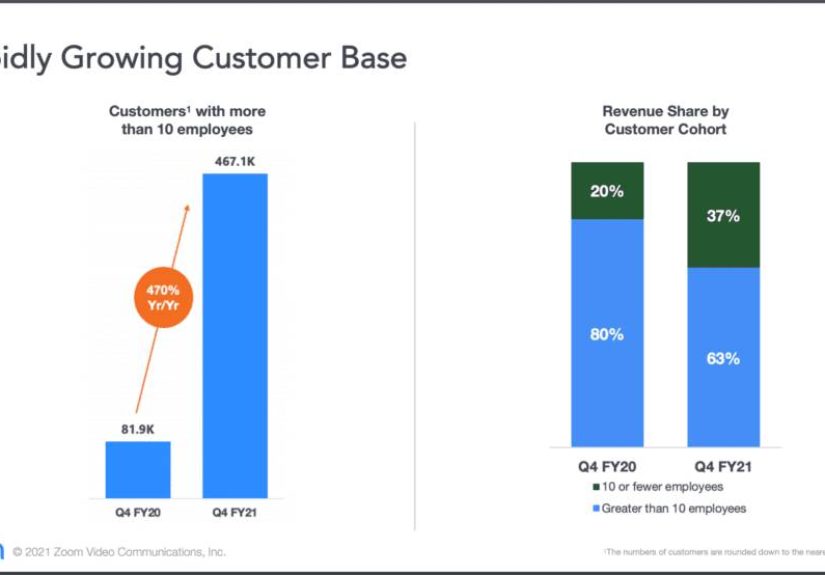
- Zoom: reported ~220,400 enterprise customers (as of Jan 31, 2024), while also serving a broad online customer base that’s measured and discussed differently.
Takeaway: “1 million customers” is usually achieved by SMB/prosumer products with frictionless onboarding, broad TAM, and strong retention mechanicsnot by classic enterprise SaaS.
The Math Behind the Madness: What 1 Million Customers Implies
Customer count and ARR are welded together
Customer count is never just a bragging right. It implies a revenue model. Here’s the back-of-the-napkin math:
- 1,000,000 customers × $10/month ≈ $120M ARR
- 1,000,000 customers × $20/month ≈ $240M ARR
- 1,000,000 customers × $50/month ≈ $600M ARR
Now add reality:
- Not everyone pays full price (discounts, promos, annual plans).
- Churn is real (especially for low-price SMB tools).
- Support, billing ops, fraud, and compliance costs rise with volume.
So if a SaaS company claims 1M paying customers, you can almost bet it’s operating in a massive category (marketing, websites, accounting, commerce, productivity) and has built serious self-serve infrastructure.
Why Most B2B SaaS Won’t Chase 1 Million Customers (and Shouldn’t)
Because “more customers” isn’t always “better business”
For a typical B2B SaaS company, chasing a million customers can be a trap. The moment you optimize for customer count, you often:
- push pricing down,
- increase support load,
- attract lower-intent buyers,
- and make churn your biggest growth competitor.
Many of the best SaaS businesses are built on a different equation:
Fewer customers × higher ACV × expansion × high retention = compounding machine.
That’s why you’ll see enterprise SaaS leaders celebrate metrics like:
- customers over $100K in annual spend,
- net revenue retention,
- expansion rate,
- multi-product adoption.
The Patterns Shared by SaaS Companies That Do Hit 1 Million Customers
1) They’re self-serve by default
If your onboarding requires a call, a contract negotiation, or a PDF someone has to sign… you are not reaching a million customers. You’re reaching a million meetings, and nobody wants that.
2) They sell to SMBs, prosumers, or consumers
Enterprise budgets are big, but enterprise logos are limited. SMBs are chaotic, but there are millions of them. Products that solve universal SMB paingetting paid, getting found, sending email, building a website, storing fileshave the best shot.
3) They have a “default value” moment fast
The best million-customer products deliver value before a user can change their mind. The time-to-value is measured in minutes, not weeks.
4) Their retention mechanics are baked in
Million-customer scale requires a product that becomes a habit, a workflow, or an infrastructure layer. If customers can cancel without consequences, they will. Usually right after the free trial. Usually right after you finally understand your own pricing page.
If You’re Building SaaS: What Should You Track Instead of “1 Million Customers”?
Unless you are deliberately building mass-market SaaS, “customers” alone is a misleading North Star. Better metrics:
- ARR and growth rate (the scoreboard)
- Net revenue retention (the compounding engine)
- Payback period (whether growth is profitable)
- Activation rate (product reality check)
- Churn + expansion (your true growth rate)
And if you really want a “count” metric to motivate the team, pick one that matches your model:
- Enterprise SaaS: # of $100K+ customers
- Mid-market SaaS: # of customers above target ACV
- Product-led SaaS: # of activated workspaces or # of weekly active teams
- SMB self-serve SaaS: # of paying customers (and churn by cohort)
FAQ: Quick Answers to the Question Everyone Actually Means
How many SaaS companies have 1 million paying customers?
Very few. It’s possible, but it tends to happen in broad, self-serve categories (websites, marketing, accounting, commerce, productivity). Classic enterprise SaaS usually wins with far fewer customers at far higher ACV.
Does 1 million users count?
It counts for distributionand it can be a massive advantageif you can convert and retain paying customers. But “1 million free users” is not the same business achievement as “1 million paying customers.” One is reach. The other is revenue-grade product-market fit.
Is it better to have 1 million customers or 10,000 customers?
Depends on pricing, retention, support cost, and expansion. Plenty of top-tier SaaS companies print money with 10,000 customers because ACV and retention are strong. Plenty of million-customer companies are also phenomenalbut they run a very different operational playbook.
Conclusion: The Real Answer (and the Useful Answer)
If by “customers” you mean paying accounts, then the number of SaaS companies with 1 million customers is small. It’s a club dominated by companies that:
- sell self-serve,
- target SMB/prosumer/consumer markets,
- price accessibly,
- and build world-class onboarding + retention systems.
If you’re building B2B SaaS, the more practical benchmark isn’t “How do I get 1 million customers?” It’s:
How do I build a product that keeps customers, expands inside accounts, and compounds ARR?
Because a million customers is a flex. Compounding retention is a business.
Founder Field Notes: 1 Million Customers in the Real World (Experience & Lessons)
Let’s talk about what “1 million customers” feels like operationallybecause the milestone isn’t just a revenue story, it’s a systems story. And if you’ve ever fantasized about waking up to a dashboard that reads “1,000,000,” here’s the part people don’t put on the celebratory LinkedIn post.
You stop running a product… and start running a civilization
At small scale, you can fix problems with hustle: a quick hotfix, a personal apology email, a one-time refund. At a million customers, hustle becomes a rounding error. You don’t “solve tickets.” You design policy. You don’t “ship a feature.” You manage migration risk. Every decision becomes a question of blast radius.
Your edge is no longer featuresit’s consistency
Customers at scale aren’t all power users. Many are casual, distracted, or terrified of change. Some signed up years ago and barely remember why. That means your win condition shifts from “delight a niche” to “deliver predictable value to everyone.” Fancy features still matter, but reliability becomes the quiet hero. Uptime, billing accuracy, email deliverability, renewals, password resetsthese are suddenly the core product, even if nobody claps for them.
Every growth lever has a shadow cost
When you pour gasoline on acquisition, you also pour gasoline on support volume, fraud attempts, refund requests, compliance complexity, and edge-case behavior. Free trials attract real buyersand professional free-trial enjoyers. Price tests don’t just change revenue; they change ticket tone. New entry plans don’t just add customers; they add churn cohorts you’ll be analyzing for the next 18 months like a true connoisseur of pain.
Localization is not a checkbox
A million customers usually means international reach, which means billing in multiple currencies, handling taxes, and supporting payment methods your original checkout flow never dreamed of. Even language support is only the beginning. Expectations differ by market: some customers want live chat instantly; others prefer email; others will happily call at 3 a.m. your time. Your product becomes global before your org chart is ready for it.
The best million-customer companies obsess over “time-to-value” like it’s rent
At scale, the biggest leak isn’t “competitors.” It’s confusion. The signup-to-value journey has to be so smooth that a distracted small business owner can succeed between two meetings and a lukewarm coffee. The teams that win here are the ones that treat onboarding like a product, not a tutorial. They instrument everything, ruthlessly cut steps, and design defaults that make the first outcome nearly inevitable.
The milestone is less “We made it!” and more “Now we can’t break anything.”
Here’s the paradox: hitting 1 million customers proves you can growbut it also means your tolerance for mistakes shrinks dramatically. A pricing bug that hits 0.1% of customers is suddenly a thousand angry emails. A minor permissions issue becomes a security headline. A confusing UI change becomes a churn spike with a six-figure ARR shadow. So the real “experience” of a million customers is maturity: process, observability, incident response, and the kind of boring excellence that keeps the whole machine humming.
If you want the milestone, build for it early: self-serve onboarding, strong reliability, clear packaging, and support systems that scale. Because the day you cross a million customers, the celebration is realbut so is the pager.