Table of Contents >> Show >> Hide
- Why a DIY twisty side table is such a smart project
- Plan the design before you touch the saw
- Materials and tools
- How to build a DIY twisty side table
- How to make it sturdy, smooth, and good-looking
- Common mistakes to avoid
- Best finish ideas for a DIY twisty side table
- Where this table works best
- Real-world experiences with a DIY twisty side table
- Conclusion
If you have ever looked at a sculptural side table in a fancy store and thought, “That is gorgeous, but also suspiciously close to my monthly grocery budget,” welcome. A DIY twisty side table is the kind of project that looks artsy, modern, and just a tiny bit smug, yet it can be made with basic tools, affordable lumber, and a healthy respect for measuring before cutting. In other words, it is the woodworking equivalent of showing up to a potluck with a homemade dessert and pretending you did not absolutely practice the recipe twice.
The charm of a twisty side table is simple: it combines function and sculpture. It holds your coffee, plant, candle, or book stack, but it also acts like a little design statement. The twisted base gives it movement, the compact footprint makes it great for small spaces, and the overall shape looks far more complicated than it usually is. That is a beautiful quality in furniture and in magic tricks.
This guide walks through how to build a DIY twisty side table in a realistic, beginner-friendly way. We will cover sizing, materials, cutting strategy, assembly, finishing, and the common mistakes that try to ruin the party. We will also wrap up with practical experience-based insights so your project looks intentional instead of “abstract due to circumstances.”
Why a DIY twisty side table is such a smart project
A twisty side table checks a lot of boxes at once. First, it is compact, which means it does not demand a giant shop, giant budget, or giant emotional support system. Second, it is customizable. You can make it taller for a bedside table, shorter for a plant stand, darker for a moody modern look, or bright and painted if your decorating style says, “I enjoy fun, but with structure.”
Third, this project teaches real woodworking skills without throwing you directly into the deep end. You practice accurate cutting, dry-fitting, gluing, clamping, sanding, and finishing. Those are transferable skills, which is a fancy way of saying this little table is secretly teaching you how to build bigger and better furniture later. Sneaky table. Very educational.
And finally, the twisty design makes a small amount of material look special. A straightforward one-board version can still feel custom because the visual interest comes from angles and form rather than expensive joinery or rare hardwoods. That is good news for anyone whose lumber aisle choices are “pine,” “more pine,” and “pine with confidence.”
Plan the design before you touch the saw
Pick the right height
Before building anything, decide how the table will be used. If it is going beside a sofa or chair, aim for a height that feels comfortable next to the arm. If it is more like a nightstand, slightly taller can work well. For many DIY twisty side tables, the sweet spot is around 20 to 24 inches tall. That range feels practical without making the narrow base look tippy.
Choose a top size that matches the room
The classic twisty design usually has a small top and bottom, which helps emphasize the sculptural base. A top around 8 to 12 inches wide works for a drink, a small lamp, or a plant. If you want the table to hold more than one object at a time, go a little wider. Just remember: once the top gets wider, you need to think more carefully about stability, weight, and wood movement.
Use wood that matches your skill level
If you are a beginner, standard off-the-shelf boards are perfectly fine. Pine, spruce, or whitewood keep the cost down and make the project accessible. If you want a cleaner grain and a more furniture-like finish, poplar is a nice upgrade. Maple and oak look beautiful, but they can be less forgiving on tools and wallet. There is no woodworking trophy for making your first twisty side table harder than it needs to be.
Think about the finish early
Do not wait until the very end to decide whether you want paint, stain, or a clear finish. Softwoods like pine can get blotchy under stain, so if you know you want that warm wood look, plan on careful prep and a conditioner. If you want a bold painted piece, you can worry less about perfect grain character and focus more on crisp sanding and clean edges.
Materials and tools
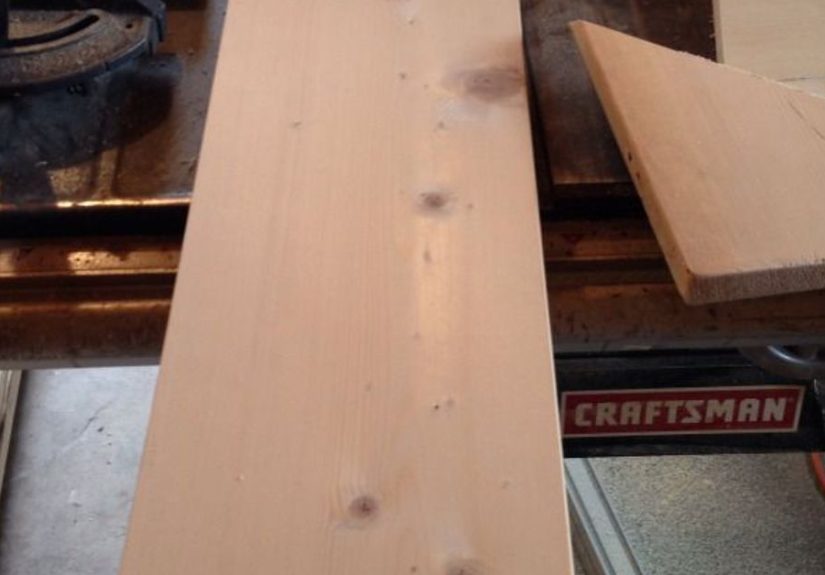
For a simple DIY twisty side table, you do not need a heroic supply list. A practical version can be built with one long board, wood glue, screws or brad nails for temporary holding power, sandpaper, stain or paint, and a protective topcoat. Tools can be equally basic: a miter saw or circular saw, a drill/driver, clamps, a measuring tape, a square, and a sander.
If you own a table saw and feel comfortable with angled cuts, great. If not, you can still build a twisty side table with a more approachable cutting strategy and careful marking. Fancy tools are fun, but accurate layout is still doing most of the heavy lifting here.
How to build a DIY twisty side table
Step 1: Cut the main pieces
Most twisty side tables have four essential parts: a top, a bottom, and two angled leg pieces that create the twisting effect. In the simplest version, you cut the top and bottom from the same board, then cut two long pieces for the crossing center section. Keep your cuts clean and label every piece immediately. Trust me, “I’ll remember which one this is” has started many unnecessary mysteries in the garage.
Step 2: Lay out the twist before assembly
Dry-fit everything on a flat surface. This step matters more than people think. The table may look symmetrical in your head, but wood has a way of exposing optimism. Arrange the two center pieces so they visually twist as they intersect between the top and base. Step back. Squint. Turn the pieces around. Make sure the shape feels balanced before glue enters the scene like an overcommitted friend.
Step 3: Make the angled cuts carefully
The visual magic of the table comes from the angles, so cut slowly and make test cuts on scrap if needed. If your design uses 45-degree bevels or similar angled edges, accuracy matters more than speed. Tiny errors compound fast in geometric furniture. One slightly off cut can turn “modern sculptural table” into “wooden optical illusion with commitment issues.”
Step 4: Assemble the center structure first
Once your angled pieces fit properly, glue and clamp them. Some builders tack the pieces together with brad nails or add screws in hidden areas for extra insurance. That is especially helpful on a narrow sculptural build where parts can shift during clamping. Check for square and level as you go. Even if the design is twisty, the finished table should still sit flat on the floor without rocking like it is trying to start a band.
Step 5: Attach the top and bottom
With the center structure stable, attach the top and bottom pieces. Keep the overhang even and use a square to make sure nothing drifts out of alignment. If your top is modest in size, simple glue-and-screw or glue-and-nail construction may be enough. If you decide to scale up to a wider solid-wood top, use hardware or slotted attachment methods that allow seasonal movement rather than locking the wood in place too rigidly.
Step 6: Fill, sand, and refine the shape
Now the table starts moving from “construction object” to “actual furniture.” Fill visible holes if that suits your finish plan, then sand progressively. Start coarse enough to remove saw marks and glue residue, then move to finer grits for smoothness. Pay attention to edges, corners, and transition points where angled pieces meet. Those little spots are where a project quietly reveals whether you rushed.
Step 7: Apply your finish
If staining, test the color on scrap first. If using pine, apply conditioner so the stain does not go blotchy and weird. If painting, prime first for a more even and durable finish. For a natural look, a clear polyurethane, polycrylic, or furniture wax can work well depending on the sheen and durability you want. A side table gets real life use, so a protective topcoat is not optional unless you enjoy ring marks from mugs and regret.
How to make it sturdy, smooth, and good-looking
Do not skip the dry fit
Dry-fitting is where you catch small alignment issues before they become permanent personality traits. A twisty design can be visually forgiving in some ways, but wobble is not charming. Lay all parts out, test every joint, and confirm the table sits flat before final assembly.
Sand with patience, not rage
Sanding is not glamorous, but it is what separates a handmade piece from a “weekend panic object.” Sand with the grain when possible, remove dust between stages, and soften sharp edges slightly so the finish adheres better and the table feels nicer to the touch. This is especially important on a piece that people will grab, move, and admire up close.
Respect glue time
Wood glue is strong, but only if you let it do its job. Clamp carefully, clean squeeze-out, and give the joints time to cure before stressing the build. This is not the moment to decide the table is done and immediately balance a giant ceramic planter on top of it. Let the glue win first.
Use a flat reference surface
Assemble on the flattest surface you have. A warped workbench or uneven garage floor can trick you into building a twisty side table that looks straight during assembly and wobbles later indoors under much harsher judgmental lighting.
Common mistakes to avoid
Mistake one: making it too tall without widening the footprint. A sculptural side table looks sleek, but height and narrowness can become a bad partnership. If the design gets taller, increase the top and base size or reinforce the structure accordingly.
Mistake two: rushing angled cuts. Measure twice, cut once, then measure again because geometry enjoys drama. A twisty table depends on angles looking intentional, not approximate.
Mistake three: staining before proper prep. Stain does not hide flaws; it spotlights them like a theater director with trust issues. Sand well, remove dust, and test the finish on scrap.
Mistake four: overcomplicating the first build. Your first DIY twisty side table does not need exotic joinery, hidden compartments, a marble top, built-in charging, and emotional symbolism. Build a solid version first. Add flair later.
Best finish ideas for a DIY twisty side table
Warm walnut stain: Great for a modern organic look. It gives even humble lumber a more expensive vibe.
Black paint: If you want the table to read as a sculptural silhouette, black is dramatic and clean.
Natural matte clear coat: Perfect if the wood grain is attractive and you want a softer, Scandinavian-style finish.
Two-tone finish: A painted base with a stained top adds contrast without making the table look too busy.
Glossy color: Ideal for playful spaces, kids’ rooms, or anyone who wants the table to act like a little exclamation point in the room.
Where this table works best
A DIY twisty side table is surprisingly versatile. Use it beside an accent chair, next to a sofa, as a compact nightstand, or as a plant stand in an awkward corner that currently holds nothing but dust and unrealized potential. It also works well in entryways for keys and mail, though be honest about whether your entryway needs “stylish catchall” or “serious clutter intervention.”
Because the profile is visually interesting, the table works best when it has a little breathing room. Do not bury it between oversized furniture pieces. Let it be seen. It did all that twisting for a reason.
Real-world experiences with a DIY twisty side table
The experience of building a DIY twisty side table is often a funny combination of confidence and suspicion. At the start, the project feels almost too simple. It is just a few boards, a few angled cuts, and a compact form. Then you lay the pieces on the floor and realize the table is asking you to think in three dimensions before coffee has fully kicked in. That moment is normal. Almost everyone who builds one goes through a phase of holding two boards in the air and whispering, “You make sense in theory.”
One of the most common experiences is discovering that the project looks harder than it actually is once the dry fit starts coming together. The angles may seem intimidating on paper, but after the first test assembly, the shape suddenly clicks. That is the point where the build becomes fun. You stop seeing random cutoffs and start seeing a real piece of furniture. It is a very satisfying switch, and it is probably why this kind of table has such staying power among beginner woodworking projects. It gives you that “I made a thing that looks expensive” rush without requiring a full cabinet shop and a second mortgage.
Another very real experience is learning just how much sanding affects the final result. Builders often say the table looked merely okay before sanding, then dramatically better afterward. That is especially true on geometric pieces where edges, seams, and little alignment flaws catch the eye. Sanding smooths the transitions, softens the feel, and makes the whole design look intentional. It is not the glamorous part of the build, but it is often the part that makes guests say, “Wait, you made that?” instead of “Oh nice, very rustic.” Sometimes “rustic” is a compliment. Sometimes it is witness protection for a rough finish.
Finish choice also changes the emotional experience of the project. A dark stain can make the piece feel mature and polished, while paint makes it more playful and forgiving. Many first-time builders are pleasantly surprised by how different the same table can look with a different finish. That is useful because it means the twisty side table can evolve with your space. If your first version is natural wood and later you redecorate, you can repaint or refinish it rather than start from scratch. The table may be dramatic in shape, but it is not high-maintenance.
Perhaps the best experience connected to this project is that it teaches restraint. You learn to slow down, test the fit, check alignment, and trust the process. You also learn that small furniture can still make a big visual impact. A DIY twisty side table does not dominate the room, but it usually gets noticed. It feels useful and sculptural at the same time, which is a rare sweet spot in home projects. And when you finally place a lamp or mug on top and see it doing its tiny furniture job with style, it is deeply satisfying. You built something practical, personal, and genuinely cool. That is a pretty good return on one board and a weekend.
Conclusion
A DIY twisty side table is proof that a small woodworking project can still deliver big design energy. It is compact, customizable, beginner-friendly, and far more stylish than its modest material list suggests. If you plan the size carefully, cut accurately, sand like you mean it, and choose a finish that suits your room, you can end up with a piece that looks custom-made because, well, it is. The best part is not just saving money. It is ending up with a side table that actually has personality instead of looking like it arrived in a flat box with emotional baggage.
So if you have been hunting for a DIY furniture project that is practical, modern, and just quirky enough to be memorable, this is a strong contender. Build one, style it well, and enjoy casually mentioning that you made it yourself every chance you get. Not constantly. Just enough.