Table of Contents >> Show >> Hide
- What Is Earth’s Inner Core Made Of?
- How Big Is the Inner Core, and Where Does It Sit?
- Why Is the Inner Core Solid If It Is So Hot?
- How Do Scientists Know What’s in the Inner Core?
- The Secret Hidden Layer: Is There an Innermost Inner Core?
- Does Earth’s Inner Core Move?
- Why the Inner Core Matters So Much
- What Scientists Still Don’t Know
- Final Thoughts: Earth’s Center Is Not Quiet, It’s Just Far Away
- Experiences Related to the Topic: What It Feels Like to Think About Earth’s Inner Core
- SEO Tags
Earth has always been a bit dramatic. It has erupting volcanoes, grinding tectonic plates, oceans that never sit still, and an atmosphere that can go from postcard-pretty to tornado-level rude in a hurry. But for all the action on the surface, the planet’s deepest mystery is still buried at the center: the inner core.
This hidden region is not some giant underground cave, lava chamber, or sci-fi control room with blinking alien lights. The truth is both stranger and cooler. Earth’s inner core is a blazing-hot, solid metal sphere made mostly of iron and nickel, packed so tightly by pressure that it stays solid even at temperatures similar to the surface of the sun. And now, scientists think it may contain an additional hidden layer inside it, sometimes called the innermost inner core. Yes, the inner core may have its own inner core. Earth really said, “Let’s add one more plot twist.”
So what is in Earth’s inner core, how do scientists know, and why does this deeply buried metal ball matter to life up here where coffee spills and Wi-Fi outages feel like major events? Let’s dig in, metaphorically, because literally digging that far would be a terrible career choice.
What Is Earth’s Inner Core Made Of?
The short answer is this: Earth’s inner core is made mostly of iron and nickel. That part is well supported by decades of geophysics, mineral physics, and seismic studies. Scientists compare Earth’s behavior to iron-rich meteorites, measure how seismic waves move through the planet, and model how materials behave under crushing pressure and extreme heat. All roads keep pointing back to a metallic center.
But the story does not end with iron and nickel. Researchers also suspect the core contains small amounts of lighter elements such as silicon, sulfur, oxygen, carbon, or hydrogen. These ingredients may sound like Earth’s center is following a weird recipe, but they matter because pure iron alone does not fully explain the core’s density and behavior. Even a little bit of lighter material can change how the core crystallizes, conducts heat, and affects seismic wave speeds.
That means the inner core is best described not as a giant cannonball of pure metal, but as a dense, pressurized alloy with a chemistry scientists are still working to pin down. It is one of the most inaccessible places in the universe we actively study, which is humbling when you remember it is inside our own planet.
How Big Is the Inner Core, and Where Does It Sit?
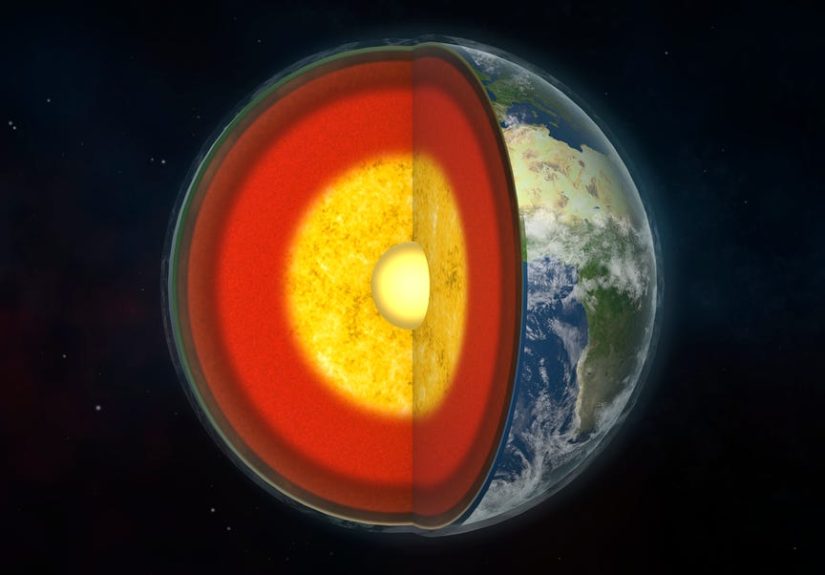
The inner core sits at the very center of Earth, surrounded by the liquid outer core, which is itself wrapped by the mantle and then the crust. Its radius is about 1,221 kilometers (roughly 759 miles), making it a little smaller than the moon. The surrounding outer core is much thicker and made of liquid iron and nickel, while the mantle above that is hot rock that flows slowly over geologic time.
Even though the inner core sounds huge, it occupies only a small fraction of the planet. Earth’s radius is about 6,371 kilometers, so the inner core is like the metallic heart at the center of a much larger rocky body. Small in proportion, enormous in importance.
Why Is the Inner Core Solid If It Is So Hot?
This is the part that makes people do a double take. If the inner core reaches temperatures around 5,400 degrees Celsius, why is it solid instead of liquid?
Because pressure is the ultimate enforcer.
At the center of Earth, the pressure is so intense that atoms are squeezed together and cannot move freely the way they do in a liquid. In other words, the temperature is high enough to melt metal under normal conditions, but the pressure is so extreme that the material stays solid anyway. The outer core, by contrast, is under slightly less pressure, so it remains liquid.
This solid-versus-liquid split is one of the most important features of Earth’s structure. It helps explain how the planet generates its magnetic field and why seismic waves behave the way they do when they travel through the deep interior.
How Do Scientists Know What’s in the Inner Core?
No one has sampled Earth’s inner core directly. The deepest humans have drilled barely scratches the planet compared with the distance to the center. So scientists do what science does best: they get clever.
They Listen to Earthquakes
The main tool for studying the inner core is seismology. When earthquakes happen, they send waves through Earth. Some of those waves pass through rock, some slow down, some bend, and some vanish in certain layers. By tracking exactly how those waves travel, scientists can infer what kind of material they moved through.
Two important types of seismic waves are P waves and S waves. P waves can move through solids and liquids. S waves, however, can only move through solids. That is why S waves do not pass through the liquid outer core but can reveal clues about the solid inner core. This difference helped scientists figure out long ago that Earth’s core is layered rather than uniform.
They Measure Seismic Shadows and Echoes
Earth also creates seismic “shadow zones,” places where certain waves do not arrive because they were blocked or bent by deep layers. These shadows are not geological magic tricks; they are important evidence. More recently, researchers have gone beyond simple wave paths and started analyzing waves that reverberate through the planet multiple times. These repeated echoes offer sharper clues about the center of Earth, kind of like tapping a wall versus mapping a whole room with sonar.
That is how scientists have strengthened the case for an extra structure inside the inner core itself.
The Secret Hidden Layer: Is There an Innermost Inner Core?
Now we get to the headline-grabbing part.
In recent years, seismic studies have suggested that Earth’s inner core may not be uniform. Instead, it may contain a distinct central region with different physical properties from the rest of the inner core. Scientists often describe this as an innermost inner core, or a hidden layer nested inside the solid metal sphere.
This does not mean there is a hollow cavity, a secret ocean, or a buried dragon. It means seismic waves appear to move through the deepest center in a different way than they do through the surrounding inner core shell. Specifically, the waves show differences in anisotropy, which is a fancy word for saying waves travel at different speeds in different directions.
That matters because wave direction can reveal how crystals are aligned. If the iron crystals at the very center are arranged differently from those in the outer part of the inner core, that suggests the innermost region formed under different conditions or preserves evidence of an ancient planetary event. Some researchers think this hidden layer may be a fossil record of how Earth’s core changed over time.
In plain English: the center of Earth may have its own geological memory.
So What Might This Hidden Layer Be?
The leading idea is that the hidden layer is still mostly iron and nickel, but with a different crystal structure or alignment. That would mean the composition may be broadly similar while the texture and internal organization differ. Think less “new ingredient” and more “same ingredients, different arrangement, much bigger consequences.”
Some studies estimate this deepest distinct region may span roughly 600 kilometers across, though details are still being refined. Scientists are careful here, and rightly so. The inner core is not easy to image, and multiple models are still on the table. But the evidence for a structurally distinct central zone has grown stronger.
Does Earth’s Inner Core Move?
Yes, but not in the blockbuster-movie way.
The inner core is suspended inside the liquid outer core, and researchers have long debated whether it rotates at a slightly different rate than the rest of the planet. Newer work has strengthened the idea that the inner core’s motion changes over time relative to Earth’s surface.
Some recent studies suggest the inner core began to slow relative to the mantle around 2010, after previously rotating slightly faster. This has been described as “backtracking,” though that phrase can sound more dramatic than the underlying physics. The inner core is not slamming on the brakes or spinning backward like a vinyl record in a DJ mishap. It is moving slightly differently relative to the layers above it.
Why does this happen? Scientists think the answer involves a tug-of-war between magnetic forces generated in the outer core and gravitational forces from the mantle. The details are still under active study, which is science’s polite way of saying, “We’re onto something, but this puzzle still has missing pieces.”
Why the Inner Core Matters So Much
If the inner core were just sitting there being dense and mysterious, it would still be interesting. But it also helps power one of Earth’s most important protective systems: the magnetic field.
Earth’s magnetic field is generated mainly by motion in the liquid outer core. As that electrically conducting metal moves, it creates the geodynamo that powers the magnetosphere. That magnetic shield helps protect Earth from solar wind and harmful charged particles. Without it, our atmosphere and surface environment would be far less hospitable.
The inner core plays a role in this system because as Earth cools, material in the outer core crystallizes onto the solid inner core. That process releases heat and changes the chemistry of the surrounding liquid, helping drive the convection that feeds the magnetic field. So while the outer core does the main dynamo work, the inner core helps keep the engine going.
There is also evidence that the solid inner core may be much younger than Earth itself, possibly forming around 550 to 565 million years ago. If that estimate is correct, the birth and growth of the inner core may have helped strengthen or restore Earth’s magnetic field at a critical point in planetary history. That makes the inner core not just a geological feature, but a possible player in the long story of habitability.
What Scientists Still Don’t Know
For all the progress, the inner core still guards plenty of secrets.
- The exact mix of light elements remains uncertain.
- The precise crystal structure of iron under core conditions is still debated.
- The size, shape, and sharpness of the hidden inner layer are still being refined.
- The timing of inner core formation is better constrained than before, but not fully settled.
- Researchers are still testing how the inner core grows, deforms, and possibly flows over vast timescales.
Some studies even suggest the inner core may be slightly uneven, with growth or structure varying from one side to another. In other words, Earth’s center may be less like a perfect steel marble and more like a slowly evolving, deeply pressurized archive of planetary history.
Final Thoughts: Earth’s Center Is Not Quiet, It’s Just Far Away
When people imagine hidden worlds, they usually look up toward distant planets, icy moons, or galaxies full of cosmic chaos. But one of the strangest hidden worlds is right under our feet. Earth’s inner core is a solid sphere of iron and nickel, likely mixed with small amounts of lighter elements, heated to extraordinary temperatures and squeezed by almost unimaginable pressure. And inside that already mysterious region, scientists now see evidence of an additional hidden layer that may preserve clues to Earth’s ancient past.
That is what makes the question “What’s in Earth’s inner core?” so satisfying. The answer is not just “metal.” It is a story about pressure, seismic waves, crystal alignment, magnetic shielding, planetary evolution, and a secret structure that researchers are still trying to decode.
Earth may look familiar from the sidewalk, airplane window, or satellite photo. But at the center, it is still a wonderfully weird place.
Experiences Related to the Topic: What It Feels Like to Think About Earth’s Inner Core
There is something uniquely humbling about learning about Earth’s inner core. You can stand on a city sidewalk, hear traffic, feel your phone buzz, complain about the weather, and still be perched above a metallic sphere so hot and strange that it sounds made up. That contrast is part of the experience. The planet feels ordinary until you remember what is underneath it. Then suddenly even a quiet afternoon seems to be happening on top of a very dramatic machine.
For students, the first encounter with the inner core is often a small intellectual shock. In school, Earth can seem neatly organized: crust, mantle, core, done, quiz on Friday. But the deeper you go, the less tidy it gets. You find out that the core is not one thing but multiple regions. Then you learn that the solid inner core sits inside a liquid outer core. Then someone mentions there may be an innermost inner core, and that seismic waves can bounce through the planet several times to reveal it. At that point, Earth science stops feeling like a dusty wall chart and starts feeling like detective work.
For scientists, the experience is even more intense. They do not watch the inner core directly. They wait for earthquakes, collect faint signals, compare waveforms, test models, discard weak explanations, and argue over tiny changes in timing that can rewrite the structure of the planet’s center. It is a form of listening more than looking. That may be one of the most beautiful things about this field: people are effectively using the rumble of earthquakes to hear the shape of a hidden world.
There is also a philosophical experience tied to the inner core. It reminds us that the familiar surface of Earth is only the thinnest skin on a deep, dynamic planet. Mountains, oceans, forests, and cities feel huge to us, but they are surface details on a world whose most powerful processes happen far below sight. Thinking about the inner core can make human concerns feel smaller, but not in a bleak way. More in a “wow, we live inside a much bigger story than we usually notice” way.
Even everyday experiences connect back to it. Navigation systems, auroras, and Earth’s long-term habitability all depend in part on the magnetic field, and that field depends on processes linked to the core. So while almost nobody wakes up thinking, “Thank goodness for convecting liquid metal around a solid iron center,” we are quietly benefiting from that setup all the time.
And maybe that is the emotional core of the inner-core story. It is hidden, remote, unreachable, and yet deeply personal. You will never visit it. You will never touch it. But it has shaped the world you live in from the beginning. That is a rare kind of wonder: the feeling that something completely out of reach is still part of your daily life.