Table of Contents >> Show >> Hide
- Why Hero/Villain Team-Ups Feel So Satisfying
- The Three Ground Rules of Working With Your Nemesis
- Iconic Hero/Villain Combos in Conversation
- Thor & Loki (Marvel)
- Rey & Kylo Ren (Star Wars)
- Professor X & Magneto (X-Men)
- Batman & Catwoman (The Dark Knight Rises)
- Clarice Starling & Hannibal Lecter (The Silence of the Lambs)
- Dom Toretto & Deckard Shaw (The Fate of the Furious)
- James Bond & Jaws (Moonraker)
- Neo & the Machines (The Matrix Revolutions)
- So… Would These Combos Survive a Weekly Staff Meeting?
- Real-World Experiences Related to Hero/Villain Team-Ups (About )
Movies love a clean fight: hero on the left, villain on the right, popcorn in your lap, morality sorted like laundry.
But the moment a story forces those two to share a goal, the whole room leans in. Suddenly the villain isn’t just a
cackling obstaclethey’re a complicated coworker. And the hero? Also complicated. (Turns out “good” still has a temper,
a blind spot, and a tendency to dramatically leave meetings early.)
This is the magic of movie hero/villain combos: when enemies negotiate, coordinate, and occasionally save each other’s
necks, we get tension and character. It’s the ultimate “group project” scenarioexcept the PowerPoint has lasers,
the deadline is apocalypse, and someone’s definitely hiding a secret second agenda. [1]
Why Hero/Villain Team-Ups Feel So Satisfying
In storytelling terms, the protagonist–antagonist relationship is the engine of conflict. When you force that engine to
run in the same directioneven temporarilyyou don’t remove tension; you concentrate it. Cooperation becomes a high-wire
act. Every shared glance means, “Are you about to betray me?” and every successful move feels earned. [2]
These alliances usually happen for one of three reasons:
- A bigger threat shows up and both sides hate that guy more.
- Mutual benefit makes collaboration cheaper than war (emotionally, politically, or literally).
- Character revelation is neededbecause nothing exposes values like an enemy watching you choose.
And yes, sometimes the “villain” is more of an antihero, a rival, or a morally gray chaos gremlin. That still counts.
Movies aren’t HR-compliant. They’re vibe-compliant.
The Three Ground Rules of Working With Your Nemesis
1) Name the shared objective out loud
If you can’t agree on the goal, you can’t agree on anything. The best team-ups declare the target plainly:
“Stop the Sentinels.” “Escape Sakaar.” “Don’t let the Matrix melt.” Clear objectives reduce betrayal… slightly.
[3]
2) Set boundaries (even if they’re ridiculous)
Heroes demand rules: no civilians harmed, no “genocide as a productivity hack,” no stabbing partners “just to see what
happens.” Villains roll their eyes, but boundaries create a framework where trust can exist for five minutes.
3) Keep score without keeping grudges
The healthiest on-screen collaborations don’t pretend the past didn’t happen. They acknowledge it, move forward
for now, and save the reckoning for laterbecause the asteroid is currently scheduled to arrive at 7:00 PM.
Iconic Hero/Villain Combos in Conversation
Below are famous movie hero/villain pairingssome actual allies, some temporary “fine, we’ll do it together” situations
reimagined as post-mission debriefs. The facts come from what the films depict; the banter is the part the camera
didn’t catch. (Probably because the camera was running away from explosions.)
Thor & Loki (Marvel)
In Thor: Ragnarok, Thor and Loki’s relationship is basically “brothers” plus “betrayal cardio,” but they still
end up navigating bigger threats and messy politics together. [4]
Thor: “We should establish trust. Like… a safe word. Mine is ‘brother.’”
Loki: “Your safe word is the thing that makes me want to betray you more.”
Thor: “Cool. We’ll do teamwork anyway.”
Loki: “Fine. But I’m taking credit when this works.”
Working-together lesson: siblings (and rivals) can cooperate when the mission is clear and the stakes
are personaljust don’t confuse “helpful” with “reformed.” [5]
Rey & Kylo Ren (Star Wars)
The sequel trilogy plays with connection and conflict: Rey and Kylo Ren can be adversaries and uneasy allies within
the same storyline, including moments where they fight side-by-side before returning to opposition. [6]
Rey: “We are not a team.”
Kylo: “We’re a temporary strategic partnership.”
Rey: “That’s just ‘team’ wearing a cape.”
Kylo: “This cape is very expensive.”
Working-together lesson: collaboration can happen even when values clashbut it stays fragile until
both sides agree on what “winning” means. [7]
Professor X & Magneto (X-Men)
Their ideological rivalry is a franchise core, and X-Men: Days of Future Past uses catastrophe to push past
grudges and force coordinationbecause extinction is a strong meeting facilitator. [8]
Charles: “We can’t save the future by repeating the past.”
Erik: “I’m not repeating anything. I’m upgrading.”
Charles: “Your ‘upgrade’ is always ‘more metal.’”
Erik: “Metal is reliable. People are… motivational speeches.”
Working-together lesson: you don’t need agreement to collaborateyou need a shared problem definition
and a plan that uses each person’s strengths without endorsing their worst impulses. [9]
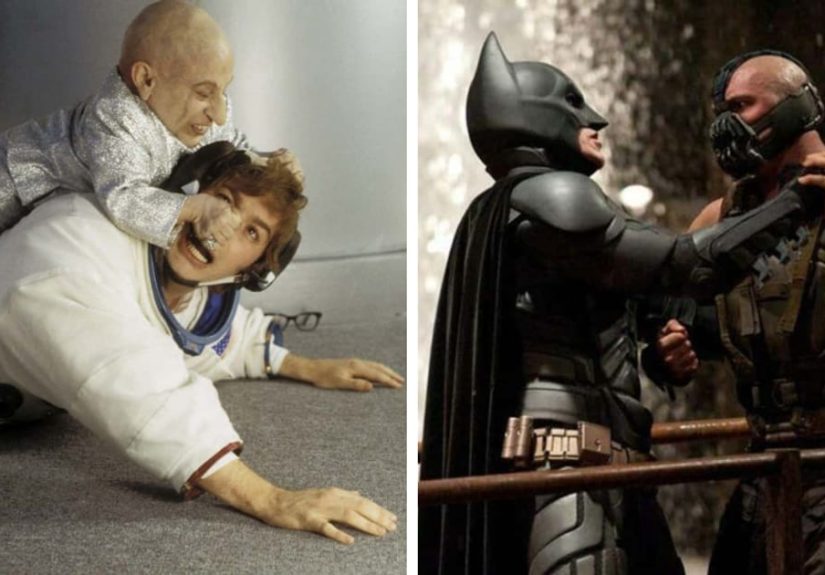
Batman & Catwoman (The Dark Knight Rises)
Bruce Wayne and Selina Kyle start with mistrust and competing goals, but the story pairs them in a city-wide crisis where
pragmatic alliance beats solo heroics. [10]
Batman: “I don’t work with criminals.”
Catwoman: “You literally dress like a bat and lurk on rooftops. That’s not a tax-deductible hobby.”
Batman: “I have rules.”
Catwoman: “Perfect. I have loopholes.”
Working-together lesson: the best partnerships balance idealism and realismone sets the moral compass,
the other reads the room (and the exits). [11]
Clarice Starling & Hannibal Lecter (The Silence of the Lambs)
This is one of cinema’s most unsettling collaborations: a young FBI trainee seeking insight from an incarcerated killer
to catch another murderer. The “help” comes with psychological strings attached. [12]
Clarice: “I’m here for professional assistance.”
Lecter: “Of course. Let’s call it… a mentorship.”
Clarice: “Mentors don’t usually barter with trauma.”
Lecter: “You’d be surprised what passes for networking.”
Working-together lesson: information partnerships can be powerful and dangerousclarify what’s being
exchanged, protect boundaries, and never confuse “useful” with “safe.” [13]
Dom Toretto & Deckard Shaw (The Fate of the Furious)
The Fast & Furious universe treats “former enemy” as a renewable resource. In The Fate of the Furious,
alliances shift under pressure, and old rivals coordinate when the larger threat demands it. [14]
Dom: “Family means we don’t leave anyone behind.”
Shaw: “We’re not family.”
Dom: “Yet.”
Shaw: “Don’t ‘yet’ me. I’m allergic to emotional arcs.”
Working-together lesson: redemption is often less about apologies and more about choices under pressure.
Do the right thing when it costs you somethingthen we’ll talk trust. [15]
James Bond & Jaws (Moonraker)
Bond films love a henchman pivot, and Moonraker features the kind of turn where a former threat becomes an ally
once the villain’s plan makes loyalty impossible. [16]
Bond: “I didn’t expect you to help.”
Jaws: “…”
Bond: “That’s fair. Strong silent type.”
Jaws: “…”
Bond: “We’ll call it ‘aligned incentives.’”
Working-together lesson: some alliances form when the villain’s “vision” starts looking like collateral
damage for everyoneincluding the villain’s own people. [17]
Neo & the Machines (The Matrix Revolutions)
By The Matrix Revolutions, the conflict isn’t just humans versus machinesit’s also “everything versus a runaway
threat inside the system.” Neo’s endgame hinges on bargaining across enemy lines to stop a mutual problem. [18]
Neo: “I’ll handle the threat you can’t control.”
Machines: “Why should we trust you?”
Neo: “You shouldn’t. But you should fear what happens if you don’t.”
Machines: “Acceptable logic. Proceed.”
Working-together lesson: sometimes teamwork is a contract, not a friendship: clear terms, mutual
necessity, and a shared understanding of the cost of failure. [19]
So… Would These Combos Survive a Weekly Staff Meeting?
Honestly? Some would thrive. Loki would absolutely “reply-all” with a meme. Magneto would demand a bigger budget and
somehow get it. Clarice would take detailed notes and go home exhausted. And Batman would say nothing, stare at the
agenda, and disappear through a vent.
But that’s why these movie hero/villain combos keep working: they reveal the truth about cooperation. Teamwork isn’t
about liking each other. It’s about aligning goals, managing risk, and choosing restraint when instinct says “obliterate.”
When heroes and villains work together on screen, the entertainment isn’t just the actionit’s the negotiation of power,
trust, ego, and ethics in real time.
Real-World Experiences Related to Hero/Villain Team-Ups (About )
You don’t need a cape (or a space station) to recognize the feeling: the moment you realize you have to work with someone
you don’t fully trust. Maybe they’re a competitor, a difficult colleague, a former friend, or the person who once turned
a group chat into a battlefield. In real life, “hero/villain” usually translates to “we have different incentives,” and
that’s where most teamwork stress actually lives.
One common experience is the forced alliance project: two teams get merged, budgets get cut, and suddenly
you’re sharing tasks with the group you used to argue with in meetings. The secret to surviving it is the same one movies
usemake the mission visible. Instead of debating personalities, you anchor everything to outcomes: deadlines, quality
standards, and what success looks like. When the objective is concrete, it leaves less room for petty sabotage disguised
as “feedback.”
Another experience shows up during competitive partnerships. Think of two creators collaborating because
the audience wants it, or two businesses co-marketing because both sides benefit. The tension here isn’t hatredit’s fear
of being outshined. The fix is to define credit early: who owns what, who speaks when, and what each party gets out of
the final product. When credit is ambiguous, people start protecting ego instead of protecting the work.
Then there’s the “I’ll help you, but I remember everything” situationlike working with a person who once
made your life harder (intentionally or not). In movies, this is where heroes insist on rules. In real life, boundaries
look like documentation, clear handoffs, and fewer “trust me” moments. It’s not cold; it’s professional. Boundaries are
what let cooperation happen without reopening old wounds every Tuesday.
You might also recognize the temporary truce under pressure: a crisis hitsclient emergency, family
issue, health scare, deadlineand conflict gets paused because the stakes got bigger. These moments can be clarifying.
People show you who they are when things go sideways. The “villain” might surprise you with competence and care. Or they
might confirm your worst suspicions. Either way, you come out with better information, and information is power.
Finally, there’s the experience that movies rarely show: what happens after the team-up. Real life
doesn’t end on a triumphant score. If you collaborated with a rival and it went well, you still need a reset conversation:
what worked, what didn’t, and what rules should exist next time. If it went badly, you don’t have to keep “re-allying”
out of guilt. You can downgrade the relationship into something stable: limited contact, defined roles, fewer shared
decisions. That’s not defeat. That’s wisdom.
The best takeaway from famous hero/villain collaborations is surprisingly grounded: you can cooperate without surrendering
your values. You can be strategic without being cruel. And you can keep the mission moving without pretending everyone
is suddenly best friends. Teamwork, on-screen or off, is often just disciplined behavior in the presence of discomfort.