Table of Contents >> Show >> Hide
- Escher’s Early Training Gave Him the Right Kind of Discipline
- Travel Turned His Curiosity Into a System
- He Started With Geometry, Then Pushed It Toward Life
- Escher Used Printmaking Techniques That Matched Mathematical Thinking
- He Turned Mathematical Ideas Into Visual Drama
- Why Escher’s Art Still Feels Fresh
- How M.C. Escher Really Created His Mathematical Artwork
- Experiencing Escher’s Mathematical World Today
M.C. Escher did not become famous by painting fruit bowls, sleepy meadows, or the usual artist starter pack. He became famous by making viewers question whether stairs could rise forever, whether hands could draw themselves, and whether fish might swim straight into geometry class without ever leaving the page. His artwork feels mathematical not because it is stuffed with equations, but because it is built on structure, repetition, symmetry, logic, and a delightfully stubborn refusal to behave like ordinary pictures.
That is the secret to understanding how Escher created his mathematical artwork: he did not begin as a mathematician trying to make art prettier. He began as a highly disciplined printmaker who became obsessed with visual order. Over time, he discovered that geometry, tessellation, perspective, infinity, and paradox were not just subjects to illustrate. They were tools he could use to build entire worlds.
In other words, Escher was less “guy doodling fancy patterns” and more “visual engineer with an artist’s eye and a magician’s timing.” His prints look playful, but they are constructed with immense care. Every edge matters. Every repeated shape has a job. Every illusion is tuned like a piano until it sings.
Escher’s Early Training Gave Him the Right Kind of Discipline
Escher was born in the Netherlands in 1898, and he studied at the School for Architecture and Decorative Arts in Haarlem. That detail matters because architecture and decorative design trained him to think in terms of structure, pattern, space, and surface. He was not being shaped into a loose, splashy painter. He was being shaped into someone who understood order.
At school, he was strongly influenced by Samuel Jessurun de Mesquita, a graphic artist and printmaker whose work emphasized bold contrasts, stylized forms, and the expressive power of black and white. That mentorship helped steer Escher toward printmaking, especially woodcuts, wood engravings, and lithographs. Those media suited his temperament perfectly. Printmaking rewards patience, precision, and control. Escher had all three in industrial quantities.
That technical background became the skeleton of his later mathematical artwork. Before he could make a staircase loop forever, he had to know how to organize a flat surface. Before he could make lizards crawl out of a tessellation, he had to master line, contrast, and repeatable form. Escher’s illusions were never random tricks. They were carefully printed arguments.
Travel Turned His Curiosity Into a System
In his early adult years, Escher traveled widely, especially through Italy and Spain, sketching landscapes, towns, architecture, and decorative details. His Italian works show how closely he observed real places. He studied cliffs, villages, stairways, and dramatic viewpoints with almost cartographic attention. This sharpened his understanding of perspective and spatial construction, two ingredients that later helped him bend reality without snapping it.
The major turning point, though, came through his encounters with Islamic ornament, especially the tile and wall designs of the Alhambra in Granada. There he saw interlocking patterns that covered surfaces without gaps or overlaps. For many people, that would have been a lovely travel memory. For Escher, it was like finding the cheat code to the universe.
He became fascinated by the possibility of dividing the plane into repeating units and then transforming those units into recognizable living forms. Instead of repeating plain polygons, he wanted birds, fish, reptiles, angels, devils, and sea creatures to lock together with the same clean efficiency as geometry. That idea grew into what he called the “regular division of the plane,” one of the core principles behind his mathematical art.
He Started With Geometry, Then Pushed It Toward Life
From Grid to Creature
Escher often began with a geometric framework such as squares, triangles, or hexagons. These shapes naturally tessellate, meaning they can cover a surface completely without leaving gaps. But Escher did not stop at the polite stage where geometry teachers nod approvingly. He altered the sides of those shapes, bit by bit, while preserving their ability to fit together.
If a bump appeared on one side, a matching inward curve had to appear on the neighboring side. If one edge became a bird’s beak, another had to become the space that accepted that beak. This was not decoration added after the fact. The image and the structure developed together. In Escher’s hands, geometry did not sit underneath the artwork like hidden scaffolding. It became the artwork.
Symmetry Was the Quiet Boss of the Whole Operation
Escher loved symmetry because symmetry lets repetition feel inevitable. Reflection, rotation, translation, and glide reflection gave him a system for generating patterns that were both orderly and surprising. He explored these transformations extensively in his notebooks, making study after study before arriving at a finished print.
That practice explains why his pictures feel so balanced even when they are visually weird. A viewer may not consciously identify the symmetry group at work, but the brain senses coherence. The image feels right before it feels strange, and that is part of Escher’s genius. He invites the eye in with order and then ambushes it with paradox.
Positive and Negative Space Became Equal Partners
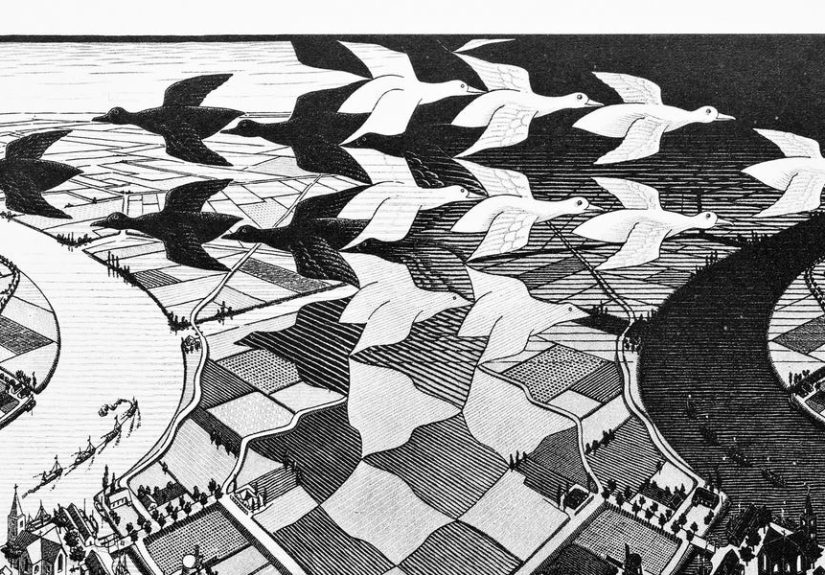
One of Escher’s smartest moves was refusing to treat the background as dead space. In many of his tessellations, the “empty” area is not empty at all. It is another creature, another shape, another story. Fish turn into birds. White forms become black forms. Angels become devils. Day becomes night. It is visual diplomacy with a tiny bit of chaos.
This figure-ground reversal gave his mathematical art motion and wit. It also made the viewer work harder, which is exactly why the images linger in memory. You do not just see an Escher print. You negotiate with it.
Escher Used Printmaking Techniques That Matched Mathematical Thinking
Escher’s major media were woodcut, wood engraving, and lithography. Each of these techniques encouraged deliberate construction. A woodcut demands planning because carving is not the sort of thing you “just vibe through.” A lithograph allows smooth tonal transitions and crisp illusionistic effects. Wood engraving makes detailed pattern and line work possible. Escher selected techniques that matched the visual problem he wanted to solve.
For works centered on tessellation and highly controlled repetition, printmaking was ideal because it naturally favors systems, reversals, layering, and exact transfer. Even when the final image looked spontaneous or impossible, its making was methodical. That balance between mystery and control is one reason his work still feels so modern.
He Turned Mathematical Ideas Into Visual Drama
Tessellation and Metamorphosis
In works such as Sky and Water I, Escher explored transformation through repetition. Fish become birds as the pattern shifts in density, contrast, and identity. This is one of his most brilliant strategies: mathematics provides continuity while imagery provides narrative. The underlying structure holds steady even as the recognizable forms evolve.
That is why these prints feel alive. Escher did not merely repeat shapes. He choreographed transitions. A motif slides from abstraction into representation and back again, like geometry putting on a costume and then pretending nobody noticed.
Self-Reference and Recursive Logic
Drawing Hands is one of Escher’s most famous works because it captures a deep logical puzzle in a simple image: each hand appears to draw the other into existence. This is visual recursion, a loop in which cause and effect chase one another in a circle. It is not a math diagram, yet it operates with mathematical elegance.
The lithograph works because Escher understood exactly where realism had to be convincing and where the illusion had to remain impossible. The wrists emerge from a flat sheet, the hands become fully modeled, and the viewer accepts the impossible arrangement long enough to enjoy the joke. It is philosophy disguised as excellent draftsmanship.
Möbius Strips and One-Sided Surfaces
Escher was also fascinated by topological ideas, including the Möbius strip, a surface with only one side. In works like Möbius Strip II, he did not merely illustrate a mathematical object. He animated it with marching ants, turning an abstract concept into something memorable and slightly unsettling. That was one of his great gifts: he made mathematics look inhabited.
Instead of presenting geometry as a cold system, he treated it like a stage set full of creatures with somewhere urgent to be. Even when viewers did not know the term “topology,” they could feel that something unusual was happening. Escher made advanced ideas visually intuitive.
Hyperbolic Geometry and the Circle Limit Prints
Later in his career, Escher became deeply interested in non-Euclidean geometry, especially hyperbolic space. His Circle Limit prints show repeating figures that shrink toward the boundary of a circle while seeming to continue infinitely. These works are among the clearest examples of how he translated mathematical concepts into popular visual language.
The astonishing part is that the images feel decorative, meditative, and slightly cosmic all at once. The figures get smaller toward the edge, yet none of them seem less important. Infinity is suggested not by chaos, but by disciplined repetition. That is classic Escher: the infinite rendered through order.
Impossible Architecture and Penrose Ideas
In works such as Ascending and Descending and Waterfall, Escher pushed perspective into paradox. These prints use the visual logic of architecture against itself. Locally, each part of the structure seems plausible. Globally, the whole thing becomes impossible. The stair rises forever. The water falls forever. Physics resigns. Your eyeballs file a complaint.
These images connect to the broader tradition of impossible figures, including forms associated with Penrose’s visual paradoxes. Escher’s genius was to turn those conceptual puzzles into complete worlds populated by monks, towers, channels, and human action. He was never content with a neat little brain teaser. He wanted a full theatrical production.
Why Escher’s Art Still Feels Fresh
Escher’s work still resonates because it sits at the intersection of beauty and thought. Viewers do not need formal training in mathematics to enjoy it, but mathematics deepens the pleasure. Artists admire the composition. Designers admire the structure. Mathematicians admire the transformations. Ordinary viewers admire the fact that a print can make them laugh, squint, and question reality before lunch.
He also feels contemporary because so much of modern visual culture depends on pattern, modularity, tiling, repetition, and algorithmic thinking. Long before digital tools made geometric manipulation easy, Escher was doing it by hand with stubborn concentration. His prints anticipate computer graphics, visual coding, generative design, and even the kind of optical trickery that now floods social media. The difference is that Escher built his illusions with craftsmanship so careful it still humbles the room.
How M.C. Escher Really Created His Mathematical Artwork
So, how did M.C. Escher create his mathematical artwork? He combined rigorous printmaking technique, intense observation, travel-based inspiration, a fascination with symmetry, and a willingness to treat mathematics as a visual playground rather than a dry academic subject. He used grids, transformed shapes, studied repetition, explored impossible perspective, and tested ideas obsessively in notebooks before turning them into finished prints.
Most importantly, he understood that mathematics in art is not about adding formulas to a picture. It is about building a picture so carefully that logic itself becomes visible. In Escher’s hands, geometry could breathe, paradox could dance, and infinity could fit neatly inside a frame. That is not just impressive. That is art doing backflips in formal wear.
Experiencing Escher’s Mathematical World Today
To really appreciate Escher, it helps to think about the experience of standing in front of one of his prints rather than simply reading about it in an art history summary. At first, many people respond to his work with a quick burst of delight. “Oh, cool,” the brain says. “A staircase that goes nowhere. Nice.” But then something interesting happens. The longer you look, the less stable the image becomes. Your eye begins to travel. It tries to map the logic of the picture. It succeeds in one corner, fails in another, then circles back for a rematch.
That push-and-pull is part of Escher’s power. His pictures create an experience of thinking. They are not only objects to admire; they are puzzles to inhabit. A landscape by another artist might invite you to imagine walking into it. An Escher print invites you to imagine solving it. And just when you think you have, it quietly changes the rules.
There is also a very human pleasure in the way Escher makes abstract ideas feel tactile. Infinity in a textbook can sound intimidating, like a concept wearing a tweed jacket and speaking too quickly. Infinity in Escher can look like fish, angels, reptiles, or stars shrinking toward an edge you can never reach. Suddenly the idea is not remote. It is visual, playful, and strangely emotional. You feel both the order and the impossibility at the same time.
Modern viewers often discover Escher through posters, memes, puzzles, video games, or social media clips about optical illusions. But seeing the actual logic of his work unfold, whether in a museum, a high-quality reproduction, or a careful study session, is a different experience. You notice how precise the line work is, how controlled the compositions are, and how much narrative he sneaks into patterns that might otherwise seem purely decorative. He was not just making tricks. He was creating environments where logic and imagination collide without canceling each other out.
That may be why Escher remains such a gateway artist for people who think they do not like math or do not “get” art. He offers a middle path. You can enter through curiosity, humor, pattern, beauty, or sheer confusion. Once inside, you start to realize that mathematics is not only about calculation and art is not only about emotion. Both can be systems of discovery. Both can sharpen perception. Both can make the world feel larger.
In a culture flooded with fast images, Escher still rewards slow looking. His work asks for patience, but it pays you back with surprise. The first glance gives you spectacle. The second gives you structure. The third gives you philosophy. By the fourth, you may be staring at a group of impossible stairs wondering whether your entire afternoon has become a metaphor. That, frankly, is a pretty good return on investment.
Escher’s mathematical artwork endures because it transforms looking into an active adventure. It lets viewers experience symmetry as drama, perspective as mischief, and infinity as something almost touchable. Few artists have made the mind feel so visible on the page. Fewer still have done it with this much elegance, humor, and control.