Table of Contents >> Show >> Hide
- What Is a C60 Plan, Exactly?
- What the New SaaStr AI Benchmarking Tool Actually Does
- The Secret Sauce: It Starts With L4M, Not Delusion
- Why This Tool Lands at the Right Time for 2026
- How the Tool Can Build a 2026 C60 Plan in Seconds
- What a Good 2026 C60 Plan Should Actually Include
- Why Benchmarking Makes the Output More Valuable
- Where Founders Can Still Mess This Up
- How to Turn the SaaStr Output Into a Real Operating Plan
- Extended Experience Section: What Teams Usually Feel When They Use a Tool Like This
- Conclusion
Planning season has a special way of making smart founders feel like they are trapped in an Excel escape room. One tab says you are crushing it. Another says you should maybe stop buying office snacks. A third tab is named “FINAL_v12_REAL_FINAL” and cannot be trusted under oath.
That is exactly why the new SaaStr AI Benchmarking Tool is getting attention. Instead of making founders hand-build a forecast from scratch, it helps turn recent financial data into a practical 2026 C60 plan in seconds. That matters because a real operating plan should not be a work of fiction, a motivational poster, or a spreadsheet powered by wishful thinking and cold brew. It should be a base-case plan you can actually run the company against.
In plain English, the appeal is simple: upload the kind of document most founders already have lying around, let AI pull out the numbers, and get a fast, realistic view of revenue trajectory, burn, runway, and what your next 12 months could look like if current trends keep behaving like current trends. Which, to be fair, is not always exciting. But it is extremely useful.
And in 2026, useful beats dramatic. Investors still care about growth, but they care just as much about efficiency, retention, expansion, hiring discipline, and whether your AI strategy produces actual leverage instead of expensive theater. That is why a tool that helps founders move from “we have a vibe” to “we have a base case” can be far more valuable than another dashboard that merely looks intelligent.
What Is a C60 Plan, Exactly?
A C60 plan is a financial and operating plan you have roughly a 60% confidence of hitting. Not 90%, because that is usually too conservative to run a growth company. Not 10%, because that is a stretch plan wearing a fake mustache. C60 sits in the middle. It is your realistic base case.
This is the plan that should guide your board goals, hiring pace, spending decisions, and operating cadence. It is not your dream scenario. It is not your doom scenario. It is your “if we execute competently and the world does not catch fire, this is probably where we land” scenario.
That framing matters more than ever for 2026. A lot of SaaS and B2B AI companies are still navigating a market where growth is available, but it has to be earned with better execution. The era of slapping a giant number into a forecast and hoping the market salutes is, mercifully, harder to get away with now.
What the New SaaStr AI Benchmarking Tool Actually Does
The core idea is refreshingly unromantic. The tool takes recent revenue and burn data from documents you already produce, such as an investor update, a board deck, or a financial summary, and uses that data to create a forward-looking plan. Instead of forcing a founder or operator to manually clean, map, model, and project every line item, the system automates the heavy lifting and gives you a quick read on what your company is likely to do next.
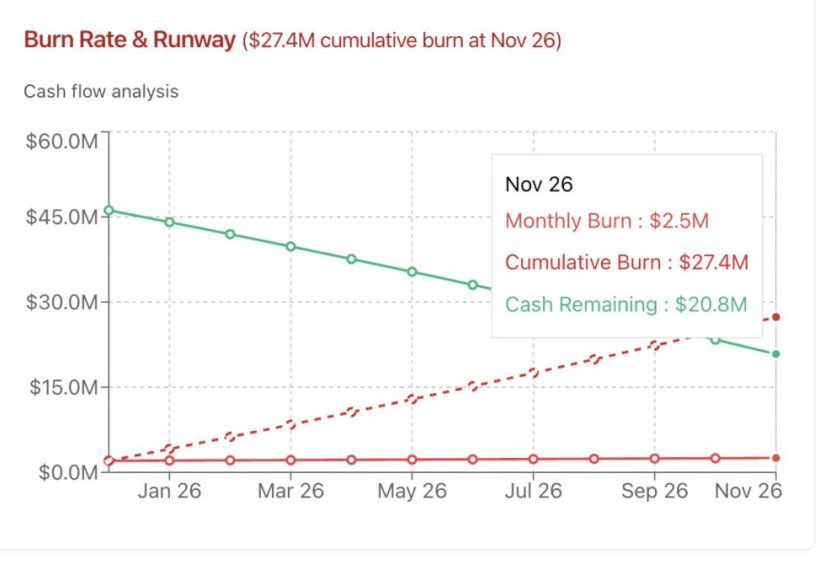
That includes the pieces founders actually care about when they are being honest with themselves: projected revenue trajectory, burn trend, expected runway, and the infamous “zero cash date,” which is the sort of number that can turn a casual Monday into a spiritually formative event.
What makes the tool notable is not that it uses AI. Everyone uses AI in the headline now. The interesting part is that it uses AI for a narrow, high-value workflow: extracting financial inputs, applying a realistic projection method, and turning that into a plan you can act on immediately.
The Secret Sauce: It Starts With L4M, Not Delusion
At the heart of the workflow is a simple concept: L4M, or Last Four Months. You look at the average growth rate of the most recent four months and roll it forward into the next year. You do the same for burn. That gives you a base-case model grounded in what the business is actually doing, not what you hope it starts doing after one inspirational offsite and a redesigned homepage.
This is important because recent operating history is often more predictive than founder optimism. If your company has been growing at a steady but modest pace, L4M keeps the model honest. If your burn has been creeping up, L4M refuses to pretend that your expenses are suddenly going to become deeply spiritual and self-regulating.
That honesty is precisely why the approach works. A simple model built on recent reality is often more valuable than a sophisticated model built on assumptions that collapse the moment somebody misses quota, delays a launch, or discovers that “AI-powered enterprise demand” is not, in fact, a substitute for pipeline.
Why This Tool Lands at the Right Time for 2026
The broader market context makes the timing feel smart. AI adoption is everywhere, but scaled impact is still uneven. Many companies are experimenting, piloting, and talking a very big game, while only a smaller share have truly embedded AI into workflows and tied it to measurable business outcomes. In other words, AI is not rare anymore. Operational clarity still is.
That is why a forecasting and benchmarking tool can be more strategically useful than a flashier AI demo. It forces operators to connect AI to business mechanics: revenue growth, cost discipline, hiring, and cash survival. If your AI story cannot improve those variables, it may be a product feature, but it is not yet a company strategy.
It also fits how modern B2B teams now work. AI is increasingly used to parse unstructured information, generate recommendations, and speed up decision-making across sales, finance, and operations. A tool that can read financial documents and quickly produce a planning framework is not some futuristic magic trick anymore. It is simply a logical extension of how AI is already being used in enterprise workflows.
How the Tool Can Build a 2026 C60 Plan in Seconds
1. It turns existing documents into usable operating data
Most founders do not lack data. They lack time, standardization, and patience. The numbers already exist in monthly updates, board packs, revenue summaries, and cash reports. The SaaStr tool closes the annoying gap between “we have the numbers somewhere” and “we have a base plan we can use this afternoon.”
2. It creates a realistic base-case projection
By leaning on recent performance instead of heroic assumptions, the tool generates the most important planning output first: the base case. This is your C60. It tells you what the business is likely to do if current trends continue with reasonable execution.
3. It surfaces runway risk fast
Revenue forecasts are fun because they point upward. Runway forecasts are useful because they point toward consequences. When a tool shows you where cash runs out under current burn, that is when planning stops being abstract and starts becoming operational.
4. It gives you a foundation for your stretch and downside plans
Once the C60 exists, building adjacent scenarios becomes easier. Your C10 stretch plan can push revenue assumptions higher and model the extra costs needed to reach them. Your C90 plan can cut revenue expectations, keep expenses more grounded, and test how ugly things get if the quarter goes sideways. Suddenly, scenario planning is not a three-day finance ritual. It is an extension of one solid base case.
What a Good 2026 C60 Plan Should Actually Include
A useful C60 plan is not just a top-line revenue number. It should become the operating backbone of the company. That means the plan should cover several core areas.
Revenue trajectory
You need a monthly or quarterly view of how revenue is likely to grow based on recent trends. Not because growth is the only metric that matters, but because nearly every other strategic decision depends on whether revenue is rising slowly, steadily, or like a caffeinated lab experiment.
Burn and runway
A 2026 plan without burn and runway is a screenplay, not an operating plan. You need to know not just how much you are spending, but how long current spending gives you before capital becomes the main character in every meeting.
Hiring pace
This is one of the biggest advantages of a fast C60 model. It helps answer the uncomfortable question: how many people can we actually afford to hire? The right plan links hiring to likely revenue and likely cash, not to abstract ambition. That matters even more now that companies are rethinking team structure in light of AI leverage.
Go-to-market efficiency
Your plan should not just ask, “How much can we sell?” It should ask, “How efficiently can we sell it?” Metrics like CAC payback, new customer acquisition efficiency, and sales and marketing productivity still matter. Recent benchmark research shows that efficient growth is increasingly shaped by the balance between retention and acquisition, not by brute-force spend alone.
Retention and expansion
As companies scale, expansion revenue becomes a bigger growth engine. That means a credible C60 plan should reflect whether your growth depends mostly on new logos, customer expansion, or both. Founders who ignore retention and expansion are often surprised later when the top line looks flatter than the pipeline deck promised.
AI investment with measurable impact
A 2026 plan should include AI spending and AI-enabled productivity assumptions, but only when those assumptions connect to real workflow changes and measurable KPIs. AI should not appear in the model as a decorative line item whose main purpose is impressing the board. It should show up where it improves speed, capacity, margin, output, or customer value.
Why Benchmarking Makes the Output More Valuable
The word “benchmarking” matters here. A plan is stronger when you can compare your numbers to peers and broader market patterns. Maybe your burn is normal for your stage. Maybe your CAC payback is worse than you thought. Maybe your retention is quietly carrying the company harder than your outbound motion. Benchmarking helps turn internal numbers into context.
That is also why this type of tool feels timely. The best operators in 2026 are no longer satisfied with gut-check planning. They want to know how their growth, efficiency, and expansion compare with other SaaS and AI-forward companies. Benchmarks do not make decisions for you, but they do help you stop telling yourself flattering stories in a market that is already expensive enough.
And yes, this can be mildly painful. Good benchmarking often reveals that one of your favorite narratives is actually a coping mechanism. But that is still much cheaper than discovering the truth after hiring too fast, underpricing AI, or pushing fundraising until the runway graph starts looking like a ski slope.
Where Founders Can Still Mess This Up
Even the best planning tool cannot save a founder from creative self-deception. There are still a few classic mistakes to avoid.
- Treating the C60 like a stretch plan: If you inflate the base case, the rest of the plan becomes useless.
- Ignoring the hiring implications: If the model says you can afford three key hires and you approve eight because “momentum,” the spreadsheet did not fail. Leadership did.
- Using AI without redesigning workflows: Adding AI tools without changing process, accountability, or KPIs usually creates activity, not leverage.
- Skipping the downside case: A company that only models success is not being optimistic. It is being lazy.
- Never refreshing the model: A C60 plan should be a living operating baseline, not a ceremonial PDF you open once per quarter when somebody asks an uncomfortable question.
How to Turn the SaaStr Output Into a Real Operating Plan
If the tool gives you a fast C60 plan, the next step is not to admire the graph. The next step is to operationalize it.
First, pressure-test the assumptions with your leadership team. Does the projection broadly match what sales, customer success, product, and finance are seeing? Second, connect the base case to headcount and spend. Third, build the stretch and downside scenarios around it. Fourth, identify the few variables that can most meaningfully move the outcome: retention, pricing, sales productivity, win rate, ramp time, or gross margin. Finally, decide what has to change in the business if you do not like what the base case tells you.
That last step is the whole point. The C60 plan is not there to flatter you. It is there to tell you whether the current version of the company is good enough to reach the next stage without magical thinking.
Extended Experience Section: What Teams Usually Feel When They Use a Tool Like This
One of the most interesting things about a tool like the new SaaStr AI Benchmarking Tool is not just what it calculates, but what it changes emotionally inside a company. The first experience many founders have is a weird mix of relief and insult. Relief, because they finally have a base plan in front of them. Insult, because the base plan is often much less glamorous than the one living in their head. That is normal. Most leaders do not need more ambition. They need faster contact with reality.
In practice, the first big reaction is usually around revenue. Teams often realize the company is not on track for the heroic number everyone casually repeated in meetings. The second reaction is almost always about burn. A founder may have intellectually known that spending was rising, but seeing a projected zero cash date on a chart has a way of turning a background concern into a front-of-mind operating priority. Suddenly, hiring plans get more specific. Vendor conversations get shorter. “Let’s just add a few people” stops sounding strategic and starts sounding expensive.
There is also a very real board-level benefit. When a company comes into planning with a grounded C60, the conversation changes. Instead of debating pure opinion, the team can discuss trade-offs. If the base case is too low, what must change to improve it? If the downside case is too risky, what do we cut, accelerate, or fix? It makes planning feel less like theater and more like management.
Another common experience is that AI spending gets a lot less fuzzy. Before a grounded plan, teams may talk about AI as a broad strategic priority. After a grounded plan, they start asking more useful questions. Which workflows should be redesigned first? Which roles gain leverage? Which projects improve retention, sales productivity, support efficiency, or margin in a measurable way? That is when AI becomes part of operating discipline instead of just part of the company’s LinkedIn personality.
Founders also tend to discover that a realistic base plan is not demotivating. Oddly enough, it can be energizing. Once the number is believable, the team knows what it is chasing. The stretch plan becomes more meaningful because it sits on top of real math, not fantasy. Sales leaders can set targets with fewer side-eye glances. Finance stops playing bad cop. Product and GTM teams can see exactly which levers matter most.
Perhaps the biggest experience-related shift is speed. Traditional planning can drag for days or weeks, especially when data is messy and every scenario is built manually. A tool that creates the first useful draft in seconds changes the rhythm. Teams can spend less time assembling the first spreadsheet and more time debating what to do about it. That is a better use of executive time, and frankly, a better use of human life.
So when people say a tool like this can build your 2026 C60 plan in seconds, the real promise is not just speed. It is faster honesty. And for founders trying to grow efficiently, hire responsibly, and make AI actually pay rent, faster honesty may be one of the most valuable upgrades available.
Conclusion
The new SaaStr AI Benchmarking Tool is compelling because it tackles a brutally practical problem: most founders need a real 2026 operating plan, and many still do not have one. By turning recent revenue and burn data into an instant C60 framework, the tool helps companies move from speculation to action. That does not replace judgment, finance leadership, or deeper planning. But it gives founders something they desperately need before any great annual plan begins: a realistic starting point. In 2026, that is not a small advantage. It is the difference between running the company with sight and running it on hope.