Table of Contents >> Show >> Hide
- Why Addressing a College Recommendation Letter Matters
- How to Address College Recommendation Letters: 9 Steps
- Step 1: Check Each College’s Recommendation Requirements
- Step 2: Use the Correct Recipient
- Step 3: Include the Student’s Full Legal Name
- Step 4: Follow the Application Portal Instructions
- Step 5: Address Mailed Letters Correctly When Needed
- Step 6: Respect FERPA and Confidentiality Rules
- Step 7: Give Recommenders the Right Context
- Step 8: Use a Professional Letter Format
- Step 9: Confirm Submission Without Pestering
- Common Mistakes to Avoid
- Sample College Recommendation Letter Addressing Format
- Experience-Based Advice: What Actually Helps in Real Life
- Conclusion
Note: This article is based on current guidance from reputable U.S. admissions and college-planning sources, including Common App, College Board BigFuture, MIT Admissions, Stanford Admission, Harvard College, Yale Admissions, Princeton Admission, and Duke Undergraduate Admissions.
Addressing a college recommendation letter sounds simpleuntil you realize there are portals, FERPA waivers, counselor forms, teacher evaluations, optional recommenders, school-specific rules, and the occasional mysteriously named “Recommenders and FERPA” tab staring at you like it knows your GPA. The good news? Once you understand the process, it is much less dramatic than it looks.
A college recommendation letter is not just a formal document with a student’s name slapped on top. It is part of an admissions file, and it must be sent to the right place, by the right person, in the right format, with enough identifying details to match it to the correct applicant. Whether you are a student preparing instructions for a teacher, a counselor sending materials, or a recommender writing the letter itself, proper addressing helps prevent delays, confusion, and the dreaded “missing materials” email.
Most recommendation letters today are submitted through online application systems such as the Common Application or a school-specific admissions portal. Still, some colleges may allow email or mailed submission in special cases. That means “addressing” a recommendation letter now includes more than writing “Dear Admissions Committee.” It also means correctly labeling the student, choosing the right recipient, following submission instructions, and making the letter easy for admissions offices to process.
Why Addressing a College Recommendation Letter Matters
College admissions offices receive thousands of documents during application season. A strong recommendation can help a student stand out, but only if the letter actually reaches the student’s file. Proper addressing makes the letter look professional, helps the college match it with the right applicant, and shows respect for the admissions process.
Recommendation letters also carry more weight when they feel specific and credible. Colleges often prefer letters from teachers who taught the student in core academic subjects, especially during junior or senior year. Counselors may also submit a school report, transcript, school profile, and counselor recommendation. Because these materials are often handled separately from the student’s own application, clarity is everything.
Think of the recommendation letter as a suitcase at the airport. If the tag is clear, it gets where it belongs. If the tag is missing, smudged, or says only “For Emma,” it may go on a long vacation without the applicant.
How to Address College Recommendation Letters: 9 Steps
Step 1: Check Each College’s Recommendation Requirements
Before addressing any college recommendation letter, confirm what the college actually requires. Some schools ask for one counselor recommendation and two teacher recommendations. Others allow optional letters from coaches, employers, mentors, clergy, research supervisors, or community leaders. A few colleges limit extra letters because they only want information that adds something new.
Students should review each college’s admissions website and application checklist. Pay attention to the number of required recommendations, the preferred type of recommender, accepted submission methods, and deadlines. For example, highly selective colleges often request teacher recommendations from core academic subjects such as English, math, science, social studies, world language, or other major academic courses.
If the school says recommendations must come directly from the recommender, do not collect the letter yourself and upload it unless the college specifically allows that. Admissions offices generally want letters to be confidential and sent through official channels.
Step 2: Use the Correct Recipient
When the letter itself needs a salutation, the safest professional choice is usually:
Dear Admissions Committee,
This works because recommendation letters are usually read by multiple admissions officers, not one single person. If the college provides a specific recipient, such as “Office of Undergraduate Admission,” use that instead. Avoid overly casual greetings like “Hi there,” “To whoever reads this,” or “Dear College People.” The last one may be emotionally honest, but it is not ideal.
If the letter is being submitted through an online portal, the salutation is still useful because it gives the letter a polished structure. A recommender does not need to customize the greeting for every college unless writing a school-specific letter. For most applications, “Dear Admissions Committee” is professional, flexible, and widely accepted.
Step 3: Include the Student’s Full Legal Name
The student’s full legal name should appear clearly in the letter. This is especially important if the student uses a nickname, has a common name, or has a name that appears differently across school records, test records, and application portals.
A strong opening might look like this:
I am pleased to recommend Isabella Marie Chen for admission to your undergraduate program.
If appropriate, the recommender may also include the student’s high school, graduation year, date of birth, or application ID, especially when submitting by email or mail. Some colleges specifically ask that emailed materials include identifying information such as the applicant’s full legal name, high school, date of birth, and type of recommendation. The goal is simple: make it impossible for the letter to get lost in the admissions shuffle.
Step 4: Follow the Application Portal Instructions
Most college recommendation letters are addressed and submitted through an application platform. The student usually enters the recommender’s name and email address, then the system sends the recommender instructions. The recommender uploads the letter or completes an evaluation form directly through the portal.
Students should not assume every recommender already knows how the system works. Give each recommender clear instructions, including which platform to use, which colleges require letters, what deadlines apply, and whether the recommendation is academic, counselor, optional, or supplemental.
A simple instruction note can prevent many problems:
Thank you again for writing my recommendation. You should receive an email from Common App with upload instructions. This is for my teacher recommendation. My earliest deadline is November 1, and I have attached my resume and college list for reference.
That little paragraph is like a GPS for your recommender. Without it, they may still arrive, but they might take three unnecessary exits.
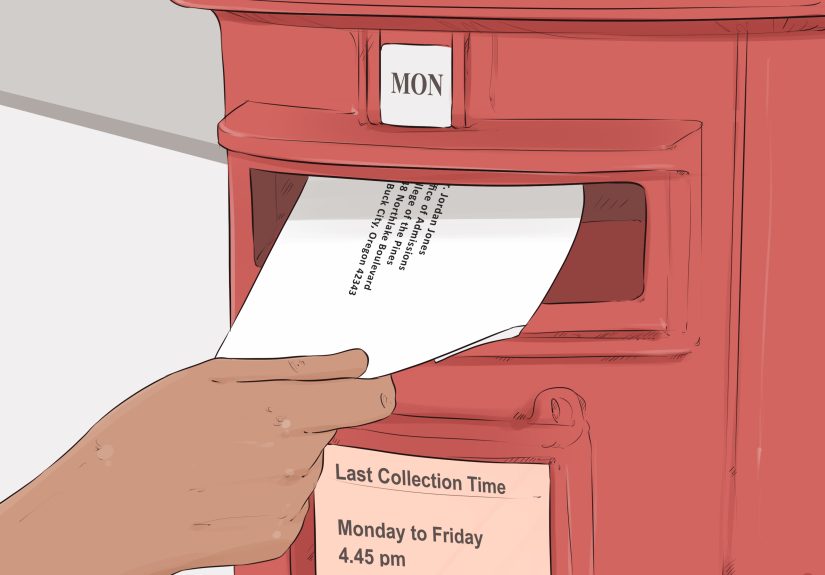
Step 5: Address Mailed Letters Correctly When Needed
Mailed recommendation letters are less common than online submissions, but they still exist in special cases. If a college allows or requires a mailed letter, use the exact mailing address listed on the college’s admissions website. Do not rely on a random address from a search result, an old brochure, or your cousin’s memory from 2014.
A mailed envelope should generally include:
- The college’s official admissions mailing address
- The student’s full legal name
- The student’s high school name
- The application type, if helpful
- The recommender’s return address
For example:
Office of Undergraduate Admission
Example University
123 College Avenue
College Town, ST 12345
On the envelope or cover sheet, the recommender might write:
Recommendation for: Jordan Alexander Rivera, Lincoln High School, First-Year Applicant
If the student is providing envelopes, they should be pre-addressed and stamped. This is especially helpful for busy teachers and counselors who are already juggling classes, grading, meetings, and the eternal mystery of the copy machine.
Step 6: Respect FERPA and Confidentiality Rules
Students using the Common Application are asked to make a FERPA decision. In simple terms, FERPA relates to whether the student waives the right to review recommendation letters after enrollment. Many colleges and recommenders view waived letters as more candid because the writer knows the student does not plan to read them later.
Students should read the FERPA instructions carefully before making a selection. Once recommenders are invited, changing the decision can become complicated. If the student has questions, the school counselor is often the best person to ask.
Confidentiality also affects how the letter is addressed and submitted. If the college expects the recommender to submit directly, the student should not ask to see, edit, or upload the letter. Instead, the student can help by giving the recommender a brag sheet, resume, transcript summary, list of colleges, deadlines, and examples of meaningful classroom moments.
Step 7: Give Recommenders the Right Context
A well-addressed letter is not only about the greeting. It is also about helping the recommender write to the right audience. A teacher writing to an admissions committee should explain how they know the student, what subject they taught, how long they worked with the student, and what qualities make the student ready for college.
Students can make this easier by providing a short recommendation packet. This may include:
- A resume or activity list
- A short “brag sheet” with achievements and personal qualities
- Major interests or possible fields of study
- A list of colleges and deadlines
- Important instructions for each application portal
- Specific memories from the class or activity
For example, instead of saying, “Please write that I’m hardworking,” a student might say, “One moment that meant a lot to me was when I revised my research paper three times after your feedback and eventually presented it to the class.” That gives the recommender a real story, not just a floating adjective with shoes.
Step 8: Use a Professional Letter Format
If the recommender is writing a traditional letter, the format should be clean and professional. The letter may include the recommender’s name, title, school or organization, email address, date, greeting, body paragraphs, closing, and signature.
A basic structure looks like this:
Date
Dear Admissions Committee,
Opening paragraph: Identify the student and explain the recommender’s relationship to them.
Body paragraphs: Describe the student’s academic strengths, character, growth, leadership, curiosity, resilience, or contribution to the classroom. Use specific examples.
Closing paragraph: Summarize the recommendation clearly and confidently.
Sincerely,
Recommender Name
Title
School or Organization
Email Address
The letter should be direct, warm, and specific. Admissions officers do not need a novel. They need insight. A one- to two-page letter is usually enough, unless a college gives a specific word limit or form requirement.
Step 9: Confirm Submission Without Pestering
After the letter is requested, students should monitor their application portal to confirm whether the recommendation has been received. If the deadline is approaching and the letter has not been submitted, send a polite reminder.
A good reminder sounds like this:
Dear Ms. Thompson, thank you again for writing my college recommendation. I wanted to kindly remind you that my first deadline is November 1. Please let me know if you need any additional information from me. I really appreciate your help.
Notice what is missing: panic, guilt, seventeen exclamation points, and “Did you do it yet???” Teachers and counselors are human beings, not recommendation vending machines. A respectful reminder works much better than digital tapping on the glass.
Common Mistakes to Avoid
Using the Wrong College Address
Always use the address or submission method listed by the college. Admissions offices may have different addresses for transcripts, financial aid, undergraduate admission, graduate admission, and general mail. Sending a recommendation to the wrong office can delay processing.
Forgetting Student Identifiers
If a letter is emailed or mailed, it should include enough information to identify the applicant. A full legal name is essential. Additional details such as high school name, birth date, application ID, or applicant portal ID may be helpful when the college requests them.
Requesting Too Many Extra Letters
More letters do not automatically mean a stronger application. Some colleges specifically say additional recommendations are only useful if they add new, detailed information. A short, vivid letter from a teacher who knows the student well is usually better than a fancy but generic letter from someone with an impressive title.
Asking Too Late
Students should ask recommenders well before deadlines. Many college-planning resources suggest giving teachers and counselors plenty of time, often several school weeks when possible. Last-minute requests can lead to rushed letters, stressed recommenders, and awkward hallway encounters.
Sample College Recommendation Letter Addressing Format
Here is a simple example of how a recommender might address the letter:
October 10, 2026
Dear Admissions Committee,
I am pleased to recommend Maya Elizabeth Johnson for admission to your undergraduate program. I taught Maya in AP English Language during her junior year at Northview High School, and I have also worked with her as faculty advisor for the school literary magazine.
This opening works because it identifies the student, explains the relationship, and begins professionally. It does not waste time with a vague greeting or dramatic drumroll. Admissions readers can immediately understand who the letter is about and why the recommender is qualified to write it.
Experience-Based Advice: What Actually Helps in Real Life
In real college application seasons, recommendation letters tend to go smoothly when students behave like organized project managers instead of frantic squirrels with Wi-Fi. The students who make the process easiest usually do three things well: they ask early, they provide clear materials, and they follow up politely.
One practical experience many students discover is that recommenders appreciate context more than compliments. Saying “You’re my favorite teacher” is kind, but it does not give the teacher much to write about. Saying “Your class helped me become more confident discussing primary sources, especially during the civil rights research project” gives the teacher a scene, a skill, and a reason to remember the student’s growth. That kind of detail can turn a general letter into a memorable one.
Another lesson is that organization reduces anxiety. Students often worry that teachers will forget deadlines, but the better solution is not constant messaging. It is a clean, useful recommendation packet. A one-page document with the student’s full name, email, high school, college list, deadlines, intended major interests, and submission platforms can save everyone time. If a teacher is writing for five different seniors, the student who provides clear instructions becomes instantly easier to help.
Students should also understand that the best recommender is not always the teacher who gave the highest grade. A teacher who saw the student struggle, improve, ask thoughtful questions, help classmates, or take feedback seriously may write a stronger letter than a teacher who only knows the student earned an easy A. Colleges are interested in academic readiness, but they also care about curiosity, maturity, resilience, collaboration, and character.
For students applying to multiple colleges, it helps to create a recommendation tracking sheet. The sheet can include each college, application platform, deadline, required teacher letters, counselor materials, optional recommendations, and submission status. This does not need to be fancy. A simple spreadsheet or checklist works. The point is to avoid realizing at 11:47 p.m. that one college wanted a counselor form and two teacher evaluations while another accepted only one teacher letter and no extras.
Students should also be careful with optional recommendations. If a college allows an extra letter, the extra recommender should add a new angle. A robotics coach might describe leadership under pressure. An employer might describe reliability and customer service. A research mentor might explain intellectual independence. But if the optional letter simply repeats “This student is smart and nice,” it may not help much. Admissions officers already assume applicants are trying to present themselves well; what they need is evidence.
Finally, gratitude matters. After the letter is submitted, students should send a thank-you note. It can be short, sincere, and specific. Teachers and counselors often write recommendations outside normal work hours, squeezed between grading, meetings, family time, and probably reheating coffee for the third time. A thoughtful thank-you does not affect admission, but it does reflect maturity. It also keeps the relationship strong, which matters because the people who support students during the application process often continue cheering for them long after decisions arrive.
Conclusion
Learning how to address college recommendation letters is really about learning how to communicate clearly. Use the correct recipient, include the student’s full legal name, follow each college’s submission rules, respect confidentiality, and give recommenders enough context to write something specific. Most letters today travel through online portals, but the same principle applies everywhere: make the letter professional, identifiable, and easy for the admissions office to process.
A great recommendation letter does not need fireworks. It needs clarity, credibility, and real examples. When students and recommenders work together thoughtfully, the letter becomes more than a required document. It becomes a meaningful piece of the application that helps admissions officers see the person behind the grades, activities, and carefully polished essay drafts.