Table of Contents >> Show >> Hide
- What Was the Mars Opportunity Rover?
- Why Did Opportunity Die?
- Opportunity’s Mission Was Supposed to Last 90 Days
- What Did Opportunity Discover on Mars?
- Why People Cared So Much About Opportunity
- Opportunity’s Legacy in Mars Exploration
- The Human Experience Behind “Mars Opportunity Rover Is Dead”
- Conclusion
The Mars Opportunity rover is dead, but let’s be clear: this was not a tragic little robot that failed early, got lost, and quietly became expensive space furniture. Opportunity was the overachiever of Mars explorationthe machine that turned a planned 90-sol mission into nearly 15 years of science, engineering, dust, rocks, crater-hopping, and emotional damage for anyone who has ever felt attached to a solar-powered rover.
NASA officially declared the Opportunity rover mission complete on February 13, 2019, after months of unsuccessful attempts to restore communication. The rover had gone silent during a massive global dust storm on Mars in June 2018. Because Opportunity relied on solar panels, the storm blocked the sunlight it needed to recharge. Eventually, the little explorer that could had no power left to phone home.
Still, “Mars Opportunity Rover Is Dead” is only half the story. The better headline might be: “Mars Opportunity Rover Refuses to Retire for 14 Extra Years, Then Leaves Behind a Scientific Legacy Big Enough to Make Earth Applaud.” Less catchy, perhaps, but much more accurate.
What Was the Mars Opportunity Rover?
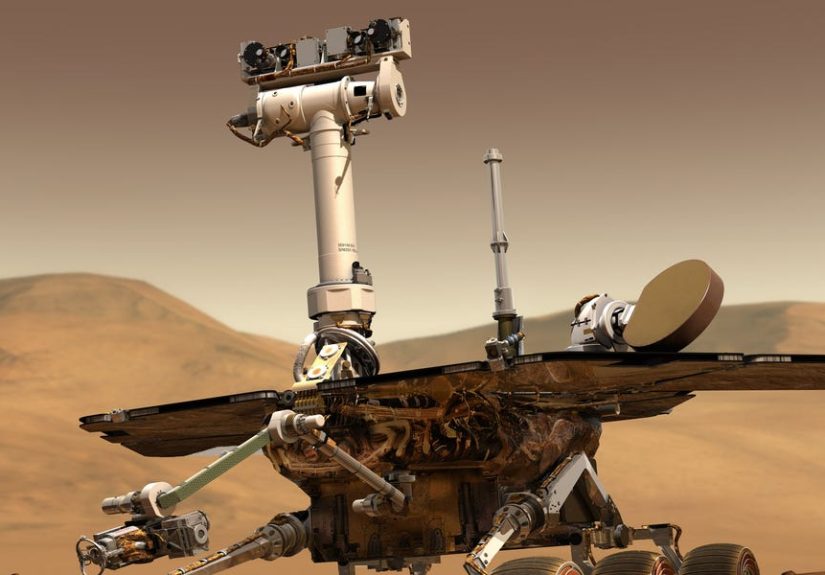
Opportunity, also known as Mars Exploration Rover-B, was one of NASA’s twin robotic geologists sent to Mars in 2003. Its sibling, Spirit, landed first in January 2004. Opportunity landed later that same month in Meridiani Planum, a broad plain near the Martian equator. Together, the two rovers were designed to help scientists understand whether Mars once had conditions suitable for liquid waterand possibly life.
Opportunity was about the size of a golf cart, equipped with six wheels, cameras, a robotic arm, scientific instruments, solar panels, and the kind of stubborn personality humans tend to assign to machines that do their jobs too well. It was built to operate for 90 Martian days, called sols, and drive about 1,100 yards. Instead, it traveled more than 28 miles across Mars.
That distance may sound modest on Earth. A determined marathon runner could cover it before lunch and still complain about the post-race banana selection. But on Mars, 28 miles is legendary. Every meter required planning, hazard avoidance, energy management, and patience. The rover had to navigate rocks, slopes, sand ripples, crater rims, dust accumulation, freezing temperatures, and communication delays between planets.
Why Did Opportunity Die?
Opportunity’s death was not sudden in the Hollywood sense. There was no explosion, no dramatic tumble into a canyon, no alien handshake gone wrong. The end came from a planet-wide dust storm that darkened the Martian sky in 2018.
The 2018 Mars Dust Storm
In late May and early June 2018, a dust storm began expanding across Mars. Mars is famous for dust storms, but this one grew into a global event, covering the planet and dramatically reducing sunlight at the surface. For a solar-powered rover, that was a serious problem. Opportunity needed sunlight to charge its batteries, warm its systems, and keep communicating with Earth.
By June 10, 2018, NASA received the rover’s final signal. The data showed extremely low power and a sky darkened by dust. A popular phrase later spread online“My battery is low and it’s getting dark”as if those were Opportunity’s final words. It is a beautiful line, but it was not a literal message from the rover. Opportunity did not send poetry. It sent engineering data. Humans supplied the heartbreak.
Why NASA Could Not Wake It Up
After the dust storm began to clear, NASA engineers tried repeatedly to contact Opportunity. They sent more than a thousand recovery commands, hoping the rover might wake up, recharge, and respond. The team considered several possibilities: the batteries might have failed, the clock might have reset, the rover might have been too cold, or dust might have coated the solar panels so heavily that recovery was impossible.
NASA made its final contact attempt in February 2019. When Opportunity still did not respond, the agency declared the mission complete. It was the end of active operations, but not the end of Opportunity’s influence.
Opportunity’s Mission Was Supposed to Last 90 Days
One of the most delightful facts about Opportunity is how badly it ignored its warranty. NASA designed the rover for 90 sols, or a little over 92 Earth days. The mission ended up lasting more than 5,000 sols. That is not just exceeding expectations. That is showing up for a temporary job and becoming the CEO.
Several factors helped Opportunity last so long. Its engineering was strong, its team on Earth was creative, and Martian winds occasionally cleaned dust from its solar panels. These “cleaning events” gave the rover fresh energy and allowed it to keep working long after anyone reasonably expected it to stop.
The rover also benefited from careful driving. Mission planners did not simply point Opportunity toward a crater and say, “Good luck, little buddy.” They studied terrain, calculated energy needs, planned safe routes, and adjusted based on new images and data. A single drive on Mars could take days or weeks of preparation. Exploration at interplanetary distance rewards patience, not reckless speed.
What Did Opportunity Discover on Mars?
Opportunity’s scientific achievements changed how researchers understood Mars. Before missions like Spirit and Opportunity, Mars was known as a cold, dry desert world. The rovers helped show that the planet had a much more complex and watery past.
Evidence of Ancient Water
One of Opportunity’s most famous discoveries involved tiny round mineral formations nicknamed “blueberries.” These small spherules were rich in hematite, a mineral often associated with water-related processes. Opportunity also examined layered rocks, sulfate minerals, and other geological clues suggesting that liquid water once existed in the area.
This mattered because water is central to the search for past life. Opportunity did not find Martian microbes. It did not uncover fossils, alien footprints, or a tiny red mailbox labeled “Mars Residents Association.” But it did find evidence that some environments on ancient Mars may have been wet enough to interest astrobiologists.
From Eagle Crater to Endeavour Crater
Opportunity landed inside Eagle Crater and immediately found interesting rocks. Later, it explored larger and more scientifically valuable sites, including Endurance Crater, Victoria Crater, and Endeavour Crater. Each stop revealed new details about Martian geology.
Endeavour Crater became especially important because it exposed older rocks than many of the rover’s earlier locations. There, Opportunity found clay minerals that likely formed in water with a more neutral pH. That kind of environment would have been more favorable for microbial life than highly acidic water. In simple terms, Opportunity helped scientists move from “Mars had water” to “some Martian water may have been relatively friendly.”
A Record-Setting Drive
Opportunity became the first rover to complete a marathon-distance drive on another world. It passed the 26.2-mile mark in 2015, a milestone that would be impressive even if Mars had snack tables and cheering spectators. By the end of the mission, the rover had traveled 28.06 miles, making it one of the most successful surface explorers in space history.
Why People Cared So Much About Opportunity
Technically, Opportunity was a machine. Emotionally, it became something more. Engineers, scientists, space fans, students, teachers, and casual internet users began to see the rover as a hardworking explorer with personality. NASA teams often referred to rovers using human-like language, partly because it helped describe complex operations and partly because, after years of caring for a robot on another planet, emotional attachment becomes hard to avoid.
Opportunity’s story had all the ingredients of a great adventure: a small explorer, a hostile world, a mission against impossible odds, unexpected discoveries, and a final silence. It was science, but it felt like storytelling. The rover survived winters, dust storms, mechanical challenges, and aging hardware. Every extra year felt like a bonus chapter.
When NASA announced the end of the mission, the public response was surprisingly emotional. People made artwork, wrote tributes, shared memories, and mourned a robot they had never met. That may sound odd until you remember that humans also name cars, apologize to furniture after bumping into it, and cheer for fictional dragons. Opportunity gave people something real to admire.
Opportunity’s Legacy in Mars Exploration
The Mars Opportunity rover is dead, but its legacy is alive in every modern Mars mission. The rover helped prove that long-term robotic exploration on Mars was not only possible but incredibly valuable. It also gave mission designers practical lessons about mobility, power, navigation, autonomy, dust, durability, and science operations.
Lessons for Curiosity and Perseverance
Later rovers such as Curiosity and Perseverance benefited from the trail blazed by Spirit and Opportunity. Curiosity, which landed in 2012, uses a nuclear power source rather than solar panels, allowing it to avoid the specific vulnerability that ended Opportunity’s mission. Perseverance, which landed in 2021, carries more advanced instruments and is collecting samples that could one day be returned to Earth.
Opportunity showed that Mars rewards mobility. A rover that can travel from one geological setting to another can build a richer story than a lander fixed in one place. Opportunity’s journey across Meridiani Planum turned Mars from a distant red dot into a landscape with layers, textures, slopes, craters, mineral veins, and history.
A Scientific Foundation for the Search for Life
The search for life on Mars depends on understanding where water existed, when it existed, and what kind of chemistry surrounded it. Opportunity’s discoveries contributed directly to that foundation. By studying rocks shaped by water, the rover helped scientists identify ancient environments that may once have been habitable.
That does not mean Opportunity proved life existed on Mars. It did something more careful and scientific: it narrowed the possibilities, strengthened the evidence for past water, and gave future missions better questions to ask. In science, a good question can be as valuable as a dramatic answer.
The Human Experience Behind “Mars Opportunity Rover Is Dead”
When people hear that the Mars Opportunity rover is dead, they often react in a way that surprises them. After all, Opportunity was not alive. It had no thoughts, no feelings, no little robot dreams of opening a bakery on Olympus Mons. Yet the news still felt personal. That reaction says a lot about the way humans experience exploration.
Opportunity became a symbol of persistence. Most of us know what it feels like to be sent into difficult conditions with a limited battery and a vague instruction to “keep going.” Maybe that is why the rover’s story connected so strongly. It worked in silence, far from home, doing a job that mattered. It did not complain about the cold, the dust, or the fact that its commute was literally across another planet.
There is also something deeply moving about teamwork across distance. Every image Opportunity sent back was the result of engineering on Earth and survival on Mars. Scientists studied the rover’s data. Engineers planned its drives. Communicators sent commands through space. The rover responded hours later, if all went well. That slow rhythm created a relationship between humans and machine that felt almost like conversation.
For students, Opportunity made space feel reachable. It proved that exploration is not only about astronauts in shiny helmets. It is also about programmers, geologists, mechanical engineers, mission planners, camera specialists, data analysts, and people who know exactly how much power a dusty solar panel can produce on a bad Martian afternoon. The mission showed that curiosity is a team sport.
For adults, Opportunity offered a rare kind of optimistic news. In a world where headlines often arrive wearing muddy boots, the rover’s story was a reminder that humanity can still build things for discovery rather than destruction. We can send a robot to another planet and use it to ask patient, intelligent questions about rocks. That is beautifully weird. It is also profoundly human.
The phrase “Opportunity is dead” may sound final, but the experience of the mission is not. The rover’s images are still studied. Its data remains useful. Its story continues to inspire documentaries, classrooms, science writing, and future missions. Opportunity’s physical body rests on Mars in Perseverance Valley, but its influence travels much farther.
There is comfort in that. Machines stop working. Missions end. Batteries fail. Dust wins eventually. But knowledge accumulates. A rover can go silent and still keep teaching us. Opportunity reminds us that success is not always about lasting forever. Sometimes success is about doing far more than anyone expected, leaving behind better maps, better questions, and a slightly larger sense of what humans can accomplish.
So yes, the Mars Opportunity rover is dead. But if a robot can have a legacy, Opportunity has one of the finest in space exploration. It gave us Mars in greater detail, gave scientists evidence of ancient water, gave engineers a masterclass in endurance, and gave the public a story worth remembering. Not bad for a rover that was supposed to last three months.
Conclusion
The death of the Mars Opportunity rover marked the end of one of NASA’s most extraordinary robotic missions. Opportunity began as a 90-sol experiment and became a nearly 15-year expedition across the Martian surface. It found evidence of ancient water, explored craters, studied minerals, broke driving records, survived brutal conditions, and helped reshape our understanding of the Red Planet.
Its final silence in 2018 and official mission end in 2019 were emotional moments, but they were not failures. Opportunity did exactly what great exploration missions are supposed to do: it exceeded expectations, expanded knowledge, and inspired people to look up. The rover may be still and quiet now, but its story continues to move.
Note: This article is based on verified public information from NASA mission records, JPL updates, university science reporting, and reputable U.S. space science coverage. Source links are intentionally not inserted to keep the HTML clean for web publishing.