Table of Contents >> Show >> Hide
- What Tangential Content Is (and What It’s Not)
- Start With Audience Gravity, Not Product Gravity
- Where Tangential Content Fits in a Modern SEO Content Strategy
- A 7-Step Whiteboard Method to Generate Tangential Content Ideas
- Step 1: Define your audience (one sentence, no jargon)
- Step 2: List the audience’s top non-product concerns
- Step 3: Expand each category into “why people care” angles
- Step 4: Reality-check with search intent
- Step 5: Choose a “linkable asset” format
- Step 6: Build the “brand bridge” (one paragraph, not a sales ambush)
- Step 7: Vet the idea before you build it
- Tangential Keyword Research Without Losing the Plot
- Examples of Tangential Content Ideas (By Industry)
- How to Optimize Tangential Content for Google and Bing
- How to Measure Tangential Content Success
- Conclusion: Tangents With a Job Description
- Field Notes: of Real-World Tangential Content Lessons
Ever stared at a blank whiteboard so long you started seeing faces in the dry-erase residue? Same energy.
Content teams do this every week: you need fresh ideas, but you’ve already written “10 Tips to Choose the Right
[Insert Product Here]” and the internet politely asked you to stop.
Enter tangential content: the art of creating content that’s not directly about what you sell,
but is deeply about what your audience cares about. Think of it as the smart “side quest” that levels up
your brand authority, earns links, and expands organic reachwithout turning your blog into a brochure wearing a fake mustache.
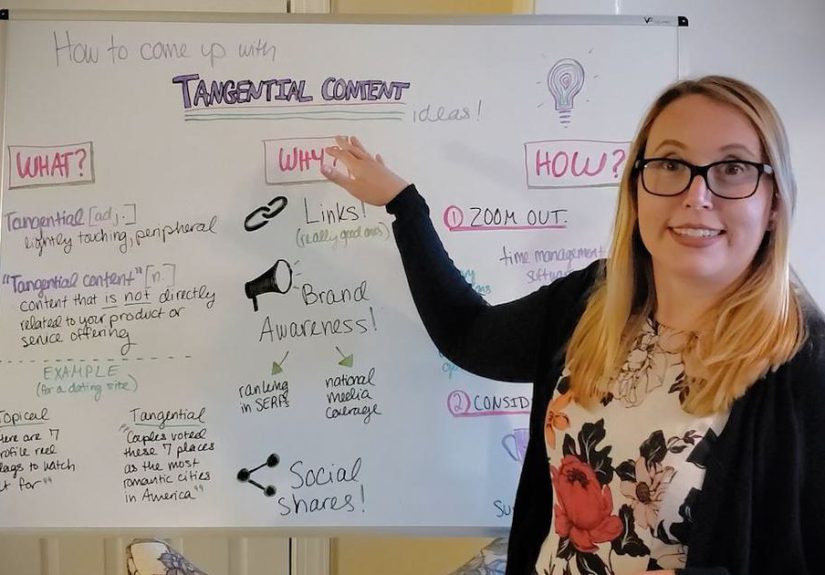
This guide is inspired by the Whiteboard Friday approach popularized on Moz: define the audience’s world,
find adjacent topics that naturally attract attention, then build a subtle bridge back to your brand.
We’ll keep it practical, SEO-friendly for Google and Bing, andmost importantlyhuman.
What Tangential Content Is (and What It’s Not)
Tangential content: relevant to your audience, not your SKU list
Tangential content is content your target audience finds valuable even if it doesn’t mention
your product until the very end… or not at all. The connection is the audience, not the offering.
You’re publishing something that makes readers think: “Wow, this brand gets me.”
It’s not random. It’s “adjacent on purpose.”
Tangential doesn’t mean “we got bored and made a pancake recipe blog.” It means your content is adjacent
to your space through lifestyle, priorities, constraints, and curiosity. If your audience is the sun,
your product is one planet. Tangential content explores the rest of the solar systemwithout drifting into deep space.
Why tangential SEO works
- Broader reach: You show up for topics your audience searches before they’re ready to buy.
- Link earning: Publishers tend to link to useful resources, original research, and interesting storiesnot sales pages.
- Authority building: Relevance plus quality creates the kind of trust that compounds over time.
- Brand memory: Being helpful in “side topics” makes you the brand people remember when it’s purchase time.
Start With Audience Gravity, Not Product Gravity
The fastest way to ruin tangential content is to start with your product and stretch outward like taffy until it snaps.
Instead, start with your audience and work inward.
Build an “Audience Universe” map
On a whiteboard (or a digital equivalent), write your audience in the middle. Then add rings around them:
- Daily realities: work, home, finances, health, family, time, stress, routines
- Goals: security, growth, convenience, recognition, freedom, stability
- Fears: wasting money, making the wrong choice, getting scammed, falling behind, losing time
- Communities: hobbies, professional groups, creators they follow, publications they read
- Moments: life events and deadlines that change behavior (moving, hiring, traveling, starting a business)
This “universe” is where tangential content lives. Your product is still relevantbut it’s not the main character in every scene.
Sometimes it’s the helpful supporting character that shows up at the perfect moment with snacks and a solution.
Use audience research to avoid “guessing in public”
Good tangents feel obvious in hindsight because they match real interests. Tools and research platforms can help you uncover:
the sites your audience visits, creators they follow, the words they use to describe their problems, and the questions they ask.
The goal is to replace “I think they care about this” with “They clearly care about this.”
Where Tangential Content Fits in a Modern SEO Content Strategy
Tangential content isn’t meant to replace your core content. It complements itespecially if you think in terms of a
content funnel (awareness → consideration → conversion) and a topic cluster model (hub-and-spoke).
Core vs. tangential vs. link-worthy “publisher bait”
- Core content: directly tied to your product/service and customer problems (high conversion intent).
- Tangential content: aligned with the audience’s world (high reach and share potential).
- Link-worthy assets: research, data stories, tools, and explainers that other sites cite.
The sweet spot is when tangential content also has a “linkable asset” anglesomething genuinely useful, unique,
or insightful enough that other sites want to reference it.
A 7-Step Whiteboard Method to Generate Tangential Content Ideas
Here’s a repeatable process you can run in under an houryes, even if your team’s “brainstorming” usually turns into
a 40-minute debate about comma placement in a headline.
Step 1: Define your audience (one sentence, no jargon)
Example: “We help small business owners who are great at their craft but tired of guessing how to run the business side.”
Keep it human. If your sentence contains “leveraging synergies,” the whiteboard marker should be taken away.
Step 2: List the audience’s top non-product concerns
Write 8–12 categories that matter to them. For many B2B audiences, these include: hiring, cash flow, productivity,
compliance, security, career growth, leadership, and customer acquisition. For consumer audiences: budgeting, wellness,
relationships, travel, home, and time management.
Step 3: Expand each category into “why people care” angles
This is where ideas stop being generic and start being sticky. For each category, ask:
- What’s the emotional driver? fear, pride, relief, belonging, curiosity
- What’s the friction? cost, time, confusion, risk, complexity
- What’s the consequence? money lost, opportunities missed, stress increased
- What’s the moment? a deadline, a life change, an industry shift
“Hiring” becomes “How long it takes to hire in different U.S. cities” or “The true cost of a bad hire (and how to prevent one).”
You’re hunting for angles with natural curiosity built in.
Step 4: Reality-check with search intent
Before you fall in love with an idea, validate that people actually want it. You’re looking for:
- Clear intent: informational (“how to”), comparative (“best”), or practical (“checklist,” “template”).
- SERPs that match your format: if top results are tools and calculators, a 900-word blog post may struggle.
- Room to be better: outdated results, weak explanations, thin content, or missing examples.
Step 5: Choose a “linkable asset” format
If you want tangential content that earns links, pick formats that publishers cite:
- Original research: surveys, data analysis, benchmarks
- Rankings and comparisons: “best/worst,” “most/least,” trends over time
- Interactive tools: calculators, templates, quizzes (use responsibly, not like a carnival game)
- Definitive explainers: “what it is,” “why it matters,” “how to do it” with real examples
Step 6: Build the “brand bridge” (one paragraph, not a sales ambush)
Tangential content should connect back to your brand naturally. A simple structure:
- Deliver value first (the full guide, research, or tool).
- Offer a next step that matches the reader’s stage (newsletter, checklist download, related hub page).
- Soft mention of how your product helpswithout turning the article into a pop-up ad disguised as a paragraph.
Step 7: Vet the idea before you build it
Use a quick checklist:
- Audience fit: Will your target reader genuinely care?
- Originality: Has it been done a million times? If yes, can you add a new angle or better data?
- Goal alignment: Is this for links, awareness, email signups, or assisted conversions?
- Execution reality: Can your team create it well (not just “create something”)?
Tangential Keyword Research Without Losing the Plot
Tangential SEO isn’t “ignore keywords.” It’s “use keywords to find real curiosity,” then write for humans.
The best approach combines topic discovery with gap analysisso you don’t just create more content, you create
content that fills missing needs.
Use topic discovery to widen the idea set
Topic research tools can generate subtopics, headlines, and question patterns around a seed idea. This is useful when your
whiteboard categories are solid, but you need angles that match how people search.
Use content gap analysis to find “missing conversations”
A content gap analysis compares your coverage to what competitors rank for and what searchers want. It’s not just a list of keywords;
it’s a map of what your audience expects to findand currently can’t find on your site.
Organize tangential ideas into topic clusters
Topic clusters help you avoid publishing 40 disconnected tangents that confuse users and dilute internal linking.
Build a pillar page for a broad theme your audience cares about (even if it’s not product-specific),
then create supporting articles that answer sub-questions and link back to the hub.
Bonus: clusters improve user experience because readers can actually navigate your content like a helpful library,
not like a junk drawer full of half-used batteries and mystery keys.
Examples of Tangential Content Ideas (By Industry)
Below are sample ideas designed to show the “audience-first” logic. Treat these as templates for thinkingnot copy-paste prompts.
B2B SaaS (project management, analytics, HR, finance)
- Productivity: “The hidden cost of context switching (and how teams can reduce it).”
- Hiring: “What job candidates value most in 2026 (survey + breakdown).”
- Leadership: “Manager habits that reduce burnout (with a self-audit worksheet).”
- Budgeting: “Small business cash-flow calendar: what to plan for each month.”
Finance (banking, investing, tax, insurance)
- Life events: “The real budget for moving to a new city: a checklist by category.”
- Behavioral money: “Why people overspend on subscriptions (and how to fix it in 20 minutes).”
- Safety: “How to spot financial scams: a quick guide for families.”
Health & wellness (fitness apps, clinics, supplements)
- Sleep: “What actually improves sleep quality (and what’s just expensive vibes).”
- Habits: “A beginner-friendly habit tracker template (printable + digital).”
- Work health: “Desk setup basics: reduce pain without buying a $900 chair.”
Home services and consumer brands
- Seasonal planning: “The ‘two-hour home reset’ checklist before guests arrive.”
- Energy savings: “Which upgrades pay off fastest? A plain-English breakdown.”
- Family life: “Emergency prep kit checklist (and what you can skip).”
Notice the pattern: each topic connects to what the audience cares about (time, money, safety, stress, pride),
not what the brand wants to shout into the void.
How to Optimize Tangential Content for Google and Bing
The SEO goal isn’t to “trick” search engines. It’s to make your content easy to understand, easy to navigate,
and obviously useful. Google’s guidance emphasizes people-first content and signals of trust, while Bing has long emphasized
content quality through concepts like authority, utility, and presentation. Translation: be helpful, be clear, and don’t make your page look like it lost a fight with a pop-up generator.
On-page SEO that doesn’t feel like a robot wrote it
- Match the headline to intent: If the query is “how to,” don’t title it like a philosophy dissertation.
- Use clean H2/H3 structure: Help readers skim and search engines parse.
- Add internal links with “information scent”: Link labels should clearly describe what’s next (not “click here,” ever).
- Make it readable: short paragraphs, bullets, examples, and a logical flow.
- Show credibility: author info, methodology for data, and transparent assumptions.
Avoid the tangential trap: “SEO-first content” that feels empty
If your tangential content exists only because a keyword tool said it had volume, readers will feel it.
Search engines increasingly reward content that satisfies real intent and demonstrates trustworthiness.
Your job is to create something you’d proudly send to a friend without adding, “Ignore the first 12 paragraphs, it gets good eventually.”
How to Measure Tangential Content Success
Tangential content often wins in ways that don’t show up as immediate last-click conversions. Measure it like a grown-up:
track both direct and assisted outcomes.
Core metrics to watch
- Organic traffic growth: especially new users and non-branded queries
- Backlinks and referring domains: earned links over time
- Brand mentions: citations, press coverage, social shares
- Engagement quality: scroll depth, time on page, return visitors
- Assisted conversions: visitors who later convert via core pages
- Newsletter signups or downloads: a “soft conversion” that proves the content resonated
Set expectations: tangential is a portfolio, not a lottery ticket
One tangential post might quietly bring steady traffic for years. Another might earn a spike of links because a publisher needed a citation.
The point is to build a library of assets that collectively increase your authority and widen your organic footprint.
Consistency beats magic.
Conclusion: Tangents With a Job Description
Tangential content is how you grow beyond the narrow set of keywords directly tied to your product.
It helps you meet your audience earlier, earn trust faster, and build the kind of authority that makes
your core pages easier to rank.
The winning formula is simple (not easy, but simple):
start with audience reality, brainstorm adjacent topics with clear “why people care” hooks,
validate with search intent, choose linkable formats, and connect back to your brand with a light touch.
And if someone tells you tangential content is “off-brand,” remind them: your audience doesn’t wake up thinking,
“I can’t wait to read a product landing page today.” They wake up thinking, “How do I solve my problem without losing my mind?”
Show up for thatand the brand growth follows.
Field Notes: of Real-World Tangential Content Lessons
When teams first try tangential content, the most common moment happens about 12 minutes into brainstorming:
someone says, “Okay… but how does this sell our product?” and the room goes quiet like you just asked a cat to do math.
That discomfort is normal. Tangential content isn’t supposed to sell in the same way core content does. It’s supposed to
earn attention, build trust, and create brand familiarityso later content (and product pages)
convert more easily.
Another pattern: teams overcorrect and pick topics that are so far from the brand that the connection feels like a hostage note.
(“We sell payroll software… here’s a guide to tropical fish ownership.”) The fix is to return to the audience universe map.
If your audience truly cares about the topicand the topic intersects with their constraints (time, money, risk, career)you’re on track.
If the only reason it’s on the board is “it could go viral,” you’re probably building a content sugar rush that crashes fast.
The highest-performing tangential campaigns usually share three traits:
- They have a hook that travels: data, rankings, myth-busting, or a clear contrarian insight.
- They’re packaged for skimming: sharp subheads, charts/tables (when relevant), and obvious takeaways.
- They respect reader dignity: no fluff intros, no “as we all know,” and no 17-step processes for boiling water.
Outreach is another reality check. If your tangential piece is meant to earn links, it needs a reason a publisher would cite it.
“We wrote a blog post” is not a reason; “we analyzed 200,000 anonymized records and found a trend” is a reason.
When you don’t have proprietary data, you can still create linkable value by aggregating credible sources, building a useful tool,
or creating a definitive explainer that’s genuinely better than what currently ranks.
Finally, teams often underestimate internal linking and navigation. Tangential content should not be a dead-end.
Add “next step” paths that feel natural: a related hub page, a checklist download, a beginner guide, or a “start here” resource.
Labels matter. Readers click what feels relevant and obvious, so make link text descriptive and place it where it helps decision-making.
The biggest mindset shift is this: tangential content is a long-term asset class. It’s not a stunt.
Build a small portfoliosay 6–12 piecesand measure growth in organic reach, links, and assisted conversions across the set.
When it works, it feels unfair in the best way: you publish content that people actually want, and search engines reward you for not being annoying.