Table of Contents >> Show >> Hide
- Why Yoga Can Help Back Pain (And When It Usually Does)
- Safety First: A Quick Checklist Before You Start
- Set Yourself Up for Success (2 Minutes That Matter)
- The Best Yoga Poses to Reduce Back Pain (With Smart Modifications)
- 1) Cat-Cow (spinal mobility warm-up)
- 2) Child’s Pose (rest + gentle back stretch)
- 3) Sphinx Pose (gentle supported backbend)
- 4) Thread the Needle (upper back + shoulder release)
- 5) Supine Knees-to-Chest (lower back reset)
- 6) Reclined Figure Four (piriformis/hip stretch)
- 7) Supine Hamstring Stretch (with a strap)
- 8) Bridge Pose (glutes + posterior chain support)
- 9) Low Lunge (hip flexor release)
- 10) Supine Twist (gentle rotational release)
- 11) Downward-Facing Dog (optional, with guardrails)
- 12) Mountain Pose (posture that prevents re-pain)
- Three Simple Routines (Pick One and Repeat It)
- Common Mistakes That Make Back Pain Worse (And How to Avoid Them)
- How to Progress (Without Waking Up Regretful)
- When to See a Pro (Because Yoga Isn’t a Substitute for Diagnosis)
- Conclusion
- Experiences: What People Commonly Notice When Yoga Helps Back Pain (About )
- SEO Tags
If your lower back could talk, it would probably say: “I didn’t sign up to be a chair accessory.”
Between commuting, desk work, doom-scrolling, and sleeping in positions that look like a pretzel’s cry for help,
it’s no wonder back pain is so common.
The good news: yoga can be a smart, evidence-backed way to reduce many kinds of everyday back painespecially
the stubborn, “nothing is technically broken but I’m still uncomfortable” kind. The even better news: you don’t
need to be bendy. You need to be consistent, gentle, and a little bit curious about how you move.
This guide walks you through what to do, how to do it safely, and how to build a simple yoga routine that helps
your back feel less like a cranky coworker and more like… a normal back.
Why Yoga Can Help Back Pain (And When It Usually Does)
Most everyday back pain isn’t caused by one dramatic event. It’s often a cocktail of stiffness, weak or
underused support muscles (hello, core and glutes), irritated tissues, and stress-driven tension. Yoga addresses
that combo in a few key ways:
1) Better mobility where you’re stiff
Gentle spinal motion (like Cat-Cow) can improve how your back and hips move, which can reduce the “stuck” feeling
many people get after sitting or standing too long.
2) Strength for the muscles that protect your spine
A happier back usually comes from stronger support: deep core muscles, glutes, and the small stabilizers along
the spine. Yoga postures like Bridge and supported Plank variations can build that strength without aggressive
loading.
3) Less “guarding” from stress
Back pain is not just mechanicalit’s also nervous-system-related. Slow breathing, steady pacing, and relaxing
out of “brace mode” can reduce the body’s tendency to clamp down on muscles when it senses threat.
4) Comparable benefits to other forms of exercise for chronic low back pain
Research consistently finds yoga can improve pain and function for chronic low back pain, often similarly to
other structured exercise programs. Translation: yoga isn’t magic, but it can be a very solid “movement medicine”
optionespecially if you enjoy it enough to keep doing it.
The biggest predictor of success isn’t the pose list. It’s doing a safe, repeatable routine regularlythink
“brushing your teeth,” not “training montage.”
Safety First: A Quick Checklist Before You Start
Yoga is generally safe when it’s gentle and well-paced, but back pain has a wide range of causes. Use this quick
safety filter so you don’t accidentally “stretch your way” into a worse week.
Get medical advice promptly if you have red flags
- New loss of bladder or bowel control, numbness in the groin/saddle area, or severe weakness
- Fever, unexplained weight loss, or history of cancer with new back pain
- Major trauma (fall, car accident) or suspected fracture
- Severe pain that’s getting rapidly worse or pain with significant neurologic symptoms
Use the “no sharp pain” rule
Yoga for back pain should feel like mild-to-moderate stretching, gentle muscular effort, or soothing pressure.
Sharp pain, pinching, electric zaps, or pain that spikes during a pose is your cue to stop, back off, or modify.
If your pain shoots down a leg (possible sciatica)
Be extra cautious with deep forward folds and aggressive hamstring stretching. For some people, those can
irritate sensitive nerves. Favor neutral-spine positions, gentle hip work, and supported backbends like Sphinx
instead.
When in doubt, choose “supported and boring”
A rolled blanket, a yoga strap, a chair, and a wall can turn risky shapes into back-friendly ones. Boring is a
feature. Your spine loves boring.
Set Yourself Up for Success (2 Minutes That Matter)
Before you jump into poses, set the stage. This is the unglamorous part that keeps yoga helpful instead of
“why do I feel weird now?”
What you’ll want nearby
- A yoga mat or carpeted floor
- Two firm pillows or a folded blanket
- A strap (or a belt/towel)
- A chair or wall for balance and support
Start with breath (yes, really)
Try this: inhale through the nose for 4 seconds, exhale for 6 seconds, for 5 rounds. Longer exhales can help
downshift the nervous system. Less tension often means less “guarding” in the lower back.
Use a pain scale that keeps you honest
Aim for 0–3 out of 10 discomfort during practice. If you spike higher, modify. If you feel worse
for hours afterward, you did too much too soonreduce range, time, or intensity next session.
The Best Yoga Poses to Reduce Back Pain (With Smart Modifications)
These are common, back-friendly poses used in therapeutic-style yoga programs. Do them slowly, breathe, and
prioritize alignment over depth.
1) Cat-Cow (spinal mobility warm-up)
Why it helps: Lubricates spinal movement and gently wakes up your core and back muscles.
- Start on hands and knees: hands under shoulders, knees under hips.
- Inhale: gently drop the belly, lift the chest and tailbone (Cow).
- Exhale: round the back, draw belly in, tuck tailbone slightly (Cat).
- Repeat 6–10 slow rounds.
Modify: If wrists complain, come to forearms or make fists. If knees complain, add a folded blanket under them.
2) Child’s Pose (rest + gentle back stretch)
Why it helps: Relaxes the lower back and opens the hipsgreat when your back feels “tight and tired.”
- Kneel, sit back toward heels.
- Fold forward, forehead down (or onto a pillow/blanket).
- Reach arms forward or rest them by your sides.
- Breathe slowly for 6–10 breaths.
Modify: Place a pillow between belly and thighs if folding feels cramped. If knees dislike bending, do a “child’s pose at a chair” (forearms on a chair seat, hips back).
3) Sphinx Pose (gentle supported backbend)
Why it helps: Encourages mild lumbar extension, which can feel great for many people who sit a lot.
- Lie on your belly, elbows under shoulders, forearms on the mat.
- Gently press forearms down and lift the chest.
- Keep glutes relaxed; think “lengthen” more than “crunch.”
- Hold 15–45 seconds, breathe evenly.
Modify: If you feel pinching in the low back, move elbows slightly forward, lower the lift, or try a folded blanket under the ribs.
4) Thread the Needle (upper back + shoulder release)
Why it helps: Upper back tension can make the lower back work overtime. This helps redistribute the load.
- On hands and knees, slide the right arm under the left.
- Rest right shoulder and right side of head on the mat (or a pillow).
- Left hand can stay planted or reach overhead for a deeper twist.
- Hold 5–8 breaths each side.
5) Supine Knees-to-Chest (lower back reset)
Why it helps: Gently decompression-like feeling and relaxation for the lumbar area.
- Lie on your back, knees bent.
- Bring one knee toward chest, then the other (or one at a time if sensitive).
- Hold behind thighs or on shins. Breathe 6–10 breaths.
Modify: Keep one foot on the floor if pulling both knees increases pain or feels too intense.
6) Reclined Figure Four (piriformis/hip stretch)
Why it helps: Tight hips can tug on the pelvis and irritate the low back. This targets the “deep butt” muscles safely.
- Lie on your back with knees bent.
- Cross right ankle over left thigh (making a “4”).
- Either stay here or thread hands behind the left thigh and draw legs closer.
- Hold 6–10 breaths each side.
Modify: If you feel knee strain, flex the foot of the crossed leg and keep the pull gentle.
7) Supine Hamstring Stretch (with a strap)
Why it helps: Hamstring tension can limit hip motion and encourage back compensation.
- Lie on your back, loop a strap around the ball of one foot.
- Extend that leg upward to a comfortable stretch (knee can be slightly bent).
- Keep the other knee bent with foot on the floor if needed.
- Hold 5–8 breaths each side.
Modify: If nerve-like symptoms appear (tingling, zinging), back off and bend the knee more.
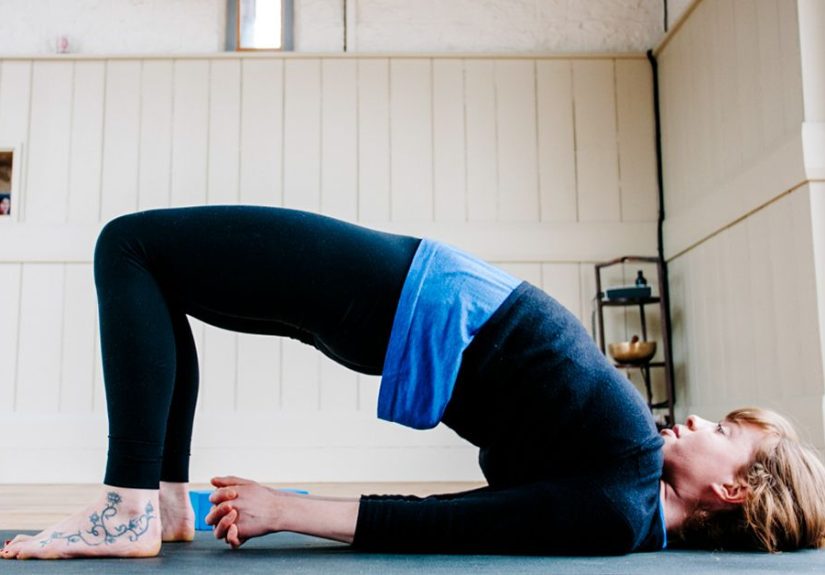
8) Bridge Pose (glutes + posterior chain support)
Why it helps: Strengthens glutes and back-body muscles that help offload the lumbar spine.
- Lie on your back, knees bent, feet hip-width, heels near sit bones.
- Exhale, gently tuck pelvis and lift hips.
- Inhale at the top, exhale slowly down.
- Do 6–10 controlled reps, or hold 10–20 seconds.
Modify: Place a yoga block (or firm pillow) under the sacrum for a supported bridge hold.
9) Low Lunge (hip flexor release)
Why it helps: Tight hip flexors from sitting can tilt the pelvis and increase lumbar strain.
- From kneeling, step right foot forward into a lunge.
- Gently shift hips forward until you feel a stretch in the left front hip.
- Keep torso tall; think “zip up” the lower belly lightly.
- Hold 5–8 breaths each side.
Modify: Put padding under the back knee. If balance is tricky, hold a chair or do it next to a wall.
10) Supine Twist (gentle rotational release)
Why it helps: Releases tight paraspinal muscles and can calm the nervous system.
- Lie on your back, arms out like a “T,” knees bent.
- Drop knees gently to one side; keep shoulders heavy.
- Turn head the opposite direction if it feels good.
- Hold 6–10 breaths each side.
Modify: Place a pillow under the knees so the twist is supported and not tugging.
11) Downward-Facing Dog (optional, with guardrails)
Why it helps: Can lengthen the spine and stretch calves/hamstrings, but it’s not for everyone with back pain.
- From hands and knees, tuck toes and lift hips up and back.
- Keep knees bent as much as needed to maintain a long spine.
- Press the floor away and breathe 3–5 breaths.
Modify: Try “Down Dog at a wall” or “at a chair” to reduce load and keep the back comfortable.
12) Mountain Pose (posture that prevents re-pain)
Why it helps: If you practice yoga but stand like a collapsed folding chair all day, your back will file a complaint.
- Stand tall, feet hip-width.
- Soften knees, stack ribs over pelvis, shoulders over ribs.
- Imagine the crown of your head floating upward.
- Breathe 5 slow breaths, feeling steady and balanced.
Three Simple Routines (Pick One and Repeat It)
Consistency beats complexity. Choose one of these sequences and do it 3–5 days per week.
If you want a “correct” answer: the correct routine is the one you’ll actually do.
10-minute “Back Reset” (great for busy days)
- Breathing: 5 slow rounds (inhale 4, exhale 6)
- Cat-Cow: 8 rounds
- Child’s Pose: 8 breaths
- Reclined Figure Four: 6 breaths each side
- Supine Twist: 6 breaths each side
20-minute “Mobility + Support” (a balanced option)
- Breathing: 5 rounds
- Cat-Cow: 10 rounds
- Low Lunge: 6 breaths each side
- Sphinx: 30 seconds
- Bridge: 8 slow reps
- Hamstring Strap Stretch: 6 breaths each side
- Supine Twist: 8 breaths each side
30-minute “Build Resilience” (when you’re ready)
- Breathing + gentle warm-up: 2 minutes
- Cat-Cow: 10 rounds
- Thread the Needle: 6 breaths each side
- Low Lunge: 8 breaths each side
- Supported Bridge hold: 30–60 seconds
- Bridge reps: 8 reps
- Hamstring Strap Stretch: 8 breaths each side
- Child’s Pose: 10 breaths
- Supine Twist: 10 breaths each side
- Mountain Pose: 5 breaths (practice posture on purpose)
Common Mistakes That Make Back Pain Worse (And How to Avoid Them)
Mistake 1: Stretching like you’re trying to win an award
Back pain yoga is not an audition for “Most Flexible Human.” If you chase depth, you can irritate joints and
sensitive tissues. Aim for stability first, range second.
Mistake 2: Holding your breath
Breath holding is a sneaky sign you’re forcing it. If you can’t breathe smoothly, back off the pose intensity.
Mistake 3: Forcing forward folds on a sensitive back
Some backs hate deep flexionespecially if there’s disc sensitivity or nerve irritation. Use hip hinges,
bend knees, and choose supported variations.
Mistake 4: Practicing once a week and expecting miracles
A little yoga, done often, tends to beat a lot of yoga done rarely. Try 10–20 minutes most days, then reassess
after 2–4 weeks.
How to Progress (Without Waking Up Regretful)
Here’s a practical progression that keeps you out of the “I did a big session and now I’m mad at myself” cycle:
Week 1–2: Calm things down
- Focus on gentle mobility + relaxation (Cat-Cow, Child’s Pose, Supine Twist)
- Keep holds short and intensity low
- Stop before you feel “done”; leave a little in the tank
Week 3–4: Add support strength
- Introduce Bridge reps, supported Bridge holds, and posture practice
- Increase holds by 10–15 seconds only if you feel better afterward
- Keep a simple log: what you did and how you felt later that day
Beyond: Make it real-life-proof
- Add walking, light strength work, and “movement breaks” during the day
- Use yoga as maintenance, not a last-minute rescue mission
When to See a Pro (Because Yoga Isn’t a Substitute for Diagnosis)
If your back pain is persistent, repeatedly disruptive, or worsening, consider checking in with a healthcare
professional. Physical therapists, sports medicine clinicians, and primary care providers can help determine
what’s driving your pain and which movements are most helpful.
Yoga can be part of a smart plan, but if something feels offespecially leg weakness, progressive numbness,
or severe night paindon’t “stretch through it.” Get evaluated.
Conclusion
Doing yoga to reduce back pain is less about mastering fancy poses and more about rebuilding trust with your own
bodyone gentle rep at a time. Start with safe, supported movements. Breathe like you mean it. Strengthen the
muscles that protect your spine. And repeat often enough that your back stops acting like every little movement
is a personal insult.
If you keep it consistent for a few weeks, many people notice they move more easily, recover faster from long
sitting, and feel less “tight and fragile.” That’s not hypeit’s what tends to happen when you give your spine
better options than “sit all day, panic at night.”
Experiences: What People Commonly Notice When Yoga Helps Back Pain (About )
People often expect yoga for back pain to feel like an instant “pop-and-fix” moment. In reality, the first
noticeable change is usually more boringand more useful: you start catching your patterns. The way you always
lean into one hip while brushing your teeth. The way your shoulders creep up toward your ears when you answer
email. The way you hold your breath when you stand up from the couch like it’s a heavyweight event. Yoga tends
to turn on the lights in those rooms.
In the first week or two, a common experience is feeling looser right after practice, then a little stiff again
later. That doesn’t mean it “didn’t work.” It usually means your body likes the movement, but your daily habits
are still winning the tug-of-war. This is where short routines shine. Ten minutes in the morning can reduce that
“rusty hinge” feeling; five minutes after work can stop your back from locking up after a long sit. Many people
report the biggest early payoff is simply standing up more smoothly and feeling less guarded.
Another frequent experience: you realize your hips are the plot twist. Someone may come in thinking, “My back is
the problem,” then discover their hip flexors feel like dried leather from sitting, or their glutes are basically
“on vacation,” leaving the lower back to do all the work. When they start doing Low Lunge and Bridge consistently,
their back often feels less pressurenot because the back got “stretched,” but because the workload got shared.
People with stress-driven tension often describe yoga’s impact as a nervous-system shift. They might notice their
pain is worse on intense days and lighter after slow breathing and gentle twists. The back doesn’t always need
a stronger stretch; sometimes it needs a message that the emergency is over. Longer exhales, supported poses,
and a calm pace can create that message. It’s not “all in your head,” but it is very much connected to how your
body processes stress.
By weeks three and four, many people report fewer “flare-ups” from everyday triggerslike loading groceries,
getting out of the car, or standing in line. The pain may not vanish, but it becomes less dramatic and less
fragile. The best sign you’re on track is not that you can do a deeper pose; it’s that normal life feels easier.
If your back tolerates sitting longer, recovers faster, and surprises you less often, your routine is doing its job.
A final, very real experience: learning what to skip. People often get better when they stop forcing deep forward
folds, stop pushing through sharp sensations, and start choosing modifications without ego. The win is not “I did
the full expression.” The win is “I did the version that helped, and I can do it again tomorrow.”