Table of Contents >> Show >> Hide
- Before You Start: The One Formula That Runs the Show
- Step 1: Confirm It’s a Regular Polygon (No Sneaky Imposters)
- Step 2: Gather What You Know (n, Side Length, Apothem, Radius… Anything Helps)
- Step 3: Find the Perimeter (Because Area Loves Perimeter)
- Step 4: Find the Apothem (a) Using the Info You Have
- Step 5: Use the Main Area Formula
- Step 6: If You Only Have Side Length and n, You Can Use a One-Line Formula Too
- Step 7: Sanity-Check Your Answer (So You Don’t Accidentally Invent New Physics)
- Extra Tips: Common Mistakes (and How to Dodge Them)
- Wrap-Up: The Cleanest Way to Remember It
- Real Experiences With Regular Polygon Area (About )
Regular polygons are the overachievers of the geometry world: all sides equal, all angles equal, and somehow they still
have time to look perfectly symmetrical. The only “problem” is figuring out their area without getting lost in a maze of
formulas, calculator buttons, and that one friend who insists “it’s basically a circle.”
In this guide, you’ll learn a reliable, repeatable method for finding the area of a regular polygonwhether
you’re working with a triangle, hexagon, octagon, or a “what-even-is-that” 17-gon. We’ll keep it practical, show multiple
ways to get the measurements you need, and include real examples so you’re not stuck with pure theory.
Before You Start: The One Formula That Runs the Show
The most useful all-purpose formula for the area of any regular polygon is:
Area = (1/2) × apothem × perimeter
If that sounds like a spell from a fantasy novel, don’t worry“apothem” is just the distance from the center of the polygon
straight out to the middle of a side, hitting it at a right angle. It’s basically the polygon’s “inner radius.”
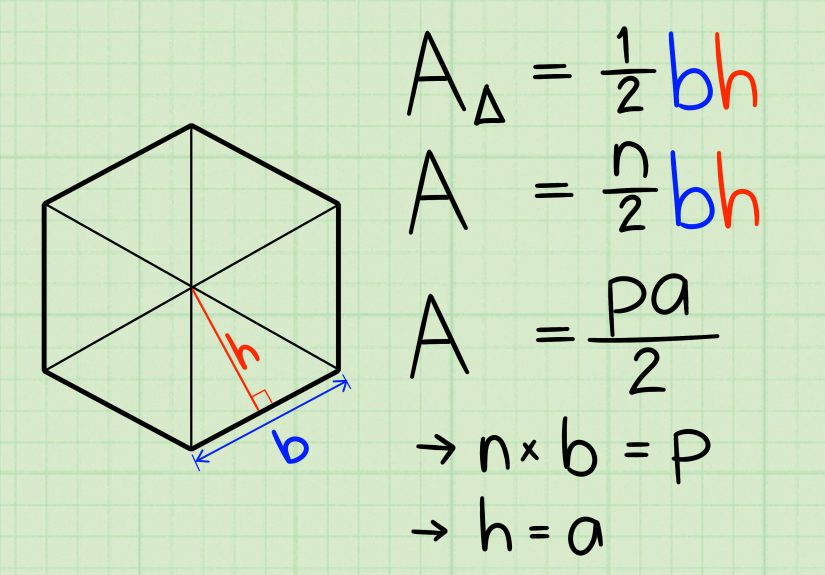
Why does the formula work? A regular polygon can be split into identical triangles by drawing lines from the center to each
vertex. Each triangle has base = side length and height = apothem, so each triangle’s area is (1/2) × side × apothem.
Add up n identical triangles and you get (1/2) × apothem × (sum of all sides) = (1/2) × apothem × perimeter.
Step 1: Confirm It’s a Regular Polygon (No Sneaky Imposters)
A polygon is regular if it is both equilateral (all sides equal) and equiangular
(all interior angles equal). If you’ve got a “square-ish” shape with one side slightly longer, that’s not a regular polygon
it’s a drama polygon, and it needs a different approach.
Also note: these steps are for regular, convex polygons (the normal kind that don’t cave in on themselves).
Star polygons are cool, but they’re a separate party.
Quick checklist
- All sides the same length?
- All angles the same measure?
- Shape doesn’t_toggle inward?
Step 2: Gather What You Know (n, Side Length, Apothem, Radius… Anything Helps)
Write down what you’re given. Most regular polygon area problems give you one of these sets:
- Side length (s) and number of sides (n)
- Apothem (a) and perimeter (P) (or enough info to find P)
- Circumradius (R) (center to vertex) and n
- Perimeter (P) and apothem (a) directly (the dream scenario)
If you know n and s, you can find the perimeter immediately:
P = n × s.
Step 3: Find the Perimeter (Because Area Loves Perimeter)
The perimeter of a regular polygon is just the side length multiplied by the number of sides:
P = n × s
Example: A regular octagon has 8 sides. If each side is 6 cm, then:
P = 8 × 6 = 48 cm
Easy win. Take it. Celebrate briefly. Then continue, because geometry never lets you relax for long.
Step 4: Find the Apothem (a) Using the Info You Have
The apothem is the key to the whole operation. If it’s given, you can skip ahead. If not, you can compute it using
trigonometry or relationships with the circumradius.
Option A: If you have side length (s) and number of sides (n)
Use this apothem formula:
a = s / (2 × tan(π/n))
This comes from splitting one of the central triangles in half: you get a right triangle where half the side length is
opposite angle (π/n) and the apothem is adjacent.
Option B: If you have the circumradius (R) and n
The apothem is:
a = R × cos(π/n)
(Because the apothem and circumradius form a right triangle with angle π/n at the center.)
Option C: If you have the apothem already
Congratulations. Your problem is basically on easy mode. Proceed to Step 5 and act humble about it.
Step 5: Use the Main Area Formula
Once you have apothem (a) and perimeter (P), compute:
Area = (1/2) × a × P
Example 1: Regular Octagon (given side length)
Suppose you have a regular octagon with side length s = 6 cm. Then n = 8.
- Perimeter: P = n × s = 8 × 6 = 48 cm
-
Apothem: a = s / (2 × tan(π/n)) = 6 / (2 × tan(π/8))
Since π/8 = 22.5°, tan(22.5°) ≈ 0.4142, so:
a ≈ 6 / (2 × 0.4142) = 6 / 0.8284 ≈ 7.24 cm - Area: A = (1/2) × a × P ≈ 0.5 × 7.24 × 48 ≈ 173.8 cm²
That’s the areaclean, consistent, and not a single mysterious “because math said so” moment required.
Example 2: Regular Hexagon (a common special case)
A regular hexagon is extra friendly because it splits into 6 equilateral triangles. If side length s = 10 in:
- Perimeter: P = 6 × 10 = 60 in
-
Apothem: for a regular hexagon, a = (√3/2) × s, so
a ≈ 0.866 × 10 = 8.66 in - Area: A = 0.5 × 60 × 8.66 ≈ 259.8 in²
Same formula, different path to the apothem. Geometry is flexible like thatwhen it wants to be.
Step 6: If You Only Have Side Length and n, You Can Use a One-Line Formula Too
Once you’ve seen how the apothem method works, you might prefer a direct formula that uses only the number of sides
(n) and side length (s):
Area = (n × s² / 4) × cot(π/n)
This is basically the same method “compressed.” It comes from substituting the apothem expression into the
(1/2)ap formula.
Example 3: Regular Pentagon (side length only)
Let’s say a regular pentagon has s = 9 ft, so n = 5.
- Compute π/n = π/5 = 36°
- cot(36°) ≈ 1 / tan(36°) ≈ 1 / 0.7265 ≈ 1.376
- Area ≈ (5 × 9² / 4) × 1.376 = (5 × 81 / 4) × 1.376 = (405 / 4) × 1.376 ≈ 101.25 × 1.376 ≈ 139.3 ft²
This is great when you want speed, but the apothem-perimeter formula is often easier to explain (and easier to remember).
Step 7: Sanity-Check Your Answer (So You Don’t Accidentally Invent New Physics)
Before you circle your final answer with confidence, do a quick reality check:
- Units: perimeter is in units (cm, ft, in), apothem is in units, so area must be in square units (cm², ft², in²).
-
Magnitude: if your octagon has side length 6 cm, an area around 174 cm² is reasonable. If your calculator says 17,400 cm²,
something went off the rails (usually degrees vs radians, or a missing parenthesis). -
Compare to a circle: a regular polygon with many sides approximates a circle. If you increase the number of sides while
keeping side length similar, the shape gets “rounder” and area behavior should make sense. - Rounding: keep extra decimals during trig steps and round at the end to avoid compounding errors.
Extra Tips: Common Mistakes (and How to Dodge Them)
Mixing up apothem and radius
The circumradius goes from the center to a vertex. The apothem goes from the center to the
middle of a side at a right angle. They’re related, but they’re not the same.
Using degrees when your calculator is in radians (or vice versa)
In formulas like tan(π/n), π means you’re working in radians. If your calculator expects degrees, you’ll get
nonsense. (To be fair, your calculator will deliver that nonsense with incredible confidence.)
Forgetting that “perimeter” is all sides
If a polygon has n sides of length s, the perimeter is n × s. Not s. Not s + a. Not “whatever feels right.”
Wrap-Up: The Cleanest Way to Remember It
If you remember nothing else, remember this:
- Perimeter: P = n × s
- Area: A = (1/2) × a × P
- Apothem (if needed): a = s / (2 × tan(π/n))
That trio will carry you through most regular polygon area problemshomework, tests, construction layouts, design projects,
and any unexpected moment when someone asks, “How much space is inside this perfectly symmetrical shape?”
Real Experiences With Regular Polygon Area (About )
The first time most people “get” the area of regular polygons is when it stops being a worksheet question and becomes a
real “how much material do we need?” moment. One of the most relatable examples is crafting: think quilts, tiled tabletops,
stained glass, or even those trendy geometric wall shelves. A regular hexagon looks cute on Pinterest, but it becomes
serious when you need to know how much wood, paint, or fabric it takes to fill the inside without wasting a bunch.
That’s where the apothem-perimeter formula feels less like a math rule and more like a life hack.
A surprisingly common “polygon area” situation shows up in DIY and home improvement. Imagine building a small firepit pad
or patio feature with pavers arranged as a regular octagon. You might know each side is, say, 12 inches, because that’s
how you cut the border stones. But what you really need is the total surface area so you can buy the right amount of
base sand or calculate how many center pavers fit. When you compute the perimeter (8 × 12 = 96 inches) and then find
the apothem with tan(π/8), it clicks that you’re basically measuring “half the perimeter times the inward height.”
Suddenly, the apothem isn’t a weird vocabulary wordit’s the distance that tells you how tall each of those interior
triangles is.
Another place regular polygons show up is design and manufacturing. People who play with 3D printing, laser cutting,
or CNC routing often work with regular polygons because they tessellate nicely or create strong, symmetrical parts.
If you’re making a coaster set with regular pentagons, you might be given only the side length from the design file.
The direct formula with cot(π/n) is fast, but many makers still prefer the apothem method because it provides a built-in
check: if your apothem seems too small compared to the side length, something’s wrong before you even hit “print.”
Even in a classroom setting, the most memorable experience tends to be the “triangle dissection” momentdrawing lines from
the center to each vertex and realizing you didn’t invent a new shape problem at all. You turned one complicated polygon
into n identical triangles, and triangles are friendly. That shift is huge: instead of memorizing a formula, you understand
why it works. And once you understand it, you’re less likely to mess up under pressure (like during a timed test when your
brain suddenly forgets what a square is).
The best practical habit I’ve seen is keeping your process consistent: identify n, compute perimeter, find apothem, then
apply A = (1/2)aP. That routine prevents the classic mistakeslike mixing up radius and apothem or ending up with an answer
in regular units instead of square units. In real projects, that kind of mistake costs time and money. In math class, it
costs points. Either way, the method saves you.