Table of Contents >> Show >> Hide
- Why Fishing Matters in Stardew Valley on Switch
- How to Fish Stardew Valley Switch: 9 Steps
- Step 1: Get Your First Fishing Rod from Willy
- Step 2: Equip the Rod and Stand Near Water
- Step 3: Hold Y to Cast Your Line
- Step 4: Wait for the Bite
- Step 5: Keep the Fish Inside the Green Bar
- Step 6: Practice on Easier Fish First
- Step 7: Upgrade to the Fiberglass Rod and Use Bait
- Step 8: Upgrade to the Iridium Rod for Tackle
- Step 9: Match Fish to Season, Weather, Time, and Location
- Best Beginner Fishing Tips for Nintendo Switch Players
- Common Mistakes When Fishing on Switch
- Best Fishing Progression Route for New Switch Players
- How Fishing Helps You Complete the Community Center
- Advanced Fishing Strategy After You Learn the Basics
- of Real Gameplay Experience: Learning to Fish on Switch
- Conclusion
Fishing in Stardew Valley on Nintendo Switch can feel like trying to balance a slippery pancake on a pogo stick. One second the fish is calm, the next it shoots upward like it just remembered it left the stove on. But once you understand the controls, timing, rods, bait, and a few sneaky tricks, fishing becomes one of the best ways to earn gold, complete bundles, level up, and stock your kitchen with ingredients that are not suspiciously dug out of the trash.
This guide explains exactly how to fish Stardew Valley Switch players can master, using nine practical steps. Whether you are brand-new, stuck on the fishing mini-game, or just tired of losing Catfish like they owe you money, this article breaks everything down in simple American English with real gameplay examples.
Why Fishing Matters in Stardew Valley on Switch
Fishing is more than a side activity. It is a full skill path with its own levels, professions, tools, recipes, treasure chests, Community Center requirements, and money-making potential. Fish can be sold, cooked, gifted, placed in ponds, used in quests, or donated to the Fish Tank bundles. Early in the game, fishing is also one of the most reliable ways to make gold before your crops become a tiny vegetable empire.
On Nintendo Switch, the basic fishing button is the Y button, which acts as the Use Tool button. You hold it to cast, release it to throw the line, press it when a fish bites, and use it during the mini-game to control the green fishing bar. That one button does a lot of work, so yes, it deserves a coffee break.
How to Fish Stardew Valley Switch: 9 Steps
Step 1: Get Your First Fishing Rod from Willy
Early in your first spring, you will receive a letter from Willy asking you to visit him at the beach. Go south from Pelican Town, cross the bridge area near the shore, and enter the Fish Shop. Willy gives you the Bamboo Pole, your first standard fishing rod. It cannot use bait or tackle, but it is enough to begin catching common fish in rivers, lakes, and the ocean.
If you are struggling, buy the Training Rod from Willy’s Fish Shop. It costs only 25g and is designed for beginners. The Training Rod makes the green fishing bar larger, which gives you more room to keep the fish inside it. The trade-off is that it only catches easier, basic fish and cannot use bait or tackle. Still, for learning the rhythm, it is fantastic. Think of it as training wheels, except the wheels smell faintly like sardines.
Step 2: Equip the Rod and Stand Near Water
Open your toolbar and select your fishing rod. Stand near a body of water such as the ocean, the river in town, the river in Cindersap Forest, or the mountain lake. You can fish in many watery places, but not all fishing spots are equally useful. Some small ponds produce more trash, while deeper or better-positioned water usually gives you better catches.
For beginners, the mountain lake near the Mines is a friendly place to practice because many of the fish there are slower and easier than the wild little chaos rockets found elsewhere. The ocean is also good for early catches like Sardines and Anchovies, depending on season and time.
Step 3: Hold Y to Cast Your Line
On Nintendo Switch, press and hold Y to begin casting. A casting meter appears. The longer you hold the button, the farther your bobber will fly. Release Y when the meter is near full for a longer cast.
A longer cast usually helps because distance from land can reduce trash and improve fish quality. You do not need a perfect max-distance cast every single time, especially while learning, but aim for deeper water when possible. You can also slightly angle your cast with the joystick during the cast, which helps you reach bubbles or better tiles.
Step 4: Wait for the Bite
After your bobber lands, wait. Do not mash buttons immediately. Your character is not trying to win a cooking show; patience matters. When a fish bites, the bobber wiggles, you hear a sound, and an exclamation mark appears above your farmer’s head.
When you see the exclamation mark, press Y quickly to hook the fish and start the mini-game. If you wait too long, the fish gets away before the mini-game begins. This is one of the most common beginner mistakes on Switch: players cast correctly, hear the bite, then panic for half a second. Unfortunately, fish are not famous for their patience.
Step 5: Keep the Fish Inside the Green Bar
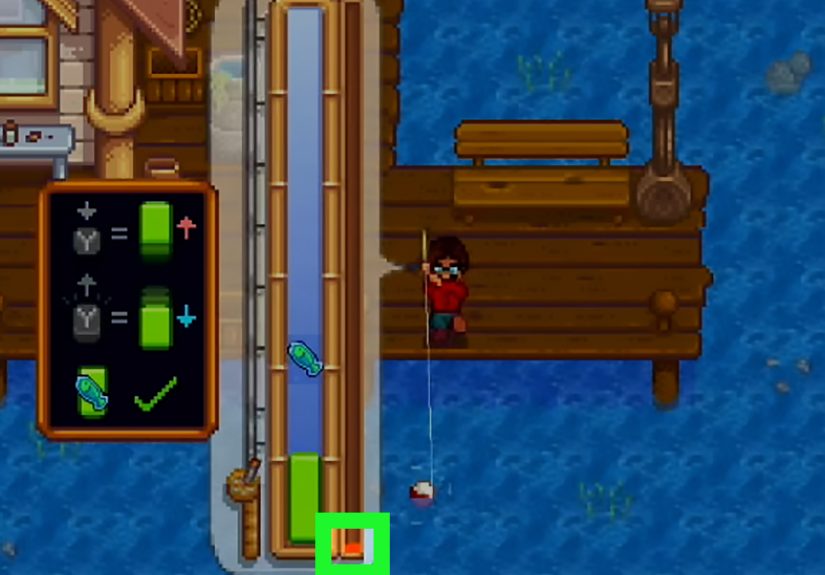
The fishing mini-game is the part that makes new players either feel like champions or consider moving to a desert farm where water cannot hurt them. The goal is simple: keep the moving fish icon inside the green rectangle until the progress bar on the side fills completely.
Pressing or holding Y raises the green bar. Releasing Y lets it fall. Tapping Y repeatedly can keep the bar hovering in place. Holding Y too long makes the bar shoot upward, and letting go too long makes it drop. The trick is to use short taps and controlled holds instead of panicked button smashing.
Imagine the green bar is a tiny elevator. The fish is your impatient passenger. Your job is not to launch the elevator into space; your job is to keep it gently lined up with the fish. Use quick taps when the fish is steady, hold briefly when it rises, and release carefully when it drops.
Step 6: Practice on Easier Fish First
Not all fish behave the same. Some move slowly and predictably. Others bounce around like caffeinated popcorn. Early on, focus on easy fish so you can build muscle memory. Carp, Chub, Sardine, Anchovy, Sunfish, and Smallmouth Bass are generally less terrifying than high-difficulty fish like Catfish, Sturgeon, Lava Eel, or Legendary Fish.
The Training Rod is especially helpful here. It limits you to easier fish and gives you a larger green bar. Even though your catches will be normal quality, they still count toward experience, achievements, and your collection. Once you gain a few fishing levels, the normal fishing bar becomes larger, making the mini-game easier even with better rods.
Step 7: Upgrade to the Fiberglass Rod and Use Bait
When you reach Fishing Level 2, Willy sells the Fiberglass Rod for 1,800g. This is the first rod that can use bait. Bait does not make the mini-game easier directly, but it makes fish bite faster, which means less standing around staring at water like you are waiting for it to apologize.
To use bait on Switch, open your inventory, select the bait, and attach it to the rod. The Fiberglass Rod can use bait but not tackle. Standard bait is affordable, can be crafted from Bug Meat after unlocking the recipe, and is one of the best upgrades for anyone who fishes often.
Once bait is attached, each cast consumes one piece. If you run out, the game tells you that you have used your last bait. Keep extra bait in a chest or carry a stack when planning a long fishing day.
Step 8: Upgrade to the Iridium Rod for Tackle
At Fishing Level 6, you can buy the Iridium Rod for 7,500g. This rod can use both bait and tackle. Tackle can change the fishing experience in powerful ways. The Trap Bobber makes fish escape more slowly when they are outside the bar, which is excellent for difficult fish. The Cork Bobber slightly increases the size of your fishing bar. The Spinner and Dressed Spinner reduce wait time by increasing bite rate. The Treasure Hunter helps if you love fishing treasure chests and pretending you are a pirate with better posture.
Tackle wears out after repeated fish bites, so do not be surprised when it disappears. For serious fishing trips, bring backups. Later, after Fishing Mastery, the Advanced Iridium Rod can use bait and two tackles at once, which lets advanced players stack effects and chase tougher goals.
Step 9: Match Fish to Season, Weather, Time, and Location
Learning the controls is only half the job. The other half is knowing where and when to fish. Many fish are available only in specific seasons, weather, times of day, and locations. For example, some fish appear only when it rains, some only at night, and some only in the ocean, river, lake, mines, or special areas.
Before hunting a specific fish, check four things: season, weather, time, and location. If you are trying to catch Walleye, you need the correct rainy conditions and time window. If you want Catfish, rainy days matter. If you are chasing Sturgeon, the mountain lake and proper seasons are key. Legendary Fish have even stricter rules, including specific locations and high fishing skill requirements.
For everyday fishing, choose a spot based on your goals. Want money? Fish where valuable seasonal fish appear. Want bundle progress? Target the specific bundle fish. Want easy experience? Practice on slower fish. Want treasure? Use tackle and longer casts. Want peace? Maybe avoid Catfish until your thumb stops trembling.
Best Beginner Fishing Tips for Nintendo Switch Players
Use Tapping Instead of Holding Too Long
The most important Switch fishing tip is to avoid holding Y nonstop. Holding makes the bar accelerate upward, and that momentum can cause overshooting. Short rhythmic taps give better control. If the fish rises steadily, hold Y briefly. If it drops, release and let the bar fall, then tap again before it slams into the bottom.
Do Not Chase Every Tiny Movement
Beginners often overcorrect. The fish moves up a little, so they launch the bar upward. Then the fish drops, and the bar is still flying like a confused elevator. Instead, watch the fish’s general direction. If it wiggles slightly inside the bar, stay calm. Make small adjustments.
Let the Bar Bounce Less at the Bottom
When the green bar falls to the bottom, it can bounce, making control harder. Tap Y just before it hits the bottom to soften the landing. This little habit makes a big difference during long fights.
Eat Fishing Buff Food
Food with fishing buffs temporarily increases your fishing level, which can enlarge the green bar and improve your chances. Trout Soup from Willy is a simple early option. Later, stronger foods can help with difficult fish and Legendary Fish.
Fish in Bubbles Whenever Possible
Sometimes bubbles appear in the water. Cast into them if you can. Bubbles make fish bite much faster and can improve the kind of fish you hook. If the bubbles are slightly out of reach, try angling your cast with the joystick.
Common Mistakes When Fishing on Switch
Using the Wrong Rod for Your Skill Level
If you cannot catch anything with the Bamboo Pole, switch to the Training Rod. There is no shame in using the beginner tool. Stardew Valley is cozy, not a thumb wrestling championship.
Fishing in Poor Spots
Some water tiles produce more trash than fish. If you keep pulling up Joja Cola, broken glasses, and soggy newspapers, move to a better body of water or cast farther from shore.
Ignoring Time and Weather
If a fish is not available in your current conditions, no amount of button skill will summon it. Always check whether the fish needs rain, night, a specific season, or a specific location.
Trying Legendary Fish Too Early
Legendary Fish are meant to be hard. Do not chase them with low fishing skill, no tackle, and the confidence of someone who just caught three Carp. Level up first, bring the right rod, use buff food, and prepare for a fight.
Best Fishing Progression Route for New Switch Players
Start with Willy’s Bamboo Pole, then buy the Training Rod if the mini-game feels impossible. Practice at the mountain lake or ocean until you reach Fishing Level 2. Buy the Fiberglass Rod and use bait to speed up catches. Keep fishing to earn money and experience. At Fishing Level 6, buy the Iridium Rod and begin using tackle for difficult catches.
Along the way, save at least one of each fish until you know whether you need it for bundles, quests, cooking, or ponds. Selling every fish is tempting, especially early on, but future-you may not appreciate present-you’s “sell first, think never” financial strategy.
How Fishing Helps You Complete the Community Center
The Fish Tank bundles require fish from different seasons, locations, times, and weather conditions. This encourages you to fish throughout the year instead of waiting until winter and realizing you missed several spring-only opportunities. Keep a chest near your house for bundle fish, and label it mentally as “Do Not Sell, Seriously.”
Fishing also helps you unlock useful rewards and progress toward restoring Pelican Town. Completing bundles is one of the most satisfying parts of the game, and fishing plays a major role. Even players who dislike fishing at first often become grateful once they see how much progress a few well-planned rainy days can create.
Advanced Fishing Strategy After You Learn the Basics
Once you are comfortable, focus on quality and efficiency. Cast farther from land for better average results. Use bait to reduce waiting. Use tackle to match your goal: Trap Bobber for hard fish, Cork Bobber for a larger bar, Spinner for speed, Treasure Hunter for chest runs, and Quality Bobber when you care about fish quality.
Keep track of fish behavior. Smooth fish are easier, darting fish are harder, and sinker or floater patterns require different reactions. When a fish moves quickly, do not panic. Keep the bar close, recover gradually, and avoid wild overcorrections.
As your Fishing level rises, your green bar gets larger. That means every catch makes future catches easier. Fishing has a snowball effect: the beginning is the hardest, but once you gain levels, better rods, bait, tackle, and food buffs, you start feeling like the valley’s aquatic tax collector.
of Real Gameplay Experience: Learning to Fish on Switch
The first time many players try fishing in Stardew Valley on Switch, they assume they are doing something wrong. The cast works, the fish bites, the mini-game appears, and then the fish icon launches itself upward like it has urgent business with the moon. The green bar lags behind, the progress meter drains, and the fish escapes. After three or four failures, it is easy to think fishing is broken. It is not broken; it is just secretly a rhythm game wearing a straw hat.
One of the best experiences for learning is spending a full in-game morning at the mountain lake with the Training Rod. Do not worry about profit at first. Treat it like practice. Cast into the deepest water you can reach, wait for the bite, and focus only on controlling the bar. After a few catches, you begin to notice that tapping Y lightly gives more control than holding it. You also learn that the bar has weight. It does not stop instantly. It keeps moving for a moment, which is why gentle adjustments work better than dramatic ones.
A useful beginner habit is to watch the fish, not the progress bar. The progress bar tells you whether you are winning, but the fish tells you what to do next. If the fish rests near the bottom, tap just enough to keep the green bar from bouncing too hard. If it rises slowly, hold Y for a short burst. If it jumps, follow it, but do not chase so aggressively that you overshoot. The best fishing sessions feel calm, almost musical: tap, pause, tap-tap, hold, release, tap again.
Rainy days are also memorable. At first, rainy-day fish can feel rude. Catfish, for example, may humble even confident players. But rain is valuable because it opens special fish opportunities. A smart approach is to use rainy days for targeted fishing only when you are ready. Early on, you can still fish easier locations and build experience. Later, with the Iridium Rod, Trap Bobber, bait, and a fishing food buff, those once-impossible fish become manageable.
Another practical experience: fishing is one of the best early-game money makers if you commit to it. A day spent fishing can pay for seeds, backpack upgrades, or the Fiberglass Rod. The key is preparation. Empty your backpack, bring food if your energy is low, start early, and stay near your chosen water source. If you catch treasure chests, they can include useful items that make the day even more profitable.
Eventually, the same mini-game that felt impossible starts feeling satisfying. You recognize fish patterns. You know when to tap and when to hold. You upgrade rods without fear. You stop blaming Willy, the ocean, and possibly the entire trout population. That is the magic of fishing in Stardew Valley on Switch: it begins as frustration, turns into practice, and becomes one of the most rewarding skills in the game.
Conclusion
Learning how to fish Stardew Valley Switch style is all about understanding the Y button, practicing the green bar mini-game, choosing beginner-friendly fish, and upgrading your equipment at the right time. Start with the Bamboo Pole or Training Rod, use short taps instead of panicked holds, fish in good locations, and pay attention to season, weather, time, and water type.
Once you get past the awkward beginning, fishing becomes a powerful tool for earning gold, completing the Community Center, finding treasure, cooking recipes, and enjoying the slower rhythm of valley life. The fish may still be dramatic, but now you will be ready for their underwater theater performance.