Table of Contents >> Show >> Hide
- Why Your Interview Introduction Matters (More Than You Think)
- What Interviewers Are Really Asking When They Say “Tell Me About Yourself”
- The Ideal Length (And the One Thing You Must Not Do)
- The Best Frameworks for a Job Interview Introduction
- How to Introduce Yourself in a Job Interview: Step-by-Step
- Fill-in-the-Blank Self-Introduction Template (So You Can Build Yours Fast)
- Strong Examples of How to Introduce Yourself in an Interview
- Common Mistakes to Avoid (So You Don’t Accidentally Audition for a Podcast)
- How to Tailor Your Introduction to Different Interview Situations
- How to Practice Your Job Interview Introduction (Without Sounding Scripted)
- Quick Checklist: A Great Self-Introduction Includes
- Conclusion
Your job interview introduction is basically the movie trailer of your career: it should be short, clear, and make the hiring manager think, “Okay… I’m in.”
The problem? A lot of people treat “Introduce yourself” like a trapdoor and fall straight into rambling, awkward fun facts, or a dramatic reading of their resume. (Spoiler: your interviewer already has your resume. They do not need the director’s commentary.)
This guide shows you exactly how to introduce yourself in a job interviewwhat to say, how long it should be, how to tailor it to the role, and how to sound human (confident, not robotic). You’ll get simple frameworks, strong examples, and a few friendly reminders to stop saying “I’m a perfectionist” like it’s still 2009.
Why Your Interview Introduction Matters (More Than You Think)
The first minute sets the tone. Not because interviewers are judgmental villains twirling mustachesbut because humans make quick impressions. Your introduction quietly answers:
- Can you communicate clearly?
- Do you understand what this job needs?
- Do your strengths match the role?
- Are you someone we can work with?
A strong self-introduction gives the interviewer a clean mental “map” of you. A messy one makes them work harder to find the pointlike hunting for the remote while you’re sitting on it.
What Interviewers Are Really Asking When They Say “Tell Me About Yourself”
It sounds casual. It isn’t. Most versions of this question translate to: “Give me the highlights of your background that are most relevant to this jobthen connect it to why you’re here.”
Common variations include:
- “Walk me through your resume.”
- “I’d love to learn more about your journey.”
- “Tell me something that’s not on your resume.”
- “How would you describe yourself?”
Your goal is not to recite your life story. Your goal is to deliver a short, job-relevant narrative that makes the next question easier for them to ask.
The Ideal Length (And the One Thing You Must Not Do)
For most interviews, aim for 60–90 seconds. If the interviewer seems warm and curious, you can stretch toward two minutesbut only if you’re still being relevant.
The one thing you must not do: start from the beginning of time. Your interviewer does not need the origin story of your interest in spreadsheets (though honestly, that would be impressive).
The Best Frameworks for a Job Interview Introduction
1) The Present–Past–Future Formula (Simple, Flexible, Hard to Mess Up)
This is the most popular structure for a reason. It keeps your answer organized and prevents the “and then… and then…” spiral.
- Present: What you do now (or what you’re doing currently if you’re a student).
- Past: One or two relevant steps that built your skills.
- Future: Why this role/company is the next logical step.
Bonus: It sounds naturallike a story with a beginning, middle, and a “please hire me” ending.
2) The “3P” Pitch: Position, Proof, Purpose
If you want a crisp, business-friendly self-introduction, use:
- Position: Who you are professionally right now.
- Proof: A measurable win or standout strength.
- Purpose: Why you’re excited about this role.
3) The “Themes” Method (Great for Career Changers or Non-Linear Paths)
Instead of listing jobs, group your experience into 2–3 themes that match the job descriptionlike: “customer obsession,” “process improvement,” or “leading cross-functional teams.” This helps your background feel intentional, even if your path looks like a scenic road trip.
How to Introduce Yourself in a Job Interview: Step-by-Step
Step 1: Start With a Professional Greeting (Yes, It Still Matters)
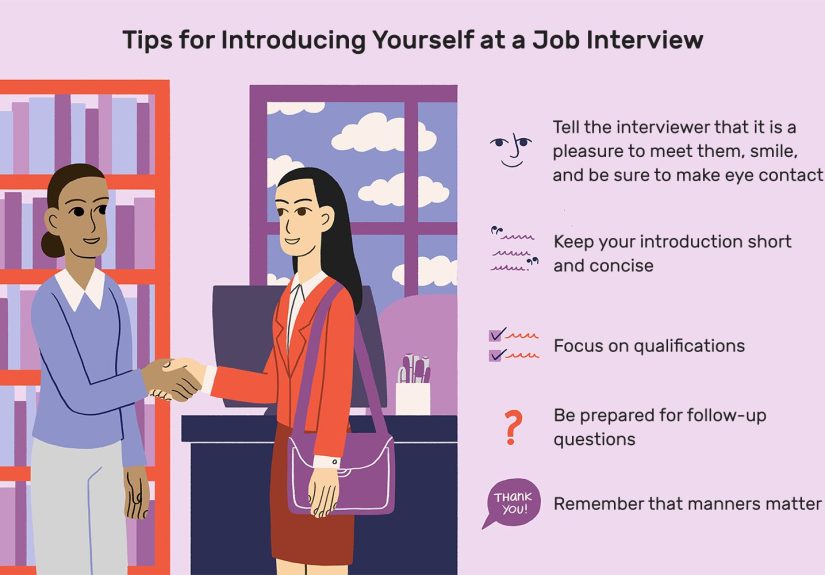
If it’s in person: smile, make eye contact, and greet them like a colleague you respectbecause that’s the goal. If a handshake is offered, take it. If not, don’t force it. (We’re aiming for “confident professional,” not “unexpected grip strength competition.”)
For video interviews: look at the camera, not your own face. Otherwise you’ll appear to be staring lovingly at yourself, whichwhile aspirationalcan be misread.
Step 2: Say Your Name and a One-Line Professional Label
This is your quick “anchor.” Examples:
- “I’m Jordan Lee, a data analyst focused on customer insights and experimentation.”
- “I’m Priya Patel, a project manager who specializes in cross-team launches and operational clarity.”
- “I’m Sam Rivera, a recent finance graduate with internship experience in FP&A and reporting.”
Step 3: Give 1–2 High-Impact Highlights (With Proof)
Choose accomplishments that match the job. When possible, use numbers, scope, or outcomes:
- Revenue impacted
- Time saved
- Costs reduced
- Conversion improved
- Projects delivered
- Teams influenced
Not everything has to be a percentage. “Led a cross-functional launch with engineering and marketing” is still concreteeven without confetti cannons and a KPI parade.
Step 4: Connect the Dots to This Job (The Part Most People Forget)
This is where you earn the interview. You’re not just saying what you’ve doneyou’re showing why it matters here:
- “That’s why this role stood out…”
- “I’m excited about your focus on…”
- “This position is a great fit because…”
The interviewer should be able to think: “Yes, that’s exactly what we need.”
Step 5: Land the Plane With a Clean Close
End with a simple line that invites the conversation forward:
- “I’d love to share more about how I approach [key skill] and what I’m looking for next.”
- “I’m happy to go deeper on any of those projects.”
- “That’s the quick versionwhere would you like me to start?”
Fill-in-the-Blank Self-Introduction Template (So You Can Build Yours Fast)
Use this to draft your own “tell me about yourself” answer without sounding like a chatbot reading cue cards:
Template:
- “I’m [Name], a [role/field] currently [doing what, where].”
- “Recently, I [key accomplishment], which led to [result].”
- “Before that, I [relevant past experience/theme], where I built [skill].”
- “I’m interested in this role because [specific reason tied to company/role], and I’d love to bring [strength] to [team goal].”
Strong Examples of How to Introduce Yourself in an Interview
Example 1: Experienced Professional (Marketing)
“I’m Taylor Chen, a growth marketer currently leading lifecycle campaigns for a B2C subscription brand. Over the last year, I rebuilt our email onboarding and reactivation flows, which improved trial-to-paid conversion and reduced early churn. Before that, I worked in performance marketing where I got really strong at testing, segmentation, and translating data into creative direction. I’m excited about this role because your team is scaling personalization across channels, and that’s exactly where I do my best workbuilding systems that drive measurable growth without annoying customers.”
Example 2: Entry-Level Candidate (Recent Grad)
“I’m Alex Martinez. I recently graduated with a degree in supply chain management, and I’m coming from an internship where I supported inventory reporting and helped standardize weekly metrics for our operations team. One project I’m proud of was improving a tracking process that reduced manual updates and made it easier for the team to spot issues early. I’m interested in this role because it blends analysis and coordination, and I’m excited about your company’s focus on reliability and customer experience.”
Example 3: Career Changer (Customer Success to Product)
“I’m Morgan Davis. For the past four years, I’ve been in customer success, working closely with mid-market SaaS clients to drive adoption and retention. Over time, I found myself drawn to the product sideespecially when I partnered with product managers to turn customer pain points into feature requests and workflow improvements. I started taking on internal projects, like mapping onboarding friction and proposing changes that reduced support tickets for new users. I’m now looking to move into product operations because I love connecting customer insight, data, and executionand this role seems built for exactly that.”
Example 4: Technical Candidate (Software Engineer)
“I’m Jamie Brooks, a software engineer focused on backend systems and reliability. In my current role, I’ve worked on API performance and observabilitymost recently leading a project to reduce latency by refactoring a key service and improving caching and monitoring. Earlier in my career, I built internal tools that helped teams ship faster with fewer production incidents. I’m excited about this opportunity because your platform is operating at scale, and I’d love to contribute to systems that are fast, resilient, and easy for developers to work with.”
Common Mistakes to Avoid (So You Don’t Accidentally Audition for a Podcast)
- Repeating your resume word-for-word: summarize and add context, impact, and “why this matters.”
- Going too personal too fast: “I have two cats and a dream” is charming, but not your opening.
- Being vague: “I’m a hard worker” means nothing without proof. Show the work.
- Overloading details: pick highlights. You can share the rest when asked.
- Not tying it to the job: your introduction should feel tailored, not recycled.
- Apologizing: “I’m probably not the best…” is an instant self-own. Don’t.
How to Tailor Your Introduction to Different Interview Situations
Phone Screen (Recruiter Intro)
Keep it tighterabout 45–60 seconds. The recruiter is checking fit: role alignment, timeline, and basics.
- Lead with your current role and the kind of roles you’re targeting.
- Highlight 1–2 relevant strengths.
- Close with why you’re interested in this company.
Panel Interview
Your introduction should help multiple people “place” you quickly. Keep it structured and use one standout win. If you know who’s on the panel, consider a subtle nod to the function: “I’m excited to chat with both product and engineering today because my recent work sat right at that intersection.”
Behavioral Interview
Your intro should tee up story-ready themes (leadership, conflict, problem-solving). Choose highlights that give the interviewer obvious follow-up questions.
Virtual Interview
Add a small “tech-aware” opener if needed: “Hi! Can you hear me okay?” Then proceed. Also:
- Speak slightly slower than you think you need to.
- Pause before answering so you don’t talk over anyone.
- Keep notes minimalno scrolling through a novel while pretending to make eye contact.
How to Practice Your Job Interview Introduction (Without Sounding Scripted)
The goal is polished, not memorized. Practice enough that you can say it naturally, even if the interviewer interrupts, asks you to go deeper, or your brain briefly forgets what words are.
- Record yourself once. Yes, it’s mildly uncomfortable. That’s how you know it’s working.
- Practice in “chunks,” not word-for-word. Memorize the structure and key points.
- Test your timing and trim anything that doesn’t serve the job.
- Ask a friend to stop you if you get vague or go off-road.
Quick Checklist: A Great Self-Introduction Includes
- Your name and professional identity
- Current situation (role, school, or focus)
- One or two relevant wins (with proof)
- A clear connection to the role and company
- A clean closing line that invites questions
Conclusion
The best way to introduce yourself in a job interview is to be strategic, not encyclopedic. You’re giving the interviewer a guided tour: where you are now, how you got here, and why this role makes sense next. Keep it concise, make it relevant, and add proof so your claims don’t float away like motivational posters.
If you remember only one thing, make it this: Your introduction is not your biographyit’s your pitch. And a good pitch always answers, “Why you, and why here?”
Extra: Real-World Experiences That Make Your Introduction Better (500+ Words)
Here’s what tends to happen in real interviewswhere the lighting is weird, the chair is too low, and your brain decides to forget the word “collaboration” for no reason. Candidates often assume the introduction has to be perfect. In practice, it just has to be clear.
One common experience: people over-prepare the first line and under-prepare the middle. They nail “Hi, I’m Jordan!” and then drift into an ocean of details: every role, every tool, every team, every time they ever opened Excel. The fix is simple: pick a lane. Choose one or two highlights that match the job and let the interviewer pull more information out of you with follow-up questions. That’s not “leaving things out.” That’s pacing.
Another pattern: strong candidates sabotage themselves with apologetic framingespecially career changers and job seekers with a gap. They open with what they think is a disclaimer: “So, I don’t have direct experience, but…” The room immediately hears, “I’m not qualified,” even if that isn’t true. A better approach is confident context: “I’m transitioning from customer success into product operations. In my current role, I’ve led cross-functional process improvements and partnered with product on workflow changesso I’m excited to bring that experience into a role that sits closer to product execution.” Same truth. Completely different impact.
In-person interviews create their own “experience lessons.” Candidates who arrive flustered often ramble because their nervous system is still sprinting. The real-world trick: build in a buffer and a reset. Get there early. Sit for two minutes. Breathe. Review your three anchor points (present, proof, purpose). Your introduction will sound calmer because you actually are calmer. Revolutionary concept, I know.
Virtual interviews have different failure modes. Candidates sometimes sound flatnot because they’re boring, but because video calls steal energy. The experienced move is to add 10% more warmth than you think you need: slightly more smile, slightly more vocal variety, slightly more intentional pauses. And if your Wi-Fi does a dramatic plot twist, don’t panic-apologize for five minutes. State the issue, propose a fix, and continue: “Looks like my connection frozesorry about that. I’m back now. I was saying…” That’s professionalism under pressure, which is secretly a great skill to demonstrate.
Finally, real interviews reward specificity. Candidates who say, “I’m results-driven,” are instantly forgettable. Candidates who say, “I reduced processing time by 25% by simplifying the handoff between sales and onboarding,” become concrete in the interviewer’s mind. Even if your work isn’t easily measurable, you can still show scope: “I supported three stakeholders,” “I managed five concurrent projects,” “I coordinated across engineering and support,” or “I built a process the team now uses weekly.” Those details come from lived experienceand they’re exactly what makes your introduction sound real.
The most helpful mindset shift candidates report is this: your introduction isn’t a performance; it’s a preview. You’re offering the interviewer a clean, relevant starting point for the conversation. If you do that well, the rest of the interview feels less like an interrogation and more like a collaborative discussion about whether the role fitson both sides.

![18 Best Types of Charts and Graphs for Data Visualization [+ How to Choose]](https://corkopencoffee.org/wp-content/uploads/2026/05/18-best-types-of-charts-and-graphs-for-data-visualization-how-to-choose-qKM1PBYG-thumb.jpg)