Table of Contents >> Show >> Hide
- The Spring Is There, But It Is Not Doing The Launching
- What Is A Four-Bar Linkage?
- Print-In-Place Design Makes It Even More Interesting
- BB Shooter, Airsoft Gun, And Air Gun: Similar Words, Different Ideas
- The Safety Conversation Is Not Optional
- Why This Mechanism Is Clever
- The Detent: Small Feature, Big Personality
- What Makers Can Learn From It
- Experience Notes: What This Kind Of Design Teaches In The Real World
- Conclusion: The Best Trick Is The One You Can Understand
- SEO Tags
Some titles make you stop scrolling. “This BB Shooter Has A Spring, But Not For What You Think” is one of them. At first glance, it sounds like another familiar spring-powered BB shooter: pull something back, store energy in a spring, release it, and watch a tiny plastic BB zip away like it has a meeting to attend. Simple, right?
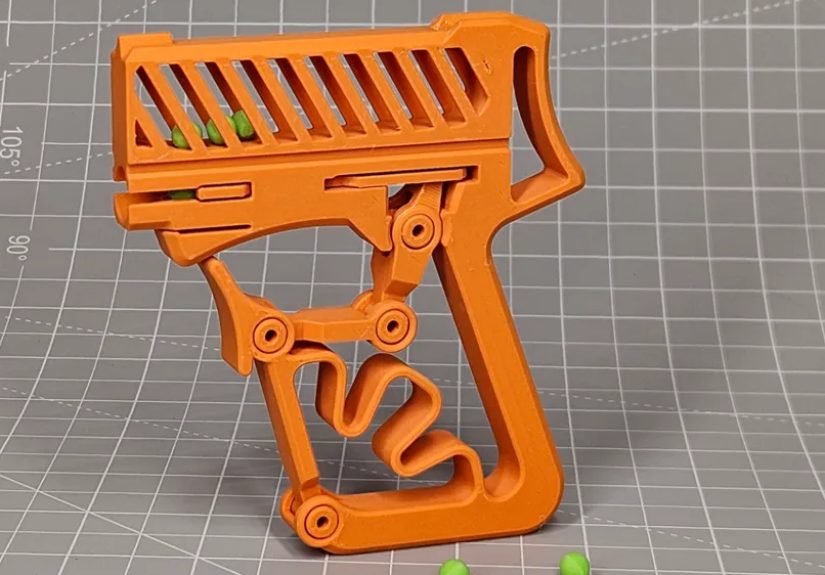
Not exactly. The clever twist is that the spring is not the star of the launch. It is more like the stagehand quietly resetting the curtain after the actor takes a bow. In this design, the spring mainly returns the trigger to its starting position. The real action comes from a four-bar linkage, a detent, a striker-like pusher, and a very satisfying bit of mechanical advantage.
That is what makes this BB shooter interestingnot because it is powerful, flashy, or complicated, but because it flips expectations. It reminds us that great mechanical design is not always about adding more force. Sometimes, it is about routing ordinary finger motion through a clever path until a small mechanism does something surprisingly elegant.
The Spring Is There, But It Is Not Doing The Launching
Most people hear “spring BB shooter” and imagine a compressed spring providing the main energy. That assumption makes sense. Many airsoft and BB-style devices use springs in some way, often to move a piston, striker, or plunger. In the usual mental model, the spring is pulled back, held under tension, then released to drive the projectile forward.
This design takes a different route. The spring is present, but its job is humble: it helps the trigger return after being pulled. The launch itself is created by the motion of the linkage and the way the BB interacts with a small retaining feature known as a detent. The trigger pull moves a linkage, the linkage pushes a striker forward, and the BB resists movement until enough pressure builds to pop it past the detent.
That little “pop” is the secret sauce. Instead of a spring storing and dumping energy like a mini catapult, the user’s finger supplies the motion directly through the mechanism. The detent temporarily holds the BB, the linkage multiplies and redirects the trigger movement, and the projectile is released once the force threshold is reached.
It is less “slingshot in disguise” and more “tiny mechanical argument between geometry and friction.” Geometry wins. The BB leaves.
What Is A Four-Bar Linkage?
A four-bar linkage is one of the classic building blocks of mechanical engineering. It uses four connected links arranged in a closed chain. One link is fixed, one acts as the input, one acts as the output, and one floats between moving joints. That sounds technical, but the idea is everywhere: windshield wipers, folding mechanisms, pliers, pedal linkages, and countless machines use versions of this principle.
In a BB shooter like this, the four-bar linkage transforms the movement of the trigger into a different movement at the striker. A rearward trigger pull can become a forward push. That is the magic. The mechanism is not merely transferring motion; it is reshaping it.
Why Mechanical Advantage Matters
Mechanical advantage is the reason a small input can create a useful output. It is why a bottle opener works, why pliers make you feel stronger than your fingers actually are, and why a cleverly arranged linkage can make a tiny printed toy feel surprisingly snappy.
In this BB shooter, mechanical advantage helps the trigger finger overcome the resistance of the BB sitting against the detent. The shooter does not need a large spring to slam the projectile forward. Instead, the linkage gives the user’s pull a more useful direction and leverage profile. The result is a simple, compact motion that feels more sophisticated than the number of parts would suggest.
Print-In-Place Design Makes It Even More Interesting
The design is also notable because it is print-in-place. That means the moving parts can be produced as one connected object on a 3D printer, rather than printed separately and assembled later with pins, screws, rods, or hardware. For makers, that is a big deal. It turns a mechanism into a single-print demonstration of tolerances, clearances, hinges, flexures, and design confidence.
Print-in-place mechanisms are fun because they feel a little impossible the first time you see them. You remove a part from the printer, flex a joint, free a hinge, and suddenly the object moves. No toolbox. No fasteners. No tiny screw rolling under the workbench where all tiny screws go to start a new civilization.
However, print-in-place also brings challenges. The designer must account for material stiffness, layer adhesion, friction, joint clearance, and how easily a printed hinge can move without breaking. A four-bar linkage printed as one piece needs enough freedom to articulate, but not so much looseness that the motion becomes sloppy. That balance is what separates a neat prototype from a plastic noodle with ambition.
BB Shooter, Airsoft Gun, And Air Gun: Similar Words, Different Ideas
The phrase “BB shooter” can mean different things depending on context. Some people use it casually for low-power plastic BB launchers or airsoft-style toys. Others think of metal BB guns, pellet guns, or non-powder air guns. These categories matter because the safety risks and legal treatment can vary widely by design, projectile, power source, age of user, and local rules.
Traditional BB guns often use compressed air, CO2, spring-piston systems, or pump mechanisms to launch projectiles. Airsoft devices usually fire lightweight plastic BBs and are commonly used in recreational games with protective gear. A small 3D printed BB blaster, like the one discussed here, belongs more naturally in the world of mechanical novelty, toy hacks, and design demonstrations.
Still, the word “toy” should never be treated as permission to be careless. Projectiles can injure eyes, skin, teeth, and pride. Pride usually heals fastest. Eyes do not always get that lucky.
The Safety Conversation Is Not Optional
Projectile toys and non-powder guns have a long safety history for a reason. BBs, pellets, airsoft rounds, foam darts, and other small projectiles can cause injuries, especially when used without proper eye protection or supervision. Medical and consumer safety organizations consistently warn that eyes are particularly vulnerable.
For any BB shooter, even a low-power plastic one, the safety rules should be boringly strict. Never aim at people, animals, faces, windows, screens, or anything fragile. Use appropriate eye protection when projectile play is involved. Keep small projectiles away from young children. Do not bring realistic-looking projectile devices into public places. Store them responsibly. Know local rules before using or displaying anything that resembles a gun.
Why Appearance Matters
One overlooked issue is visual confusion. A projectile device that looks too realistic can be mistaken for something much more dangerous. That risk is not theoretical; communities, schools, and law enforcement agencies treat look-alike weapons seriously. Responsible design should make a toy or prototype clearly toy-like, brightly colored, and used only in controlled private spaces.
This is especially important for 3D printed designs. A printer can produce almost any shape, which is both wonderful and dangerous. Makers have a responsibility to avoid creating objects that could be confused for real weapons, especially in public or around children.
Why This Mechanism Is Clever
The charm of this BB shooter is that it solves a small mechanical problem in a fresh way. A trigger normally pulls backward. A projectile needs forward motion. A spring is often used to store energy. But here, the spring is demoted to reset duty, while the linkage does the main thinking.
That design choice offers several lessons. First, motion can be redirected without electronics. Second, a familiar component can serve an unfamiliar role. Third, mechanical advantage can make a simple human input feel stronger and more precise. Fourth, clever geometry can reduce the number of separate parts required.
In a world full of battery-powered everything, there is something delightful about a design that says, “No circuit board today, thanks. I brought levers.”
The Detent: Small Feature, Big Personality
The detent is the tiny gatekeeper in the system. It temporarily resists the BB’s forward movement. When the striker pushes the BB against that resistance, force builds. Once the force passes the required threshold, the BB slips past the detent and launches.
This is not unlike pressing a snap button, clicking a pen, or popping a lid into place. The satisfaction comes from crossing a threshold. Before the threshold, the mechanism resists. After it, the motion releases quickly. That sudden transition gives the design its crisp feel.
From an engineering perspective, threshold behavior is fascinating because it makes simple mechanisms feel intentional. The detent does not need electronics, sensors, or software. It simply uses shape, resistance, and timing. It is a tiny mechanical bouncer at the club door saying, “Not yet… not yet… okay, go.”
What Makers Can Learn From It
The best takeaway from this BB shooter is not “make a shooter.” It is “study the mechanism.” The four-bar linkage, trigger return spring, detent release, gravity-fed BB path, and print-in-place construction all demonstrate useful design principles that can apply to safer, non-projectile projects.
For example, the same ideas could inspire a candy dispenser, a marble-run release gate, a desk toy, a teaching model, a switch actuator, or a kinetic sculpture. A trigger-like input does not have to launch anything dangerous. It can ring a bell, flip a sign, open a latch, advance a counter, or release a foam ball into a tabletop game.
Design Principle 1: Do Not Assume The Obvious Job
The spring looks like it should be the power source. It is not. That is a useful reminder for designers: components do not have fixed destinies. A spring can launch, return, cushion, preload, align, absorb shock, or simply keep a part from flopping around like a tired fish.
Design Principle 2: Let Geometry Do The Work
Good geometry can simplify a product. A well-designed linkage can replace multiple parts, reduce assembly, and create a motion that feels natural. In print-in-place design, that is especially valuable because fewer separate pieces usually mean less assembly time and fewer failure points.
Design Principle 3: Build Safety Into The Concept
Safety should not be an afterthought taped onto the end of a project. It should be part of the concept from the beginning. With projectile-related designs, that means low energy, obvious toy appearance, controlled use, supervision, eye protection, and no public carry. It also means avoiding modifications that increase force, range, realism, or risk.
Experience Notes: What This Kind Of Design Teaches In The Real World
In practical maker spaces, designs like this tend to become conversation magnets. Someone pulls the trigger, sees a small piece move in an unexpected direction, and immediately wants to know how it works. That curiosity is the real value. A mechanism that can be understood by watching it move is one of the best teaching tools available.
The first experience many people have with print-in-place mechanisms is a mix of wonder and suspicion. The part comes off the printer as one object, yet it has moving joints. The natural reaction is to wiggle it carefully, then a little less carefully, then announce to everyone nearby that “it actually works,” as if the printer has just performed a card trick.
With a BB shooter mechanism, the lesson is more specific. Users expect the spring to be the power source. When they learn that the spring only returns the trigger, the design becomes more memorable. It challenges the basic assumption that every projectile toy must work like a tiny spring cannon. That surprise turns a simple object into a mechanical puzzle.
Another useful experience is learning how much feel matters. A mechanism can be technically functional and still feel terrible. If a linkage binds, if the trigger travel is awkward, if the detent releases unpredictably, or if the printed joints are too loose, the design loses its charm. Good mechanical design is not only about whether something moves. It is about whether the motion feels controlled, repeatable, and satisfying.
This is where the four-bar linkage becomes a great classroom example. Students and hobbyists can see how changing pivot positions changes the motion. They can understand why leverage matters. They can feel how resistance builds before release. They can compare the trigger’s backward travel with the striker’s forward movement. That kind of tactile learning is hard to get from a diagram alone.
There is also a practical reminder about responsibility. Any object that launches a projectile, even a lightweight plastic BB, changes the tone of a room. People become more alert, and they should. The safest and most educational use of such a mechanism is as a controlled demonstration: pointed at a safe backstop, handled with eye protection, kept away from children, and never treated as a prank device. The fastest way to ruin a clever mechanism is to use it foolishly.
Finally, this design shows why small mechanical inventions still matter. Not every great idea needs an app, a battery, or Bluetooth connectivity that mysteriously fails right before guests arrive. Sometimes a few printed links, a return spring, and a carefully shaped detent are enough to teach motion, leverage, restraint, and design creativity. That is a pretty good return on a small piece of plastic.
Conclusion: The Best Trick Is The One You Can Understand
“This BB Shooter Has A Spring, But Not For What You Think” is a great title because it points to a bigger truth: good engineering often hides in the role reversal. The obvious part is not doing the obvious job. The spring is not launching the BB. The linkage is turning a pull into a push. The detent is setting the release threshold. The print-in-place body is proving that complex motion can come from a single printed object.
As a BB shooter, it is a clever novelty. As a mechanical lesson, it is even better. It demonstrates four-bar linkage motion, mechanical advantage, trigger return behavior, detent release, and the appeal of print-in-place design. It also reminds makers that safety, context, and responsible use matter whenever projectiles are involved.
The most interesting part is not that a small plastic BB can be launched. The interesting part is how much thinking is packed into the motion before it happens. In that sense, the spring may not be doing what you thinkbut the designer certainly was.

![18 Best Types of Charts and Graphs for Data Visualization [+ How to Choose]](https://corkopencoffee.org/wp-content/uploads/2026/05/18-best-types-of-charts-and-graphs-for-data-visualization-how-to-choose-qKM1PBYG-thumb.jpg)