Table of Contents >> Show >> Hide
- What Is an Artificial Muscle Robotic Arm?
- Why Artificial Muscles Matter in Robotics
- The Uncanny Valley: Why This Robotic Arm Feels So Weird
- How Artificial Muscles Work
- What Makes the Artificial Muscle Robotic Arm So Compelling?
- Real-World Uses for Artificial Muscle Robotic Arms
- The Big Engineering Challenges
- The Human Reaction: Awe, Discomfort, and Curiosity
- Experience-Based Reflections: Walking Beside the Artificial Muscle Arm
- Conclusion: The Future Has Muscles, and It Is Learning Manners
There are robot arms that look like factory equipment, all clean angles, steel joints, and confident industrial swagger. Then there are robot arms that move just a little too much like a person. They flex, curl, lift, twitch, and grip with the kind of soft, tendon-like motion that makes your brain whisper, “That is impressive,” while your spine quietly files a complaint.
The artificial muscle robotic arm sits right in that strange neighborhood: a fascinating intersection of soft robotics, biomimetic engineering, hydraulic power, pneumatic actuators, humanoid design, and the famous “uncanny valley.” It is not scary because it is evil. It is eerie because it is close. A metal claw is easy to understand. A hand-shaped machine powered by muscle-like tubes that curls around an object with almost human rhythm? That is where science fair meets haunted puppet theater.
Yet behind the weirdness is a serious engineering story. Artificial muscles could change how robots grip delicate objects, assist people with mobility, handle tools, work near humans, and one day make prosthetic limbs feel less mechanical. The question is not simply, “Can we build a robotic arm that moves like us?” The bigger question is, “What happens when it does?”
What Is an Artificial Muscle Robotic Arm?
An artificial muscle robotic arm is a robotic limb that uses flexible actuators designed to mimic the pulling, contracting, or bending behavior of biological muscles. Instead of relying only on rigid electric motors at every joint, the arm may use pneumatic artificial muscles, hydraulic artificial muscles, electroactive polymers, twisted-and-coiled fibers, shape-changing materials, or even lab-grown biological muscle tissue in biohybrid designs.
In a traditional robot arm, motors rotate joints with precise mechanical control. That is perfect for welding car frames or moving boxes in a warehouse. But human arms do not work like a row of door hinges. We move through coordinated contractions of muscles, tendons, skin, joints, and feedback from our nervous system. We are squishy, elastic, adaptive, and occasionally terrible at opening pickle jars.
Artificial muscle systems try to borrow some of that biological elegance. A common example is the McKibben-style pneumatic muscle, which typically uses a flexible bladder inside a braided sleeve. When pressure increases, the structure expands in diameter and contracts in length, producing a pulling force. Other designs use fluids, origami-like internal skeletons, soft polymers, electric fields, or material structures that bend and twist when activated.
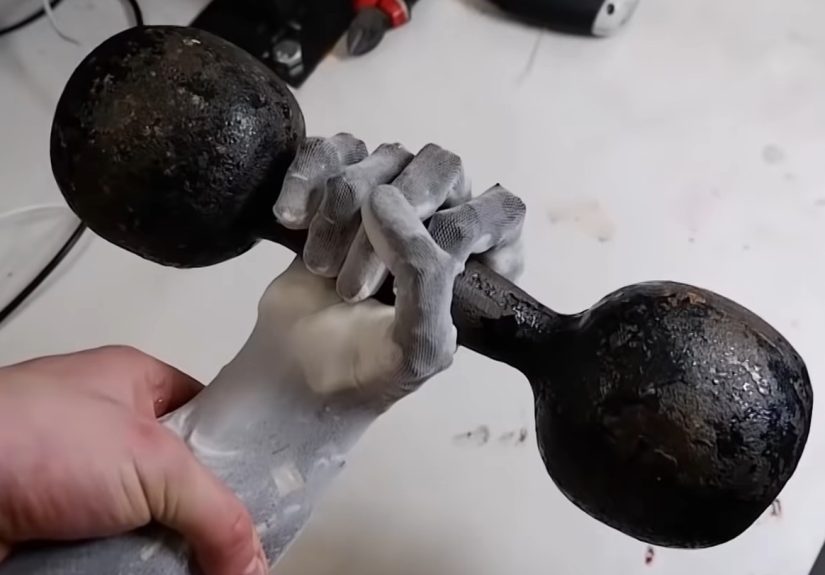
The artificial muscle robotic arm that inspired this topic drew attention because it used water pressure to animate a hand-and-arm structure with unsettlingly lifelike movement. The muscles reportedly worked under significant pressure, giving the robotic limb enough force to lift weight while still producing a flexible, organic-looking motion. That combinationstrength plus softnessis exactly why soft robotics is so exciting.
Why Artificial Muscles Matter in Robotics
Robots are excellent at being strong. They are less naturally excellent at being gentle. A rigid robot can crush an object unless it has excellent sensors and carefully tuned control software. A soft robotic hand, however, can conform around a tomato, cable, tool handle, or oddly shaped part with less risk of damage. That is why researchers are interested in soft actuators for manufacturing, healthcare, prosthetics, space exploration, wearable devices, and human-robot interaction.
They Make Robots Safer Around People
Industrial robots traditionally operate behind safety cages because a fast-moving rigid arm can be dangerous. Soft robotic systems reduce some of that risk by adding compliance. In plain English: when something squishy bumps into you, it is usually less alarming than being body-checked by a metal beam with a PhD in torque.
Artificial muscles can absorb impact, limit force naturally, and move in ways that are more forgiving. This makes them appealing for collaborative robots, rehabilitation devices, and assistive machines that must operate close to human bodies.
They Improve Dexterity
Human hands are engineering masterpieces. They can crack an egg, thread a needle, hold a hammer, type a rant about printer ink prices, and detect tiny texture changes. Recreating that dexterity with rigid robotic parts is extremely difficult.
Artificial muscle robotic arms can use distributed actuation, meaning movement can come from many muscle-like components instead of a few motors. This allows more natural bending, curling, gripping, and fine adjustment. Soft fingers can wrap around objects instead of only pinching them. For tasks such as handling fruit, medical tools, fragile electronics, or household items, that flexibility matters.
They Reduce Mechanical Complexity
A motor-driven robotic hand often needs gears, pulleys, cables, bearings, and rigid linkages. Artificial muscles can simplify parts of that system by creating motion directly through expansion, contraction, or bending. Some soft actuators are also lightweight, low-cost, and relatively easy to fabricate.
Researchers have explored origami-inspired artificial muscles that can lift far more than their own weight, printable pneumatic muscles for anatomy-based robots, and soft grippers that can be made from silicone, fabric, elastomers, or flexible composites. The field is not one single invention. It is a growing toolbox of ways to make machines move less like cranes and more like living systems.
The Uncanny Valley: Why This Robotic Arm Feels So Weird
The uncanny valley is the uncomfortable feeling people may experience when a humanlike object looks or moves almost like a personbut not quite. A cartoon robot is cute. A clearly mechanical arm is interesting. A hyper-realistic artificial hand that moves with tendon-like rhythm but has no skin, no warmth, and no human intention? That can feel like discovering a mannequin has been doing CrossFit after midnight.
The artificial muscle robotic arm falls into this valley because motion is powerful. We often focus on appearance when discussing humanoid robots, but movement may be even more important. A stiff robot with a human face looks strange. A faceless robotic arm that moves like a forearm can also trigger the same reaction. Our brains are tuned to read biological motion quickly. When the signal is close but incomplete, the result can be fascination mixed with discomfort.
That reaction is not a failure of design. It is evidence that the technology is approaching something biologically meaningful. When a robotic hand curls its fingers in a smooth, muscle-driven pattern, viewers recognize the motion before they fully understand the machine. The arm becomes less like a tool and more like a creature-shaped question mark.
How Artificial Muscles Work
Artificial muscles come in several major categories. Each has strengths, limitations, and a slightly different flavor of “robot gym membership.”
Pneumatic Artificial Muscles
Pneumatic artificial muscles use compressed air to produce contraction or bending. They are often lightweight, flexible, and capable of producing strong pulling forces. The classic braided design expands outward and shortens when pressurized, similar to how a finger trap tightens when pulled.
These muscles are popular in soft robotics because they are relatively simple and powerful. The challenge is control. Air compresses, which can make precise positioning difficult. Pneumatic systems also need pumps, valves, tubing, and pressure regulation. A robotic arm powered by air may look elegant on the outside while secretly dragging around a small plumbing convention behind the curtain.
Hydraulic Artificial Muscles
Hydraulic artificial muscles use fluid instead of air. Water or oil can provide strong, smooth movement because liquids are less compressible than gases. This can improve force transmission and stability. A water-powered robotic arm can feel especially lifelike because fluid pressure allows controlled, muscle-like motion.
The trade-off is complexity. Hydraulic systems must handle leaks, seals, pressure limits, weight, and maintenance. Water pressure can make an artificial muscle robotic arm impressive, but no one wants a humanoid hand that starts sweating from the wrong places.
Electroactive Polymers
Electroactive polymers change shape when exposed to an electric field. They have long been studied as artificial muscles because they can be lightweight, quiet, and flexible. NASA and other research groups have explored these materials for space robotics and small grippers, where lightweight actuation is valuable.
The dream is a material that bends, contracts, or flexes like muscle with minimal mechanical hardware. The challenge is achieving enough force, durability, safety, and reliability for real-world use. Electroactive polymers are promising, but many designs still face practical barriers before they can replace conventional actuators in demanding robots.
Twisted and Coiled Artificial Muscles
Some artificial muscles are made by twisting and coiling fibers so they contract when heated or activated. These designs can be surprisingly strong for their size and may be made from materials such as nylon, conductive fibers, or specialized composites. They are interesting for wearable devices, soft grippers, and compact actuation systems.
However, heat-based actuation can be slower than motor-driven motion, and repeated heating cycles raise questions about efficiency and lifespan. They are clever, but they do not always move with the instant response people expect from a robotic hand.
Biohybrid Muscle Systems
Biohybrid robotics goes one step further by using living muscle tissue as part of the machine. Researchers have demonstrated small robotic systems powered by cultured muscle cells, and more recent biohybrid hand experiments show how biological tissues might actuate jointed fingers.
This is where the uncanny valley gets a basement level. A robot arm with artificial muscles is one thing. A robot hand powered by real lab-grown muscle tissue is another. The scientific potential is huge, especially for understanding biology, prosthetics, and human-machine interfaces. Still, the emotional reaction is understandable. People hear “robot hand with living muscle” and immediately look around for the nearest movie warning label.
What Makes the Artificial Muscle Robotic Arm So Compelling?
The appeal of an artificial muscle robotic arm is not only that it can lift something. Lots of machines can lift things. Forklifts exist. Gym bros exist. The real appeal is how it lifts.
A muscle-driven robotic arm can produce movement that feels less segmented. Fingers may curl progressively. The wrist may shift with softer transitions. The forearm may seem to tense. Even without skin, the movement can suggest anatomy. That is what makes viewers lean in.
In robotics, motion quality matters. A robot designed for a factory can move in sharp, efficient paths. A robot designed for a home, hospital, or prosthetic limb must move in a way that feels understandable and safe to humans. Smoothness, timing, force control, and compliance all influence trust.
Artificial muscles also invite modular design. Engineers can place actuators along a limb in arrangements that resemble muscle groups. This opens the door to more anatomically inspired robots. Instead of forcing humanlike behavior through rigid joints, designers can build structures that naturally bend, pull, and respond in more organic ways.
Real-World Uses for Artificial Muscle Robotic Arms
Prosthetics and Assistive Technology
One of the most meaningful applications is prosthetic limbs. Modern prosthetics have improved dramatically, but many still struggle with weight, comfort, intuitive control, and natural motion. Artificial muscles could help create lighter, quieter, softer prosthetic hands or arms that respond more fluidly.
A prosthetic hand does not need to look like science fiction to be life-changing. It needs to grip a cup, hold a phone, carry groceries, button clothing, and survive daily use. Soft actuators could help prosthetics become more comfortable and adaptable, especially when combined with better sensors and control systems.
Medical and Rehabilitation Robots
Soft robotic arms and wearable muscle-like actuators can support rehabilitation by guiding movement without rigid force. A therapy device that assists the wrist, elbow, or fingers must be gentle, adjustable, and responsive. Artificial muscles are well suited for this kind of interaction because they can apply distributed force rather than pushing at one hard contact point.
Space Exploration
NASA and JPL have studied artificial muscle concepts for robotic explorers because space robots benefit from lightweight, compact, flexible systems. A soft gripper could handle irregular rocks, fragile samples, or oddly shaped tools. In low-gravity environments, adaptability is valuable because the robot cannot rely on the same assumptions used in Earth-based factories.
Manufacturing and Agriculture
Factories increasingly need robots that can handle variable objects, not just identical parts. Agriculture is even messier. Fruits, vegetables, plants, and packaging materials vary constantly. A soft robotic arm with artificial muscles could grip delicate produce without bruising it, pick objects from cluttered bins, or work safely beside people.
Humanoid Robots
Humanoid robots are the headline-grabbers. Artificial muscles could make them more natural, safer, and stronger without relying entirely on rigid motor assemblies. But humanoid design also magnifies the uncanny valley problem. The more humanlike a robot becomes, the more people expect humanlike timing, balance, gaze, touch, and intention. Getting one detail wrong can turn “amazing” into “please put that back in the lab.”
The Big Engineering Challenges
Artificial muscle robotic arms are exciting, but they are not magic. Engineers still face serious challenges before these systems become common outside research labs and maker workshops.
Control Is Hard
Biological muscles are controlled by nervous systems with enormous feedback loops. Robotic artificial muscles need sensors, algorithms, pressure control, position tracking, and safety systems. Soft materials bend and deform in complex ways, making motion harder to predict than with rigid parts.
Power Systems Can Be Bulky
Pneumatic and hydraulic arms often need pumps, compressors, reservoirs, valves, and hoses. A demo arm may look beautifully organic while depending on external hardware. For mobile robots, prosthetics, or wearable systems, reducing the size and weight of the power supply is critical.
Durability Matters
Soft materials can fatigue, tear, leak, stretch, or degrade. A robotic arm used in real life must repeat motions thousands or millions of times. That means materials must survive pressure cycles, bending, temperature changes, and accidental abuse.
Sensing Must Improve
Human muscles and skin provide constant feedback. We know how hard we are gripping, where our fingers are, and whether an object is slipping. Robotic arms need similar sensing through pressure sensors, stretch sensors, optical fibers, tactile skins, force feedback, and control software. Without sensing, a soft robotic hand is just a very expensive noodle with ambitions.
The Human Reaction: Awe, Discomfort, and Curiosity
The artificial muscle robotic arm works as both technology and theater. People are drawn to it because it looks like progress they can feel. It does not require a technical background to understand the significance of fingers curling, tendons tightening, or a wrist shifting with soft force. The motion tells the story.
At the same time, discomfort is part of the experience. A robotic arm that resembles a human limb invites comparison. We notice what is missing: skin, warmth, hesitation, intention, tiny imperfections, and the subtle coordination that living bodies perform effortlessly. The closer the machine gets, the more obvious the gaps become.
That is the paradox of the uncanny valley. A simple robot can be charming because expectations are low. A highly humanlike robot can be unsettling because expectations are high. Artificial muscle arms live in the middle, where technology is advanced enough to resemble life but not complete enough to feel alive.
Experience-Based Reflections: Walking Beside the Artificial Muscle Arm
Watching an artificial muscle robotic arm in action is different from reading about one. On paper, it is a collection of actuators, pressure ratings, flexible sleeves, valves, joints, and materials. In motion, it becomes something else. The first impression is usually surprise. The movement is too smooth to file under “ordinary robot,” yet too exposed and mechanical to be mistaken for a human limb. It is like watching a skeleton remember yoga.
The most memorable part is the delay between understanding and reacting. At first, the viewer sees a machine. Then the fingers curl, and the brain upgrades the category to “hand.” That tiny mental switch is powerful. A gripper grabs. A hand reaches. A gripper clamps. A hand seems to choose. Of course, the robot is not choosing in a human sense, but the motion language is familiar enough to make us project intention onto it.
That projection is why artificial muscle robotics feels emotionally different from conventional automation. A factory robot can be impressive, but it rarely feels personal. It swings, rotates, and repeats. An artificial muscle arm flexes. It suggests effort. It looks like it is straining, even when the strain is just pressure inside engineered tubes. The result is a machine that appears to have a body rather than just a mechanism.
There is also a practical lesson hidden inside the weirdness: good robotics is not only about raw power. The best demonstrations are often the ones where the arm handles something with control rather than brute force. Lifting a heavy object proves strength. Holding a fragile object proves intelligence in design. When a soft robotic hand conforms around an item without crushing it, the value becomes obvious. This is the kind of technology that could someday help an older adult open a drawer, assist a worker with repetitive lifting, or allow a prosthetic user to hold objects with greater confidence.
Still, the experience is not all polished futurism. Many artificial muscle systems have visible tubing, external pumps, experimental frames, and movements that occasionally look more biology-class than consumer-product. That is normal. Early technologies often arrive wearing their lab coats inside out. The first versions do not need to be beautiful. They need to prove that the concept works.
The uncanny feeling may even be useful. It reminds designers that humanlike robots are not only engineering projects; they are social objects. A robotic arm meant for a lab can be strange. A robotic arm meant for a hospital room, classroom, home, or prosthetic socket must be trustworthy. It must move in a way people can predict. It must signal safety. It must avoid surprising users with sudden gestures or creepy pauses.
In that sense, strolling through the uncanny valley is not a detour. It is part of the development path. Engineers need to learn which motions feel helpful, which feel unsettling, and which cross the line from “cool robot” to “why is the coat rack breathing?” Artificial muscle robotic arms are teaching that lesson one flex at a time.
Conclusion: The Future Has Muscles, and It Is Learning Manners
The artificial muscle robotic arm is more than an eerie video clip or a clever maker project. It represents a major direction in robotics: machines that are softer, safer, more adaptive, and more biologically inspired. By replacing some rigid mechanisms with muscle-like actuators, engineers can build robotic systems that grip, curl, bend, and respond with a new level of natural motion.
The uncanny valley reaction is real, but it should not overshadow the potential. Artificial muscles could improve prosthetics, rehabilitation tools, humanoid robots, space explorers, agricultural automation, and human-friendly machines. The technology still faces hurdles in control, durability, sensing, and power supply, but progress across soft robotics suggests those problems are being actively attacked from multiple angles.
Maybe the future robot arm will not look like a shiny metal claw or a rubbery horror prop. Maybe it will look like a practical, quiet, capable tool that moves with just enough softness to be useful and just enough machine-ness to avoid making everyone in the room take one step backward. Until then, the artificial muscle robotic arm gives us a fascinating preview of what happens when robots stop merely movingand start flexing.
Note: This HTML article is written for web publishing and synthesizes real robotics concepts, soft actuator research, and artificial muscle engineering trends without adding source links inside the article body.

![18 Best Types of Charts and Graphs for Data Visualization [+ How to Choose]](https://corkopencoffee.org/wp-content/uploads/2026/05/18-best-types-of-charts-and-graphs-for-data-visualization-how-to-choose-qKM1PBYG-thumb.jpg)