Table of Contents >> Show >> Hide
- 14 Steps to Figure Out Whether Someone Is Lying in a Text
- 1. Start with their normal texting style
- 2. Watch for answers that do not actually answer the question
- 3. Notice when the story gets weirdly vague
- 4. Be careful with overexplaining simple things
- 5. Look for contradictions across messages
- 6. Pay attention to distancing language
- 7. Notice hedging, softening, and escape hatches
- 8. Treat delayed replies and edits as clues, not verdicts
- 9. Watch for defensiveness that arrives too early
- 10. See whether they avoid checkable details
- 11. Ask the same thing in a different way
- 12. Move the conversation to a different format
- 13. Check facts before you check your blood pressure
- 14. Trust patterns, not one suspicious sentence
- What to Do if You Think Someone Is Lying Over Text
- Real-World Experiences: What People Often Learn the Hard Way
- Conclusion
- SEO Tags
Text messages are sneaky little things. They look simple, but they remove tone of voice, facial expression, timing context, and all the other human accessories that usually help you decide whether someone is being honest or just serving you a digital side salad of nonsense. That means figuring out whether someone is lying in a text is possible, but it is never as easy as spotting one weird emoji and declaring yourself the Sherlock Holmes of iMessage.
If you want to know how to tell if someone might be lying over text, the best approach is not to hunt for one “magic sign.” Real deception detection works better when you look for patterns: changes in language, evasive answers, contradictions, unusual defensiveness, and details that do not hold up when checked. In other words, you are not trying to catch a villain twirling a mustache. You are trying to notice when the story does not sit right.
This guide breaks the process into 14 practical steps. Some signs may point to a lie. Some may point to stress, distraction, or plain old bad texting habits. That is why context matters so much. Read these steps like a smart filter, not a lie detector with batteries included.
14 Steps to Figure Out Whether Someone Is Lying in a Text
1. Start with their normal texting style
The first rule is simple: do not judge a text in a vacuum. Compare it with how that person usually writes. Are they normally chatty but suddenly clipped and robotic? Are they usually casual but now sound like they hired a tiny lawyer to type for them? A lie often stands out not because it looks strange in general, but because it looks strange for them.
For example, if your friend usually replies with, “Yep, be there in 10,” but now sends, “I am currently in transit and should be arriving shortly,” your eyebrow has permission to rise. Not because formal language equals lying, but because a sudden shift can signal extra self-monitoring.
2. Watch for answers that do not actually answer the question
One of the clearest red flags in text conversations is evasion. You ask, “Did you send the email?” and they respond, “I was super busy all afternoon.” That may be true, but it is not an answer. When people are being straightforward, they usually answer the actual question before giving context. When they are dodging, they often give context instead of clarity.
A clean answer sounds like: “No, not yet. I got tied up.” An evasive answer sounds like: “Today has been crazy and I have had no time to breathe.” Cute. Still not an answer.
3. Notice when the story gets weirdly vague
Truthful messages often include natural detail. Not a novel. Just normal, grounded specifics. Liars, on the other hand, may keep things fuzzy to avoid getting pinned down. If someone says, “Something came up,” “I was dealing with stuff,” or “It was just a whole thing,” they may simply be tired. But if they stay vague even after a reasonable follow-up, that is more interesting.
Say you ask, “Why did you miss the meeting?” If the person replies, “Family emergency,” that is specific enough. If they say, “A lot happened,” and then keep floating away like a dramatic fog machine, that can suggest they do not want to commit to a story they may need to defend later.
4. Be careful with overexplaining simple things
Sometimes people lie by adding too much. A truthful answer is often efficient. A deceptive answer can become a mini documentary packed with unnecessary details, side roads, and strange justifications. This happens because the writer may be trying to sound convincing instead of simply being clear.
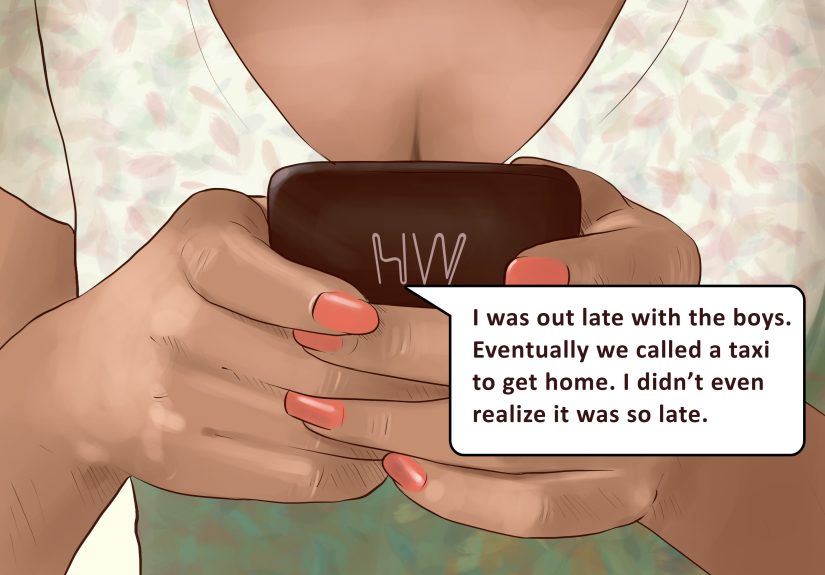
Imagine you ask, “Were you at home?” and get: “Yeah, I got home around 6:12, took my shoes off, heated leftovers, watched two episodes of that show I told you about, then my phone died, then I showered.” Maybe true. Maybe also a performance worthy of an award no one asked for.
The trick is balance. Too little detail can be suspicious. Too much can be suspicious too. The sweet spot is natural detail that feels relevant, not rehearsed.
5. Look for contradictions across messages
If you want to know if someone is lying in a text, consistency matters more than punctuation. Compare what they are saying now with what they said earlier. Small contradictions are often more revealing than dramatic ones. Liars tend to manage the main point of a story but lose control of the side details.
Maybe they said, “I just got your text,” but they responded to a different message ten minutes earlier. Maybe they said they were “already in bed,” then later mention they “just got back.” A contradiction does not automatically prove deception, but it is a signal that the account needs a second look.
6. Pay attention to distancing language
When people feel uncomfortable about what they are saying, they may create distance between themselves and the message. This can show up as less ownership, less direct language, or odd wording that softens commitment. You may see phrases like “that happened,” “mistakes were made,” or “things got mixed up” instead of “I forgot” or “I lied.”
In texting, distancing can also look like weirdly indirect phrasing. Instead of “I did not go,” the person writes, “Plans changed.” Changed by whom, exactly? The universe? A mysterious committee?
7. Notice hedging, softening, and escape hatches
Hedging is not a smoking gun, because lots of honest people hedge when they are nervous. Still, repeated uncertainty language can matter. Words like “maybe,” “kind of,” “probably,” “basically,” and “to be honest” can create little escape doors inside a message.
Take this example: “I pretty much told her what happened.” That phrase pretty much is doing suspiciously heavy lifting. So is “to be honest,” which sometimes arrives like a banner announcing that honesty has just entered the building late.
Look for clusters, not single words. One hedge means nothing. Five hedges in a message about a simple event can be telling.
8. Treat delayed replies and edits as clues, not verdicts
Many people assume that a slow reply means someone is lying. Not so fast. They could be driving, working, showering, napping, or staring into the refrigerator wondering what happened to their life. That said, reply timing can matter when it changes sharply during a specific line of questioning.
If a conversation flows normally and then suddenly slows way down when you ask one concrete question, that may suggest the person is thinking harder about the answer. The same goes for visible editing, deleting, or rewriting. On its own, it proves nothing. Combined with vagueness and inconsistency, it becomes more meaningful.
9. Watch for defensiveness that arrives too early
Sometimes a person who is lying goes straight into defense mode before you have even accused them of anything. They may act offended, flip the focus onto your trust issues, or treat a normal question like an attack. This is not always manipulation, but it can be.
Example: You ask, “Did you really talk to the landlord?” and they fire back, “Wow, so now I am a liar? You never trust me.” That reaction may be less about your question and more about buying time, shifting the emotional center of the conversation, or making you back off.
10. See whether they avoid checkable details
A person telling the truth is usually less afraid of specifics that can be verified. A person lying often keeps the story just vague enough to avoid being checked. They may avoid names, times, screenshots, locations, or other details that could either confirm or destroy the claim.
If someone says, “I spoke to customer service,” a natural follow-up is, “Which number did you call?” If they are truthful, they might say, “The one on the website.” If they are lying, you may get a fog bank of “I do not remember” and “it does not matter anyway.”
11. Ask the same thing in a different way
This is one of the most useful and least dramatic methods. Do not interrogate like a detective in a crime show. Just revisit the point from another angle later. Honest people usually stay steady because they are recalling what happened. Liars are more likely to adjust wording, shift timelines, or suddenly get irritated because they are managing a version rather than remembering reality.
You do not need to be sneaky. You can simply ask, “So you were already there when I called?” and compare that with the earlier answer. If the details start doing cartwheels, pay attention.
12. Move the conversation to a different format
Texting gives people time to craft, edit, delay, and shape a story. That is one reason deception can be harder to detect in text than in face-to-face conversation. If something matters, suggest a phone call, voice note, or in-person conversation. Not because body language solves everything, but because live interaction reduces the ability to endlessly polish a response.
A simple, calm message works: “This feels confusing over text. Can we talk for five minutes?” If the person resists every effort to move into a clearer format, especially when the issue is important, that resistance itself may be useful information.
13. Check facts before you check your blood pressure
Before you accuse anyone of lying, verify what can actually be verified. Look at timestamps, prior messages, plans, receipts, calendars, or anything else relevant and ethical. This is not a suggestion to snoop through someone’s private life. It is a reminder to separate evidence from assumptions.
People misread texts all the time. Tone gets lost. Typos happen. Autocorrect causes tiny social disasters hourly. If there is a reasonable innocent explanation, rule that out first. Good judgment is calmer than suspicion.
14. Trust patterns, not one suspicious sentence
The biggest mistake people make is treating one odd text as final proof. That is how harmless confusion turns into avoidable drama. The smarter move is to look for repeated behavior: evasive replies, contradicting stories, shifting details, strategic defensiveness, and refusal to clarify. One clue is a question mark. Several clues over time become a pattern.
If the pattern keeps showing up, the real issue may not be whether one text was a lie. It may be whether the relationship has enough trust, honesty, and accountability to feel safe. That is the deeper question, and honestly, it is usually the one that matters most.
What to Do if You Think Someone Is Lying Over Text
Once you suspect deception, try not to launch into an all-caps courtroom opening statement. Go for direct, calm language instead. Ask one clear question. Stick to the facts. Avoid psychoanalyzing every comma. A message like, “Your answers are not lining up, and I want a straight answer,” is much stronger than ten paragraphs of detective energy.
If the other person becomes hostile, doubles down on obvious contradictions, or repeatedly twists the conversation to make you feel foolish for asking basic questions, that tells you something valuable. In healthy communication, clarification is possible. In unhealthy communication, confusion becomes a strategy.
And yes, sometimes the best answer is not “How do I catch this lie?” but “Why am I doing all the work to get basic honesty?” That question tends to clear the fog pretty fast.
Real-World Experiences: What People Often Learn the Hard Way
People rarely figure out deception from one dramatic text. More often, they notice it after a long string of little oddities that only make sense in hindsight. Someone says, “Sorry, just saw this,” every single time a direct question appears. Another person claims they are “almost there” when experience says that means they are still in pajama pants arguing with their charger. A partner insists, “Nothing is wrong,” but their messages get shorter, colder, and more defensive every time a specific topic comes up. None of those moments proves a lie alone, but together they start sounding like a marching band.
One common experience is the vague cancellation text. It usually arrives dressed as mystery: “Something came up.” At first, that sounds normal. Life does come up. But after the third or fourth version of the same message, with no real explanation and a new excuse every time, people begin to realize they are not dealing with bad luck. They are dealing with a person who wants the flexibility of your trust without the responsibility of honesty.
Another familiar story happens in dating. Someone is warm, attentive, and funny until one direct question appears: “Were you out with your ex?” Suddenly the tone changes. Replies get delayed. The language gets strangely polished. There is a lot of “Honestly,” “You are overthinking,” and “Why are you making this a thing?” Hours later, the explanation finally arrives, but it somehow answers everything except the actual question. Many people say that was the moment they learned an important truth: defensiveness is often more revealing than denial.
Friendships have their own version. Maybe a friend says they forgot your birthday dinner because work was hectic. Fair enough. Then you see social posts from the exact time they said they were unavailable. Again, one inconsistency could be harmless. But what stings is often not the lie itself. It is the feeling that the person thought a flimsy excuse was good enough. That is why lying by text can feel especially insulting. It is efficient, distant, and weirdly casual, like someone tossing dishonesty at you between snack breaks.
Many people also learn that texting can create false alarms. A short reply can feel rude when the person is merely exhausted. A delayed response can look deceptive when their phone was dead. A strangely worded message can sound guilty when they were just rushing through a grocery store with one hand and a screaming toddler in the cart seat. That is why the best communicators do not jump from “This feels off” to “Aha, betrayal.” They slow down, ask better questions, and look for repeat patterns.
The most useful lesson people report is this: when someone is honest, clarification usually brings relief. When someone is dishonest, clarification often brings more fog. The details get softer, the emotions get louder, and the conversation somehow turns into a debate about your reaction instead of their behavior. Once you notice that pattern, your job is not to become a better text detective. Your job is to decide what kind of communication you are willing to keep accepting.
Conclusion
If you want to know how to know if someone is lying in a text, the answer is not hidden in a single delayed reply, one suspicious “lol,” or a rogue period that suddenly looks like emotional warfare. The best method is more grounded than that. Compare the message with the person’s usual style, look for evasiveness, watch for contradictions, notice distancing language, and verify what you can. Above all, remember that lies tend to reveal themselves through patterns, not isolated glitches.
Texting is convenient, but it is also a terrible place to solve trust issues if both people are not communicating clearly. So if something important feels off, move beyond the screen, ask direct questions, and pay attention to whether clarity shows up or keeps running away. Your goal is not to become paranoid. Your goal is to become hard to mislead.