Table of Contents >> Show >> Hide
- Why Learning How to Make Cookies Matters
- Cookie Basics: Ingredients You Need (and What They Actually Do)
- How to Make Cookies: Step-by-Step Method
- 1) Read the recipe all the way through first
- 2) Prep your oven and pans
- 3) Measure ingredients correctly
- 4) Mix dry ingredients separately
- 5) Cream butter and sugars (if the recipe uses softened butter)
- 6) Add eggs and vanilla
- 7) Add dry ingredients and mix just until combined
- 8) Fold in mix-ins
- 9) Portion the dough and chill if needed
- 10) Bake, cool briefly on the pan, then move to a rack
- How to Control Cookie Texture (Chewy, Crispy, or Cakey)
- Common Cookie Mistakes and How to Fix Them
- Cookie Safety Tips You Shouldn’t Ignore
- How to Store and Freeze Cookies (Because Future You Deserves Cookies Too)
- Easy Cookie Variations Once You Know the Method
- Cookie-Making Experience: What I Wish Someone Told Me Earlier (Extended Notes)
- Final Thoughts
If you’ve ever wondered how to make cookies that taste like they came from a real bakery (instead of a mysterious cafeteria on a Tuesday), you’re in the right kitchen. Cookie baking is part science, part timing, and part resisting the urge to eat the dough before it reaches the oven. This guide breaks down the full process in a practical, fun, and actually useful wayfrom ingredients and mixing to baking, cooling, storing, and troubleshootingso your next batch turns out delicious on purpose, not by accident.
Whether you want chewy chocolate chip cookies, crisp edges with soft centers, or cutout cookies that keep their shape, the core method is the same. Once you understand the basics, you can make cookies with confidence and stop blaming your oven for everything.
Why Learning How to Make Cookies Matters
Cookies are one of the best beginner-friendly baked goods because they teach essential baking skills fast: measuring flour correctly, creaming butter and sugar, mixing without overworking the dough, and recognizing doneness by sight. They also give immediate feedback. If your cookies spread too much, turned cakey, or baked unevenly, the dough is basically giving you notes.
The good news? Small changes make a big difference. A short chill, better flour measuring, or slightly gentler mixing can transform a flat batch into bakery-style cookies. Once you learn the “why,” you can tweak texture and flavor like a pro.
Cookie Basics: Ingredients You Need (and What They Actually Do)
Core Cookie Ingredients
Flour: All-purpose flour gives structure. Too much flour can make cookies dry, thick, or cakey. Too little can make them spread into sweet pancakes.
Butter: Adds flavor and richness. Softened butter is common for creaming; melted butter can create denser, chewier cookies with less puff.
Sugar: Granulated sugar helps crispness and spread. Brown sugar adds moisture, chew, and deeper flavor thanks to molasses.
Eggs: Bind the dough and add structure, moisture, and richness. Extra egg white can push cookies toward puffier, cakier territory.
Leavening (baking soda / baking powder): Helps lift and affects browning and texture. Too much can make cookies puff too much.
Salt: Balances sweetness and makes the cookie taste like a cookie, not sugar with identity issues.
Vanilla extract: Adds aroma and warmth. It’s a small ingredient with big personality.
Mix-ins: Chocolate chips, nuts, oats, dried fruit, coconut, toffee bits, or spices. This is where your cookie gets its main character energy.
Helpful Tools (You Don’t Need a TV Studio Kitchen)
- Mixing bowls
- Hand mixer or stand mixer (or a strong arm and determination)
- Measuring cups/spoons or, better yet, a kitchen scale
- Baking sheets
- Parchment paper
- Cookie scoop or spoon
- Cooling rack
- Spatula
How to Make Cookies: Step-by-Step Method
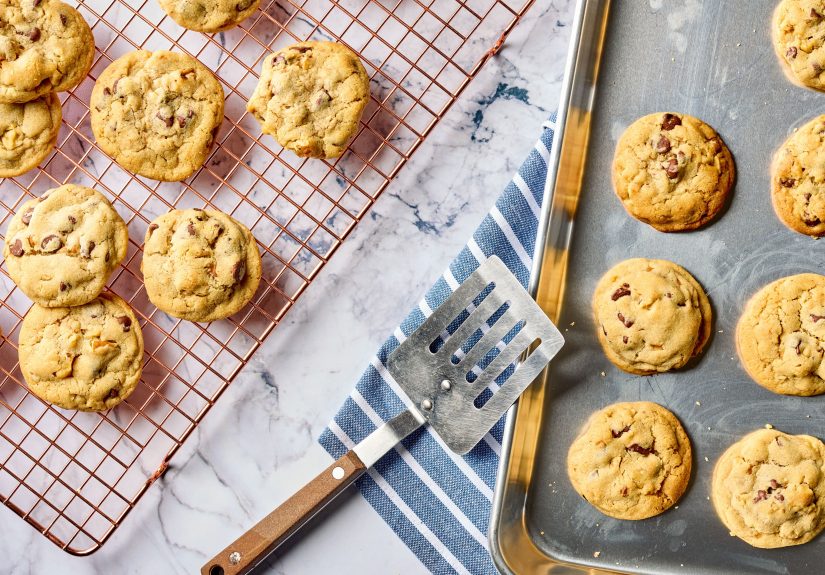
Here’s the classic method for drop cookies (like chocolate chip cookies), which is the best place to start if you’re learning how to make cookies from scratch.
1) Read the recipe all the way through first
Yes, really. This prevents dramatic mid-mix discoveries like “chill for 2 hours” or “needs softened butter” when your butter is still fridge-brick hard. Check the bake temperature, yield, chill time, and ingredient temperatures before you start.
2) Prep your oven and pans
Preheat the oven fully so the first batch bakes correctly. Line baking sheets with parchment paper for easier cleanup, more even browning, and less sticking. If a recipe says ungreased sheet, follow it. Cookie recipes are oddly specific for a reason.
3) Measure ingredients correctly
This is one of the biggest differences between “pretty good” and “why are these hockey pucks?” For flour, spoon it into the measuring cup and level it off, or weigh it for best accuracy. Scooping directly from the bag can pack in extra flour, which changes the whole texture.
4) Mix dry ingredients separately
Whisk together flour, salt, and leavening in a separate bowl. This helps distribute everything evenly so you don’t get one cookie that tastes normal and another that tastes like baking soda dared you to notice it.
5) Cream butter and sugars (if the recipe uses softened butter)
Beat softened butter with granulated and brown sugar until combined and slightly fluffy. This step adds air and influences spread and texture. Creaming too little can leave a dense dough; over-creaming can add too much air and make cookies puffier or cakier than intended.
6) Add eggs and vanilla
Add eggs one at a time, mixing just until incorporated. Then add vanilla. Scrape down the bowl so everything mixes evenly. This is not a race. Dough rewards patience and a rubber spatula.
7) Add dry ingredients and mix just until combined
Gradually add the flour mixture and mix on low speed (or fold by hand) until no dry streaks remain. Stop there. Overmixing develops gluten and can make cookies tougher or cakier.
8) Fold in mix-ins
Stir in chocolate chips, nuts, oats, or other additions. Distribute evenly, but don’t keep mixing forever. If your dough is sticky, that’s normal for many recipes.
9) Portion the dough and chill if needed
Use a cookie scoop for even size so the cookies bake at the same rate. If the recipe says chill the dough, do it. Chilling helps control spread, improves handling, and often improves flavor and texture. Even 30 minutes can make a noticeable difference for many drop cookies.
10) Bake, cool briefly on the pan, then move to a rack
Place dough balls with enough spacing (usually 1 to 2 inches apart, depending on size). Bake until the edges are lightly golden and the centers look slightly underdone for chewy cookies. They continue baking on the hot pan for a few minutes after coming out. Transfer to a cooling rack so steam escapes and the bottoms don’t get soggy.
How to Control Cookie Texture (Chewy, Crispy, or Cakey)
If you want to master how to make cookies, learn what changes texture. This is where baking goes from “following directions” to “making choices.”
For Chewy Cookies
- Use more brown sugar than white sugar
- Chill the dough before baking
- Don’t overbake; pull when centers still look a bit soft
- Measure flour carefully (too much flour can make them dry)
- Consider melted butter or partially melted butter in recipes designed for chew
For Crispy Cookies
- Use a bit more granulated sugar
- Flatten dough slightly before baking (if the recipe allows)
- Bake a little longer for deeper golden edges
- Use thinner scoops/portions
- Cool completely before storing
For Thicker or Puffier Cookies
- Start with cool dough
- Use the flour amount exactly as written
- Avoid over-warm butter
- Don’t overcrowd the baking sheet
- Use a sturdy baking sheet and proper oven temperature
Why Cookies Spread Too Much
Common reasons include warm dough, too little flour, over-greased pans, too much sugar, or an oven that isn’t fully preheated. If your cookies spread into one giant “family-style cookie,” chill the dough longer and test-bake one cookie before committing a full tray.
Common Cookie Mistakes and How to Fix Them
Problem: Cookies are flat and greasy
Fix: Chill the dough, measure flour more carefully, and make sure butter wasn’t too warm. Also check your oven temperature with an oven thermometer if batches keep coming out oddly pale and spread out.
Problem: Cookies are dry or crumbly
Fix: You may have added too much flour or baked too long. Pull cookies sooner and cool them on a rack. For dough that feels too stiff, some recipes tolerate a small splash of milk, but only if the texture clearly looks off.
Problem: Cookies are too cakey
Fix: Mix less once flour is added, avoid over-creaming butter and sugar, and review flour/egg/leavening amounts. Cakey cookies often come from too much structure and too much air.
Problem: Burned bottoms
Fix: Use parchment, cool your baking sheet between batches, and avoid dark pans if your recipe is already prone to fast browning. Rotate pans if your oven has hot spots.
Problem: Uneven baking
Fix: Scoop evenly sized portions, bake one sheet at a time (especially in smaller ovens), and space cookies consistently for better airflow.
Cookie Safety Tips You Shouldn’t Ignore
Raw cookie dough is tempting. It smells amazing. It looks innocent. It is also not considered safe to eat if it contains raw flour and/or raw eggs. Flour is a raw ingredient, and baking is what kills harmful germs. If kids are helping, remind them that “licking the spoon” is a movie move, not a food safety plan.
Wash hands after handling raw dough, clean mixing tools and counters, and store dough chilled if you’re not baking immediately. If the recipe includes a long rest, keep the dough covered in the refrigerator.
How to Store and Freeze Cookies (Because Future You Deserves Cookies Too)
Storing Baked Cookies
Cool cookies completely before storing. Keep them in an airtight container at room temperature. Store soft and crisp cookies separately, or the textures will mingle and everybody loses.
Freezing Cookie Dough
Portion dough into balls, freeze on a lined tray until firm, then transfer to a freezer-safe bag or container. Label with the cookie type, date, and bake temp/time. This is the kind of life organization that feels suspiciously adult.
Freezing Baked Cookies
Freeze fully cooled cookies in layers separated by parchment. Thaw at room temperature. Some cookies are also great warmed briefly in the oven for that just-baked vibe.
Easy Cookie Variations Once You Know the Method
Classic Chocolate Chip Cookies
The standard gateway cookie. Focus on proper creaming, accurate flour measurement, and chill time if you want thicker cookies with better flavor.
Sugar Cookies (Cutout Style)
Chilling is especially important for shape retention. Roll between parchment for easier handling and less extra flour. Bake until the cookies look set, not browned (unless the recipe says otherwise).
Oatmeal Cookies
Watch doneness carefully. The edges should be lightly golden and the centers set. Mix-ins like raisins, cranberries, or chocolate change moisture slightly, so keep an eye on the first batch.
Cookie-Making Experience: What I Wish Someone Told Me Earlier (Extended Notes)
Here’s the part no one tells you when you first learn how to make cookies: your first “bad” batch is usually still pretty edible. It may be flat, weirdly puffy, or shaped like a topographic map, but it’s often delicious enough to vanish by the next morning. That’s actually one of the best things about cookiesthey are forgiving teachers.
One of the biggest breakthroughs in my cookie-making experience was learning to stop treating every dough the same. Early on, I made the classic mistake of thinking, “A cookie is a cookie.” Then I tried to make cutout sugar cookies with warm dough, and the stars turned into abstract amoebas. That was the day I fully respected chill time. Now, if a recipe says chill, I chill. If it says chill twice, I sigh dramatically and then do it anyway. The results are always worth it.
Another lesson: measuring flour changed everything. I used to scoop straight from the bag because that felt efficient. It was efficientif my goal was to produce dry, thick cookies that looked like they were emotionally unavailable. Once I switched to spoon-and-level (and eventually a scale), my cookies became more consistent. Same recipe, different outcome. It felt like discovering that my oven had been innocent this whole time.
I also learned that the first batch is your scout batch. Don’t expect perfection on tray one. Bake two or three cookies first and watch what happens. Do they spread too much? Chill longer. Too thick? Gently flatten the next scoop. Too pale? Give them another minute. This tiny test-batch habit saves ingredients, saves frustration, and saves you from serving “rustic” cookies that are only rustic because you guessed.
Texture preferences in a household can be hilariously specific, too. Some people want crisp edges and chewy centers. Others want soft cookies all the way through. And there is always one person who says, “I like them kind of underbaked,” which is useful feedback but also a little chaotic. The best solution I’ve found is simple: portion dough evenly, bake one tray for the minimum time, and let another tray go 1–2 minutes longer. Same dough, two personalities.
Holiday baking taught me the value of freezing dough. Instead of baking six dozen cookies in one exhausted marathon, I now portion and freeze dough ahead of time. It turns cookie baking into a small pleasure instead of a flour-covered crisis. On a random weeknight, you can bake four cookies, not forty. This is excellent for portion control in theory and excellent for “I deserve a cookie” in practice.
Finally, the best cookie experience has less to do with perfection and more to do with repetition. Every batch teaches you something: how your oven runs, how long your pans stay hot, how chilled dough behaves, what “lightly golden” actually looks like in your kitchen. The more you bake, the more intuitive it becomes. At some point, you stop asking, “How do I make cookies?” and start saying, “Do I want chewy today, or crispy?” That’s when you know you’ve leveled up.
Final Thoughts
Learning how to make cookies is less about memorizing one recipe and more about understanding a method. Measure carefully, mix intentionally, chill when needed, watch for visual doneness, and cool properly. Once you get those fundamentals down, you can create everything from simple weeknight chocolate chip cookies to decorated holiday cutouts without breaking a sweat (or at least without pretending the smoke alarm is a timer).
Start with one reliable recipe, keep notes on what worked, and make small adjustments. Cookie baking gets better fastand the homework is delicious.
![18 Best Types of Charts and Graphs for Data Visualization [+ How to Choose]](https://corkopencoffee.org/wp-content/uploads/2026/05/18-best-types-of-charts-and-graphs-for-data-visualization-how-to-choose-qKM1PBYG-thumb.jpg)