Table of Contents >> Show >> Hide
- Introduction: Why Make Your Own Stretcher Bars?
- Tools and Materials You Will Need
- How to Make Stretcher Bars: 7 Steps
- Important Tips for Better DIY Stretcher Bars
- Common Mistakes to Avoid
- When Should You Buy Stretcher Bars Instead?
- Experience Notes: What I Learned From Making Stretcher Bars
- Conclusion
Note: This guide is written for artists, students, hobby woodworkers, and canvas-loving perfectionists who want a practical, safe, and budget-friendly way to build stretcher bars at home. If you are using power tools, work with an experienced adult, wear eye protection, clamp your wood securely, and keep your fingers out of the “oops zone.”
Introduction: Why Make Your Own Stretcher Bars?
Learning how to make stretcher bars is one of those studio skills that feels small until the exact canvas size you need does not exist at the art store. Suddenly, you are standing in an aisle, holding a pre-made frame that is either too tiny, too expensive, too flimsy, or shaped like it gave up halfway through life. Making your own canvas stretcher bars gives you control over size, strength, depth, and finish. It also makes you feel slightly like a Renaissance craftsperson, minus the powdered wig and mysterious candle lighting.
Stretcher bars are the wooden frame pieces used to support canvas for painting, printing, mixed media, or display. A good stretcher bar frame keeps the canvas taut, square, and lifted slightly away from the wood so the brush does not hit a hard ridge underneath. That raised outer edge is important because it prevents the dreaded “ghost line,” where the inner frame presses against the canvas and becomes visible through paint. Nobody wants a secret rectangle haunting their masterpiece.
Professional stretcher bars are often made from straight, dry wood such as pine, spruce, fir, poplar, or laminated wood. They may include beveled profiles, mitered or interlocking corners, and small wedges called canvas keys that allow tension adjustments. For a home studio project, you can make a strong fixed stretcher frame with simple tools, careful measuring, and smart construction. If you want a fully adjustable museum-style frame, that requires more advanced joinery, but the method below produces a reliable DIY stretcher frame for many painting and display needs.
Tools and Materials You Will Need
Before cutting anything, gather your supplies. A project that starts with “Where did I put the square?” often ends with one corner looking like it has a personal grudge against geometry.
Recommended Materials
- Straight kiln-dried pine, poplar, spruce, or fir boards
- Wood glue
- Wood screws or brad nails
- Corner braces, optional but helpful for beginners
- Sandpaper, medium and fine grit
- Canvas, linen, or primed canvas roll
- Staples for attaching canvas
Recommended Tools
- Tape measure
- Pencil
- Carpenter’s square or speed square
- Miter box and hand saw, or a miter saw with supervision
- Clamps
- Drill or screwdriver
- Staple gun
- Canvas pliers, optional but useful
- Dust mask and eye protection
For small canvases, common board sizes such as 1 x 2 lumber can work well. For larger canvases, choose wider or deeper wood, and consider adding cross braces. Thin, cheap, twisted lumber may save a few dollars now but can turn your painting into a potato chip later. Pick boards that are straight, dry, and free from big knots near the ends.
How to Make Stretcher Bars: 7 Steps
Step 1: Decide the Canvas Size and Frame Depth
Start by choosing the finished size of your canvas. For example, you may want a 16 x 20 inch painting surface, a 24 x 36 inch gallery-style canvas, or a custom panoramic size that says, “I reject standard rectangles, thank you very much.” Write down the exact outside dimensions of the frame.
Next, decide how deep you want the frame to be. A shallow stretcher frame is easier to build and works well if the finished painting will be placed in a traditional frame. A deeper frame, often called gallery depth, is better if the canvas edges will be visible. Gallery-style canvases usually look more substantial on the wall and can be painted around the sides for a finished look.
For beginners, keep the first project moderate in size. A 12 x 16 or 16 x 20 inch stretcher frame teaches the process without demanding heroic levels of precision. Very large canvases need stronger wood, extra bracing, and more attention to preventing bowing.
Step 2: Choose Straight, Dry Wood
The quality of your stretcher bars begins with the lumber. Look down the length of each board before buying it. If it curves, twists, bows, or looks like it wants to become a boat, put it back. Canvas tension will pull on the frame from all directions, so warped wood will only get more dramatic once fabric is stretched across it.
Kiln-dried wood is preferred because it contains less moisture than fresh or poorly dried lumber. As wood gains or loses moisture, it can expand, shrink, and warp. That movement affects canvas tension and can lead to sagging, corner gaps, or a frame that no longer sits flat on the wall. Pine and poplar are popular choices because they are affordable, workable, and usually easy to find in U.S. hardware stores.
If you are making a painting support for serious archival work, consider purchasing professional stretcher bars instead of basic lumber, especially for large paintings or valuable artwork. Professional bars often include a raised lip, better milling, and stronger corner systems. For practice, student work, décor, and custom sizes, a carefully built DIY frame is usually a very satisfying solution.
Step 3: Measure and Mark the Four Bars
Measure twice, cut once, and then measure again because wood has a way of humbling people. For a simple rectangular frame with mitered corners, you will need two long bars and two short bars. The longest outside edge of each piece should match your final canvas dimensions.
For a 16 x 20 inch frame, mark two pieces with an outside length of 20 inches and two pieces with an outside length of 16 inches. If you are cutting 45-degree miters, the long point to long point measurement should equal the final outside dimension. This is where careful marking matters. A tiny error in one piece can turn into a frame that rocks on the table like an uneven café chair.
Use a sharp pencil and a square to mark clean lines. Label each piece before cutting. Write “top,” “bottom,” “left,” and “right” if that helps. Woodworking is easier when your future self does not have to solve a mystery puzzle involving four nearly identical sticks.
Step 4: Cut the Corners Accurately
The corners are where your stretcher frame becomes either beautiful or suspicious. You can use 45-degree miter cuts for a cleaner look, or you can build a butt-jointed frame where the ends meet squarely. Mitered corners look more professional but require more accuracy. Butt joints are simpler and can be strong when glued, screwed, and braced properly.
If using a miter box and hand saw, secure the wood and cut slowly. Let the saw do the work. If using a miter saw, follow safety guidelines carefully and ask an experienced adult for help if needed. Keep hands away from the blade, wear eye protection, and do not rush. The goal is a stretcher frame, not a dramatic woodworking story that begins with “So there I was…”
After cutting, lightly sand the ends to remove splinters. Do not round over the corner joints too much, because you want the pieces to meet tightly. Dry-fit the frame on a flat surface and check that all corners close neatly.
Step 5: Create a Raised Edge or Beveled Face
A good stretcher bar should support the canvas mostly at the outer edge, not across the entire flat face of the wood. This small detail helps keep the canvas surface clear of pressure marks. Commercial stretcher bars often have a sloped or rounded profile that lifts the canvas away from the inner part of the frame.
For a DIY version, you have a few options. The easiest method is to round over or gently sand the front outside edge of each bar, making sure there are no sharp corners that could stress or cut the canvas. A better method is to use a router to create a rounded or beveled outer lip, but that requires more experience and careful tool handling. Another simple option is attaching a thin strip along the front outside edge of each bar, creating a raised lip for the canvas to rest on.
Whatever method you choose, keep the front surface smooth. Canvas can telegraph bumps, splinters, dents, and rough spots. If the frame feels scratchy to your hand, it will not be kind to your canvas. Sand until the wood feels clean and even.
Step 6: Assemble the Frame Squarely
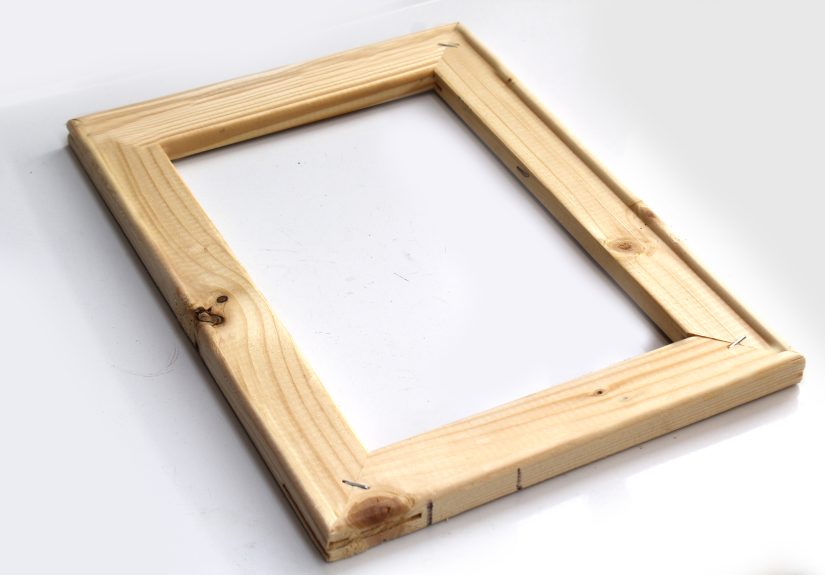
Lay the four bars face down on a flat work surface. Apply wood glue to the joints and bring the corners together. Use clamps to hold everything steady, but do not clamp so aggressively that the frame shifts out of alignment. Wood glue is helpful; panic clamping is not.
Use a carpenter’s square to check each corner. Then measure diagonally from one corner to the opposite corner. Measure the other diagonal the same way. If both diagonal measurements match, the frame is square. If they do not match, gently adjust the frame until they do. This diagonal check is one of the most important steps in making stretcher bars because canvas tension will exaggerate any crookedness.
Once the frame is square, secure the corners with screws, brad nails, or corner braces. Pre-drilling screw holes helps prevent splitting, especially near the ends of the wood. For larger frames, add flat metal corner brackets or wooden corner blocks on the back. These reinforcements are not glamorous, but neither is a painting that slowly becomes a parallelogram.
Step 7: Add Bracing, Sand, and Stretch the Canvas
Small frames may not need internal bracing. Larger frames often do. As a general rule, if one side is longer than about 30 inches, consider adding a center brace. For very large frames, use cross braces in both directions. Braces help prevent the bars from bowing inward under canvas tension.
Cut the brace so it fits snugly between the opposite bars without forcing the frame out of square. Attach it from the back with screws or brackets. Make sure the brace sits slightly behind the front plane of the frame, so it does not press into the canvas. If the brace touches the canvas, it may create a visible ridge after painting.
Sand the entire frame, paying special attention to edges and corners. Wipe away dust. Then place your canvas face down on a clean surface and center the frame on top. Leave enough extra canvas on all sides to wrap around the bars and staple to the back. A good working allowance is usually 2 to 3 inches beyond the frame on each side, depending on frame depth.
Start stapling at the center of one side, then move to the opposite side and pull the canvas snug. Staple the center there. Repeat with the remaining two sides. Continue working outward from the center, alternating opposite sides so the tension stays even. Save the corners for last, folding them neatly like wrapping a present for someone who judges corners professionally.
Important Tips for Better DIY Stretcher Bars
Use the Right Wood for the Job
Not all boards deserve to become stretcher bars. Avoid green, wet, or heavily knotted wood. Avoid boards with cracks or severe grain changes near the ends. A small knot in the middle may be harmless, but a knot at a corner can weaken the joint. For larger artwork, consider poplar or higher-quality pine rather than bargain-bin lumber.
Do Not Overstretch the Canvas
A taut canvas is good. A canvas stretched like a trampoline for squirrels is not. Overstretching can distort the frame, tear fibers, or create future tension problems as humidity changes. Pull the canvas evenly and firmly, but do not try to defeat physics with your staple gun.
Keep the Frame Square During Stretching
Even if the wooden frame starts square, uneven canvas tension can pull it out of shape. Check the diagonals again after stapling the first few points. If the frame begins shifting, remove a staple or two and correct the tension before continuing. This is much easier than discovering the problem after the entire canvas is attached.
Think About the Final Display
If the painting will go into a traditional frame, a shallow stretcher may be best. If the canvas will hang unframed, a deeper gallery wrap looks cleaner. If you want painted edges, make sure your canvas is large enough to wrap around the sides and reach the back. Planning ahead saves you from the classic studio tragedy known as “almost enough fabric.”
Common Mistakes to Avoid
The first common mistake is using warped wood. No amount of enthusiasm can turn twisted lumber into a stable stretcher frame. Start with straight material.
The second mistake is skipping the diagonal measurement. A frame can look square to the eye and still be slightly off. Your eyes are talented, but a tape measure has fewer opinions.
The third mistake is placing braces too close to the canvas surface. Internal supports should strengthen the frame without touching the stretched fabric. If they press against the canvas, they can create lines that show through paint.
The fourth mistake is stapling one entire side before moving to the opposite side. This creates uneven tension and wrinkles. Always work from the center outward, switching sides as you go.
The fifth mistake is ignoring humidity. Wood and canvas both react to moisture. A canvas stretched tightly in a damp garage may behave differently once it moves into an air-conditioned room. Build and stretch in a clean, stable environment whenever possible.
When Should You Buy Stretcher Bars Instead?
Making your own stretcher bars is rewarding, but buying professional bars makes sense in some cases. If the painting is large, valuable, commissioned, or intended for long-term exhibition, professional stretcher bars may provide better stability and adjustability. Commercial stretcher bars often include interlocking corners and canvas keys, which allow small tension adjustments later.
For student work, practice canvases, decorative art, photography transfers, theater projects, and custom odd sizes, DIY stretcher bars are a great choice. They are especially useful when you want a size that stores do not carry or when you need several canvases without making your wallet quietly leave the room.
Experience Notes: What I Learned From Making Stretcher Bars
The first thing you learn when making stretcher bars is that wood has personality. Some boards are calm, straight, and cooperative. Others seem to have spent the night plotting against your square. Choosing good lumber is not a boring preparation step; it is half the battle. I have seen beginners spend an hour trying to force a twisted board into a perfect rectangle, only to end up with a frame that wobbles like a restaurant table with one short leg. The better move is simple: reject bad wood early.
The second lesson is that measuring diagonals feels unnecessary until it saves the entire project. When a frame is only slightly out of square, the mistake may not be obvious at first. Then the canvas goes on, the corners start pulling unevenly, and suddenly the finished piece looks just a little wrong. That tiny wrongness is surprisingly loud. Measuring both diagonals before fastening the frame is one of those habits that separates a clean build from a frustrating rebuild.
Another practical experience is that small canvases are forgiving, while large canvases are honest. A 12 x 16 inch frame might tolerate a minor mistake. A 36 x 48 inch frame will announce every weakness in the construction. Longer stretcher bars bow more easily, so bracing becomes essential. A single center brace can make a dramatic difference, and for bigger pieces, cross bracing is not overkill. It is insurance.
Canvas stretching also teaches patience. Pulling hard in one direction may feel productive, but even tension matters more than brute force. The best results usually come from working slowly from the center outward, switching from side to side, and checking the surface often. If a wrinkle appears, it is better to fix it immediately than to staple around it and hope it develops character. Wrinkles rarely become charming. They usually become permanent guests.
I also learned that corners deserve more attention than people expect. A messy corner can make an otherwise good canvas look amateur. The trick is to fold consistently, keep extra fabric flat, and avoid giant bulky lumps. Think neat gift wrapping, but with staples and fewer holiday songs. If the canvas is thick, trimming excess fabric carefully can help, but never cut so close that the corner loses strength.
Finally, making stretcher bars changes how you look at canvases in stores and galleries. You start noticing depth, corner quality, bar thickness, canvas tension, and whether the frame sits flat. That awareness is useful because it helps you choose better materials and build better supports. A painting is not only paint on fabric; it is paint on fabric supported by a structure. When that structure is strong, square, smooth, and well-built, the artwork has a better chance to look good and last longer.
Conclusion
Learning how to make stretcher bars gives artists more freedom, especially when working with custom canvas sizes or trying to save money without sacrificing quality. The process is straightforward: choose good wood, measure carefully, cut accurately, create a smooth raised edge, assemble the frame squarely, add braces when needed, and stretch the canvas with even tension. The magic is not in fancy tools; it is in patience, precision, and refusing to trust a board that looks like a banana.
DIY stretcher bars are not just a budget trick. They help you understand the structure behind your art. Once you build your own frame, you become more aware of tension, support, canvas behavior, and long-term stability. That knowledge makes you a better maker, whether you paint landscapes, abstract pieces, portraits, murals, or mysterious art that relatives describe as “very interesting.”