Table of Contents >> Show >> Hide
- Why $10 Bills Deserve a Closer Look
- How to Tell If a $10 Bill is Real: 13 Things to Look For
- 1. Feel the Paper First
- 2. Check for Raised Printing
- 3. Hold the Bill Up to Light for the Hamilton Watermark
- 4. Look for the Security Thread
- 5. Use UV Light to Check the Orange Glow
- 6. Tilt the Bill and Watch the Color-Shifting Ink
- 7. Examine the Microprinting
- 8. Check the Red and Blue Security Fibers
- 9. Study the Portrait of Alexander Hamilton
- 10. Inspect the Borders and Fine Lines
- 11. Verify the Serial Numbers
- 12. Look for the Treasury Seal and Federal Reserve Details
- 13. Watch for “Replica,” “Copy,” or “For Motion Picture Use Only”
- What If the $10 Bill Is Older?
- Are Counterfeit Detection Pens Reliable?
- What to Do If You Think You Have a Fake $10 Bill
- Real-World Experiences: Practical Lessons from Handling $10 Bills
- Conclusion
That little orange-tinted $10 bill in your hand may look harmless, but before you slide it into your wallet, cash drawer, tip jar, or birthday card, it deserves a quick inspection. Counterfeit money is not always dramatic. It does not always arrive in a duffel bag during a suspicious midnight exchange. Sometimes it shows up as change from a busy store, payment for a used bicycle, or a slightly-too-crisp bill at a yard sale.
The good news? You do not need a laboratory, a trench coat, or a detective nickname to spot many fake $10 bills. Modern U.S. currency includes built-in security features designed to help ordinary people authenticate money with their eyes, fingers, and a little light. The key is knowing what to look for and checking more than one feature before making a decision.
This guide explains how to tell if a $10 bill is real using 13 practical checks. It focuses mainly on the redesigned $10 note issued from 2006 to the present, while also noting that older U.S. bills can still be legal tender. So yes, a bill can look different and still be real. Money, like fashion, has gone through phases.
Why $10 Bills Deserve a Closer Look
Many people carefully inspect $50 and $100 bills but barely glance at smaller denominations. That is exactly why counterfeiters may try to pass fake $10 bills. A cashier may hold a $100 up to the light but toss a $10 into the drawer without a second thought. A buyer in a cash transaction may check the amount but not the details. That quick moment of trust creates an opening.
A real $10 bill has several features that work together: special cotton-linen paper, raised printing, a watermark, a security thread, color-shifting ink, microprinting, and precise design details. One feature alone is not enough. A counterfeit pen mark, for example, can be helpful in some situations, but it should never replace checking the actual security features.
How to Tell If a $10 Bill is Real: 13 Things to Look For
1. Feel the Paper First
Start with touch. Genuine U.S. currency is not printed on ordinary copy paper. It is made from a special blend of cotton and linen, which gives it a firm, slightly textured feel. A real $10 bill should not feel waxy, flimsy, glossy, or like a page from a home printer.
Run the bill between your fingers. Real currency feels durable but flexible. Counterfeit bills often feel too smooth, too stiff, too limp, or oddly slippery. If you handle cash often, your fingers may notice the problem before your eyes do. Think of it as your wallet’s built-in lie detector.
2. Check for Raised Printing
Real U.S. currency uses a specialized printing process that leaves parts of the design slightly raised. On a $10 bill, gently run your fingernail or fingertip over Alexander Hamilton’s portrait, the large numerals, and the words on the front of the note. You should feel texture, not a perfectly flat surface.
Counterfeit bills made with standard printers often feel flat because regular ink sits differently on paper. If the bill looks right but feels like a smooth flyer from a pizza place, pause and inspect further.
3. Hold the Bill Up to Light for the Hamilton Watermark
One of the most important checks is the watermark. Hold the $10 bill up to a light source and look in the blank space to the right of Hamilton’s portrait. On a modern $10 note, you should see a faint image of Alexander Hamilton. The watermark should be visible from both sides of the bill.
If the watermark is missing, printed on the surface, too dark, too cartoonish, or shows the wrong person, that is a major red flag. A watermark is part of the paper itself, not a decoration printed on top.
4. Look for the Security Thread
While holding the bill to the light, look for an embedded vertical security thread. On the redesigned $10 bill, the thread appears to the right of Hamilton’s portrait. It should not look like a line printed on the surface. It is embedded inside the paper.
The thread should contain the text “USA TEN” and a small flag in an alternating pattern. If the line is simply drawn on, blurry, missing, or in the wrong place, the bill may be counterfeit.
5. Use UV Light to Check the Orange Glow
If you have access to an ultraviolet light, check the security thread. On a genuine modern $10 bill, the security thread glows orange under UV light. This is a quick check often used by stores, banks, and cash handlers.
Do not confuse the $10 bill’s orange glow with other denominations. Different U.S. bills have security threads that glow different colors. A $10 bill that glows blue, green, yellow, or pink may require a closer look because the thread might belong to another denomination or the bill may be altered.
6. Tilt the Bill and Watch the Color-Shifting Ink
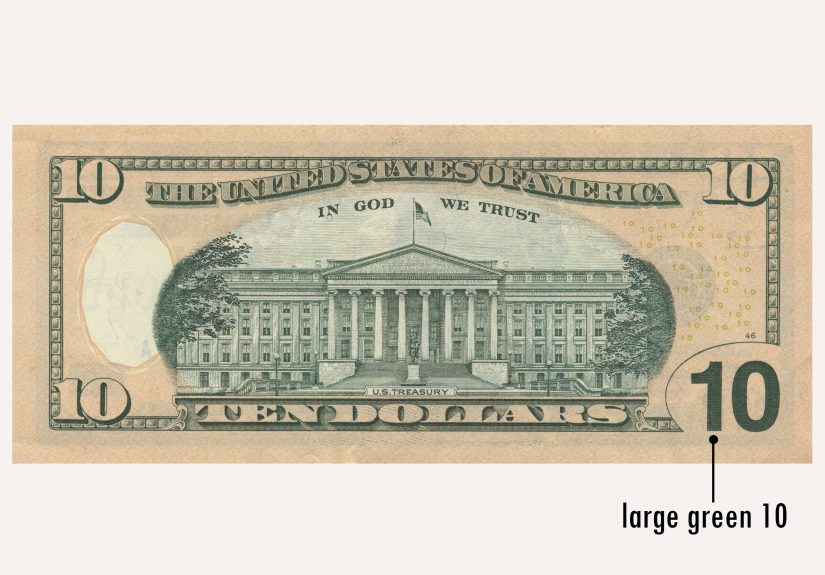
On the front of a modern $10 bill, look at the numeral “10” in the lower right corner. Tilt the note back and forth. The color should shift from copper to green. This color-shifting ink is difficult to reproduce accurately with basic printing equipment.
If the numeral stays the same color from every angle, looks dull, or appears painted rather than printed, inspect the bill carefully. A real $10 bill should do its little color-change magic trick without needing applause.
7. Examine the Microprinting
Microprinting is tiny text that appears in specific areas of genuine currency. It is often too small to read clearly without magnification. On older $10 designs, microprinting can appear around the portrait’s oval frame. On modern notes, fine text and fine-line details are part of the overall security design.
Use a magnifying glass if you have one. Real microprinting should look sharp, not like a row of smudged ants marching through fog. Counterfeiters often struggle to reproduce tiny text cleanly, so blurry microprinting is a warning sign.
8. Check the Red and Blue Security Fibers
Real U.S. currency paper contains tiny red and blue fibers embedded throughout the material. These fibers are not simply printed on the surface. They are part of the paper blend.
Look closely at the bill. If the red and blue marks appear printed flat on top of the paper, or if they line up too neatly, that may be suspicious. Real fibers are random and subtle. They do not look like someone attacked the bill with a patriotic ballpoint pen.
9. Study the Portrait of Alexander Hamilton
The portrait on a real $10 bill should be sharp, detailed, and lifelike. Hamilton’s face should not look muddy, overly dark, fuzzy, or washed out. Fine lines in the portrait should remain clear, especially around the eyes, hair, collar, and background.
Counterfeit portraits often look flat because standard printers cannot reproduce engraved detail well. Compare the suspicious bill with another $10 bill if possible. Side-by-side comparison is one of the easiest ways to notice odd shading, poor alignment, or weak detail.
10. Inspect the Borders and Fine Lines
Genuine currency has crisp borders, delicate line work, and careful spacing. On a fake $10 bill, the border may look blurry, broken, uneven, or too thick. The fine background lines may merge together instead of staying distinct.
Look at the edges of the bill, the scrollwork, and the detailed patterns behind the portrait. If the artwork looks like it has been through a low-resolution photocopier, trust your suspicion and keep checking.
11. Verify the Serial Numbers
A real $10 bill has two matching serial numbers printed on the front. They should be evenly spaced, aligned, and printed in the correct color and style for the bill’s series. The numbers should not look crooked, smeared, or mismatched.
If you receive several suspicious $10 bills at once, compare the serial numbers. Multiple bills with the exact same serial number are a strong sign of counterfeiting. Real cash does not arrive in identical-number twins like a suspiciously organized family reunion.
12. Look for the Treasury Seal and Federal Reserve Details
The Treasury seal appears on the front of the bill, and the Federal Reserve information should be clean and properly placed. The seals should look sharp, not fuzzy or poorly filled in. The letters and numbers associated with the Federal Reserve system should be printed clearly.
Counterfeit bills may include seals that look too light, too dark, off-center, or poorly detailed. While most people do not memorize every seal style, obvious printing problems are easy to spot when you slow down and compare the bill with a known genuine note.
13. Watch for “Replica,” “Copy,” or “For Motion Picture Use Only”
Some fake bills are not sophisticated counterfeits at all. They are prop money or novelty notes that someone tries to pass as real cash. Look carefully for phrases such as “For Motion Picture Use Only,” “Replica,” “Copy,” or other wording that tells you the bill is not legal tender.
These markings may appear where normal currency text should be, along the border, or near the portrait. A quick glance may miss them, especially in a busy checkout line. Take the extra second. Your cash drawer will thank you.
What If the $10 Bill Is Older?
Not every real $10 bill looks like the newest design. Older U.S. currency can remain legal tender even when the design has changed. That means a different-looking $10 bill is not automatically fake. However, older designs may have different security features.
For example, $10 bills issued from 2000 to 2006 have security features, but the color-shifting ink may behave differently than the newest design. Notes from 1990 to 2000 include a security thread and microprinting, but they do not look like the colorful modern bill. Very old notes may lack features that people now expect.
The safest approach is to match the bill to its design era. If you are unsure, compare it with official images from trusted currency education resources or ask a bank to help authenticate it.
Are Counterfeit Detection Pens Reliable?
Counterfeit detection pens can be useful, but they are not foolproof. These pens usually react to starch in ordinary wood-based paper. Since genuine U.S. currency paper is made from cotton and linen, a real bill typically does not produce the dark mark associated with regular paper.
The problem is that some fake bills may still fool a pen. For example, an altered bill may be made from genuine lower-denomination currency that has been chemically changed and reprinted as a higher denomination. In that situation, the paper may pass the pen test even though the bill is not genuine as printed.
Use a pen as a first step if you want, but do not stop there. Check the watermark, security thread, color-shifting ink, raised printing, and microprinting. A pen is a helper, not the boss.
What to Do If You Think You Have a Fake $10 Bill
If a $10 bill seems counterfeit, do not try to spend it. Knowingly passing counterfeit currency is illegal, even if you originally received the bill by accident. Also, do not return it to the person who gave it to you if the situation feels unsafe or suspicious.
Instead, keep the bill separate from genuine money. Handle it as little as possible. Write down where you got it, when you received it, and any details you remember about the transaction. If you are in the United States, contact local law enforcement or a local U.S. Secret Service field office. A bank may also help guide you through the proper reporting process.
Unfortunately, if the bill is confirmed as counterfeit, you generally cannot exchange it for a real one. That is frustrating, but it is also why a quick inspection before accepting cash matters.
Real-World Experiences: Practical Lessons from Handling $10 Bills
Anyone who has handled cash for work knows that counterfeit detection is part skill, part habit, and part “something feels weird about this.” The first lesson is that your hands often notice trouble before your brain has a full explanation. A suspicious $10 bill may feel too smooth, too stiff, or oddly thin. When that happens, it is worth slowing down instead of waving the bill through because the line is getting long.
In a busy store, the best method is to create a short routine. Feel the bill, tilt it, hold it to light, and glance at the security thread. The whole process can take just a few seconds once you know what you are doing. Cashiers who practice this routine do not look paranoid; they look professional. Besides, no customer has ever suffered permanent injury from waiting three extra seconds while their money gets a tiny security spa treatment.
For small businesses, training matters more than expensive equipment. A UV light near the register can help, but employees still need to know that a genuine $10 bill should have an orange-glowing thread. A counterfeit pen can help catch basic fakes, but staff should understand its limits. A laminated quick-reference sheet near the cash drawer can be surprisingly useful, especially for new employees who are still learning the difference between “worn but real” and “fresh from someone’s questionable printer.”
Private cash transactions deserve caution too. If you are selling a phone, bicycle, game console, or concert ticket and someone pays in cash, do not feel awkward checking the bills. It is normal. Meet in a safe public place, count the money slowly, and inspect any bill that looks unusual. If the buyer acts offended because you checked a $10 bill, remember that real money does not have feelings. People do, but real money does not.
Another helpful habit is comparing suspicious bills with known genuine ones. If you have a real $10 bill in your wallet, place the two side by side. Look at Hamilton’s portrait, the paper color, the border sharpness, and the placement of the security thread. Differences become easier to spot when your eyes can bounce between the two notes.
Finally, do not panic over a bill just because it is wrinkled, faded, taped, or older. Real money lives a rough life. It gets stuffed into pockets, dropped in parking lots, washed in jeans, folded into birthday cards, and occasionally rescued from under car seats with a french fry. Wear alone does not make a bill fake. The real question is whether the security features match the design. A beat-up bill with the right watermark, thread, paper, and ink may be perfectly genuine. A crisp bill with missing features is the one that deserves suspicion.
Conclusion
Learning how to tell if a $10 bill is real is not about becoming suspicious of every piece of cash that crosses your palm. It is about building a simple, repeatable habit. Feel the paper. Check the raised printing. Hold the bill to light for the Hamilton watermark and security thread. Tilt the numeral 10 to see the color shift. Look closely at the fibers, microprinting, portrait, borders, seals, and serial numbers.
The best protection is using several checks together. A fake bill may pass one test, but it is much harder for it to pass all 13. With a little practice, you can inspect a $10 bill quickly and confidently, whether you are working a register, selling something in person, or just wondering why that Hamilton in your hand looks like he had a rough morning.