Table of Contents >> Show >> Hide
- Introduction: Fractions Are Not the Villain of Math Class
- What Is a Fraction?
- How to Understand Fractions: 13 Steps
- Step 1: Start With the Idea of One Whole
- Step 2: Learn the Denominator First
- Step 3: Understand the Numerator
- Step 4: Use Pictures and Area Models
- Step 5: Put Fractions on a Number Line
- Step 6: Understand Unit Fractions
- Step 7: Learn Equivalent Fractions
- Step 8: Compare Fractions Carefully
- Step 9: Simplify Fractions
- Step 10: Understand Improper Fractions and Mixed Numbers
- Step 11: Add and Subtract Fractions With Like Denominators
- Step 12: Add and Subtract Fractions With Unlike Denominators
- Step 13: Practice Fractions in Real Life
- Common Fraction Mistakes and How to Avoid Them
- Why Fractions Matter Beyond Math Class
- Examples That Make Fractions Easier
- Extra Experience Section: Real-World Lessons for Understanding Fractions
- Conclusion: Fractions Make More Sense When You See the Whole Picture
Note: This copy-ready HTML article is written in standard American English for web publishing, with SEO tags included at the end in JSON format.
Introduction: Fractions Are Not the Villain of Math Class
Fractions have a dramatic reputation. For many students, they enter the room wearing a tiny cape, carrying a calculator, and whispering, “You thought whole numbers were easy? Cute.” But here is the good news: fractions are not mysterious little math monsters. They are simply numbers that describe parts of a whole, parts of a group, or division between two values.
Learning how to understand fractions is one of the most important steps in building math confidence. Fractions appear in cooking, shopping, measuring, sports statistics, construction, music, science, budgeting, and even splitting pizza fairly so nobody starts a family argument over the last slice. Once you understand what the numerator and denominator actually mean, fractions become much friendlier.
This guide explains fractions in 13 clear steps, using simple examples, practical tips, and visual thinking. Whether you are a student, parent, teacher, or adult trying to remember what happened in fifth-grade math, this article will help you understand fractions without needing to stare dramatically out a window.
What Is a Fraction?
A fraction is a number that represents part of a whole or part of a group. It is usually written with one number on top and one number on the bottom, like this: 3/4. The top number is called the numerator, and the bottom number is called the denominator.
The denominator tells how many equal parts the whole is divided into. The numerator tells how many of those equal parts you have. In 3/4, the whole is divided into 4 equal parts, and you are talking about 3 of them. Simple enough, right? The fraction is basically saying, “I have three out of four equal pieces.”
How to Understand Fractions: 13 Steps
Step 1: Start With the Idea of One Whole
Before you understand fractions, you need to understand the whole. A whole can be one pizza, one chocolate bar, one mile, one hour, one dollar, or one group of students. Fractions only make sense when you know what the whole is.
For example, 1/2 of a large pizza is not the same amount of food as 1/2 of a tiny cookie. Both are one-half, but the size of the whole changes the size of the fraction. That is why context matters. A fraction always answers the question: “Part of what?”
Step 2: Learn the Denominator First
The denominator is the bottom number in a fraction. It tells you how many equal parts make one whole. In 1/2, the denominator is 2, so the whole is divided into two equal parts. In 1/8, the denominator is 8, so the whole is divided into eight equal parts.
A common mistake is thinking that a bigger denominator always means a bigger fraction. Actually, if the numerator stays the same, a bigger denominator means smaller pieces. One slice from a pizza cut into 8 pieces is smaller than one slice from a pizza cut into 2 pieces. Your stomach understands this before your brain does.
Step 3: Understand the Numerator
The numerator is the top number. It tells how many equal parts you are counting. In 5/6, the numerator is 5, meaning you have five of the six equal parts. In 2/3, the numerator is 2, meaning you have two of the three equal parts.
Think of the denominator as the size of the pieces and the numerator as the number of pieces you have. If the fraction is 3/8, the whole was cut into 8 equal pieces, and you have 3 of those pieces. The denominator sets the stage; the numerator walks on and says, “These are mine.”
Step 4: Use Pictures and Area Models
Visual models are one of the easiest ways to understand fractions. Draw a circle, rectangle, or bar and divide it into equal parts. Then shade the parts named by the numerator. For 3/4, divide a shape into 4 equal sections and shade 3 of them.
This helps because fractions are not just symbols. They represent real quantities. A fraction circle, fraction strip, or rectangle model lets you see why 1/2 is larger than 1/4, even though 4 is bigger than 2. The picture politely tells your brain, “Look at the size of the pieces, not just the numbers.”
Step 5: Put Fractions on a Number Line
A number line shows that fractions are numbers with exact locations. To place 1/4 on a number line, start at 0 and end at 1. Divide the distance into 4 equal spaces. The first mark after 0 is 1/4, the second is 2/4, the third is 3/4, and the last is 4/4, which equals 1.
Number lines are powerful because they show fraction size, order, and equivalence. They also help students understand that fractions are not random decorations floating between whole numbers. They live on the number line, pay rent, and behave like real numbers.
Step 6: Understand Unit Fractions
A unit fraction has 1 as the numerator, such as 1/2, 1/3, 1/4, or 1/10. Unit fractions are the building blocks of other fractions. For example, 3/5 means three copies of 1/5. In other words, 3/5 = 1/5 + 1/5 + 1/5.
Once you understand unit fractions, larger fractions become easier. You stop seeing 7/8 as a scary symbol and start seeing it as seven pieces of size 1/8. Fractions become countable, just like apples, pencils, or cookies someone promised not to eat before dinner.
Step 7: Learn Equivalent Fractions
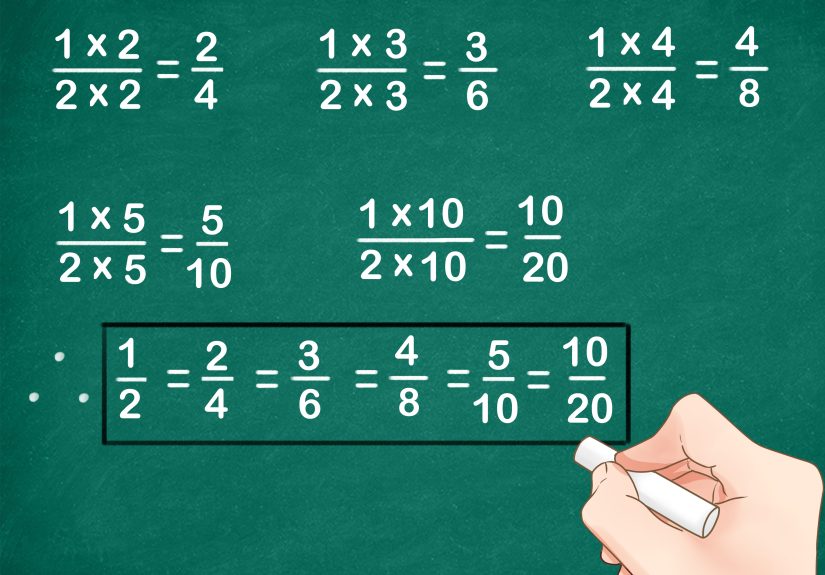
Equivalent fractions are fractions that look different but have the same value. For example, 1/2, 2/4, 3/6, and 4/8 are equivalent. They all describe the same amount of the whole, just divided into different numbers of equal parts.
You can create equivalent fractions by multiplying or dividing the numerator and denominator by the same nonzero number. For example, multiply 1/2 by 2/2 and you get 2/4. Since 2/2 equals 1, the value does not change. The outfit changes, but the math person inside is the same.
Step 8: Compare Fractions Carefully
Comparing fractions means deciding which fraction is greater, smaller, or whether they are equal. When fractions have the same denominator, compare the numerators. For example, 5/8 is greater than 3/8 because both fractions use eighths, and 5 pieces are more than 3 pieces.
When fractions have the same numerator, compare the denominators. For example, 1/3 is greater than 1/6 because thirds are larger pieces than sixths. If the denominators and numerators are both different, you can use visual models, number lines, cross multiplication, or common denominators.
Step 9: Simplify Fractions
To simplify a fraction, divide the numerator and denominator by the same common factor until there are no more common factors except 1. For example, 6/8 can be simplified by dividing both numbers by 2. That gives 3/4.
Simplifying does not change the value of the fraction. It only writes the fraction in a cleaner form. Think of it like putting away extra packaging. The product is the same, but now it fits better on the shelf.
Step 10: Understand Improper Fractions and Mixed Numbers
An improper fraction has a numerator that is greater than or equal to the denominator, such as 5/4 or 9/3. This means the fraction is equal to or greater than one whole. For example, 5/4 means five fourths. Since four fourths make one whole, 5/4 is equal to 1 and 1/4.
A mixed number combines a whole number and a fraction, such as 2 1/3. Mixed numbers are useful in everyday life. If someone says they walked 2 1/2 miles, that is easier to picture than saying they walked 5/2 miles, unless they are trying to sound like a math textbook at a picnic.
Step 11: Add and Subtract Fractions With Like Denominators
Fractions with the same denominator are called like fractions. To add or subtract them, keep the denominator the same and add or subtract the numerators. For example, 2/7 + 3/7 = 5/7. You are adding two sevenths and three sevenths, which makes five sevenths.
The denominator stays the same because the size of the pieces does not change. If you add two apple slices and three apple slices, you get five apple slices. You do not suddenly get banana slices. Math may be flexible, but it is not a fruit magician.
Step 12: Add and Subtract Fractions With Unlike Denominators
When denominators are different, you need a common denominator before adding or subtracting. For example, to solve 1/2 + 1/4, change 1/2 into 2/4. Then add 2/4 + 1/4 = 3/4.
A common denominator gives both fractions the same size pieces. Without it, you are trying to add different units. It is like adding inches and feet without converting first. Technically possible, but your math will start looking nervous.
Step 13: Practice Fractions in Real Life
The best way to understand fractions is to use them often. Measure 1/2 cup of flour. Cut a sandwich into fourths. Find 25% as 1/4 of a price. Read a recipe that calls for 3/4 teaspoon of salt. Compare 2/3 of an hour with 1/2 of an hour.
Real-life practice helps fractions feel useful instead of abstract. Fractions are not just school exercises. They are tools for describing the world accurately. Every time you split, measure, compare, share, or scale something, fractions are quietly doing the math in the background.
Common Fraction Mistakes and How to Avoid Them
Mistake 1: Treating the Numerator and Denominator as Separate Whole Numbers
Many learners see 3/4 and focus only on the 3 and the 4 separately. But a fraction is one number made from a relationship between two numbers. The numerator and denominator work together. You cannot fully understand one without the other.
Mistake 2: Forgetting That Parts Must Be Equal
Fractions only work when the whole is divided into equal parts. If a pizza is cut into four wildly uneven slices, one slice is not automatically 1/4 of the pizza. It is just a slice with confidence issues.
Mistake 3: Adding Denominators
When adding fractions with the same denominator, do not add the denominators. For example, 1/5 + 2/5 is 3/5, not 3/10. The denominator tells the type of piece. You count the pieces by adding the numerators.
Mistake 4: Thinking Bigger Denominator Means Bigger Fraction
With unit fractions, the opposite is true. One-half is larger than one-eighth because the whole is divided into fewer, larger pieces. This is why visual models are so helpful. They make the size difference obvious.
Why Fractions Matter Beyond Math Class
Understanding fractions supports later success in decimals, percentages, ratios, proportions, algebra, geometry, probability, measurement, and science. A student who understands fractions has a stronger foundation for solving equations, interpreting data, and reasoning about quantities.
Fractions also build flexible thinking. They teach you that the same value can appear in different forms. One-half can be written as 1/2, 2/4, 0.5, or 50%. That idea is essential in advanced math and everyday decision-making.
Examples That Make Fractions Easier
Example 1: Pizza Fractions
If a pizza is cut into 8 equal slices and you eat 3 slices, you ate 3/8 of the pizza. If your friend eats 2 slices, your friend ate 2/8. Together, you ate 5/8. This example works because the pieces are equal and the whole is clear.
Example 2: Money Fractions
A quarter is 1/4 of a dollar. Two quarters are 2/4, or 1/2 of a dollar. Four quarters are 4/4, or one whole dollar. Money is a great way to practice fractions because coins naturally show parts of a whole.
Example 3: Time Fractions
Thirty minutes is 1/2 of an hour. Fifteen minutes is 1/4 of an hour. Forty-five minutes is 3/4 of an hour. This helps connect fractions to clocks, schedules, and real life.
Extra Experience Section: Real-World Lessons for Understanding Fractions
One of the best experiences for learning fractions happens in the kitchen. Recipes are basically fraction worksheets disguised as dinner. If a recipe calls for 1/2 cup of milk and you need to double it, you quickly learn that 1/2 + 1/2 = 1. If you only have a 1/4 measuring cup, you discover that two 1/4 cups make 1/2 cup. Suddenly, equivalent fractions are not just a school topic; they are the difference between pancakes and flour-flavored sadness.
Cooking also teaches why the size of the whole matters. Half of a teaspoon is very different from half of a cup. Both are 1/2, but the unit changes everything. This helps learners understand that a fraction must always be attached to a whole. When students struggle with fractions, it is often because the “whole” is invisible. Real objects make the whole easier to see.
Another helpful experience is shopping. Discounts often connect fractions, decimals, and percentages. A 50% discount means the same as 1/2 off. A 25% discount means 1/4 off. If a jacket costs $80 and is 1/4 off, the discount is $20, so the sale price is $60. This kind of practice builds number sense and shows why fractions are practical. Nobody complains about understanding fractions when it saves them money.
Sports also offer great fraction practice. A basketball player who makes 7 out of 10 free throws has made 7/10 of the shots. A baseball batting average, while written as a decimal, is based on a fraction: hits divided by at-bats. Fractions help explain performance, probability, and comparison. They turn numbers into stories.
Measurement is another everyday fraction classroom. A ruler is filled with halves, fourths, eighths, and sixteenths of an inch. At first, these tiny marks may look like a secret code invented by a very patient carpenter. But once you realize that each inch is divided into equal parts, the ruler becomes a number line you can hold in your hand.
Sharing food is probably the most emotional fraction lesson. If four people share one cake equally, each person gets 1/4. If eight people share the same cake, each person gets 1/8. This makes it clear that as the denominator increases, each piece gets smaller. It also explains why extra guests at dessert time should be announced early.
A strong personal strategy for understanding fractions is to draw before calculating. When a problem feels confusing, sketch a bar, circle, or number line. Label the whole. Divide it into equal parts. Shade or mark the fraction. This simple habit slows the brain down in a good way. It changes the question from “What rule do I memorize?” to “What does this number mean?”
Another experience-based tip is to explain fractions out loud. For example, instead of saying “three-fourths,” say, “The whole is divided into four equal parts, and I have three of them.” This sentence may feel long at first, but it builds deep understanding. Over time, the meaning becomes automatic.
Finally, it helps to accept that fractions take practice. Nobody becomes fluent with fractions by reading one definition and instantly becoming the mayor of Math Town. Understanding grows through examples, mistakes, corrections, and repeated exposure. Use food, money, time, rulers, number lines, and drawings. The more ways you see fractions, the less intimidating they become.
Conclusion: Fractions Make More Sense When You See the Whole Picture
Understanding fractions is not about memorizing random rules. It is about seeing relationships: part to whole, numerator to denominator, fraction to number line, and one form to another. Once you know what the whole is, divide it into equal parts, and count those parts carefully, fractions become much easier to manage.
The 13 steps in this guide can help anyone build a stronger foundation: start with the whole, learn the numerator and denominator, use pictures, place fractions on a number line, explore unit fractions, create equivalent fractions, compare values, simplify carefully, work with mixed numbers, practice operations, and connect fractions to real life.
Fractions may never become everyone’s favorite topic, but they do not have to be scary. With the right approach, they become useful, logical, and maybe even a little fun. Yes, fun. Math heard that and is trying not to blush.