Table of Contents >> Show >> Hide
- A Million-Dollar Mansion, a Kitchen Fire, and a Silence Too Loud to Ignore
- What the 22 Pictures Reveal About the Mansion
- The Burned Kitchen: Where Luxury Meets Reality
- Why Would Everything Be Left Behind?
- The Strange Beauty of Abandoned Mansion Photography
- Luxury Does Not Protect a House From Disaster
- What Abandoned Properties Cost Communities
- The Preservation Question: Save It, Restore It, or Let It Go?
- Urban Exploration Ethics: Look, Document, Respect
- Why This Mansion Story Went Viral
- What Homeowners Can Learn From the Mansion
- Experience Section: What It Feels Like to Encounter a Burned, Abandoned Mansion
- Conclusion: A Mansion That Became a Warning and a Time Capsule
Note: This article is an original editorial synthesis based on publicly available reporting, fire-safety guidance, preservation resources, and abandoned-place photography context. It does not encourage trespassing, entering unsafe structures, or disturbing private property.
A Million-Dollar Mansion, a Kitchen Fire, and a Silence Too Loud to Ignore
Some abandoned houses whisper. Others practically grab your sleeve and say, “You need to see what happened here.” This abandoned $2.5 million mansion in upstate New York belongs firmly in the second category. Hidden deep in the woods, the home appears frozen after an electrical fire reportedly broke out in the kitchen in 2018. What makes the story so haunting is not only the fire damage, but the fact that so much was left behind: furniture, decor, personal objects, family-style details, and rooms that still look as if someone simply stepped out for a minute and forgot to come back for several years.
The mansion became widely discussed after photographer Bryan Sansivero shared a 22-photo look inside. His images show the strange tension that makes abandoned mansion photography so addictive: beauty and decay sharing the same room, luxury and loss standing awkwardly beside each other like relatives at a wedding who do not speak anymore. One moment you are admiring a grand staircase, golden cabinetry, ornate parlor decor, and a dramatic foyer. The next, you are staring into a burned kitchen and realizing that one spark can turn a dream house into a cautionary tale with crown molding.
For readers who love abandoned places, urban exploration photography, mysterious homes, old mansions, and “everything left behind” stories, this one checks every box. It has a high-value property, a fire, untouched rooms, eerie objects, and the irresistible question: why was all of this abandoned?
What the 22 Pictures Reveal About the Mansion
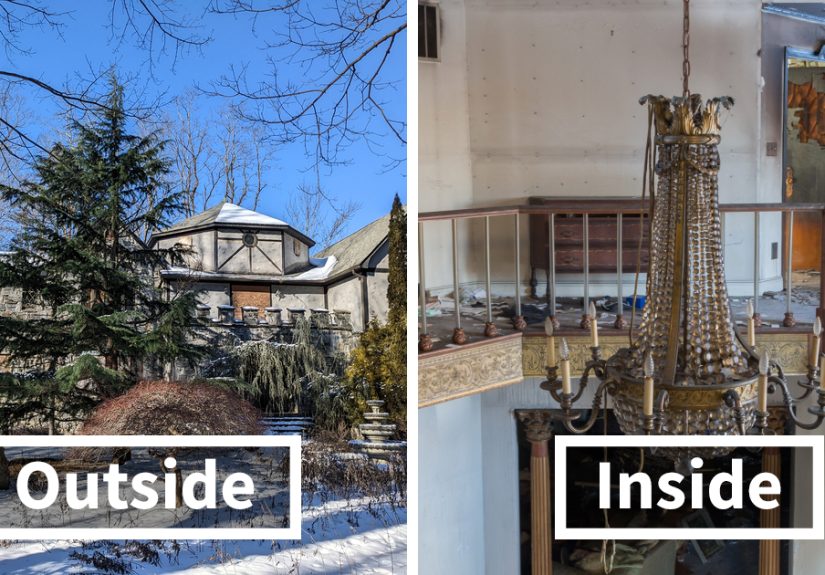
The photo set reads like a tour through a house that cannot decide whether it wants to impress you or warn you. The exterior suggests a once-proud property tucked away from ordinary traffic. Inside, the grand staircase entrance immediately signals wealth, scale, and intention. This was not a modest house with a fancy mailbox. This was a mansion built to make visitors look up, pause, and possibly wonder whether they should have worn nicer shoes.
The foyer and staircase are among the most memorable scenes because staircases in abandoned mansions often become visual symbols. They connect the public and private parts of the home, the showpiece downstairs and the bedrooms above, the life people presented and the life they actually lived. In this mansion, the staircase appears less like a simple architectural feature and more like a stage set after the actors have left.
Then come the details: golden cabinets, decorative pieces, mannequin heads, parlor arrangements, an antique pram, a formal dining room, a main bedroom, a master bathroom, and even what appears to be a family photo. These are the objects that turn an abandoned house from “old building” into “human mystery.” A broken ceiling is interesting. A family photo left behind is unsettling. A burned kitchen is dramatic. A mannequin head in a cabinet is the kind of thing that makes even brave people suddenly remember they left something important in the car.
The Burned Kitchen: Where Luxury Meets Reality
The kitchen is the emotional center of the story because it is reportedly where the electrical fire started. That detail matters. Kitchens are full of appliances, wiring, outlets, heat sources, and small daily habits that feel harmless until they are not. In large homes, especially older or heavily customized properties, electrical systems can be complicated. Add age, deferred maintenance, overloaded circuits, or appliance issues, and a beautiful kitchen can become the beginning of a disaster.
Fire does not politely stay in one room. Even when flames are limited, smoke, soot, heat, and firefighting water travel. They creep into fabrics, furniture, walls, insulation, vents, cabinets, artwork, and personal belongings. That is one reason a home can look partly intact in photographs but still be deeply damaged. A room may appear “fine” to the eye while carrying smoke odor, chemical residue, moisture problems, weakened materials, or hidden mold. Fire damage is sneaky like that. It does not always knock politely before moving into the whole house.
In the mansion photos, the kitchen damage creates a harsh contrast with the rest of the interiors. The parlor still hints at elegance. The bedrooms still suggest private routines. The staircase still performs its grand entrance. But the kitchen tells the truth: something happened here, and after that, the house was never normal again.
Why Would Everything Be Left Behind?
Whenever people see an abandoned mansion with furniture and personal belongings still inside, the same question appears: why did nobody take the stuff? The answer is usually less glamorous than the internet wants it to be. In real life, abandoned homes often involve insurance disputes, estate complications, safety hazards, legal delays, ownership changes, emotional trauma, financial problems, or a simple calculation that cleanup costs more than the items are worth.
After a fire, belongings may be contaminated by soot, smoke, water, or mold. Upholstered furniture, rugs, curtains, books, mattresses, and clothing can absorb odors and residue so deeply that saving them becomes difficult or impossible. Even objects that look valuable can become liabilities if they are unsafe to handle. That antique chair might look charming in a photo, but if it smells like a chimney married a wet basement, it may not be coming home with anyone.
There is also the emotional side. A house fire is not merely a property event. It can be a personal rupture. Some owners cannot bear to return. Some families move on before decisions are made. Some properties sit while paperwork crawls through insurance, banks, courts, or municipal offices. The result is what viewers find so fascinating: rooms that seem paused mid-sentence.
The Strange Beauty of Abandoned Mansion Photography
Abandoned mansion photography sits at the intersection of architecture, documentary storytelling, and curiosity. It attracts people because it reverses the usual real-estate fantasy. Instead of polished listing photos, fresh flowers, and suspiciously cheerful throw pillows, we see the afterlife of a home. The mansion is no longer selling a dream. It is revealing what dreams look like after time, damage, and silence have had their say.
Bryan Sansivero’s broader body of work focuses on abandoned homes, forgotten interiors, and places that feel like time capsules. That phrase matters because a time capsule is not just old; it preserves context. Floral wallpaper, old electronics, chandeliers, antique furniture, children’s objects, kitchen tools, framed pictures, and formal rooms all tell us something about the people who once moved through the space. Even without names, the rooms hold clues.
The $2.5 million mansion is compelling because it was not empty in the clean, staged way of a vacant property. It was full of fragments. The 22 pictures suggest wealth, personality, interruption, and decay all at once. That is why viewers linger. We are not simply looking at damage. We are trying to reconstruct a story from what the fire did not destroy.
Luxury Does Not Protect a House From Disaster
One of the most useful lessons from this mansion is also one of the least romantic: expensive homes burn too. A high price tag does not guarantee perfect wiring, flawless maintenance, functioning alarms, or safe appliances. A mansion can have a dramatic staircase, impressive rooms, and costly finishes, yet still be vulnerable to the same hazards as a modest suburban kitchen.
That is part of what makes the story so visually powerful. The home looks like it should have been protected by its own importance. But buildings do not survive because they are beautiful. They survive because someone maintains them, inspects them, repairs them, secures them, and responds quickly when trouble begins. Once a property becomes vacant, even a mansion starts losing the battle. Moisture enters. Animals investigate. Vandals may appear. Temperature changes stress materials. Fire damage worsens. Insurance decisions and legal delays can leave the structure in limbo.
Vacancy is not passive. It is an active condition that pushes a building downhill. A vacant mansion may look grand from the driveway, but inside, every day without care adds another small problem to the pile.
What Abandoned Properties Cost Communities
Abandoned properties are not only spooky content for late-night scrolling. They can become serious problems for neighborhoods and local governments. Vacant homes may attract trespassers, theft, vandalism, illegal dumping, and additional fire risk. If ownership is unclear or the owner is unwilling to maintain the structure, cities may be forced to inspect, secure, clean, or eventually demolish properties. Those costs do not vanish; they often land on local systems already juggling limited budgets.
High-value abandoned homes are especially strange because they look like assets from the outside. A $2.5 million mansion sounds like a treasure. But after fire, smoke, water, code issues, legal delays, and years of vacancy, the math can become brutal. The land may have value. The architecture may have value. The story definitely has value. But the building itself may require enormous investment before it is safe, livable, insurable, or sellable again.
That is why some abandoned mansions are renovated, some are stripped, some are sold as-is, and others are left to decline until demolition becomes the simplest option. It is not always the option preservation lovers want, but in the real world, romance and repair bills do not always sit at the same table.
The Preservation Question: Save It, Restore It, or Let It Go?
Whenever a grand old home is damaged, people naturally ask whether it can be saved. The answer depends on structure, moisture, fire spread, code requirements, historic value, ownership, budget, and the willingness of professionals to take on a complicated restoration. If the mansion has significant architectural features, preservation-minded experts would likely begin by documenting everything: staircases, trim, cabinetry, hardware, room layouts, plaster details, flooring, and any surviving historic records.
Restoration after fire is never one-size-fits-all. Some materials can be cleaned. Others must be removed. Structural elements may need engineering review. Smoke-damaged surfaces may require sealing, replacement, or specialized treatment. If mold has developed because of firefighting water or roof leaks, remediation becomes another major layer. In older homes, there may also be asbestos, lead paint, outdated electrical systems, and building-code upgrades waiting behind the walls like expensive little goblins.
Still, abandoned mansions matter because they preserve craftsmanship that is hard to replace. Reusing existing buildings can also be environmentally responsible. The greenest building is often the one already standing, provided it can be made safe and functional. A mansion like this raises a difficult but important question: when does a damaged building stop being a liability and become a candidate for rebirth?
Urban Exploration Ethics: Look, Document, Respect
Stories like this often inspire people to search for abandoned places nearby. That curiosity is understandable, but it needs a hard reality check. Abandoned does not mean ownerless. Empty does not mean legal. Unlocked does not mean safe. A beautiful ruin can still contain weak floors, exposed nails, unstable ceilings, broken glass, contaminated air, wildlife, mold, or hidden fire damage. In short, the house may be photogenic, but it is not your friend.
The ethical rule often repeated in urban exploration is simple: take nothing but pictures, leave nothing but footprints. A better version adds: get permission, do not reveal sensitive locations, do not force entry, do not move objects for drama, and never damage a property for content. Abandoned buildings already have enough problems without influencers kicking doors open for “vibes.”
The best abandoned-place photography preserves a moment without making the damage worse. It documents, rather than exploits. That is especially important in homes where personal items remain. A family photo, a child’s toy, or a bedroom mirror may look like a storytelling device to strangers, but it may still carry meaning for someone connected to the property.
Why This Mansion Story Went Viral
The title alone has viral ingredients: abandoned, $2.5 million, burned in a fire, everything left behind, 22 pics. Each phrase adds a hook. “Abandoned” creates mystery. “$2.5 million” adds luxury. “Burned in a fire” brings danger. “Everything left behind” suggests secrets. “22 pics” promises visual proof. The internet loves a mystery it can scroll through.
But the deeper reason people respond is emotional. The mansion shows how quickly permanence can become fragile. A grand home is supposed to represent success, stability, and security. Yet here it stands, damaged and silent, with traces of life still visible. That contradiction is powerful. It reminds us that homes are not just investments. They are containers for routines, meals, arguments, celebrations, bad wallpaper decisions, and all the ordinary moments that become precious only after they disappear.
In a way, the mansion is both spectacular and painfully ordinary. Yes, it was expensive. Yes, it had grand spaces. But the loss feels familiar because everyone understands what a kitchen means, what a staircase means, what a bedroom means, what a photo left behind means. The scale is unusual. The feeling is human.
What Homeowners Can Learn From the Mansion
Beyond the mystery, the mansion offers practical reminders. Electrical systems should be inspected, especially in older homes or houses with major renovations. Kitchen appliances should be maintained and used carefully. Smoke alarms should be installed, tested, and placed properly. Fire extinguishers should be accessible, but only used for small, contained fires when escape is still safe. Families should have a fire escape plan, because when a real fire happens, nobody rises gracefully like a movie hero. People panic, pets hide, and the hallway suddenly feels much longer than it did yesterday.
Homeowners should also document valuable belongings, store important papers safely, and understand insurance coverage before disaster happens. After a fire, photographs, receipts, and records can matter. So can professional cleanup. Fire damage is not a weekend DIY project with a scented candle and a mop. Smoke, soot, ash, water, and mold require caution, especially when a structure has been closed up for years.
The mansion’s haunting beauty should not distract from the practical message: maintenance is cheaper than disaster, and prevention is less dramatic than a 22-photo tour of what went wrong.
Experience Section: What It Feels Like to Encounter a Burned, Abandoned Mansion
Standing before a burned abandoned mansion is a very specific kind of experience. It is not the same as visiting a museum, and it is not the same as walking past a neglected house on a city block. A mansion carries expectations. You expect polish, noise, servants in old movies, dinner parties, holiday decorations, guests arriving too loudly, and somebody somewhere saying, “Please use the other staircase.” When that same mansion is silent, damaged, and left with its belongings inside, the contrast is almost physical.
The first sensation is usually disbelief. The brain sees expensive architecture and assumes care. Large homes teach us to expect landscaping, alarms, fresh paint, and a person in a fleece vest discussing property taxes. So when the windows are dark, the driveway is quiet, and the rooms are still filled with objects, it feels like reality has skipped a step. How does a place with so much value become a place nobody seems to claim?
The second sensation is caution. Fire-damaged buildings have a way of looking stable from the polite angle. A staircase may seem solid until one step complains. A ceiling may appear harmless until a stain reveals long-term water intrusion. The air may smell like old smoke, damp wood, dust, and something metallic. Even if the flames were limited to the kitchen, the whole house can feel touched by the event. Fire changes the mood of a building. It leaves behind more than black marks; it leaves a warning.
The third sensation is curiosity, and this is the dangerous one. Curiosity makes people lean closer, open drawers, look around corners, and imagine stories. In a mansion where everything is left behind, every object feels like evidence. A pram suggests family history. A dining room suggests ceremony. A family photo suggests identity. Mannequin heads suggest either a creative household, a collector, or the beginning of a horror movie that will absolutely not end well for the person holding the flashlight.
Good abandoned-place storytelling requires restraint. The best experience is not about taking souvenirs or staging scenes. It is about noticing. Notice how the grand staircase still tries to impress even after the house has lost its audience. Notice how smoke damage makes luxury feel fragile. Notice how personal objects become louder in empty rooms. Notice how the burned kitchen changes the meaning of every untouched chair and cabinet nearby.
There is also a strange humility in places like this. A $2.5 million mansion can still be undone by wiring, heat, smoke, water, time, and neglect. That does not make the house less fascinating. It makes it more honest. The mansion becomes a reminder that value is not the same as permanence. A home survives because people return to it, repair it, protect it, and remember why it matters. When those things stop happening, even the grandest rooms begin drifting toward silence.
For anyone who studies abandoned homes, photographs old architecture, writes about urban exploration, or simply enjoys mysterious real-estate stories, this mansion is unforgettable. It is beautiful, eerie, sad, and oddly funny in the way abandoned luxury can be funny. One day a room is designed to impress guests; years later strangers online are debating the emotional significance of a mannequin head in a cabinet. Life is unpredictable. Interior design is apparently even more so.
Conclusion: A Mansion That Became a Warning and a Time Capsule
The abandoned $2.5 million mansion burned by a kitchen fire is more than a collection of eerie photographs. It is a visual story about wealth, damage, memory, and the fragile line between home and ruin. The 22 pictures invite viewers into a world where luxury still exists, but only in fragments: a staircase, a parlor, a dining room, a bedroom, a family photo, a scorched kitchen, and objects left exactly where time abandoned them.
Its appeal is easy to understand. We love mysteries, especially when they come with chandeliers and a little smoke damage. But the mansion also carries serious lessons about fire safety, electrical maintenance, preservation, insurance, and the ethics of documenting abandoned places. It reminds us that every building has a life cycle, and every room holds stories long after the people are gone.
Whether this mansion is eventually restored, sold, secured, or lost to further decay, the photographs preserve a moment that feels suspended between disaster and memory. That is why the story continues to fascinate. It is not just about what was burned. It is about what remained.