Table of Contents >> Show >> Hide
- Why “Imagine the Possibilities” Works So Well as Wall Art
- Printable Wall Art 101: What You’re Actually Buying (or Making)
- How to Print “Imagine the Possibilities” Like You Totally Know What You’re Doing
- Framing and Hanging: Make It Look Expensive (Even If It Wasn’t)
- Styling Ideas for “Imagine the Possibilities” Printable Wall Art
- Personalization: Make It Yours Without Overcomplicating It
- The Boring-But-Important Part: Licensing and Usage
- Why Printable Wall Art Makes an Excellent Gift
- Conclusion: Let Your Walls Do a Little Cheerleading
- Real-Life Printing & Styling Experiences (So You Don’t Have to Learn the Hard Way)
- SEO Tags
Some home décor trends arrive loudly, knock over a lamp, and demand attention. Printable wall art is the opposite:
it quietly shows up in your inbox, waits patiently on your desktop, and thenbamyour blank wall suddenly looks like
you have your life together. Add a phrase like “Imagine the Possibilities” and you’ve got a tiny
daily pep talk that doesn’t require charging, syncing, or a monthly subscription.
This guide dives into how Imagine the Possibilities printable wall art can upgrade your space, how
to print it without heartbreak, what sizes actually make sense, and how to style it so it looks intentional (not
like you taped homework to the wall… unless that’s your vibe, in which case, carry on).
Why “Imagine the Possibilities” Works So Well as Wall Art
It’s a mood-setter, not just a quote
The best quote art doesn’t scream “MOTIVATION!” like a gym poster from 2009. It nudges. “Imagine the Possibilities”
is flexible: it can feel playful in a kid’s room, ambitious in a home office, calming in a studio, or quietly
encouraging in a hallway where you’re always running late.
It fits nearly any room that contains a human
- Home office: A subtle reminder to think bigger than your inbox.
- Nursery or kids’ room: Sweet, hopeful, and not weirdly intense.
- Classroom or tutoring space: Encouragement without the glitter explosion.
- Creative studio: Perfect for those “blank canvas, blank brain” moments.
- Entryway: A friendly greeting that says, “Welcome homenow go do cool stuff.”
Printable Wall Art 101: What You’re Actually Buying (or Making)
Digital download = instant décor
Printable wall art (also called digital download wall art) usually arrives as a high-resolution file you
can print yourself or send to a print shop. The magic is speed and flexibility: you can choose the paper, the size,
the frame, and the exact level of “fancy” you want.
File formats that play nicely with printers
Most printable quote art comes in formats like PDF, JPG, or PNG.
If you see an option like “PDF for print,” that’s often your best bet because it’s designed for crisp text and
clean lines. JPG and PNG can look great toojust make sure they’re high resolution.
Resolution: the difference between “gallery chic” and “why is it fuzzy?”
For sharp printable posters, designers commonly aim for around 300 pixels per inch at the final
print size. Translation: a small image stretched into a giant poster will look like it’s been through a blender.
Choose artwork that’s sized for the dimensions you want.
Sizes, ratios, and the “why doesn’t this fit my frame?” problem
Printable wall art often comes in multiple aspect ratios so it can fit standard frames without awkward cropping.
The most common frame-friendly sizes include:
- 8×10 and 11×14 (classic, easy to frame)
- 16×20 and 18×24 (statement pieces without taking over the house)
- 24×36 (big impactalso big responsibility)
Pro tip: if your print is slightly smaller than your frame, a mat can make it look intentional and elevatedlike
it belongs in a gallery, not a rush job.
How to Print “Imagine the Possibilities” Like You Totally Know What You’re Doing
Option 1: Print at home (budget-friendly, surprisingly good)
Home printing is great for smaller sizes (think 8×10 or 11×14) if you use decent paper and the right settings.
Here’s the short version of “printing without regret”:
- Use your printer’s best quality setting.
- Turn off “fit to page” if it crops oddlyuse 100% scale when possible.
- Do a test print on plain paper first to check margins and alignment.
- If the design has fine typography, pick a matte or smooth art paper that handles detail well.
Option 2: Print shop (best for large sizes and flawless color)
If you want bigger printable wall art16×20, 18×24, 24×36or you’re picky about color accuracy (respect), a local
print shop or office print center is often the easiest route. Many places offer:
- Matte paper (minimal glare, modern look)
- Glossy photo paper (bold color, more shine)
- Satin finishes (a middle ground that looks polished)
- Heavyweight paper options for a more substantial feel
When you upload your file, look for options like “actual size,” “no scaling,” and “high quality.” If the shop asks
whether you want borders, choose based on framing plans: borders can be helpful if you’re matting.
Choosing paper: the unsung hero of printable art prints
Paper changes everything. The same design can look airy and upscale on matte art paper, or loud and glossy on photo
paper. A quick cheat sheet:
- Matte: Great for quote art, minimal glare, fewer fingerprints.
- Glossy: Punchy color and contrast, but glare can be annoying in bright rooms.
- Textured art paper: Adds a boutique, “I bought this from a real gallery” feel.
- Heavyweight stock: Helps prints lay flatter and feel premium.
Framing and Hanging: Make It Look Expensive (Even If It Wasn’t)
Frames: match the vibe, not just the couch
For “Imagine the Possibilities” quote art, frame style matters. A sleek black frame feels modern and confident.
Natural wood feels warm and calm. White feels airy and clean. Metallic can lean glamjust don’t let it bully the
rest of your décor.
Matting: the easiest upgrade you’ll ever make
If your print is smaller than your frame, a mat is your best friend. It adds breathing room and turns “printable”
into “polished.” Example: an 8×10 print with a mat inside an 11×14 frame can look instantly intentional.
The 57-inch rule (a simple trick designers love)
A widely used guideline is to hang artwork so the center of the piece lands around
57–60 inches from the floorroughly average eye level. It’s not a law, but it’s a great default.
Above furniture, keep art comfortably closeoften a few inches above a sofa, console, or headboardso it feels
connected to the room, not floating awkwardly like it’s afraid of commitment.
Gallery walls: turn one print into a whole story
Want your printable quote art to look extra curated? Use it as the “anchor” of a small gallery wall.
Pair it with:
- Abstract shapes or watercolor textures
- A simple line drawing
- A small photo that matches your color palette
- One unexpected piece (the “plot twist”)
Keep spacing consistent (usually a couple inches between frames), and treat the whole arrangement like one big
rectangle when deciding height.
Styling Ideas for “Imagine the Possibilities” Printable Wall Art
Minimalist and modern
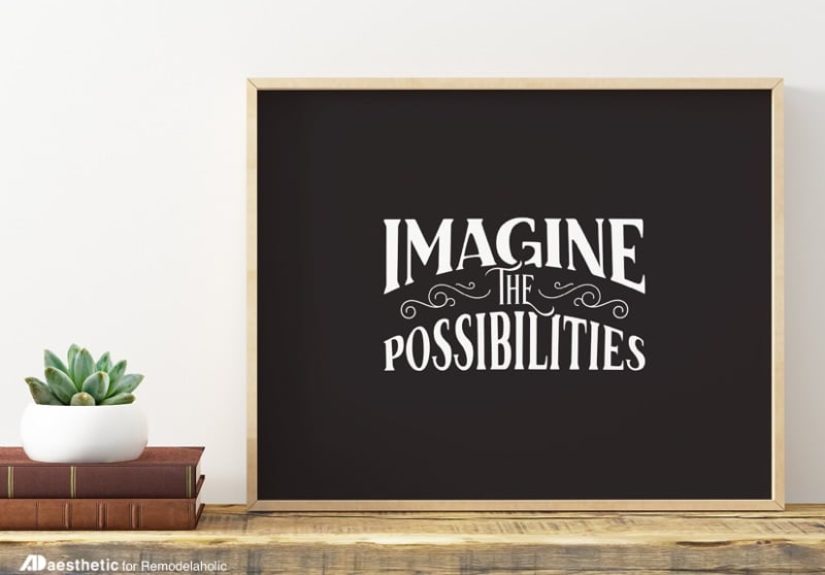
Go black text on a white background, add a thin black frame, and place it where you’ll see it oftenhome office,
hallway, or above a clean-lined console table. It reads crisp, confident, and uncluttered.
Color-pop statement
Try a bold background (or a colorful geometric accent) and let the print be the spark in an otherwise neutral room.
If your décor leans beige-on-beige (no judgmentbeige is a lifestyle), a bright printable poster can add energy
without requiring you to repaint your entire home.
Kids’ imagination corner
Place the print near bookshelves, art supplies, or a reading nook. Choose playful typography and softer colors.
Bonus points if you pair it with a rotating display of your kid’s artwork so the wall says “possibilities” and then
immediately proves it.
Classroom or studio motivation that doesn’t feel cheesy
Keep the design simple and legible from a distance. Matte paper helps reduce glare from overhead lights. If the
space is busy, pick a calmer palette so the quote doesn’t fight the room for attention.
Personalization: Make It Yours Without Overcomplicating It
Small tweaks, big payoff
Personalizing printable wall art doesn’t have to mean turning it into a scrapbook page. Subtle upgrades can look
luxe:
- Add a name or date in small text at the bottom (great for gifts).
- Match the print’s accent color to one item in the room (pillows, rug, vase).
- Choose a border style: full-bleed for modern, white border for classic.
DIY “designer” tricks
- Float frame look: Use a larger frame and center the print with a wide mat.
- Textured feel: Print on lightly textured paper for depth.
- Layering: Place the print on a picture ledge with small objects (candle, plant, mini sculpture).
The Boring-But-Important Part: Licensing and Usage
Printable wall art is usually sold with a licenseoften personal use by default. In plain English:
you can typically print it for your own home (and sometimes as a personal gift), but you generally can’t resell the
file, repost it as your own, or use it commercially unless the seller explicitly allows it. If you’re decorating a
business space or making products to sell, look for a commercial license or ask for permission.
Why Printable Wall Art Makes an Excellent Gift
“Imagine the Possibilities” printable wall art is a sneaky-good gift because it’s personal without being awkward.
It works for:
- Graduations and new jobs
- New home celebrations
- Baby showers (especially for a future dreamer)
- Encouragement gifts during big life transitions
Want it to feel extra thoughtful? Print it on heavyweight matte paper, add a simple frame, and include a note about
why you picked the phrase for them. Suddenly it’s not “a download,” it’s “a moment.”
Conclusion: Let Your Walls Do a Little Cheerleading
The best décor isn’t just prettyit supports how you want to feel in your space. Imagine the Possibilities
printable wall art is simple, optimistic, and flexible enough to fit nearly any style. Choose a design
that matches your room’s personality, print it with care (paper and resolution matter), and frame it like it’s
importantbecause your daily environment absolutely is.
If you’ve been waiting for the “perfect time” to refresh a room, consider this your sign. Download the art. Print
the thing. Hang it up. Let your wall whisper, “Heytry something cool today.”
Real-Life Printing & Styling Experiences (So You Don’t Have to Learn the Hard Way)
Here’s what tends to happen in the real world when people fall in love with printable wall art: they download it,
they hit print, and then they stare at the result like it personally betrayed them. Not because printable wall art
is trickybecause printers are tiny chaos machines with a flair for drama. The good news? Most “printing disasters”
are predictable, and once you know the patterns, you can dodge them like potholes.
Experience #1: The “Why Is It Blurry?” surprise. This usually comes from printing a file that wasn’t meant to be
big. A design that looks crisp on a phone screen can fall apart when enlarged. The fix is boring but effective:
use a high-resolution file sized for your intended print dimensions, and pick print-focused export options when
available. If the quote uses thin typography, sharpness matters even moreletters expose fuzziness fast.
Experience #2: The “My White Background Isn’t White” mystery. Homes have warm lighting, cool lighting, daylight,
and that one overhead bulb that makes everything look like a hospital hallway. Your paper reacts to lighting too.
Bright white paper can look icy under some bulbs; creamy paper can look extra warm. If your room has strong sunlight
or overhead glare, matte finishes often feel calmer and easier on the eyes.
Experience #3: The Curl of Doom. Some prints come out of a home printer with a strong opinion about being flat.
Thin paper can curl, especially with heavy ink coverage. A heavier paper stock can help, and so can letting the
print rest under a couple books (clean ones, ideally not the cookbook that smells like garlic). Framing also solves
curling instantlyone of the many reasons frames are basically adulting in rectangle form.
Experience #4: The “It’s Cropped Weirdly” heartbreak. Printers love adding margins, scaling, or “helpfully” resizing
your artwork into chaos. Doing a quick test print on plain paper saves time and prevents the kind of rage that makes
people consider taking up an entirely different hobby. When you go to a print shop, choose “actual size” or “no
scaling” when possible, and double-check that the preview shows what you expect.
Experience #5: The Hanging Height Regret. Many people hang art too high because they’re thinking about the top of the
frame, not the center. The result can make the room feel slightly “waiting room.” A simple approach is to plan for
eye level first, then adjust for furniture and grouping. And if you’re doing a gallery wall, treat the whole group
like one big pieceotherwise you end up with a “constellation of frames” situation where nothing feels connected.
Experience #6: The “It Looks Cheap” panicfollowed by the easiest upgrade ever. Matting and paper choice do an
incredible amount of heavy lifting. A quote like “Imagine the Possibilities” printed on decent matte paper, placed
inside a frame with a clean mat border, suddenly looks like a boutique find. Add consistent spacing, align it with
nearby furniture, and you’ll get that styled-home feeling without the styled-home budget.
The takeaway from all these real-world hiccups is oddly comforting: you don’t need perfection, you need a simple
process. Pick a file that fits your size goal, print on paper that matches your room lighting, do a test run for
margins, then frame and hang thoughtfully. After that, your wall art stops being “a project” and starts being what
it was meant to be: a daily reminder that you can, in fact, imagine more than what’s on today’s to-do list.