Table of Contents >> Show >> Hide
- Why the Arcade Joystick Still Matters
- The Main Parts Hiding Under the Handle
- How an Arcade Joystick Actually Registers a Move
- Why 4-Way and 8-Way Matter More Than You Think
- What Changes the Feel of a Joystick
- Maintenance: Because Dust Is the Final Boss
- Why Enthusiasts Love Looking Inside
- Experience: What It Feels Like to Really Live With an Arcade Joystick
- Conclusion
If you have ever yanked a dragon punch out of thin air, survived a bullet-hell boss by a pixel, or sent Pac-Man confidently into a corridor instead of directly into doom, you already know the humble arcade joystick deserves more respect than it usually gets. From the outside, it looks simple: a stick, a handle, a few clicks, a tiny piece of hardware living its best life. But inside an arcade joystick is a miniature mechanical drama featuring springs, pivots, switches, plastic gates, and just enough engineering to make grown adults argue passionately about octagons.
This is what makes arcade controls so charming. They are not abstract. They are physical. You can hear them, feel them, tune them, and sometimes blame them for your mistakes with a completely straight face. An arcade joystick is part input device, part machine language translator, and part personality test. Open one up, and you are not just looking at hardware. You are looking at the reason some players swear by square gates, some cling to bat tops like family heirlooms, and some will spend an entire weekend changing springs just to shave a little slop out of their quarter-circle motion.
Why the Arcade Joystick Still Matters
Modern gaming has no shortage of control options, but the arcade joystick survives because it offers something many newer devices try to imitate and rarely replace: deliberate, tactile control. A good arcade stick turns movement into a chain of mechanical events you can feel in your hand. That matters. In a genre like fighting games, where timing and precision are everything, the feel of an input can become as important as the input itself.
Arcade joysticks also carry the DNA of coin-op history. Early players learned games through cabinets, not menus. They gripped tall levers, slapped convex buttons, and understood direction through touch long before anyone started talking about latency charts on the internet. The modern fight stick is a descendant of that world, and the inside of an arcade joystick still reflects those roots. It is mechanical in the best way: honest, direct, and impossible to fake.
The Main Parts Hiding Under the Handle
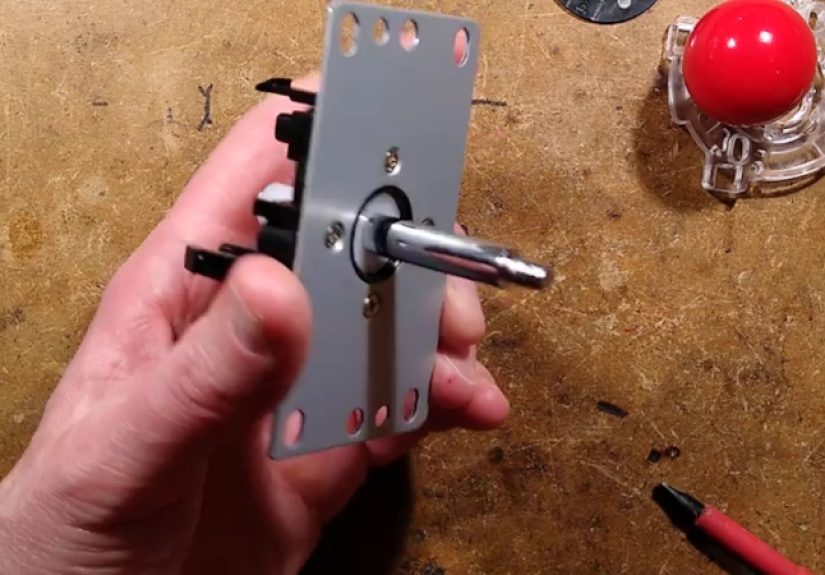
Crack open an arcade joystick and you will not find wizardry. You will find smart, practical parts that work together like a tiny factory for directional input. Each part affects feel, responsiveness, noise, and durability.
The Shaft and the Top
The visible part is the shaft and the handle attached to it, usually a ball top or bat top. This is the part your hand actually meets, so it shapes the first layer of comfort and control. Ball tops often feel nimble and traditional, especially for Japanese-style arcade sticks. Bat tops usually feel chunkier and more familiar to players who grew up around American cabinets. Neither is universally better. This is one of those arcade truths that starts technical and ends emotional.
The Actuator
Below the shaft sits the actuator, a small but important piece that pushes against the directional switches. Think of it as the translator between your hand and the joystick’s electrical signal. When you move the lever left, right, up, or down, the actuator is the part that physically makes contact with the mechanism responsible for registering that direction.
Change the actuator size and you change the joystick’s personality. A slightly oversized actuator can reduce the distance needed to engage a direction, making the stick feel faster and more immediate. That can be great for players who want crisp inputs. It can also make a joystick feel twitchy if overdone. Arcade hardware, like hot sauce, rewards restraint.
The Restrictor Gate
The restrictor gate limits how the lever moves. This part is one of the biggest reasons arcade players can turn into unpaid geometry professors. Square gates, octagonal gates, circular guides, and dedicated 4-way restrictors all change how the joystick travels and how easily you can feel cardinal directions or diagonals.
A square gate is extremely common in arcade sticks built for fighting games. It gives clear directional corners and supports diagonals well. Octagonal gates offer more notch-like feedback as the stick rolls through motion, which some players enjoy for circular inputs. A 4-way setup is essential for games designed around only up, down, left, and right. Use the wrong gate on the wrong game and suddenly your joystick becomes a chaos generator.
The Switches
This is where the magic becomes gloriously unromantic. Most modern arcade joysticks use microswitches. When the actuator presses one, the switch closes its circuit and tells the controller board, “Yes, the player definitely meant left.” Each direction usually has its own switch, which is why a joystick can feel clicky, sharp, and satisfyingly decisive.
Older arcade designs also used leaf switches, and many enthusiasts still love their smoother, softer feel. Leaf switches tend to have less audible click and a more elastic, analog-like personality even though the result is still directional input. If microswitches are a crisp handshake, leaf switches are a jazz riff. Both work. They just flirt with your fingers differently.
The Spring, Pivot, and Body
The return-to-center feel usually comes from a spring or similar centering mechanism. The spring decides how much resistance you feel and how aggressively the lever snaps back to neutral. Light tension can feel fast and effortless. Heavier tension can feel more controlled and stable. Somewhere out there is a player who has replaced the spring three times this week and still believes the next one will reveal enlightenment.
The pivot is the quiet hero. It allows smooth motion as the shaft moves across directions. If the pivot is dry, worn, or dirty, a joystick can feel scratchy, sticky, or uneven. The body and mounting hardware then keep everything aligned. Loose screws or worn parts can create wobble, missed inputs, or that unsettling sensation that your controller is slowly becoming a maraca.
How an Arcade Joystick Actually Registers a Move
The basic process is beautifully physical. You move the lever. The shaft shifts. The actuator presses one or more switches. The controller reads the closed circuit and sends that direction to the game. That is it. No dramatic digital philosophy. Just motion, contact, signal.
But within that simple chain are the details players obsess over: engage distance, throw distance, diagonal feel, switch resistance, gate shape, and return force. Engage distance is how far the stick must move before a direction registers. Throw is how far it can travel overall. A shorter engage can feel snappier. A longer throw can feel more forgiving. The balance depends on the game and the player.
Diagonals are where things get especially interesting. In many designs, diagonals happen when two switches are activated at the same time. That means the joystick is not merely choosing one direction; it is making a coordinated two-switch decision. If the shape of the gate, the size of the actuator, or the feel of the switches is off, diagonals can feel mushy, inconsistent, or harder to locate by touch.
Why 4-Way and 8-Way Matter More Than You Think
Some classic games are incredibly picky about direction. A game built for 4-way control expects only the four cardinal directions. Feed it accidental diagonals and it may respond in ways that feel wrong, sluggish, or downright cursed. That is why maze games and other early titles often perform best with a proper 4-way restrictor. The joystick is not being dramatic. It is honoring the rules the game was designed around.
By contrast, fighting games, many action games, and a huge range of later arcade titles benefit from 8-way movement, where diagonals are part of normal play. This is why switchable 4-way and 8-way joysticks are so beloved among multi-game cabinet builders. One setup can accommodate Pac-Man on one minute and Street Fighter the next. That is a neat trick, and also a wonderful excuse to spend more money on arcade parts.
What Changes the Feel of a Joystick
If two joysticks can both register directions correctly, why does one feel heavenly while the other feels like it lost an argument with a toolbox? Because feel is everything.
Spring Tension
A tighter spring increases resistance and usually creates a stronger return to center. Some players like this because it makes the lever feel controlled and intentional. Others prefer a lighter spring that allows faster wrist movement and a softer touch. Neither camp is wrong. They are simply loud.
Gate Shape
Square gates often make cardinal directions feel clear and diagonals reliable once you learn the corners. Octagonal gates provide more defined stopping points around the circle, which some people find easier for special motions. Circular setups can feel wonderfully smooth for certain genres. This is not just preference theater. It genuinely changes how your hand learns motion.
Handle Shape
Ball tops encourage fingertip or wineglass-style grips for many players, while bat tops often invite a firmer hold. Grip style affects fatigue, precision, and how dramatically you blame the controller when you drop a combo.
Switch Type
Microswitches usually feel clicky and defined. Leaf switches feel softer and less abrupt. The choice can shape both sound and timing. Some players want clear auditory confirmation. Others want silky movement without a chorus of tiny plastic applause.
Maintenance: Because Dust Is the Final Boss
Arcade joysticks are durable, but they are not magical. Over time, parts wear. Dirt gets in. Screws loosen. Lubrication dries out. Microswitches age. Springs weaken. All of this can change performance.
Common maintenance includes cleaning dust and debris, checking mounting screws, replacing worn switches, inspecting wiring, and refreshing grease on the pivot area when appropriate. If a stick feels wobbly, sticky, or inconsistent, the problem is often mechanical rather than mysterious. That is good news, because mechanical problems can usually be fixed without summoning a sorcerer or buying a whole new controller.
Modding culture grew around exactly this idea. Players realized the internals were understandable and replaceable. Suddenly, the joystick was not just a sealed product; it was a platform. Want a different spring? Change it. Want a bigger actuator? Easy. Want to swap a square gate for an octagonal one because you are convinced it will unlock your true form? Welcome to the club.
Why Enthusiasts Love Looking Inside
The inside of an arcade joystick is satisfying because it makes performance tangible. In many modern devices, the relationship between your hand and the electronics is hidden under layers of miniaturization. Arcade hardware does the opposite. It lets you see the cause and effect. Move stick, hit switch, send input. That clarity is almost charmingly old-school.
It also turns preference into a meaningful craft. When players talk about engagement, throw, tension, or gate shape, they are not imagining things. They are responding to real physical design choices. The best arcade joystick setups are the result of many small decisions, each changing how the controller communicates with the player.
That is why arcade sticks inspire a kind of mechanical affection. They are not just controllers. They are tuned instruments. A good one can feel quiet and precise, or loud and lively, or stiff and serious, or loose and playful. The internals determine the personality. Your hand just meets the attitude.
Experience: What It Feels Like to Really Live With an Arcade Joystick
There is a very specific moment that happens when you use a good arcade joystick for the first time after years on pads or analog sticks. At first, it feels ridiculous. The lever is taller than expected, the base seems too big, and the clicks sound like someone installed office equipment inside a toy. You wiggle it a little. You overcorrect. You miss motions that should be easy. For about five minutes, you feel like a person who confidently bought a violin and immediately discovered they do not, in fact, know how to be a violin person.
Then something changes. Your wrist relaxes. Your hand starts reading the edges of the gate. You stop forcing the motions and begin tracing them. A quarter-circle no longer feels like a frantic sweep across empty space. It feels like a path. A diagonal becomes something you can locate by touch. A dash becomes a rhythm. Once that clicks, the joystick starts feeling less like a controller and more like a mechanical conversation.
Opening one up for the first time adds another layer to the experience. You remove the bottom panel expecting alien machinery and instead discover an elegant little arrangement of parts doing very sensible jobs. There is the spring, looking innocent despite controlling half the feel of the stick. There is the actuator, a tiny overachiever. There are the switches, waiting to make their opinions known in four directions. Suddenly, every phrase enthusiasts throw around online makes more sense. “Too much throw.” “Needs a stiffer spring.” “I want cleaner diagonals.” These are not vague vibes anymore. They are physical realities sitting right in front of you.
Living with an arcade joystick also changes how you notice games. You start seeing how control design shapes play. Maze games feel happiest when the directions are strict and clean. Fighting games reveal how much confidence comes from reliable diagonals and quick return to center. Shooters expose whether your hand likes light tension for fast movement or heavier resistance for disciplined micro-adjustments. The joystick becomes part of the game’s language, not just the method used to access it.
And then there is the sound. Arcade joysticks do not whisper. They click, tap, and clack with the energy of a tiny mechanical band warming up in your lap. To some people, that noise is nostalgia. To others, it is proof of life. It says the input was real, the motion happened, and the machine answered. In a world full of smooth glass and silent touch controls, that kind of feedback feels almost rebellious.
Over time, the joystick picks up memory. Not literal memory, of course. It is not plotting anything. But your body remembers it. Your fingers remember where the corners live. Your wrist remembers the force needed for a clean motion. Your ears remember what a healthy switch sounds like. Once that relationship forms, the inside of an arcade joystick stops being hidden hardware and starts becoming familiar territory. It is no longer just the thing under the panel. It is the reason the whole experience feels alive.
Conclusion
Inside an arcade joystick is a lesson in why simple mechanical design can still feel extraordinary. A lever, an actuator, a gate, a few switches, a spring, a pivot, and suddenly you have a control system capable of precision, personality, and decades of player loyalty. That is a lot of heavy lifting for a device whose job description is basically “please go left on purpose.”
Whether you love retro cabinets, build custom fight sticks, or just enjoy understanding how your favorite hardware works, the joystick’s internals reveal something important: great controls are not accidental. They are built through thoughtful physical design, refined through use, and made memorable by feel. The next time you hear that click, remember you are not just pressing a direction. You are activating one of gaming’s most enduring little masterpieces.