Table of Contents >> Show >> Hide
- The Viral Story: When Your Dream Lot Meets “Karen” Logic
- Can Your Neighbors Really Tell You What To Build?
- Why Some People Lose Their Minds Over Other People’s Land
- Internet Reacts: Team MIL Suite vs. Team McMansion
- How To Handle Karen Neighbors When You Own the Land
- Lessons For Anyone Thinking About Buying “Just Land”
- Real-Life Experiences With “Karen” Neighbors and Empty Land
- Conclusion
For most people, buying land is step one in the classic life script: buy lot, build house, plant shrubs, argue about trash bins on Facebook.
But one landowner broke the script in the most harmless way possible and somehow triggered a full “Karen” neighborhood meltdown.
Instead of rushing to build a big dream home like everyone else on the cul-de-sac, they wanted something smaller, quieter, and more like a nature retreat.
Cue the outrage, gossip, and unsolicited “advice” from neighbors who seemed personally offended that someone dared to use their own property differently.
The story, which spread online and was later featured by Bored Panda, follows a buyer who purchased a large wooded lot with the remains of a burned-down house and a small, surviving mother-in-law (MIL) suite.
Their plan? Fix the little unit, enjoy the trees, and actually look at the stars at night instead of the glow of porch lights and giant TV screens through picture windows.
For many readers, that sounds like a dream.
For the neighbors, it sounded like a crime against suburbia.
The Viral Story: When Your Dream Lot Meets “Karen” Logic
A burned house, a forested lot, and one happy buyer
The land had history.
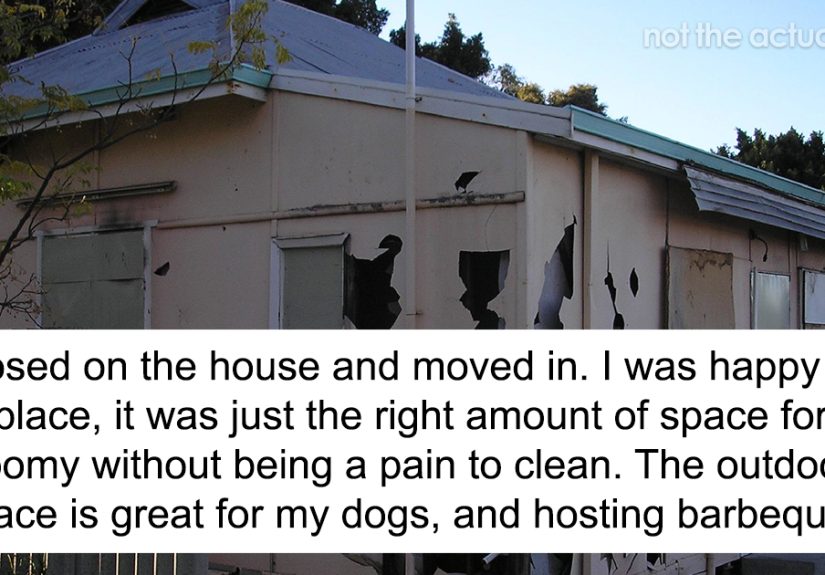
A fire had destroyed the original large home, leaving behind a charred foundation and a small, separate MIL suite that somehow survived.
The previous owners walked away, and the lot eventually went up for sale.
Enter the new buyer, who saw not a tragedy, but potential: towering trees, room to breathe, and a tiny livable unit that just needed some repairs and love.
Instead of re-creating the old big house or copying the neighbors’ “statement homes,” the buyer decided to restore the MIL suite, keep the land mostly natural, and enjoy the peaceful setting.
They weren’t anti-house or anti-neighbor; they were just pro-quiet, pro-trees, and not especially interested in funding a huge construction project purely for aesthetics or resale value.
“Everyone else built a house – why won’t you?”
That’s where the problem started.
The surrounding neighbors many of whom had big homes or had recently built new ones apparently assumed the burned-out lot would eventually sprout another large, “normal” house to match the rest of the community.
When they realized the new owner had no such plans, the vibe turned frosty very quickly.
According to the story, neighbors began hinting, then pressing, then outright complaining.
They suggested that not rebuilding a full-size home was “bad for property values,” “not in the spirit of the neighborhood,” and even “selfish,” because everyone else had invested heavily in their homes.
Some people treated the small MIL suite as if it were a temporary shed instead of a perfectly livable space.
The message was clear: conform, or you’re the problem.
Online, though, readers had a very different take.
Thousands of people sided with the landowner, pointing out that if you buy a property legally and follow local rules, you don’t owe your neighbors a showpiece house, a three-car garage, or an outdoor kitchen.
Can Your Neighbors Really Tell You What To Build?
Here’s the key question everyone always asks when these stories go viral:
can neighbors or even a homeowners association (HOA) force you to build a house you don’t want?
In the United States, what you can or cannot do with your land depends on several overlapping layers of rules:
zoning laws, building codes, county or city ordinances, and (if you have one) HOA or community association documents.
In many places, as long as you keep the property up to basic standards, you’re allowed to own it without building anything right away, or sometimes at all.
HOA rules vs. personal freedom
Things get more complicated in HOA communities.
Some HOAs include timelines that require owners of vacant lots to build a home within a set number of years or to submit plans to an architectural review committee.
Others simply require that the lot be maintained mowed, cleared of debris, and kept from becoming an eyesore while leaving the decision to build up to the owner.
Even when an HOA is involved, the authority is not unlimited.
Associations generally can’t force you to build a certain size of house if the governing documents don’t clearly say so, and they can’t invent rules after the fact to punish you for using your land in a perfectly legal way.
That’s why experts always tell buyers to read the covenants and restrictions before signing: the time to argue with the rules is before you buy, not after you move in.
Vacant lots and the “eyesore” argument
Neighbors often argue that vacant or unconventional lots drag down the street’s appearance and property values.
There’s a bigger conversation here: neglected, abandoned, or blighted properties can absolutely harm a community by attracting trash, pests, or crime.
But an actively maintained, wooded lot with a small, tidy dwelling is not the same thing as a collapsed house covered in graffiti and kudzu.
In this story, the buyer wasn’t ignoring the lot.
They were investing in it just not in the way the neighbors wanted.
From a legal standpoint, the line usually isn’t “did you build a big house?” but “are you following local codes, safety rules, and maintenance standards?”
As long as the owner stays on the right side of those rules, “we don’t like your lifestyle” isn’t a legal argument; it’s just a group complaint with good hair and a group chat.
Why Some People Lose Their Minds Over Other People’s Land
The myth of the “right kind” of neighbor
A lot of the tension in this story comes down to expectations.
Many suburban neighborhoods are built around an unwritten social script: similar houses, similar yards, similar schedules, similar priorities.
People get very comfortable with the idea that everyone around them will live more or less the same way.
When someone breaks that pattern by parking an RV long-term, turning a house into a short-term rental, or, in this case, choosing to live in a small unit on a wooded lot it can feel threatening, even if nothing actually bad is happening.
The “Karen” mindset often shows up right there: “I don’t just want my own life to feel stable, I want to control anything that might disrupt the picture in my head.”
Envy, sunk costs, and the need to justify big choices
There’s also a quieter emotional layer: envy and sunk cost.
Imagine you spent hundreds of thousands of dollars on a large new home, committed to high mortgage payments, and gave up flexibility in exchange for square footage.
Then you watch someone else enjoy the same neighborhood, the same scenery, the same school district without taking on all that debt or stress.
It’s easy to see how resentment might creep in.
Instead of thinking, “Huh, maybe I could have made a different choice,” some people double down.
If you didn’t do what they did, they interpret it as a criticism of their decisions.
So they attack your decision instead: “You’re irresponsible.” “You’re hurting property values.” “You’re not doing your fair share.”
Property values and the blame game
When in doubt, people reach for “property values” as a catch-all justification for disliking anything new or different.
It’s the Swiss Army Knife of neighborhood complaints: too many cars, wrong kind of fence, kids playing in the street, solar panels, chickens, you name it someone will claim it’s hurting resale prices.
But real estate value is influenced by many complex factors: regional demand, interest rates, local employment, schools, crime statistics, and broader market trends.
One well-kept lot with trees and a small residence is unlikely to tank a whole street.
If anything, some buyers actively seek more private, wooded lots and smaller homes because they prefer lower maintenance and more nature.
Internet Reacts: Team MIL Suite vs. Team McMansion
As the story made its way around Reddit and then Bored Panda, the comments section became a group therapy session for people who’ve dealt with controlling neighbors.
Many shared their own “Karen” experiences: neighbors who complained about legal fences, demanded access through private driveways, or called the police over perfectly normal activity.
Overwhelmingly, commenters took the landowner’s side.
People pointed out that:
- Property ownership, within the bounds of the law, includes the right to not build a massive house to impress strangers.
- Peace, trees, and a smaller footprint can be just as valid a “dream home” as a multi-story showpiece.
- Neighbors don’t get veto power over your life because they’re emotionally attached to uniform aesthetics.
The crowd-sourced verdict was simple: neighbors can have opinions, sure.
But opinions aren’t laws, and social pressure isn’t a building code.
If the owner is in compliance, the “Karen” brigade needs to take a deep breath, water their lawns, and move on.
How To Handle Karen Neighbors When You Own the Land
If you ever find yourself in a similar situation whether you own a vacant lot, a tiny house, or a quirky property it helps to have a plan that mixes politeness with backbone.
1. Know exactly what your documents say
Before arguing with anyone, know your ground rules.
That means reading:
- Your deed and plat map (to confirm boundaries and access).
- Local zoning and building codes, especially rules for permanent dwellings, setbacks, and usage.
- HOA or community covenants, conditions, and restrictions (CC&Rs), if they exist.
If the rules don’t require you to build a certain type of structure on a certain timeline, you’re working from a position of strength.
If they do require it, you at least know the truth and can decide whether to comply, ask for a variance, or rethink your investment.
2. Keep the lot tidy, even if you keep it natural
One of the easiest ways to shut down complaints is to make sure no one can fairly call your property neglected.
That might mean:
- Managing weeds and brush so the lot doesn’t become a fire hazard.
- Removing trash, old building materials, or unsafe debris.
- Trimming trees or branches that hang dangerously over a road or neighbor’s roof.
A clean, intentional-looking natural space is much harder to attack than a visibly abandoned lot.
You don’t have to manicure it like a golf course, but you should be able to show that it’s cared for.
3. Set boundaries like an adult, not a reality TV star
When neighbors start pushing, it’s tempting to clap back with equal drama.
But calm, clear boundaries usually work better.
You can say things like:
- “I’ve checked with the city and reviewed my documents I’m allowed to use the property this way.”
- “I understand you’d prefer a larger house here, but that’s not my plan.”
- “I’m happy to keep the lot maintained, but I’m not obligated to build anything else.”
You’re not asking for permission; you’re communicating facts.
If they escalate, you at least have a record of being reasonable.
4. Document harassment and know when to get help
If neighbors move from “annoying opinions” to harassment repeated trespassing, threats, attempts to interfere with your contractors or guests it’s time to start documenting.
Keep notes, save messages, and, if needed, talk to local authorities or a property attorney about your options.
Many property disputes can be resolved through clear communication and mediation, but sometimes you do need professional advice, especially if someone tries to claim part of your land, block access, or file bogus complaints against you.
Lessons For Anyone Thinking About Buying “Just Land”
The story resonates because more people are interested in alternative living situations: tiny homes, accessory dwelling units, cabins in the woods, or simply owning land as a long-term investment or retreat.
If that sounds appealing, this situation offers a few takeaways.
Do your homework before signing
Before purchasing, ask:
- Are there HOA or community rules about when and what you must build?
- Is the lot zoned for what you want (residential, mixed use, agricultural, etc.)?
- Are there size or design requirements for primary dwellings?
- Is a small existing structure legally recognized as a dwelling or just an accessory building?
It’s much easier to walk away from a restrictive lot than to fight an entrenched rule set after closing.
Expect opinions, but remember who signs the checks
Neighbors will always have opinions.
Some will be lovely and supportive; others will rehearse their grievances while staring through the blinds.
As long as you’re acting lawfully and respectfully, their preferences do not outrank your right to enjoy your property.
At the end of the day, the mortgage, taxes, and maintenance bills have your name on them, not the neighbor’s.
You’re the one who has to live with the consequences of your choices good or bad so you’re also the one who gets the final say.
Real-Life Experiences With “Karen” Neighbors and Empty Land
Stories like this one tap into a surprisingly common pattern: someone buys a property and quickly discovers that their biggest challenge isn’t money, building codes, or permits it’s other people’s expectations.
The “I bought a lot for the trees, not the prestige” buyer
One type of landowner loves nature more than square footage.
They want birdsong instead of leaf blowers, stars instead of streetlights, and maybe just a small cabin, MIL suite, or studio space to sleep in.
On paper, it’s entirely reasonable.
In practice, they often become the subject of neighborhood gossip: “Are they really living in that?” “When are they going to build a proper house?” “Is this going to hurt our values?”
Many of these owners report a familiar script: a few polite questions at first, then “concerned” suggestions, then complaints framed as community responsibility.
But when they stick to the rules and keep their lot well maintained, the drama usually dies down especially once people realize that nothing catastrophic is actually happening.
The investor who never built and what happened next
Another common scenario involves someone buying a vacant lot as an investment, with no short-term plans to build.
Maybe they hope the area will appreciate, or they’re waiting until they can afford their dream home.
In many communities, this is completely normal.
The owner mows the grass, pays the HOA dues and property taxes, and leaves the rest of the land alone.
Over time, some neighbors may grumble especially if other lots are fully built out and there’s pressure to “finish” the street.
But unless there’s a clear contractual obligation to build, most of those complaints never go anywhere.
When properties eventually sell, buyers often appreciate the chance to build custom or enjoy slightly more open space before construction happens.
The accidental lightning rod for neighborhood control issues
Occasionally, a person becomes the “lightning rod” neighbor without ever intending to.
Maybe they build a smaller house than expected, keep a portion of the land wild, or choose a design that’s atypical for the area.
Suddenly, they’re treated like rebels, even though everything they did passed inspections and complied with the rules.
People in this position often learn a few key lessons:
- Silence is not the same as consent just because no one complained when you bought the lot doesn’t mean they’ll stay quiet once they learn your plans.
- Clear documentation is your best friend emails, approvals, and governing documents can shut down a lot of amateur legal opinions.
- Picking your battles matters not every rude comment is worth a response, but repeated interference or harassment is worth addressing formally.
Some even find humor and freedom in the situation.
Once you realize that your mere existence will annoy certain people no matter what you do, it becomes easier to stop chasing their approval.
You focus on keeping your side of the property line lawful, safe, and peaceful and let the HOA drama club rehearse their lines without you.
What this all says about modern neighborhoods
The “Karen neighbors vs. quiet landowner” story is funny on the surface, but it also highlights something deeper about modern neighborhoods.
Many communities are stuck between two impulses: the desire for order and predictability, and the desire for individuality and flexibility.
HOAs, covenants, and design guidelines are attempts to manage that balance sometimes successfully, sometimes not.
When that balance tilts too far toward control, you get situations like this: people who follow the actual rules still get treated like rulebreakers because they don’t match someone else’s mental Pinterest board.
When it tilts too far toward chaos, neglected and dangerous properties really do hurt everyone.
The sweet spot is where lawful use, basic courtesy, and a little tolerance all meet.
In the end, the landowner in this story didn’t ask for a fight; they just wanted a peaceful, tree-filled place to live.
If anything, they remind us that “normal” doesn’t have to mean “identical,” and that a happy home can be a big house, a small MIL suite, or simply a patch of quiet land where you’re finally allowed to breathe.
Conclusion
“Karen” neighbors may never fully understand why someone would choose a small dwelling on a big lot instead of a big house squeezed onto every inch of buildable space.
But the law and basic common sense tend to side with the idea that if you own the land and follow the rules, you get to decide what “home” looks like.
Whether you dream of a forested hideaway, a minimalist tiny house, or the standard suburban setup, the real goal is the same: living in a place that actually fits your life, not your neighbor’s expectations.
And if that drives the local “Karen committee” a little bit wild?
Well, that’s their problem not yours.