Table of Contents >> Show >> Hide
- What Makes the MARCH Turned Leg Table Different?
- Design Breakdown: Materials, Proportions, and Why They Work
- Why This Table Works So Well as a Kitchen Island Alternative
- Space Planning Tips Before You Buy (or Build) One
- Material Care: Keep It Beautiful Without Babysitting It
- Buying Considerations: What to Ask Before You Commit
- Styling Ideas for a MARCH Turned Leg Table
- Common Mistakes to Avoid
- Real-World Experiences With a MARCH Turned Leg Table (Extended Section)
- Final Thoughts
If you’ve ever looked at a giant kitchen island and thought, “Wow, that’s beautiful… and also kind of a parking lot,” the MARCH Turned Leg Table will feel like a breath of fresh air. It has the utility of a prep station, the charm of a classic table, and the kind of presence that says, “Yes, I cook. No, I do not store mail on the stove.”
Originally developed as part of the MARCH kitchen worktable collection, this turned leg design blends old-world furniture language with practical kitchen function. That mix is exactly why it still gets attention: it looks refined, but it was clearly made to be used. Think chopping, plating, coffee-making, dough-rolling, and spontaneous conversations that somehow turn into dinner.
In this guide, we’ll break down what makes the MARCH Turned Leg Table special, how it works in real kitchens, what to know about materials like white oak and honed marble, and how to style and maintain a similar piece so it stays gorgeous for the long haul. If you love kitchens that feel collected rather than overbuilt, this one is your type.
What Makes the MARCH Turned Leg Table Different?
The biggest reason this table stands out is simple: it behaves like a worktable, not a built-in island. That sounds like a small distinction, but it changes everything about how a kitchen feels. A built-in island is permanent and architectural. A turned leg table feels like furniturelighter, more human, and often more welcoming.
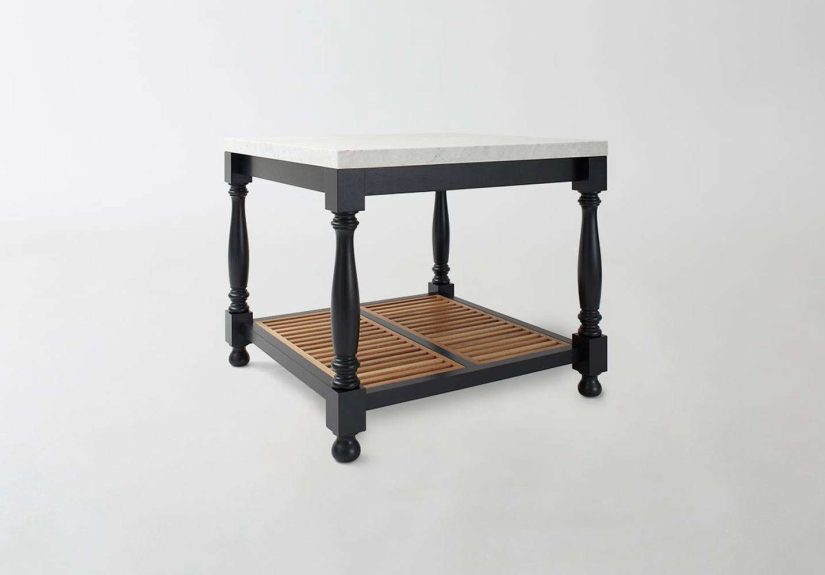
The MARCH version leans into that idea with classic turned legs, a painted base, open shelving, and a thick top. It gives you prep space and storage without making the room feel boxed in. In smaller kitchens, that visual openness matters. In larger kitchens, it keeps the center of the room from feeling like a giant slab of cabinetry.
In other words: it’s the kitchen equivalent of wearing a tailored jacket with sneakers. Polished, useful, and not trying too hard.
Design Breakdown: Materials, Proportions, and Why They Work
1) The Signature Shape and Size
A key reason the MARCH Turned Leg Table works so well is its proportion. The classic turned-leg version is commonly described at approximately 42 inches deep, 42 inches long, and 36 inches high, which puts it in comfortable counter-height territory. That height makes it ideal for standing prep work while still allowing it to function as a social surface.
The square footprint is also a smart move. A 42-by-42 surface gives you enough room to prep on one side and stage ingredients or serving pieces on the other without feeling oversized. It’s compact enough for many kitchens, but it still has “real workstation” credibility.
2) The Top: Honed Marble or Butcher Block
The original MARCH worktable collection offered several top options, but the turned leg version is especially known for its thick honed marble slab top and alternative butcher block configurations. That flexibility is one of the design’s best features because it lets the same table silhouette lean more “baker’s station,” “everyday prep table,” or “showpiece centerpiece” depending on your kitchen habits.
Why honed marble works: A honed finish has a soft, matte look that feels relaxed and architectural. It also tends to disguise tiny scratches better than a high-polish finish. For a kitchen that gets real use, that low-gloss surface can be a practical aesthetic choice.
Why butcher block works: If you actually chop, knead, and roll on your table all the time, a wood top may feel less precious and more forgiving day to day. It also adds warmthespecially in kitchens with painted cabinetry or cooler stone finishes.
3) The Base: Turned Legs and Painted Character
The turned legs are what give this table its personality. They soften the piece visually and make it read like furniture rather than equipment. In design terms, that matters because kitchens can easily become too “hard”: too many flat panels, too many rectangles, too much stone. Turned legs bring curve, rhythm, and a little craftsmanship vibe.
The painted-leg detail (often associated with Farrow & Ball finishes in the original system) adds another layer of charm. It breaks up the mass of wood and stone, and it helps the table coordinate with cabinets, trim, or wall paint. White, cream, deep green, charcoal, and muted blue all work beautifully depending on the room.
4) White Oak Shelves and Open Storage
One of the smartest features in the MARCH worktable system is the use of open, slatted shelving. On the turned leg version, white oak shelves add warmth and function without making the table feel heavy. The slatted design helps maintain airflow and keeps the storage looking lighter than a solid shelf panel would.
This is a detail people often underestimate. Open shelving under a worktable can look amazingor chaotic. The slats help it look intentional. They visually “breathe,” which is exactly what you want in the middle of a kitchen.
Why This Table Works So Well as a Kitchen Island Alternative
There’s a reason design editors and kitchen planners keep coming back to freestanding worktable ideas: they solve a lot of common kitchen problems without requiring a full remodel. A turned leg worktable gives you extra prep space, a casual gathering spot, and some storage while still feeling movable and flexible.
That flexibility is huge if you:
- rent (or don’t want to commit to a built-in island),
- have a narrow kitchen that needs visual openness,
- want a more furniture-driven look,
- love entertaining and need a central “landing zone,” or
- just want your kitchen to feel less like a cabinetry showroom.
Even in a renovated kitchen, a freestanding center table can feel more timeless than a bulky island. It keeps the room from becoming too fixed and too formal. Plus, if your tastes evolve, you can repaint, restyle, or even relocate the table later.
Space Planning Tips Before You Buy (or Build) One
1) Respect the Aisles
The prettiest table in the world won’t save a kitchen with bad circulation. If you’re placing a turned leg table in the center of the room, make sure you leave enough clearance around it for cooking and walking. A good rule is to prioritize comfortable pathways on all working sides, especially near the stove, sink, and refrigerator.
If the table will also include stools or chair seating, plan even more room on the seating side. You need space for knees, stools, and the inevitable “someone sits down exactly where you needed to pass with a hot sheet pan” moment.
2) Match Height to Function
The MARCH Turned Leg Table’s approximately 36-inch height is part of its magic because it aligns with common countertop height. That makes it excellent for prep and casual standing use. If you want formal sit-down dining, a standard dining table height (around 28 to 30 inches) is more comfortable. If you want stools, make sure the stool height matches a counter-height surface.
In short: counter height for prep and perching, dining height for long meals, bar height for casual drinks. Pick the one your household will actually usenot the one that looks best in a catalog.
3) Don’t Ignore the Table’s Visual Weight
A marble top, even on a “light” base, still has visual weight. In a compact kitchen, balance it with airy elements: open shelves, simple pendants, or lighter cabinetry. In a larger kitchen, you can go richer with darker paint, antique stools, and layered accessories.
Also, if you choose a bold leg color, repeat that color somewhere else in the room (a trim line, a stool cushion, or a pantry door) so the table looks integrated rather than dropped in from another house.
Material Care: Keep It Beautiful Without Babysitting It
Marble Top Care (The Honest Version)
Marble is beautiful and a little dramatic. That’s not a flaw; it’s the deal. A honed marble top will develop character over time, especially in a hard-working kitchen. If you want a surface that stays exactly the same forever, marble is not your soulmate. If you love patina, you’ll probably adore it.
Here’s how to keep it in great shape:
- Wipe spills quickly, especially acidic ones. Citrus, vinegar, wine, and tomato sauce can etch marble.
- Use pH-neutral cleaners. Skip harsh sprays, bleach-heavy formulas, and abrasive powders.
- Seal as needed. Sealing helps reduce staining, but it doesn’t make marble invincible. Resealing schedules vary based on use.
- Use boards and trays. A cutting board for prep and a tray for oils/coffee tools can reduce wear in high-use zones.
Think of marble like linen: part of the charm is that it looks lived in. Just not “I left lemon juice on it all weekend” lived in.
White Oak and Painted Base Care
White oak is a great choice for kitchen furniture because it’s durable, timeless, and visually warm. But like all solid wood, it moves with seasonal humidity. That movement is normal. Good table construction accounts for it by using attachment methods that allow the top or base components to expand and contract slightly over time.
For everyday care:
- Dust with a soft cloth (microfiber works well).
- Use a lightly damp cloth for sticky spots, then dry the surface.
- Avoid soaking the shelves or letting water sit around leg joints.
- Use felt pads or glides if stools or baskets bump the base often.
- Touch up paint chips early so they don’t become “distressed” in the wrong way.
If your home swings from very dry to very humid across the seasons, a stable indoor humidity range can help all wood furniture behave betternot just this table.
Buying Considerations: What to Ask Before You Commit
1) Is it an Original, a Custom Reproduction, or a MARCH-Inspired Piece?
The original MARCH worktables were part of a highly considered system with coordinated accessories and material options. If you’re shopping secondhand or commissioning a maker, ask for specifics:
- Exact dimensions (top and base)
- Top material and thickness
- Wood species and finish type
- Paint brand/color (if relevant)
- Shelf construction (solid, slatted, removable)
- How the top is attached to allow for wood movement
- Whether accessories are included
Details matter here. A table that looks similar in a photo can feel very different in person depending on proportions and material quality.
2) Consider the Real Cost of Ownership
A table like this is not only a furniture purchaseit’s a work surface, visual centerpiece, and lifestyle upgrade. So price should be evaluated against function. Historically, listings for the original product showed a premium price point, which makes sense given the craftsmanship, materials, and custom nature of the system.
If the original is outside your budget, you can still capture the look with a well-made custom piece: turned legs, a painted base, white oak shelving, and either a stone top remnant or quality butcher block. The silhouette and proportions are what make it feel “right.”
3) Accessories Make the Difference
The MARCH concept was never just a table; it was a workstation system. Slatted shelves, bins, boxes, and hanging leather components gave it personality and utility. Even if you buy a simplified version, recreate that spirit with smart storage:
- Shallow bins for onions, garlic, or linens
- A small crock or caddy for tools
- Open baskets for napkins or baking supplies
- A lower shelf setup that stays curated, not overcrowded
This is the difference between “beautiful table” and “best spot in the kitchen.”
Styling Ideas for a MARCH Turned Leg Table
Because the table reads like furniture, styling should feel like furniture styling toonot countertop staging. Keep it practical, but edited.
Everyday Styling Formula
- One tray: oils, salt cellar, pepper mill, maybe a candle
- One useful vessel: a bowl for fruit or a ceramic crock for utensils
- One soft element: folded linen towels or a runner
- One seasonal touch: branches, herbs, or a small floral arrangement
That’s enough. The table is already doing a lot visually. Let the turned legs and materials be the stars.
Color Pairings That Work
- White oak + cream paint + marble: classic, bright, transitional
- White oak + deep green legs: moody, heritage-inspired
- White oak + charcoal legs: modern farmhouse without the clichés
- White oak + dusty blue: soft and collected, especially in older homes
If your kitchen is already very busy (patterned tile, bold stone, open shelving everywhere), choose a quieter paint color. If the room is minimal, the table can carry a richer tone.
Common Mistakes to Avoid
- Choosing style over use: If you bake constantly, prioritize a practical top. If you entertain constantly, prioritize seating and circulation.
- Ignoring stool fit: Counter-height table + bar-height stool = awkward elbows and regret.
- Overloading the lower shelf: Open storage looks best when it’s functional and restrained.
- Treating marble like granite: Different stone, different rules.
- Forgetting humidity: Solid wood will move. Good construction and stable indoor conditions matter.
A little planning goes a long way. This table style is incredibly forgiving visually, but functionally it still needs a thoughtful setup.
Real-World Experiences With a MARCH Turned Leg Table (Extended Section)
One of the most interesting things about a MARCH-style turned leg table is how quickly it becomes the “default zone” in a home. People buy it thinking it will be a prep station, and then it quietly takes over half the social life of the kitchen. Morning coffee lands there. Grocery bags get sorted there. Kids do homework on one corner while dinner is getting chopped on the other. It’s not just a surfaceit’s a rhythm-maker.
In smaller city kitchens, the experience is often about relief. A built-in island can feel impossible in a tight footprint, but a freestanding table gives you the center workspace you wanted without making the room feel locked in. Owners often describe the room feeling more open because you can see under the table and around the legs. That visual openness changes the mood of the entire kitchen, especially if the table has a painted base and slatted shelves instead of a blocky cabinet form.
In family kitchens, the biggest win is flexibility. A counter-height turned leg table can support quick meal prep during the week and still look polished enough for weekend hosting. People love that it doesn’t scream “utility.” A cutting board, a stack of plates, and a vase of herbs can sit on it at the same time without the table looking cluttered. It has that rare quality of being hardworking and photogenic, which is basically the kitchen design version of finding jeans with real pockets.
Another common experience is that the lower shelf becomes a personalized zone. Some households use it for mixing bowls and baskets. Others keep cookbooks, folded table linens, or produce bins there. The slatted shelf design helps because even when the shelf is full, it doesn’t look visually heavy. It still reads airy. That’s especially useful in kitchens where every square inch counts and closed storage isn’t an option.
Marble-top users often share the same learning curve: the first etch or stain feels tragic, and the fifth one feels like character. Once people understand marble’s personality, they usually relax and enjoy it more. A honed marble top on a turned leg table tends to age in a way that feels appropriatemore like an old bakery counter than a pristine showroom slab. For many homeowners, that patina is exactly why they chose it.
Wood-top users, meanwhile, tend to appreciate the table as a true workhorse. Dough gets rolled, sheet pans land there, and the surface becomes the most-used prep area in the house. Over time, the wood gathers marks, and those marks often make the piece feel more authentic, not less. The key is regular care and realistic expectations: these tables are meant to be used, not worshipped.
Designers and home cooks alike also point out that a turned leg table changes how guests interact with the kitchen. People naturally gather around it because it feels like furniture, not a barrier. You can stand at one side and prep while friends sit or lean at another side and chat. That social quality is hard to get from a big, built-in island with a massive overhang and a row of stools lined up like an airport lounge.
In the long run, the most consistent feedback is that this style of table remains relevant even as kitchens evolve. Paint colors change. Hardware changes. Lighting gets swapped. But a well-proportioned turned leg worktable still works because it is rooted in furniture design, not a short-lived kitchen trend. It doesn’t feel “dated” so much as “established,” and that is exactly what many homeowners are trying to create.
Final Thoughts
The MARCH Turned Leg Table is a perfect example of a kitchen piece that earns its reputation. It combines utility, craftsmanship, and warmth in a way that many built-in islands simply don’t. The turned legs keep it graceful, the materials make it substantial, and the worktable concept keeps it practical.
If you love kitchens that feel lived in, layered, and deeply functional, this design is worth studyingeven if you’re buying a reproduction or building your own version. Get the proportions right, choose materials that match your real habits, and plan for the way your household actually moves through the kitchen. Do that, and you won’t just have a beautiful table. You’ll have the spot where life happens.