Table of Contents >> Show >> Hide
- Who Was Rob Gonsalves, and Why Does His Art Hit So Hard?
- Why Rob Gonsalves’ Optical Illusion Paintings Still Stand Out
- 30 Mind-Twisting Rob Gonsalves Paintings and Visual Moments Worth Staring At
- What Makes These Paintings So Addictive to Look At?
- Rob Gonsalves’ Legacy in Magical Realism and Optical Illusion Art
- Experiences Related to “Mind-Twisting Optical Illusion Paintings By Rob Gonsalves (30 Pics)”
- Conclusion
- SEO Tags
Note: Body-only HTML, ready for web publishing
Some artists want you to admire their technique. Rob Gonsalves wanted you to do a double take, squint a little, tilt your head, and then wonder whether your eyes had just politely lied to you. That was his magic. His paintings didn’t simply show a scene; they transformed one world into another while you were still looking. A city became a forest. A bedroom became an airfield. Reflections turned into living forms. Architecture softened into nature, and nature answered by pretending it had been architecture all along.
That visual sleight of hand is why Gonsalves still feels so fresh. His work sits somewhere between magical realism, surrealism, and the kind of daydream you have when you stare out the window for “just a second” and come back 20 minutes later with no idea what happened. Trained in architecture before becoming a full-time painter, he understood perspective so well that he could bend it without breaking the picture. The result was art that felt impossible, yet strangely believable.
This roundup explores why Gonsalves’ paintings continue to stop viewers in their tracks and why a gallery of 30 images can turn into a 45-minute staring contest with your own brain. If you love optical illusion paintings, surreal landscapes, imaginative art, or work that makes reality feel delightfully unstable, Rob Gonsalves belongs near the top of your list.
Who Was Rob Gonsalves, and Why Does His Art Hit So Hard?
Rob Gonsalves was the rare painter who could make technical precision feel dreamy instead of rigid. Before he built a reputation as a painter, he studied architecture and worked in that field, which helps explain why his compositions feel so structurally convincing. Even when a staircase becomes a skyline or a row of buildings melts into trees, the image never feels random. Everything is placed with care, like a visual puzzle box built by someone who loved both fantasy and geometry.
His work is often described as magical realism, and that label fits better than plain old surrealism. Gonsalves didn’t paint chaos for chaos’s sake. He started with recognizable things: bridges, windows, books, boats, children, forests, water, moonlight. Then he nudged those ordinary elements into a second meaning. Instead of shocking the viewer with weirdness, he invited the viewer into wonder. It was less “What on earth is happening?” and more “Wait… how did I miss that?”
That balance made his paintings resonate with both adults and kids. Adults could admire the design, symbolism, and patience behind the illusions. Kids could just look at a canvas and think, “Cool, the bed became an airplane runway.” Honestly, that is a perfectly respectable art criticism strategy.
Why Rob Gonsalves’ Optical Illusion Paintings Still Stand Out
He made illusion feel warm, not cold
A lot of illusion-based art is clever but emotionally distant. Gonsalves avoided that trap. His paintings are brainy, yes, but they’re also full of moonlight, memory, curiosity, and quiet adventure. Even when the perspective gets tricky, the mood stays inviting.
His architecture training gave him unfair advantages
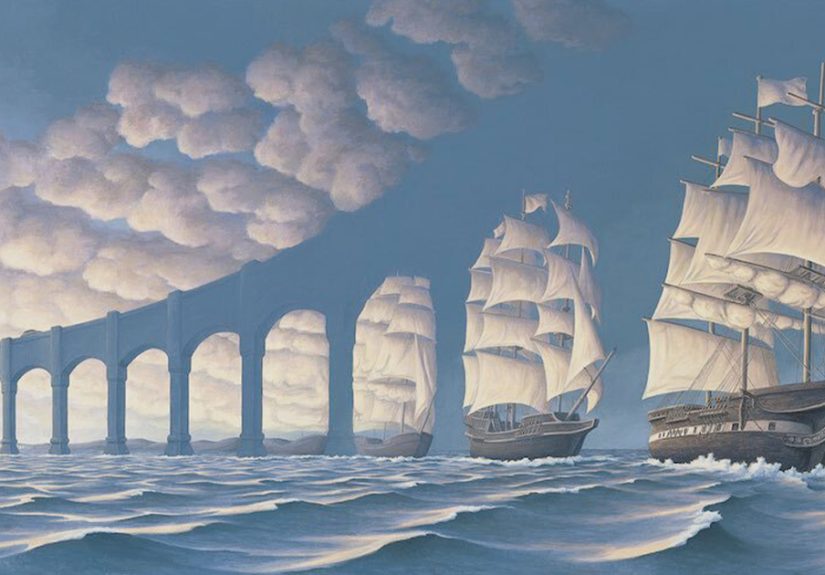
Perspective is the engine behind many of his best-known paintings. Lines recede exactly where they should. Repeated shapes echo each other just enough to support a visual switch. Roofs become cliffs. Fence posts become skyscrapers. Bridges become acrobats. These transitions work because the structure underneath them is solid.
He understood the power of the “slow reveal”
Gonsalves didn’t hand over the trick all at once. Your eye enters the painting one way, then exits another. That delay is part of the pleasure. The image rewards patience, which is almost rebellious in an era when most people scroll past everything at lightning speed.
He turned imagination into a place you could visit
Many painters depict fantasy worlds. Gonsalves made fantasy emerge from everyday reality. That is a huge difference. His paintings suggest that wonder isn’t somewhere else. It is already hiding inside the familiar, waiting for the right angle.
30 Mind-Twisting Rob Gonsalves Paintings and Visual Moments Worth Staring At
Think of this section as a gallery-style walk-through: 30 “pics,” 30 moments, 30 reasons your eyes may need a tiny coffee break afterward.
- The Woods Within. A classic Gonsalves move: architecture and landscape share the same bones until the whole image quietly flips under your gaze.
- Wilderness Gothic. He takes a familiar built environment and lets it breathe with the atmosphere of wilderness, making the man-made feel mythic.
- Autumn Cycling. The seasonal warmth helps sell the illusion, because your eye relaxes into the cozy scene before realizing it’s being artfully tricked.
- A Change of Scenery. A title like that is almost Gonsalves winking at the audience. The scenery doesn’t just change. It shape-shifts.
- Tree House in Autumn. Childhood fantasy and structural logic meet in the same frame, which is pretty much peak Rob Gonsalves.
- Nocturnal Skating. Nighttime gives him more room to play with glow, reflection, and edge, so the illusion feels softer and more mysterious.
- Carved in Stone. One of his strongest habits was making solid forms feel fluid, and this kind of image captures that beautifully.
- Bedtime Aviation. Few artists could turn the path from bed to dream into a literal takeoff strip without making it corny. Gonsalves absolutely could.
- Sailing Islands. Boats and landforms blur together so naturally that you start wondering whether geography has always been this dramatic.
- Arboreal Office. This is Gonsalves at his best: the modern world and the natural world shaking hands in one impossible image.
- Water Dancing. He loved using water because it already behaves like a visual trickster. Reflections, ripples, bodies, and motion all play well together.
- Eclipse Flower. Floral imagery lets him lean into circular rhythm and repetition, which makes the transition from one form to another feel eerily smooth.
- The city-into-forest illusion. One of his most recognizable ideas is the swap between lit skyscrapers and dark evergreens. Urban light becomes snowfall, windows become stars, and suddenly you are in two places at once.
- The bridge-into-acrobats illusion. This type of transformation shows his love of structural rhyme: what looks like support beams from afar turns into bodies in motion up close.
- The picket fence-into-skyscrapers illusion. Gonsalves understood that repetition is candy for the eye. A row of similar forms can become almost anything with the right spacing.
- The bedroom-into-landscape illusion. Quilts, pillows, and furniture become fields, roads, or horizons, proving that bedtime is really just travel with better blankets.
- The shoreline-into-street illusion. He often made boundaries do double duty. Water edges can read like roads, and roads can feel as fluid as rivers.
- The candle-into-lighthouse effect. Tiny domestic light becomes vast navigational light, which is a very Gonsalves way of saying scale is negotiable.
- The mountain-into-building silhouette. His architecture background shines here. Natural mass and constructed volume echo one another until the line between them disappears.
- The reflection-that-isn’t-just-a-reflection trick. Gonsalves loved reflections because they let him build a second reality without breaking the first one.
- The books-into-landscape moment. This kind of imagery feels especially fitting for him, since his paintings found such a natural home in picture books.
- The sky-into-stage transition. Clouds, curtains, and fabric often behave like cousins in his art, which lets atmosphere turn theatrical in seconds.
- The child’s-eye-view composition. Many paintings feel as if they were filtered through childhood wonder, where scale stretches and ordinary objects become portals.
- The moonlit transformation. Gonsalves used night scenes brilliantly because darkness hides edges just enough to make visual shifts feel inevitable.
- The road-that-becomes-a-ribbon-of-light. He knew how to guide the eye along a path, then reveal that the path was never what you assumed.
- The curtain-into-cliff illusion. Drapery and rock formations share folds, shadow, and vertical movement, so he turned that resemblance into pure visual mischief.
- The village-into-cathedral rhythm. Repeated rooftops, windows, and towers create a pattern that can swing from intimate to monumental in a single glance.
- The waterline-into-human-figure reveal. In some of his most poetic compositions, landscape elements become dancers, swimmers, or observers without losing their original identity.
- The season-shift atmosphere. Autumn leaves, winter light, and spring softness are not just decoration in Gonsalves’ work. They help camouflage the transition from one reality to another.
- The final double take. The best Rob Gonsalves painting is often the one you think you’ve already understood, right before it quietly proves you wrong.
What Makes These Paintings So Addictive to Look At?
The simplest answer is that Rob Gonsalves paintings give your brain two pleasures at once. First, there is immediate beauty: luminous skies, careful detail, inviting color, peaceful scenes. Then comes the second reward: recognition. You realize the scene is not one scene at all. It is a transformation in progress.
That two-step effect keeps viewers hooked. You are not just looking at a picture; you are participating in it. Your eye completes the metamorphosis. The painting becomes a collaboration between artist and viewer, which is one reason people can revisit the same work again and again.
There is also something deeply human in his themes. Gonsalves returned often to homes, windows, roads, bridges, books, water, and trees. These are not random symbols. They are the stuff of daily life, memory, and passage. In his hands, ordinary settings become invitations to think about movement, possibility, and perception itself.
Rob Gonsalves’ Legacy in Magical Realism and Optical Illusion Art
Rob Gonsalves left behind the kind of body of work that keeps circulating because it remains instantly shareable and quietly profound. At first glance, the paintings work perfectly well as “wow” images. But the longer people sit with them, the more they notice the discipline underneath the dream. That combination is rare.
He also occupies a sweet spot in the art world: accessible without being shallow, imaginative without being messy, technical without being dry. His paintings can live in galleries, coffee-table books, children’s books, and viral image roundups without losing their impact. That range says a lot about how skillfully he balanced sophistication and wonder.
If you are building a list of essential optical illusion painters, Gonsalves deserves more than a passing mention. He didn’t just create tricky images. He created paintings that suggest the world is more flexible, more poetic, and more alive than we usually allow ourselves to believe.
Experiences Related to “Mind-Twisting Optical Illusion Paintings By Rob Gonsalves (30 Pics)”
Looking through a Rob Gonsalves gallery is not like scrolling past ordinary art. It feels closer to wandering into a room where logic still exists, but it has agreed to loosen its tie and tell better stories. At first, you think you’re just admiring a nice landscape or a dreamlike city scene. Then the painting shifts in your mind. What looked like treetops becomes rooftops. What looked like dancers becomes a waterfall. What looked like a child’s bedroom becomes a launchpad for impossible travel. That moment of recognition is tiny, but it lands with surprising force.
One of the most memorable experiences people have with Gonsalves’ work is the instinctive need to move closer and then step back again. Up close, you admire the craftsmanship, the edges, the color transitions, the patience. From farther away, the illusion locks into place. So the act of viewing becomes physical. You are not only thinking differently; you are moving differently around the image.
Another common experience is that his paintings wake up the part of the brain usually reserved for childhood. Not childishness, but childhood itself: the part that believed blankets could become mountains, that shadows might be doorways, that a hallway at night could lead literally anywhere. Gonsalves was exceptionally good at reviving that emotional memory without making it feel sentimental. He gave wonder structure. He made imagination feel engineered.
There is also the pleasure of sharing these images with someone else. Gonsalves paintings practically demand the phrase, “Wait, do you see it?” They create conversation naturally. One person notices the obvious transformation first. Another spots a smaller echo tucked into a corner. A child may understand the emotional logic before an adult understands the technical trick. That makes the viewing experience feel communal rather than solitary.
And maybe that is the biggest reason his work stays with people. These paintings do not simply impress the eye. They adjust the mood. They slow you down. They make you more attentive. After spending time with Rob Gonsalves, the real world can feel just a little more elastic. A line of apartment windows might suddenly resemble tree trunks. A reflection in a puddle might look like a second city. A row of laundry flapping in the wind might briefly seem like sails. Once his visual language gets into your head, the everyday world starts trying on costumes.
That is a wonderful legacy for any artist to leave behind. Not just beautiful paintings, but a more curious way of seeing.
Conclusion
Rob Gonsalves created optical illusion paintings that do more than trick the eye. They invite the viewer into a gentler, stranger, more imaginative version of reality. His best works blend architecture, nature, memory, and dream logic so seamlessly that the impossible starts to feel natural. That is no small feat. It is the reason his paintings continue to fascinate longtime fans, casual browsers, art lovers, and anyone who enjoys the delicious mental wobble of a perfect visual illusion.
If you came for 30 mind-bending pictures, you got them. But if you stayed for the deeper pleasure of seeing how a master painter turned perspective into poetry, that is where Rob Gonsalves really wins.