Table of Contents >> Show >> Hide
- What Is the Moon Phase Soulmate Test?
- The TikTok Effect: Why This Trend Exploded
- The Moon Phase Part: What’s Real (Astronomy) vs. What’s Added (Meaning)
- So… What Does the Moon Phase Soulmate Test “Mean”?
- Why It Feels Accurate (Even If It’s Not)
- How to Do the Moon Phase Soulmate Test (The Fun Way, Not the Panic Way)
- What the Trend Can Be Good For (Yes, Really)
- Red Flags (The Real Ones, Not the Crescent-Shaped Ones)
- FAQ: Moon Phase Compatibility, Quickly Answered
- Conclusion: What It Means in Plain English
- Experiences People Share With the Moon Phase Soulmate Test (Plus What They Learn)
- 1) “We got a full moon, so I screenshotted it like it was a marriage certificate.”
- 2) “We didn’t match… and I laughed, but also I stared at it for 20 minutes.”
- 3) “I tried it with my best friend and it felt more accurate than with my boyfriend.”
- 4) “I tried it with my ex. That was my first mistake.”
- 5) “My parents matched. I showed them. They did not care.”
- 6) “We ‘failed’ the test, but then we talked about what we need, and that helped more than the test.”
- SEO Tags
If TikTok has taught us anything, it’s that your love life can be summarized in 12 seconds, set to a sped-up remix, and judged by strangers with usernames like @CryingInCapCut. Enter the Moon Phase Soulmate Test: a viral TikTok trend that claims you can spot your “cosmic match” by comparing the moon phase on your birthday with someone else’sthen seeing whether the two shapes “click” into a perfect full moon.
It’s romantic. It’s aesthetic. It’s suspiciously convenient. And it’s also a fascinating little case study in how the internet turns ancient symbolism and modern astronomy into a relationship game you can play on your couch while eating cereal at 2 a.m.
What Is the Moon Phase Soulmate Test?
The Moon Phase Soulmate Test (also called the moon phase compatibility test or moon phase soulmate calculator) is a simple idea: look up the lunar phase on the day you were born, do the same for another person, and then overlay the two moon images. If they form something close to a full moonlike two puzzle pieces making a neat circleTikTok declares you soulmates.
People try it with partners, crushes, exes (bold choice), best friends, siblings, andbecause it’s the internetpets. The “result” is visual and instantly shareable: either a satisfying, symmetrical full moon or a moon with a dramatic chunk missing that screams, “We’re doomed,” even if you’ve been married for 12 years.
Quick glossary (because TikTok rarely comes with instructions)
- Natal moon phase: the phase of the moon on the day you were born.
- Compatibility overlay: layering two moon-phase images to see how “complete” they look together.
- Full-moon fit: the trend’s “best” outcomeyour shapes combine into a near-perfect circle.
The TikTok Effect: Why This Trend Exploded
The Moon Phase Soulmate Test didn’t go viral because it’s scientifically bulletproof. It went viral because it’s perfect TikTok content: low effort, high emotion, and visually satisfying. TikTok thrives on trends that are:
- Fast to replicate: two birthdays in, one video out.
- Easy to personalize: every couple has “their” moon combo.
- Built for suspense: you wait for the overlay like it’s a season finale.
- Social-proof friendly: comments fill up with “OMG WE GOT A FULL MOON 😭” and suddenly you want to try it too.
Add CapCut templates, TikTok filters, and the fact that moon imagery is basically a cheat code for “romantic and mysterious,” and you get a trend that spreads like glittermeaning it shows up everywhere, and you’ll still find it in your house weeks later.
The Moon Phase Part: What’s Real (Astronomy) vs. What’s Added (Meaning)
Let’s separate two things that get blended together online: astronomy and interpretation. The moon phases themselves are real, measurable, and predictable. The moon’s appearance changes as it orbits Earth, and we see different portions of the sunlit half. That cycle repeats roughly every month.
The eight main moon phases (the real, official ones)
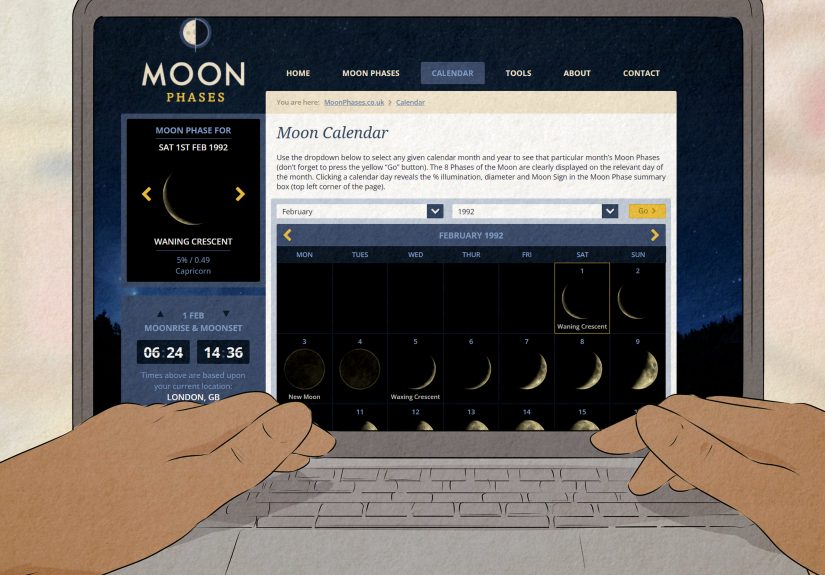
Most moon phase tools use the standard eight-phase cycle: new moon, waxing crescent, first quarter, waxing gibbous, full moon, waning gibbous, third/last quarter, and waning crescent. These are astronomy terms, not vibes.
Here’s the key: a calculator can accurately tell you the moon phase for a date. That part is legitlike a weather app, but for the sky. What the trend adds on top is the idea that the shape of the moon on your birthday somehow maps to your relationship destiny.
So… What Does the Moon Phase Soulmate Test “Mean”?
In the TikTok version of reality, the test “means” one of two things: (1) your shapes complete each other, therefore you’re meant to be; or (2) they don’t, therefore you should dramatically stare out a window while a sad piano song plays.
But the deeper meaningwhat it actually revealshas more to do with storytelling than stargazing. The trend is a modern love horoscope: a small ritual that gives people a narrative hook. “We fit together.” “We’re opposites.” “We’re twin flames.” It’s a shortcut to a feeling.
Common interpretations you’ll see online
- “Opposites complete.” A crescent + a matching opposite crescent = full moon = “soulmates.”
- “Same phase = same wavelength.” Two similar moons = “we’re aligned.”
- “Big missing piece = red flag.” A lopsided overlay = “this relationship has a lesson, not a ring.”
Some articles and creators even assign personality traits to phases (visionary new moons, emotional full moons, introspective waning crescents, etc.). That’s not how astronomy worksbut it is how symbolism works: it gives people a language for talking about feelings.
Why It Feels Accurate (Even If It’s Not)
If you tried the moon phase compatibility trend and thought, “Wait… this is weirdly true,” you’re not alone. That reaction can happen for reasons that have nothing to do with the moon and everything to do with the human brain.
1) Confirmation bias is basically your brain’s favorite hobby
If you already like someone, a “full moon” feels like proof. If you’re unsure, a “missing chunk” feels like validation. Your mind is great at collecting evidence that supports what you already suspect.
2) Barnum statements: vague enough to fit everyone
When interpretations are broad (“you crave deep connection,” “you’re learning balance”), they can feel personal because they’re flexible. That’s why horoscopesand horoscope-adjacent trendsstick.
3) The visual is persuasive
A clean, complete circle is deeply satisfying. A gap looks like “incomplete,” even if your actual relationship is healthy, supportive, and includes someone who remembers to replace the toilet paper roll (true soulmate behavior).
4) “Moon myths” have been around forever
People have linked the full moon to emotions and behavior for centuries. Modern research has repeatedly challenged the idea that full moons make people act wildly, but the cultural story remains powerful. TikTok didn’t invent moon magicit just added transitions.
How to Do the Moon Phase Soulmate Test (The Fun Way, Not the Panic Way)
- Find your natal moon phase using a moon phase calculator or a TikTok filter that asks for your birthdate.
- Do the same for the other person (partner, friend, etc.).
- Overlay the images (many templates do this automatically) and see how they “fit.”
- Laugh, screenshot, sharethen return to reality where compatibility is mostly communication and snacks.
Pro tip: treat it like a conversation starter, not a verdict. If your moons don’t form a full moon, it does not mean you should cancel your wedding venue. It means two pictures didn’t make a circle.
What the Trend Can Be Good For (Yes, Really)
Used lightly, the Moon Phase Soulmate Test can be surprisingly usefulnot as a cosmic lie detector, but as a relationship prompt:
- Icebreaker energy: “What do you think it says about us?” is easier than “Define commitment.”
- Reflection: You can talk about differences in needs, pace, or emotional style without making it a fight.
- Playfulness: Couples who play together often handle stress better. A silly ritual can be bonding.
- Pattern spotting: Not patterns in the skypatterns in how you react to “results.” That’s actually interesting data.
Red Flags (The Real Ones, Not the Crescent-Shaped Ones)
The biggest risk isn’t that your moon phases “don’t match.” It’s that the trend can feed unhealthy relationship thinking if you let it:
- Outsourcing your judgment: letting a filter decide what your lived experience already shows.
- All-or-nothing soulmate logic: believing there is exactly one perfect person and everyone else is a mistake.
- Spiral behavior: doom-scrolling “compatibility” content until you feel anxious instead of curious.
If a trend makes you feel panicky, it’s a sign to zoom out. Healthy love is built, not revealed by an overlay.
FAQ: Moon Phase Compatibility, Quickly Answered
Is the moon phase soulmate test scientific?
The moon phase calculation is scientific (astronomy). The “soulmate” interpretation is not scientifically supported. Think of it as entertainment plus symbolism.
Does birth time matter?
For a simple phase lookup, the date usually gets you close. Exact birth time and location can refine the result, but the TikTok trend is not operating at “NASA mission” precision.
Is this the same as a moon sign?
No. A moon sign is an astrology placement based on where the moon was in the zodiac at your birth. The trend mostly focuses on the moon’s phase (shape/illumination), which is a different concept.
What if we don’t make a full moon?
Then you are still two humans with the ability to communicate, compromise, and pick a shared Netflix showarguably a greater miracle than lunar geometry.
Conclusion: What It Means in Plain English
The Moon Phase Soulmate Test is a perfect snapshot of modern romance online: a little mystical, a little aesthetic, and wildly shareable. The moon phase part is real astronomy; the soulmate part is a story we layer on top because humans love patterns, symbols, and the idea that love can be “confirmed.”
If you use it like a game, it can be sweet. If you use it like a judge, it can get weird fast. Let TikTok have its full-moon momentbut let your relationship be defined by what happens when the video ends.
Experiences People Share With the Moon Phase Soulmate Test (Plus What They Learn)
Below are common, real-world-style experiences people report around the TikTok moon phase soulmate trend. These are composite examplesbecause the internet is basically one giant group chat and everyone is living some version of the same storyline.
1) “We got a full moon, so I screenshotted it like it was a marriage certificate.”
A lot of couples try the test expecting nothing and thenboomfull moon. Suddenly it feels like the universe sent a digital greeting card. People describe a quick rush of warmth, like, “Aww, we fit.” They post it, their friends comment heart emojis, and the relationship gets a tiny boost of celebratory energy. The interesting part isn’t the moon result. It’s how much humans enjoy shared symbols. The overlay becomes a private joke (“Remember when we passed the lunar exam?”), and that inside-joke glue is genuinely good for bonding.
2) “We didn’t match… and I laughed, but also I stared at it for 20 minutes.”
This is the sneaky power of visuals. Even people who don’t believe in it will sometimes feel a micro-sting when the moon looks “incomplete.” Not because they think the moon is an oracle, but because the image is a metaphor your brain understands instantly: missing piece = missing something. The healthiest reactions usually sound like: “Okay, funny. Anywayhow are we actually doing?” The trend becomes a mirror for existing doubts. If you were already anxious, it can amplify the anxiety. If you were stable, it’s just a goofy screenshot.
3) “I tried it with my best friend and it felt more accurate than with my boyfriend.”
People love using the test for friendships because it’s lower-stakes and often more playful. You can be brutally honest without fear. If the overlay “matches,” it turns into a friendship appreciation post. If it doesn’t, it becomes comedy: “Explains why you steal my fries.” The takeaway is surprisingly sweet: compatibility isn’t only romantic. Many people feel emotionally safer with friends, so the “fit” feels more believable.
4) “I tried it with my ex. That was my first mistake.”
The moon phase soulmate test is basically catnip for nostalgia. People test exes for closure, curiosity, or chaos. If it forms a full moon, it can spark the classic spiral: “Wait… were we actually meant to be?” If it doesn’t, it can feel like cosmic validation: “See? The moon agrees with the breakup.” Either way, it gives the past a storyline. The healthiest move here is to treat it like entertainment, not a sign to text someone at midnight.
5) “My parents matched. I showed them. They did not care.”
Multi-generational reactions are hilarious. Some parents are delighted (“The moon says we’re soulmates, honey!”), and others respond with, “That’s nicedid you call the dentist?” This contrast highlights what the trend actually is: a cultural moment, not universal truth. TikTok trends are built for a specific languagevisual shorthand, quick emotion, and shareability. If someone isn’t fluent in that language, the moon overlay is just… two circles.
6) “We ‘failed’ the test, but then we talked about what we need, and that helped more than the test.”
This is the best-case outcome: the trend becomes a doorway to real conversation. People use it to discuss differences without blaming each other. “Our moons don’t match” turns into “We recharge differently,” or “We show affection differently,” or “We need clearer communication.” That’s the hidden win. Not cosmic compatibilityhuman clarity.
If you’re going to take anything from these experiences, let it be this: the Moon Phase Soulmate Test works best when it stays in its laneas a fun ritual, a cute post, a conversation starter. Real compatibility shows up in boring places: how you argue, how you repair, how you listen, and whether you both agree that pineapple on pizza is either acceptable or grounds for immediate separation (choose your truth).