Table of Contents >> Show >> Hide
- Why Mud Play Matters More Than It Looks
- The Developmental Benefits of Mud Play for Kids
- Why Outdoor Messy Play Is Good for Modern Kids
- How to Make Mud Play Safe Without Killing the Fun
- Easy Mud Play Ideas Kids Actually Love
- What Parents Often Get Wrong About Mud Play
- Why the Mess Is Part of the Point
- Real-Life Experiences That Show Why Mud Play Is Worth It
There are few things more guaranteed to make adults reach for paper towels than a child sprinting toward a puddle with the confidence of an Olympic athlete. Shoes? Gone. Socks? History. Clean laundry? Living on borrowed time. And yet, for all the chaos mud creates, mud play for kids is one of the most valuable, low-cost, joy-packed activities childhood has to offer.
In a world where childhood can feel overscheduled, over-sanitized, and a little too focused on keeping everything spotless, mud is a refreshingly honest material. It squishes. It splats. It refuses to cooperate. It turns a backyard into a science lab, a pretend kitchen, a construction site, and an art studio in under five minutes. More importantly, it helps children build real skills while doing what children are biologically designed to do: explore.
This is why messy outdoor play is not a parenting failure or a laundry emergency disguised as recreation. It is a meaningful form of sensory play for kids that supports physical development, social skills, emotional resilience, creativity, and problem-solving. In other words, mud is not just dirt with better PR. It is childhood gold.
Why Mud Play Matters More Than It Looks
At first glance, mud play may seem like unstructured silliness. A child stirs dirt and water in a bucket, announces they are making “chocolate soup,” and somehow ends up with mud in places science cannot explain. But under that muddy surface, a lot is happening.
Open-ended play gives children room to test ideas, make decisions, and direct their own activity. Mud is especially good at this because it does not come with one “right” use. A plastic toy with buttons often tells a child exactly what to do. Mud says, “Good luck, tiny inventor. Figure it out.” That freedom is powerful.
When kids mix water into dry soil, they are experimenting with cause and effect. When they build mud pies, roads, castles, or pretend soups, they are using imagination and symbolic thinking. When they work with other children, they negotiate roles, share tools, solve disputes, and practice cooperation. Even when they are playing quietly alone, they are observing textures, adjusting movements, and learning through direct experience.
That is why the benefits of mud play go well beyond entertainment. It is one of the simplest ways to combine nature play, sensory exploration, STEM learning, and pretend play in a single activity that feels effortless to children.
The Developmental Benefits of Mud Play for Kids
1. It Builds Sensory Skills
Mud is a sensory superstar. It is cool, slippery, sticky, thick, drippy, grainy, and gloriously inconsistent. Children can squeeze it, pour it, pat it, poke it, smear it, and scoop it. Every one of those actions gives the brain information about texture, pressure, temperature, and movement.
This kind of sensory play helps children make sense of the world through touch and movement. For younger kids, especially toddlers and preschoolers, sensory experiences are not extras. They are part of how learning happens. Mud offers a full-body sensory experience without needing batteries, screens, or a six-step assembly manual.
2. It Strengthens Fine and Gross Motor Skills
Give a child a spoon, a bucket, a watering can, and a patch of mud, and you have just handed them a workout disguised as play. Digging, scooping, stirring, pinching, and shaping all support fine motor development. Running, squatting, balancing, hauling water, and climbing over uneven ground support gross motor skills.
Even better, kids practice these abilities naturally because they are motivated by the activity itself. Nobody has to say, “Now we will complete twelve repetitions for wrist stability.” They are too busy making a mud bakery and charging you ten leaves for a pie.
3. It Encourages Creativity and Imagination
Mud is the ultimate blank canvas. One day it becomes dinosaur habitat sludge. The next, it is fancy restaurant gravy made by a four-year-old who insists the stick is a whisk and the rock is the customer. This kind of pretend play matters because it helps children stretch language, storytelling, and flexible thinking.
Creative play also supports confidence. Kids learn that their ideas can become something tangible. A pile of dirt plus a little water can become a bakery, potion lab, racetrack, bug hotel, or moon base. That transformation starts in the mind, and childhood needs more spaces where imagination is allowed to run wild in rain boots.
4. It Supports Problem-Solving and Early STEM Learning
If you want early science without worksheets, mud is your friend. Kids notice that dry dirt behaves differently from wet dirt. They observe that too much water makes a mud wall collapse. They discover which containers hold more, which trenches direct flow, and which “recipes” produce the best pretend cake texture.
That is basic engineering, physics, measurement, and experimentation in action. Children ask questions, test theories, change plans, and try again. A mud kitchen or digging patch turns outdoor play into hands-on learning that is far more memorable than being told how materials behave.
5. It Helps with Emotional Regulation
There is something wonderfully grounding about repetitive, tactile play. Stirring, pouring, patting, and digging can feel calming and absorbing. For many children, especially after a structured school day or a tense morning, messy play provides a healthy outlet for stress and pent-up energy.
Mud also teaches a sneaky but important life lesson: not everything has to stay perfect. Things slump. Pies collapse. Water floods the trench. A shoe disappears into a puddle with dramatic flair. Children learn to tolerate mess, adapt, and keep going. That kind of flexibility is excellent for emotional resilience.
6. It Grows Social Skills
Put two or three children near mud and the odds are excellent that a whole muddy economy will form. Someone becomes the chef. Someone runs the drive-thru. Someone guards a puddle like it is a luxury resort. In the process, kids practice communication, turn-taking, collaboration, and conflict resolution.
Because mud play is open-ended, children have to create the rules together. That social negotiation is valuable. It teaches them how to listen, compromise, and work as a team without an adult narrating every move from the sidelines like a sports commentator.
Why Outdoor Messy Play Is Good for Modern Kids
Modern childhood is full of convenience. That sounds lovely until convenience starts replacing experience. Clean digital games, highly structured toys, and indoor routines have their place, but they cannot fully replace the learning that happens when kids interact with natural materials.
Outdoor play benefits children in ways that go beyond skill-building. It gets them moving. It exposes them to changing textures, temperatures, sounds, and sights. It invites risk assessment, curiosity, and attention to the environment. Nature does not behave like a toy aisle, and that is exactly why it is so useful.
Mud, in particular, adds richness to outdoor play because it is unpredictable. It changes with the weather. It reacts to water. It invites experimentation. Children do not need a complicated setup to benefit from it. A backyard, garden corner, park mud patch, or simple tub of soil and water can do the job beautifully.
How to Make Mud Play Safe Without Killing the Fun
Yes, mud play is worth it. No, that does not mean throwing kids into a random dirt patch and hoping for the best. The goal is “healthy mess,” not “chaotic mystery soil.” A few practical steps make mud play safer and much easier for adults to live with.
Choose a Clean Play Area
Pick a spot you trust. Avoid areas near old peeling paint, heavy traffic, industrial spaces, junk piles, treated wood debris, or abandoned lots. If you are unsure about soil quality, use clean soil in a container, raised bed, or DIY mud kitchen setup.
Watch Younger Children Closely
Toddlers explore with their mouths because toddlers are tiny scientists with absolutely no respect for your stress level. Supervise closely and redirect if a child tries to eat mud, lick muddy tools, or chew on dirty toys.
Wash Hands, Faces, and Toys After Play
This is the big one. After mud play, wash hands with soap and water, especially before snacks or meals. Rinse off toys that will come indoors. Mud belongs in childhood memories, not on the sandwich.
Dress for the Occasion
Use play clothes, rain boots, or clothing you do not mind sacrificing to the cause. Keep a towel, a change of clothes, and a rinse bucket nearby. You will feel much more philosophical about the mess when it is not happening in your nicest sneakers.
Check for Obvious Hazards
Before play begins, scan the area for sharp objects, glass, animal waste, chemical residue, or standing water that has been sitting too long. A two-minute check prevents a lot of drama later.
Easy Mud Play Ideas Kids Actually Love
Mud Kitchen
Set up old pots, spoons, muffin tins, bowls, and measuring cups outdoors. Add water, dirt, and natural “ingredients” like leaves, petals, or pebbles. Suddenly your yard has a five-star restaurant with terrible hygiene and excellent imagination.
Mud Construction Zone
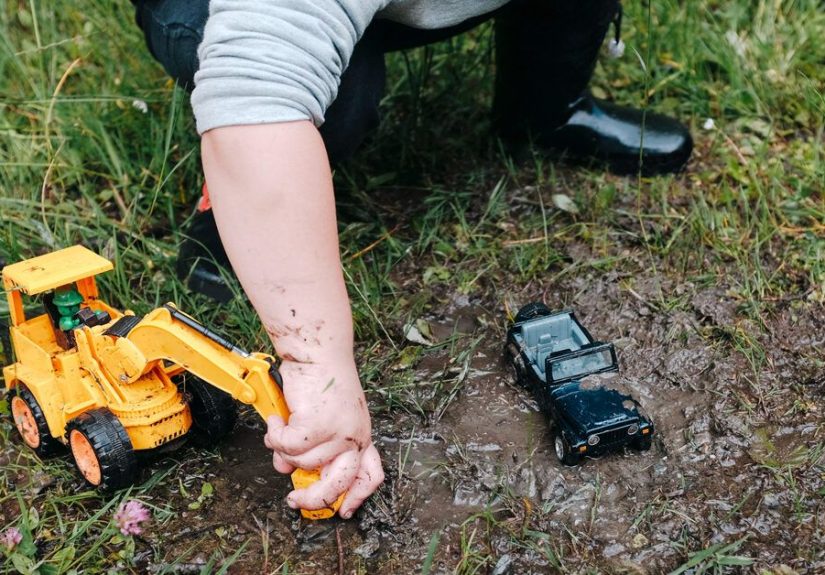
Give kids toy trucks, sticks, rocks, and small shovels. They can build roads, bridges, tunnels, dams, and tiny villages. This is fantastic for engineering thinking and cooperative play.
Mud Art
Use paintbrushes, sticks, or hands to make patterns on cardboard, pavement, tree bark, or large flat stones. Mud art is gloriously temporary, which is part of the charm.
Mud Bakery
Perfect for pretend play. Kids can make “cupcakes,” “cookies,” and “pies,” then decorate them with grass, flowers, seeds, or shells. Please admire enthusiastically. Please do not taste-test.
Puddle Jumping and Mud Obstacle Courses
After rain, let children jump, stomp, and splash. Add logs, stepping stones, buckets, or digging zones to create an obstacle course that gets the whole body moving.
What Parents Often Get Wrong About Mud Play
The biggest mistake is assuming mess has no value. Adults tend to respect neat activities because they look productive. A worksheet looks educational. A muddy child looks like a future washing machine problem. But children do not learn best only through clean, visible outcomes. They learn through doing, experimenting, repeating, and feeling.
Another common mistake is over-directing the play. Not every mud session needs a lesson plan, a theme, and printable labels. Sometimes the best thing an adult can do is provide tools, set safety boundaries, and step back. Children are very good at taking it from there.
And finally, some adults worry that allowing muddy play means giving up standards entirely. Not so. You can absolutely value both free play and soap. The trick is to separate the activity from the cleanup. Say yes to the mud, then say yes to a hose, a towel, and the world’s most satisfying post-play bath.
Why the Mess Is Part of the Point
Mud play for kids works precisely because it is hands-on, unpredictable, and gloriously imperfect. Children are not just passing time when they dig, stir, splash, and invent. They are building bodies, brains, language, confidence, and connection. They are learning how materials work, how ideas grow, how cooperation feels, and how fun can emerge from something as simple as dirt and water.
So yes, mud gets under fingernails. It sneaks into socks. It somehow reaches the back seat of the car when nobody can explain how. But childhood was never meant to be spotless. It was meant to be lived in, explored, laughed through, and occasionally hosed off on the porch.
That is why mud play is worth the mess. Not because the mess is convenient. Because the experience is.
Real-Life Experiences That Show Why Mud Play Is Worth It
Parents and educators often notice the same thing once children get permission to play in mud: the mood changes almost instantly. A child who was bored, cranky, or glued to the idea that “there is nothing to do” suddenly becomes busy in the best possible way. Give that child a patch of dirt, a little water, and a few random kitchen tools, and you may not hear from them for half an hour except for an occasional shout of, “Do not touch my mud pancakes, they are cooling!” That kind of deep engagement is not accidental. It is what happens when children find an activity that is sensory-rich, open-ended, and entirely theirs to direct.
In many families, mud play becomes the great equalizer. Siblings with different personalities often find a way to meet in the middle. The child who loves pretend play opens a mud café. The child who likes building creates roads and dams. The child who prefers collecting things starts decorating every muddy masterpiece with leaves, stones, and flower petals. Nobody has to be good at sports, drawing, or following complicated rules. Mud is democratic. Everyone gets dirty the same way.
Teachers in outdoor programs frequently describe muddy play as one of the fastest routes to collaboration. A single puddle can become a shared project. Children negotiate where the river should go, who gets the big shovel, and whether the mud pie shop accepts acorns as currency. Those conversations are not always smooth, but that is part of the benefit. Real social learning rarely looks tidy. It looks like problem-solving in rain boots.
Parents also talk about how mud changes their own perspective. At first, many adults hover nervously, seeing only stained clothes and future cleanup. Then they watch their child become focused, inventive, and genuinely joyful. The mess stops looking like damage and starts looking like evidence. Evidence of movement. Evidence of play. Evidence that a child was fully absorbed in something real.
There is also something memorable about muddy experiences that polished activities often lack. Children remember the day they built a river that actually worked, the afternoon they baked “soup cupcakes” for the dog, or the moment rain turned the backyard into an adventure course. These are not expensive memories. They are not curated. They are sticky, funny, sensory moments that become part of family stories.
And perhaps that is the most convincing argument of all. Mud play does not ask children to perform, produce, or perfect anything. It asks them to explore. In that exploration, they become more confident, more capable, and more connected to the world around them. The cleanup is real, sure. But so is the learning. So is the laughter. So is the magic of seeing a child completely at home in nature, even if nature currently happens to be all over their knees.