Table of Contents >> Show >> Hide
Enterprise AI has entered its awkward teenage phase. It is smart, ambitious, full of promises, and occasionally behaves like it learned confidence from a motivational poster. That is exactly why the early Agentforce results at SaaStr are worth paying attention to. Not because one case study settles the whole debate, but because it shows what happens when AI stops being a shiny toy and starts doing revenue work inside a real operating system.
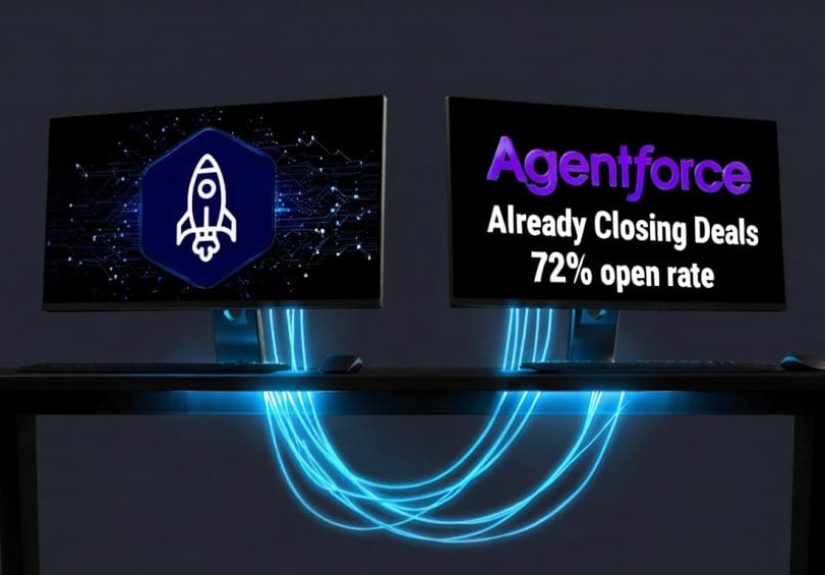
SaaStr’s take on Agentforce is refreshingly unromantic. This was not a “we replaced the whole sales team before lunch” fairy tale. It was a pretty practical use case: follow up with warm leads already sitting in Salesforce that humans had failed to pursue. In other words, the classic B2B graveyard of missed opportunities. And the early numbers were eye-catching: a 72% open rate, roughly 3,000 emails sent to previously ghosted leads, and deals already closing from contacts that had received no human follow-up for months.
That is why the phrase it’s early, but the results are really, really strong matters. It captures the right mood. This is not final proof that every enterprise should unleash an army of digital coworkers and go live on a cloud of AI confetti. It is a strong signal that AI agents become much more valuable when they operate inside systems that already contain context, workflow logic, and customer history. In plain English: AI gets a lot more useful when it knows who it is talking to.
What SaaStr Actually Proved
The best thing about the SaaStr example is that it was not built around some impossibly perfect funnel. It addressed a very normal problem. Around 1,000 warm leads had filled out forms expressing interest in sponsorships or event information, been routed to a rep, and then, well, vanished into the corporate Bermuda Triangle. No follow-up. No nurture. No second chance. Just silence.
Agentforce was applied to that neglected middle ground. These were not cold prospects scraped off the internet. They were not live website visitors asking questions in real time. They were known contacts inside Salesforce, with interaction histories, company details, prior event engagement, and intent signals already attached. That made the outreach different from generic AI SDR activity. The system was not guessing. It was continuing a relationship that the business had already started and then dropped.
That distinction matters more than most AI headlines admit. A 72% open rate on warm CRM contacts is not the same thing as a 72% open rate on cold outbound. Comparing those two is like comparing homemade lasagna to airport sushi. Both are technically food, but one has a very unfair advantage.
Still, the results deserve attention because they reveal the real strength of CRM-native agents. Agentforce is not just generating text. It is operating on top of records, history, workflows, and existing business logic. In the SaaStr case, that meant the outreach could feel less like “surprise, random AI email” and more like a relevant continuation of prior engagement.
Why Agentforce Has an Early Edge
1. Context beats clever copy
Most of the AI-agent conversation still gets trapped at the prompt layer. Which model writes better emails? Which tool personalizes subject lines? Which one sounds the least like a caffeinated intern? Those questions matter, but they are not the center of gravity in enterprise software.
The real edge often comes from context. Agentforce launched with a simple but powerful promise: agents that can analyze data, make decisions, and take action across service, sales, marketing, and commerce, all while sitting on top of Salesforce’s existing customer stack. That means the agent can use customer records, metadata, workflows, and business rules already living inside the platform.
In practice, this turns AI from “good at writing” into “good at acting with memory.” That is a much bigger deal. A model can produce a decent message from scratch. But an agent grounded in CRM context can decide which message to send, when to send it, who to prioritize, and how to route the next step. That is where software starts to feel less like a chatbot and more like labor.
2. The buying model got more realistic
Another reason the early results look stronger now than they might have a year ago is that Salesforce kept changing the pricing structure. That sounds chaotic until you remember that AI pricing across the industry has mostly resembled a group project completed five minutes before class. Salesforce started with a per-conversation model, then introduced Flex Credits at $0.10 per action, and now supports multiple buying models, including consumption and per-user approaches.
That evolution matters because enterprises do not all want to buy AI the same way. Some want predictable licenses. Some want usage-based spend tied to outcomes. Some want to test a narrow use case before rolling agents across service, sales, and internal operations. Flexible pricing lowers the emotional cost of experimentation, and in AI, that can be the difference between a pilot and a production rollout.
3. Salesforce keeps adding the boring stuff that actually matters
Here is the least glamorous truth in AI: observability, governance, and controls are not side quests. They are the whole game once a company moves beyond demos. Salesforce’s Agentforce 3 update emphasized visibility and control, including command-center style observability and native support for interoperable connections like MCP. Translation: leaders want to see what agents are doing, where they go wrong, and how to keep them from improvising their way into a compliance meeting.
If early Agentforce results feel stronger, part of the reason is that Salesforce is not positioning the product as a magic trick anymore. It is increasingly packaging it as managed, measurable, scalable software. Enterprises tend to like that. Procurement especially likes that. Procurement, famously, is not known for buying vibes.
The Broader Market Suggests This Is Not a One-Off
SaaStr’s example is compelling, but it is stronger when paired with the broader evidence. Customer stories across Agentforce deployments show a familiar pattern: the wins come first in high-volume, repetitive, context-rich workflows.
OpenTable used Agentforce to help handle support inquiries more efficiently, and Salesforce later said that OpenTable’s AI agent had handled tens of thousands of conversations in just a few weeks that would otherwise have required human support. Wiley reported a more than 40% increase in case resolution compared with its previous bot. During tax week in 2025, 1-800Accountant said Agentforce autonomously resolved 70% of its chat engagements. Saks, meanwhile, positioned Agentforce as a way to absorb routine inquiries so human teams could focus on high-touch service.
Notice the pattern. None of these examples are “the AI replaced the whole company and now also does Pilates.” They are targeted, workflow-specific, and rooted in existing operational data. That is exactly what serious enterprise adoption tends to look like at the beginning. AI does not win by taking over everything all at once. It wins by solving painful, repetitive work that businesses can measure.
Salesforce’s own commercial data reinforces that this is moving beyond pilot theater. In its fiscal Q4 2026 results, the company said Agentforce ARR reached $800 million, up 169% year over year, with more than 29,000 deals closed since launch. More than 60% of Agentforce and Data 360 Q4 bookings came from existing customer expansion, and production accounts increased nearly 50% quarter over quarter. Those are not vanity numbers. They suggest companies are not merely trying the product; many are broadening usage after initial deployments show enough value to justify expansion.
Why “It’s Early” Still Matters
Now for the less glamorous part, which also happens to be the adult part. It is still early. Very early, in some respects. Even SaaStr, which is clearly enthusiastic, has been honest that running multiple AI agents across go-to-market workflows remains messy, manual in places, and dependent on real human oversight.
That honesty is useful. It keeps the story credible. AI agents are not plug-and-play miracles. They require training, guardrails, routing logic, QA, and clean data. A bad CRM plus a smart agent is still a bad system, just one that can make mistakes at machine speed. If your Salesforce instance resembles a digital junk drawer, Agentforce will not wave a wand and turn it into operational excellence. It will simply have more drawers to rummage through.
This is where many companies get distracted by the wrong benchmark. They ask whether the agent is perfect. That is not usually the right question. The better question is whether the agent can profitably improve work that is currently not happening, happening too slowly, or happening inconsistently. SaaStr’s ghosted-lead example is powerful precisely because the baseline was terrible. Humans had done nothing. Against that baseline, even “pretty good” AI can produce meaningful revenue.
That may be the most important strategic lesson from the whole story: do not begin by asking AI to outperform your best rep, best CSM, or best support leader. Begin by asking it to rescue work the organization is currently dropping on the floor.
What B2B Companies Should Learn From SaaStr + Agentforce
Start with neglected revenue, not glamorous innovation
The smartest AI use case is often the least sexy one. Missed follow-ups. Slow lead response. Routine case handling. Ticket triage. Status updates. All the chores everyone agrees matter and nobody wants to own at scale.
Use CRM-native agents where context is already rich
If the customer, lead, or account already lives inside Salesforce with meaningful history attached, a native agent has a structural advantage. It is not starting from zero, and it does not need a scavenger hunt across disconnected systems just to sound informed.
Keep humans on the high-value work
The best customer examples do not frame AI as a replacement for judgment-heavy relationships. They frame it as a way to remove repetitive work so humans can handle complexity, nuance, and trust-building. That is not just better for employee adoption; it is usually better for customers too.
Measure operational outcomes, not demo quality
Do not fall in love with how impressive the demo looks. Fall in love with time-to-response, resolution rates, pipeline recovered, cost per action, and expansion rates after rollout. Those are the metrics that survive budget season.
Expect iteration
Salesforce’s own pricing and product roadmap evolved quickly because the market is still learning. That should not scare buyers. It should remind them that successful AI adoption is not a one-time install. It is an operating discipline.
What the Early Experience Actually Feels Like on the Ground
Here is the part that rarely makes it into launch videos with cinematic lighting and suspiciously calm executives: the early experience of deploying an AI agent is not usually dramatic. It is incremental, messy, and occasionally weird. Then one day someone notices a real metric moved, and suddenly the room gets a lot quieter.
That is what makes the SaaStr + Agentforce story resonate. It sounds like what many operators are experiencing right now. At first, there is skepticism. Will this need a massive implementation? Will the outputs be generic? Will the reps hate it? Will legal appear from a side door with a stack of concerns thick enough to stop a train? These are not irrational questions. They are exactly the right questions.
Then the first useful pattern appears. A lead gets a response that feels timely. A contact who should have been lost replies. A routine support issue gets handled without a queue backing up. A rep spends less time digging through records and more time talking to someone who might actually buy. Nobody throws confetti. But the company starts to trust the workflow a little more.
From there, the emotional journey tends to change. The conversation stops being “Can AI do this at all?” and becomes “Which parts of the process should AI own, and where do humans add the most value?” That is a healthier question. It moves the organization away from magical thinking and toward system design.
The early operator experience also teaches humility. AI agents are only as strong as the context, permissions, and workflow design around them. If records are incomplete, routing is sloppy, or the handoff between agent and human is clumsy, the cracks show fast. On the other hand, if the system has strong data, clear triggers, and sensible escalation rules, the agent starts feeling less like an experiment and more like infrastructure.
That is why the most credible early Agentforce wins are not about theatrical autonomy. They are about dependable execution. Faster follow-up. Better triage. More coverage. Fewer dropped balls. More consistent service. More chances for human teams to focus on the moments that really require persuasion, empathy, or domain judgment.
And perhaps that is the most interesting experience of all: once an agent starts doing real work, people stop obsessing over whether it is “AI enough.” They care whether it is useful. They care whether it saves time, recovers revenue, improves service, or reduces operational drag. In software, usefulness beats novelty every time. Eventually, the coolest feature in the room is the one that quietly works.
Final Take
SaaStr’s early Agentforce results look strong because they line up with a broader truth emerging across enterprise AI: agents perform best when they are grounded in real business context, aimed at concrete workflows, and measured against painfully human bottlenecks. The SaaStr case is not proof that every AI agent strategy will work. It is proof that the right AI agent strategy can work a lot sooner than many skeptics expected.
So yes, it is early. But early does not mean imaginary. Between SaaStr’s warm-lead recovery results, Salesforce’s rapidly growing Agentforce business, and customer examples from service-heavy industries, the signal is getting harder to dismiss. The market is still sorting hype from substance, and there will absolutely be overpromises, underwhelming pilots, and enough jargon to power a small city. But the strongest early Agentforce stories are not built on hype. They are built on recovered pipeline, faster resolution, and better use of human attention.
That is not a science project. That is software doing a job.