Table of Contents >> Show >> Hide
- Quick Comparison: Top RV Solar Panels at a Glance
- How to Choose the Right RV Solar Panel (Without Spiraling)
- The 8 Best RV Solar Panels for 2024
- 1) Best Overall: Renogy 200W 12V Monocrystalline (Panel or Kit)
- 2) Best “RV OEM” Style Kit: Go Power! Overlander 200W (or 190W-class kits)
- 3) Best Premium RV-Ready Option: Zamp Solar Obsidian Series
- 4) Best Heavy-Duty Rigid Panel: RICH SOLAR MEGA 200
- 5) Best Value Rigid Panel: Newpowa Pro 200W Monocrystalline
- 6) Best Flexible Panel: Renogy 200W Flexible Monocrystalline
- 7) Best Portable for Power Stations: EcoFlow 220W Bifacial Portable Solar Panel
- 8) Best Simple, Fast Setup Portable: Jackery SolarSaga 200
- Buying Guide: What “Good” RV Solar Looks Like in Real Life
- FAQ: RV Solar Panels
- Extra: of Real-World RV Solar “Experience” (What RVers Commonly Report)
- Conclusion
RV solar is basically a tiny, well-behaved sun that follows you around and pays your electric bill in silence.
Whether you’re a weekend camper who just wants to keep the fridge cold, or a full-time boondocker who treats
shore power like an ex you’re “totally over,” the right solar panel setup can make your rig feel bigger, calmer,
and way less dependent on campground hookups.
This guide rounds up eight standout RV solar panels (and panel kits) for 2024, mixing roof-mounted workhorses,
lightweight flexible panels, and portable options that pair beautifully with power stations. You’ll also get a
buyer’s guide that translates solar jargon into real-world decisionsbecause “Vmp” should not require a minor in
electrical engineering.
Quick Comparison: Top RV Solar Panels at a Glance
| Pick | Type | Best For | Why It’s a Favorite | Heads-Up |
|---|---|---|---|---|
| Renogy 200W Monocrystalline (Kit/Panel) | Rigid (roof or ground) | Most RVers | Great performance-per-dollar, common RV sizing sweet spot | Rigid panels take roof space and add weight |
| Go Power! Overlander 200W (or 190W class kits) | Rigid kit | OEM-style RV installs | RV-focused kit ecosystem and long-term support | PWM kits can be less efficient than MPPT in some conditions |
| Zamp Solar Obsidian Series | Rigid (roof/portable depending on model) | Premium, RV-ready wiring ecosystems | Strong warranty reputation and RV “solar-ready” compatibility | Premium pricing |
| RICH SOLAR MEGA 200 | Rigid | Serious roof arrays | Solid build + popular wattage for multi-panel systems | Measure your roof carefully (vents love stealing panel real estate) |
| Newpowa Pro 200W | Rigid | Value hunters | Strong specs for the money and easy expansion | Stock and model revisions happendouble-check specs before matching controllers |
| Renogy 200W Flexible | Flexible | Curved roofs, weight-sensitive rigs | Lightweight, low-profile, bends to fit weird surfaces | Flexible panels can run hotter and may not last as long as rigid glass panels |
| EcoFlow 220W Bifacial Portable | Portable/foldable | Power stations + moveable shade-chasing | Bifacial design can boost output in bright environments | Portables require setup time (and you remembering to put them away) |
| Jackery SolarSaga 200 | Portable/foldable | Fast, simple “plug-and-play” charging | High conversion efficiency claims and easy deployment | Best results require good sun angle and minimal shading |
How to Choose the Right RV Solar Panel (Without Spiraling)
1) Start with your daily energy “diet” (in watt-hours)
Solar sizing gets easier when you stop thinking in “panels” and start thinking in watt-hours per day.
A simple estimate:
- Daily solar harvest ≈ Panel watts × peak sun hours × system efficiency
- Rule-of-thumb system efficiency (controller + wiring + real-world conditions): ~70–85%
Example: A 200W panel in ~5 peak sun hours could produce about 200 × 5 = 1,000Wh at the panel.
After real-world losses, you might net roughly 700–850Wh. That’s often enough to cover phones,
lights, fans, and a surprisingly dramatic number of “just one more” device charges.
2) Roof-mounted vs. portable vs. flexible
- Roof-mounted rigid: “Set it and forget it.” Great for consistent charging while driving or parked.
-
Portable foldable/suitcase: You can move them into the sun when your campsite is shady. Great for
power stations and “we picked this site for the view, not the solar.” -
Flexible: Lightweight, low-profile, and can conform to gentle curves. Ideal for certain roofs and
weight-sensitive builds, with tradeoffs in heat and longevity.
3) Don’t ignore the charge controller (it’s the bouncer at the power club)
Your panels don’t feed batteries directly without supervision. A charge controller regulates voltage/current
so your battery gets charged safely and efficiently.
-
MPPT: Typically more efficient in many real-world conditions and can better “harvest” power when panel
voltage is higher than battery voltage. -
PWM: Often cheaper and fine for smaller, simpler systemsespecially when panel voltage closely matches
battery voltage.
4) Shade is solar’s arch-nemesis
One little shadow from an A/C shroud can steal output like a raccoon stealing hot dogs. Look for panels with good
internal design (like bypass diodes and sensible cell layouts), and plan your roof layout to minimize shading.
Portables can help because you can place them away from roof obstacles.
The 8 Best RV Solar Panels for 2024
1) Best Overall: Renogy 200W 12V Monocrystalline (Panel or Kit)
If RV solar had a “most likely to succeed” superlative, a Renogy-style 200W mono panel setup would be on the yearbook
cover. It’s a practical size: big enough to matter, small enough to scale. Many RVers start with 200W and expand
to 400W+ as their power confidence (and gadget collection) grows.
Why it stands out
- Common RV-friendly wattage for roof arrays and off-grid starter systems
- Widely supported ecosystem of brackets, wiring, controllers, and accessories
- Often sold as kits that simplify first-time installs
Best for
Weekend campers to full-timers who want dependable roof charging without spending boutique-money.
Watch-outs
Measure roof space first. Vents, antennas, skylights, and that one mystery thing you forgot exists will fight you.
Example setup
Two 200W panels (400W total) + MPPT controller + 200Ah lithium battery bank is a popular “comfortable boondocking”
baseline for moderate loads (lights, fans, phones, laptops, water pump, and careful inverter use).
2) Best “RV OEM” Style Kit: Go Power! Overlander 200W (or 190W-class kits)
Go Power! has long been common in the RV world, including factory and dealer installs. That matters because RV-specific
ecosystems often make expansion and support easierespecially if your rig is already “solar prepped” in a Go Power! flavor.
Why it stands out
- RV-focused kits with controllers designed for typical RV battery charging workflows
- Strong availability through RV retail channels
- Long-term power output warranties are common on their modules
Best for
RV owners who want a straightforward, widely-supported kit pathespecially for roof-mounted charging.
Watch-outs
Some kits lean PWM. PWM can work well, but if you’re building a larger system or want better performance in varied
conditions, MPPT is often worth considering.
3) Best Premium RV-Ready Option: Zamp Solar Obsidian Series
Zamp Solar has been a familiar name in RV “solar-ready” circles, especially because many RVs are pre-wired with ports
designed to play nicely with their plug-and-play approach. The Obsidian line is aimed at durability and RV practicality,
with a strong emphasis on warranty coverage.
Why it stands out
- Known for RV-friendly wiring/ports and “solar-ready” compatibility
- Strong warranty reputation on framed panels
- Good option for owners who value a more integrated RV solar experience
Best for
RVers who want a premium “fits the RV world” solution, especially when matching existing ports or a pre-wired setup.
Watch-outs
The premium is real. You’re often paying for ecosystem convenience, support expectations, and brand positioningnot
just raw watts.
4) Best Heavy-Duty Rigid Panel: RICH SOLAR MEGA 200
When you’re building a roof array that needs to show up day after day, you want a panel that feels like it could survive
flying gravel, thermal cycling, and the kind of wind you only meet because you insisted on driving through it.
The RICH SOLAR MEGA 200 is a popular 200W-class rigid option for RV and off-grid builds.
Why it stands out
- Classic “add more panels later” wattage and form factor
- Built for off-grid applications like RVs, cabins, and marine use
- Long-term output warranty messaging is common for this model class
Best for
Roof arrays where durability and predictable performance matter more than shaving a few pounds.
Watch-outs
Roof planning matters. A 200W rigid panel is not tiny, and RV rooftops are basically obstacle courses.
5) Best Value Rigid Panel: Newpowa Pro 200W Monocrystalline
Newpowa’s 200W-class panels tend to appeal to buyers who want solid electrical specs without paying for a luxury label.
If you’re comfortable doing a bit of homework on voltage/current matching, these can be a strong “value build” foundation.
Why it stands out
- Good published specs for a common RV-friendly wattage class
- Works well for multi-panel expansion (think 2–4 panels over time)
- Often a strong cost-per-watt play for roof arrays
Best for
DIY-minded RV owners who want more solar without turning the budget into a bonfire.
Watch-outs
Always confirm the latest panel specs before pairing with a controllermodels can get quietly revised.
6) Best Flexible Panel: Renogy 200W Flexible Monocrystalline
Flexible panels are the “yoga instructors” of RV solar: they bend, they adapt, and they look calm doing it. They’re
especially useful for curved surfaces (like certain van roofs) or builds where keeping weight down matters.
Renogy’s flexible 200W-class option is designed for bendability, portability, and a low-profile install.
Why it stands out
- Lightweight and low-profile compared to glass rigid panels
- Can conform to gentle curves (great for certain roof shapes)
- Designed with features aimed at reducing hot spots and shading headaches
Best for
Vans, teardrops, and rigs where roof weight/height is a big concernor where the roof simply isn’t flat.
Watch-outs
Flexible panels can run hotter (heat reduces output) and may not last as long as glass rigid panels in harsh long-term conditions.
Install with airflow in mind whenever possible.
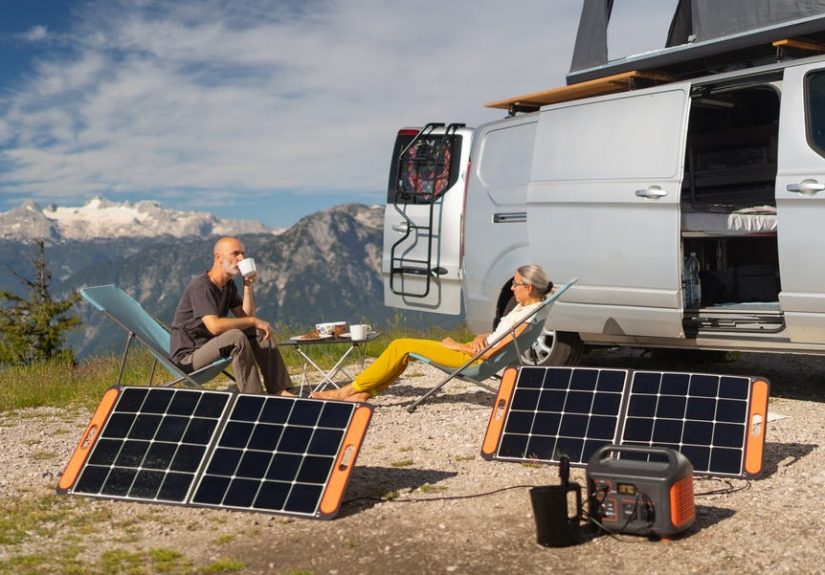
7) Best Portable for Power Stations: EcoFlow 220W Bifacial Portable Solar Panel
If you’re running a portable power station setup, a portable panel is often the simplest route: unfold, angle toward the sun,
plug in, and feel oddly proud of yourself. EcoFlow’s 220W bifacial portable panel is designed to be rugged and weather-resistant,
and the bifacial design can pick up extra energy from reflected light (think bright sand, concrete pads, or light-colored rock).
Why it stands out
- Bifacial design can increase harvest in the right environments
- Designed for frequent setup/pack-down travel life
- Strong weather resistance messaging for outdoor use
Best for
Campers who want to park in the shade and place panels in the sunespecially when charging a power station for appliances,
camera gear, laptops, or medical devices.
Watch-outs
Portables require daily habits: setting up, angling, and stowing. If you hate routines, roof-mounted might suit you better.
8) Best Simple, Fast Setup Portable: Jackery SolarSaga 200
The SolarSaga 200 is popular because it’s approachable. It’s made for people who want solar to feel like “a thing I do”
rather than “a new personality trait.” Foldable panels like this are great for topping off a power station and keeping
essentials humming without running a generator.
Why it stands out
- Portable, foldable design built for travel
- High conversion efficiency claims for its category
- Good fit for power stations and flexible campsite layouts
Best for
Anyone who wants portable solar that’s fast to deploy and easy to aimperfect for weekenders, tailgaters, and off-grid overnights.
Watch-outs
Like all portable panels, it’s sensitive to angle and shading. Ten minutes of repositioning can be the difference between “nice”
and “why is my battery still at 43%?”
Buying Guide: What “Good” RV Solar Looks Like in Real Life
Choose your “solar personality”: trickle, comfort, or full-time off-grid
-
Trickle-charger (100–200W): Great for keeping batteries healthy, running lights, charging devices, and
reducing generator time. - Comfort boondocking (300–600W): Enough for more consistent fridge support, fans, laptops, and moderate inverter use.
- Full-time off-grid (800W+): For heavier loads, bigger battery banks, and people who forget what a pedestal looks like.
Match panel voltage to controller and battery plan
Most RV “12V” panels are designed with a voltage sweet spot that works well with 12V battery charging through a controller.
When you add multiple panels, you can wire in series (higher voltage) or parallel (higher current),
and the controller must support whatever you build.
- Series: Often useful for MPPT, can reduce wire losses, but shade on one panel can affect the string.
- Parallel: Helps reduce shading impacts per panel, but increases current and may need thicker wiring.
Heat, efficiency, and why panels underperform “on purpose”
Solar ratings are tested under lab conditions. In the real world, panels get hot and output drops. That’s normal. It’s also why
people often say a “200W panel” might deliver more like 140–170W in many real conditionsespecially when mounted flat on a warm roof.
Mounting tips that save headaches
- Plan airflow: Even a little space under rigid panels helps cooling and output.
- Protect your roof: Use proper sealants and mounts designed for RV roofs.
- Fuse correctly: Fusing and proper wire gauge reduces risk and improves reliability.
- Think about maintenance: Can you clean the panel? Can you reach the wiring? Future you will appreciate present you.
FAQ: RV Solar Panels
Do I need a charge controller?
Yes. A controller regulates the power coming from panels so your battery is charged safely and efficiently.
Panels alone don’t “speak battery” fluently.
Is MPPT always better than PWM?
Not always, but often. MPPT can harvest more energy in many setups and conditions, especially when panel voltage is higher than
battery voltage or when temperatures vary. PWM can be a cost-effective choice for small systems with well-matched panel/battery voltages.
Portable vs roof-mounted: which is better?
Roof-mounted is effortless daily charging; portable is flexible placement. Many RVers end up with both: roof for baseline charging,
portable for topping off when parked in shade or during higher usage.
Extra: of Real-World RV Solar “Experience” (What RVers Commonly Report)
Let’s talk about what RV solar feels like in the real world, because spec sheets don’t mention the part where you become emotionally
invested in sun angles.
A common first-time solar moment goes like this: you install panels, you download an app (or stare at a controller screen like it’s a
Vegas slot machine), and you wait for magic. It’s sunny. The numbers climb. You feel powerful. Then a cloud drifts by and the output
dips, and you learn your first solar truth: you didn’t buy electricityyou bought a relationship with the sky.
Many RVers say the biggest surprise isn’t how much power solar can makeit’s how quickly you start noticing “invisible” loads.
The fridge cycling, the water pump, the router, the fans you swear you barely use, and the inverter that quietly sips power even when
nothing is plugged in. Solar doesn’t just supply energy; it turns you into a respectful observer of your own habits. You’ll catch
yourself saying things like, “Do we really need the blender?” which is both responsible and mildly tragic.
Shade becomes a strategic game. People who love forest campsites often discover the classic compromise: shade is great for temperature
and naps, but lousy for charging. That’s where portable panels earn their keep. RVers commonly describe the routine of placing a portable
panel in a sun patch, adjusting it twice a day, and feeling like they’ve started a small, polite farm. In brighter environmentsdesert
boondocking, open fields, or bright concrete padssome folks report that bifacial portable panels can be especially satisfying because
reflected light helps boost production. It’s like your campsite is giving you a tiny bonus for choosing the blindingly bright location.
Roof-mounted systems, on the other hand, often win on pure laziness (and laziness is a valid engineering goal). RVers who go roof-mounted
say the best part is waking up and seeing the battery recovering without doing anything. It’s less “daily project” and more “quiet background
superpower.” The tradeoff is that flat-mounted roof panels may not hit their rated output oftenespecially when the roof is hot. People notice
that output improves on cool mornings, in shoulder seasons, or when there’s decent airflow under the panels. Some add tilt mounts for winter
sun angles, but many admit they rarely tilt because, again, laziness is a lifestyle.
Over time, solar changes trip planning. RVers commonly share that once they trust their system, they stop hunting for hookups and start hunting
for silence, views, and space. They may still use shore power when it’s convenientbut it becomes a choice, not a necessity. And that’s the real
win: RV solar doesn’t just power devices. It powers options. Also, it powers the smug satisfaction of charging your phone from sunlight while
someone nearby is wrestling with a generator that refuses to start. Not that you’d brag. You’ll just smile. Quietly. In solar.
Conclusion
The “best” RV solar panel isn’t the one with the most impressive spec sheetit’s the one that fits your roof, your camping style, and your
willingness to tinker. If you want effortless daily charging, choose a roof-mounted rigid panel (or kit). If you chase shade and flexibility,
add a portable panel. If weight and curves are your reality, flexible panels can be a practical compromise. Start with a realistic power goal,
plan for expansion, and remember: the sun is generous, but it is not punctual.

![18 Best Types of Charts and Graphs for Data Visualization [+ How to Choose]](https://corkopencoffee.org/wp-content/uploads/2026/05/18-best-types-of-charts-and-graphs-for-data-visualization-how-to-choose-qKM1PBYG-thumb.jpg)