Table of Contents >> Show >> Hide
- What the M777A2 Actually Is
- Why the M777A2 Feels So Powerful
- Range, Rate of Fire, and the Reality Behind the Reputation
- Why the Marine Corps Has Valued It So Highly
- The M777A2 in Modern Conflict
- The Not-So-Romantic Truth: Its Limits Are Real
- Why It Still Matters in 2026
- Experience: What the M777A2 Feels Like in the Real World
- Final Thoughts
- SEO Tags
Some military machines look intimidating because they are huge. The M777A2 howitzer chose a different strategy: get lighter, get smarter, and still hit like a thunderstorm with paperwork. At first glance, it is “just” a towed 155 mm artillery system. Then you look closer and realize this thing changed the conversation around modern field artillery by combining mobility, precision, and raw firepower in a package that trimmed serious weight from older guns without giving up the muscle that armies and Marines expect from a heavy hitter.
That combination is why the M777A2 still matters. It is not simply a cannon on a bad day. It is a case study in how engineering, digital systems, and battlefield needs can collide in one very loud machine. The gun has built a reputation not only because it can deliver long-range fires, but because it can do so with a lighter frame, faster digital support, and enough adaptability to remain relevant in a world that now expects weapons to talk to networks, not just bark at the horizon.
In plain English, the M777A2 is powerful because it is more than brute force. It is brute force with a laptop-era brain. That is a big reason the system has remained such an important part of discussions about artillery, mobility, sustainment, and modernization.
What the M777A2 Actually Is
The M777A2 is a lightweight, towed 155 mm howitzer. The “lightweight” label is not marketing fluff dressed in camouflage. Compared with older 155 mm guns such as the M198, the M777 family cut weight dramatically through the use of titanium and aluminum alloys. That lower weight changed how quickly the weapon could be moved, how many platforms could transport it, and how well it fit the expeditionary style of operations favored by light forces and the Marine Corps.
The A2 version is where the story gets especially interesting. This variant added an advanced digital fire-control system that improved how the weapon is positioned, aimed, and integrated into a modern fire-support network. In other words, the M777A2 did not just stay light; it got smarter. That matters because modern artillery is not only about who can shoot the farthest. It is also about who can receive data faster, reduce setup friction, and put rounds where they need to go with less delay and more confidence.
The result is a system that became the general-support artillery replacement for the Army’s older M198 in light formations and a core towed 155 mm capability for the Marine Corps. That is a big job description for any gun, especially one that has to balance mobility with reach.
Why the M777A2 Feels So Powerful
Lightweight engineering that changed mobility
The first source of the M777A2’s power is not the barrel. It is the diet plan. By bringing the weight down to under 10,000 pounds in public descriptions, the system became much easier to transport than many older guns in its class. This gave commanders more flexibility and made the weapon more attractive for expeditionary forces that cannot always afford to drag a steel dinosaur across the map.
That lighter frame is not just a logistics footnote. Mobility is power. A gun that can be moved more easily is a gun that can show up where it is needed faster, support more kinds of formations, and keep pace with operations that do not politely wait around. The M777A2 became powerful partly because it was practical.
A digital brain made the cannon faster and sharper
The second source of power is the digital fire-control system. Older artillery cultures often relied more heavily on manual methods, voice traffic, and slower transitions from data to action. The M777A2 helped shift that experience. Its digital upgrade improved how crews could self-locate, orient the gun, and work with fire-direction data. That may sound like a software patch with dirt on its boots, but it is central to the gun’s real-world value.
Speed in artillery is not only muzzle velocity. It is decision speed, setup speed, and coordination speed. A digitally enabled gun can reduce friction where friction hurts most: in the moments between receiving information and turning that information into effective support. That is why the M777A2’s reputation rests as much on electronics and workflow as on blast and recoil.
Precision changed the conversation
The third ingredient is ammunition compatibility, especially the ability to employ precision-guided rounds such as Excalibur. Public Army descriptions have long emphasized that this capability gave commanders a more precise strike option at extended ranges. That took the M777A2 beyond the classic image of artillery as a blunt instrument. It gave the system a more modern identity: a heavy gun that could be paired with smarter rounds for more exact effects.
That precision angle matters for both military performance and public perception. It means the M777A2 is not famous only because it is loud. Plenty of things are loud. Toddlers are loud. Leaf blowers are loud. The M777A2 stands out because it combines heavy-caliber firepower with a digital, precision-capable architecture that feels much more current than a simple “pull cord, make boom” stereotype.
Range, Rate of Fire, and the Reality Behind the Reputation
The M777A2’s public performance figures help explain the title “ground-shaking.” Army and Marine Corps materials have described it as accurately firing 155 mm rounds at roughly 15 miles with unassisted projectiles, around 18.9 to 19 miles with assisted projectiles, and farther still with precision-guided munitions such as Excalibur. Public Army descriptions have also cited a firing rate of up to five rounds per minute.
Those numbers matter because they put the M777A2 in the sweet spot where towed artillery can still be strategically useful without becoming a relic. It reaches far enough to shape the fight, supports infantry and maneuver forces effectively, and gives commanders options that are more flexible than smaller-caliber systems. When paired with modern data and precision ammunition, its reach becomes less about volume alone and more about meaningful impact over distance.
That is also why the howitzer’s power feels bigger than its frame suggests. The weapon is not enormous by the standards of heavy land systems, but its effect downrange and its ability to support dispersed forces make it feel much larger than its physical footprint.
Why the Marine Corps Has Valued It So Highly
The Marine Corps has long appreciated weapons that can travel, deploy, and support fast-moving operations without demanding a parade route and a marching band. The M777A2 fits that mindset beautifully. It is heavy enough to deliver serious 155 mm support, yet light enough to remain useful in expeditionary settings where mobility is not optional.
Marine reporting around training and readiness repeatedly shows the M777A2 being used as a workhorse system for preparing units for deployment. That says a lot. Militaries do not repeatedly build training around a system they consider irrelevant. They build around the systems that solve real problems. The M777A2 has solved the same core problem for years: how to bring strong, responsive artillery support to forces that still need to move.
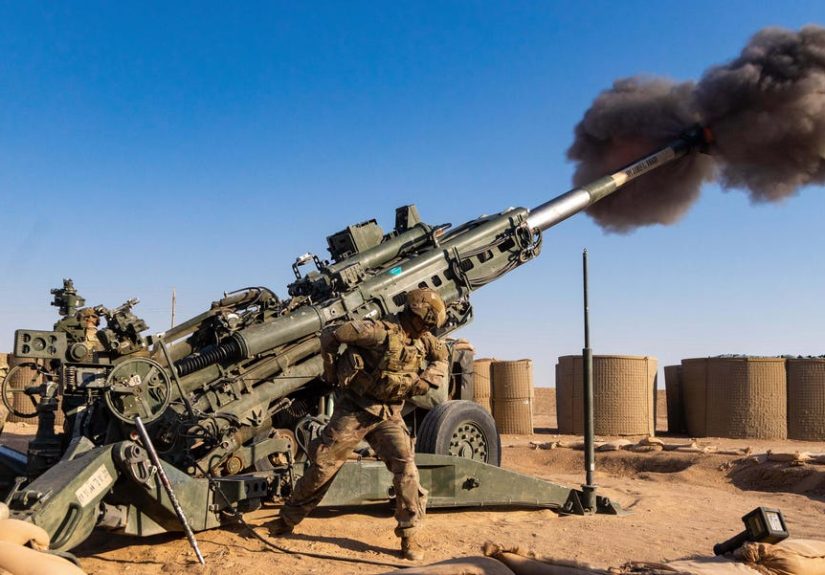
Even the physical routine around the gun says something important. Public Marine accounts describe cannoneers digging in the weapon’s “feet,” hauling rounds that weigh around 80 pounds, and spending long days on the firing line. That is not glamorous, but it is revealing. The M777A2 is not powerful because it is effortless. It is powerful because it turns a demanding, physical drill into dependable fire support.
The M777A2 in Modern Conflict
The M777A2 gained renewed global attention during the war in Ukraine, where public U.S. reporting described the system as having a meaningful battlefield impact while also exposing the very real demands of maintenance and sustainment. That second part is easy to overlook when people focus only on range and headlines, but it is essential to understanding the weapon honestly.
A modern artillery system is not just a gun tube. It is a networked piece of equipment that needs training, spare parts, repair knowledge, and constant support. Public U.S. reporting showed Army maintainers helping Ukrainian personnel remotely with M777 sustainment. That is one of the most revealing chapters in the weapon’s modern story. It proved that artillery power in the twenty-first century depends on support ecosystems as much as steel and propellant.
In other words, the M777A2 did not become relevant again simply because it could fire far. It became relevant because it demonstrated what modern artillery really is: a combination of hardware, software, logistics, training, and communications. If any one of those pieces stumbles, the gun’s reputation starts wobbling too.
The Not-So-Romantic Truth: Its Limits Are Real
For all its strengths, the M777A2 is not a magic wand on wheels. In fact, it is not on wheels in the self-propelled sense at all, and that is part of the current debate around its future. Recent U.S. analysis has highlighted the basic disadvantage of towed artillery in high-threat environments: it is slower to emplace and displace than self-propelled systems, it leaves crews more exposed, and it cannot match the all-around turret flexibility of armored alternatives.
That does not make the M777A2 obsolete. It makes it conditional. Its strengths still matter, especially in expeditionary operations, transportability, and proven 155 mm support. But its weaknesses matter too. In a world of drones, counter-battery threats, and rapidly shrinking windows of survivability, time spent setting up and moving can become a serious liability.
This is where the M777A2 becomes especially fascinating as a subject. It sits right at the intersection of two military truths. First, lightweight towed artillery still provides valuable capability. Second, the battlefield is getting nastier, faster, and less forgiving. That tension is why the M777A2 continues to be discussed so intensely.
Why It Still Matters in 2026
If the M777A2 were merely an aging legacy system, it would not keep showing up in modernization conversations. But public 2024–2026 materials show that the story is still moving. Army portfolio documents have referenced upgrades to digital fire-control components. Industry reporting has pointed to new work on M777 structures. Recent defense reporting has also described joint exercises in which Army and Marine Corps data were successfully shared to support M777 fire missions within emerging command-and-control ecosystems.
That is a big deal. It means the M777A2 is still being treated as part of a broader digital battlefield, not just as a leftover cannon waiting politely for retirement papers. At the same time, public reporting also shows the Army exploring future replacements and alternative artillery paths. That tension gives the M777A2 a very modern role: it is both proven and under review, respected and debated, indispensable in some contexts and increasingly challenged in others.
Ironically, that makes the howitzer more interesting, not less. Plenty of old systems fade into irrelevance. The M777A2 has managed to remain central precisely because it still delivers value while also forcing hard questions about what artillery should look like next.
Experience: What the M777A2 Feels Like in the Real World
To understand the M777A2, you have to move beyond the spec sheet and imagine the experience around it. Public accounts from Marines, soldiers, trainers, and maintainers suggest that life around the weapon is equal parts physical labor, digital coordination, and sensory overload. The machine may be famous for power, but the human experience around that power is what makes the system memorable.
First, there is the physical side. The M777A2 is lighter than many older guns in its class, but nobody standing next to it would describe it as “cute” or “easy.” Crews still dig in the stabilizing points, move heavy rounds, manage equipment, and work in heat, dust, mud, cold, or whatever weather decided to show up without an invitation. Public Marine descriptions of cannoneer routines make it clear that this is exhausting work. The M777A2 may be engineered for mobility, but it still demands sweat. A lot of sweat.
Then there is the sound and concussion. Even people who know the shot is coming often describe artillery in a way that suggests the body notices it before the brain finishes processing it. The noise is one thing, but the physical pressure is another. It is not just heard; it is felt through boots, chest, and ground. That is part of why the M777A2 leaves such a strong impression on ranges and in training environments. It does not politely announce itself. It introduces itself like a thunderclap that skipped small talk.
But the experience is not only primal and loud. The A2 variant also adds a distinctly modern layer. Public descriptions of digital firing control show how much of the workflow moved away from older voice-heavy methods toward screens, data, and faster digital handoff. That changes the rhythm around the gun. The M777A2 experience is not just crews muscling through drills; it is also crews trusting digital information, validating it, and working within a more networked system. In that sense, the weapon feels like a strange but effective marriage of blacksmith energy and software logic.
The maintenance experience is another story entirely. Public reporting on Ukraine highlighted that even when a howitzer is admired for its accuracy and reach, keeping it operating can be a major challenge. That is a useful reminder that the lived experience of the M777A2 includes repair calls, troubleshooting, worn parts, and sustainment headaches. Nobody puts that on a recruitment poster, but it is part of the truth. A weapon system earns respect not only when it fires, but when it can be kept in service under pressure.
There is also a teamwork dimension that deserves attention. Artillery is never really a solo act. Public accounts of Marine exercises and recent Army-Marine interoperability events show that the M777A2 is tied to observers, fire-direction teams, maintainers, movers, and increasingly to data networks that connect multiple units and services. The experience of the weapon, then, is deeply collective. It is a machine that depends on people doing different jobs well, often under stress, often with little glamour, and often with timing that leaves no room for laziness.
In that way, the M777A2 represents a broader truth about military technology. The most impressive systems are not impressive only because of what they can do on paper. They are impressive because of what trained people can keep doing with them, day after day, in imperfect conditions. The M777A2’s “ground-shaking power” is real, but so is the human effort behind every instance of that power. The experience is not movie magic. It is grit, repetition, coordination, maintenance, and a machine that makes the earth answer back when it speaks.
Final Thoughts
The M777A2 howitzer remains one of the most compelling artillery systems of the modern era because it brought together three traits that do not always coexist comfortably: heavyweight firepower, lightweight engineering, and digital-age capability. It proved that towed artillery could still evolve. It also proved that the future of artillery is not simply about building bigger guns, but about building smarter, more mobile, and more connected ones.
Its reputation is well earned, but it should be understood clearly. The M777A2 is not powerful only because it can shake the ground. It is powerful because it changed expectations for what a towed 155 mm howitzer could be. It became lighter without becoming flimsy, smarter without becoming soft, and more precise without losing the blunt authority that artillery is supposed to carry.
That is the real story of the M777A2. Not just noise. Not just range. Not just battlefield mythology. The real power of the M777A2 is that it fused mobility, precision, and proven fire support into a system that still matters even as the next generation tries to replace it. That is a rare achievement. And yes, it is also very loud.