Table of Contents >> Show >> Hide
- What Makes This 1754 Cape So Compelling?
- The Story Behind the Spruce Head Restoration
- Preservation Without the Dusty Museum Feeling
- Why Spruce Head, Maine Matters to the Design
- The Architecture of a Cape: Small House, Big Lessons
- Interior Design Ideas Inspired by the 1754 Spruce Head Cape
- Old House Restoration: What This Project Gets Right
- The “New New England” Aesthetic
- Experiences Inspired by “The New New England: A 1754 Cape on Spruce Head in Maine”
- Conclusion: A Small Cape With a Large Design Lesson
- SEO Tags
Some houses announce themselves with a circular driveway, a glassy foyer, and a kitchen island big enough to land a small plane. Then there are houses like the 1754 Cape on Spruce Head in Maine: low, quiet, weather-wise, and so beautifully restrained that it seems to whisper, “Please wipe your boots, but don’t make a production of it.”
This is not just another charming coastal Maine home. It is a case study in how old New England architecture can feel fresh without being sanded into blandness. Restored by sculptor-turned-builder Anthony Esteves, the Cape sits within a larger family compound on Spruce Head, a working island community tied to lobster boats, spruce woods, granite edges, and the kind of coastal light interior designers spend years trying to fake with expensive bulbs.
The home was originally built in 1754, later dismantled, moved, and reconstructed on Spruce Head Island in 1999 before Esteves brought it into its next life. Instead of forcing the house to become a glossy “historic-inspired” showpiece, he treated it like a living artifact: preserving hand-hewn framing, old flooring, original doors, paned windows, chimney bricks, beadboard, wainscoting, and mantel details while making careful changes for modern use. The result is what we might call the new New England: rooted, practical, artistic, and refreshingly allergic to over-decoration.
What Makes This 1754 Cape So Compelling?
The appeal of this 1754 Cape on Spruce Head in Maine begins with its honesty. A Cape house is not a mansion pretending to be humble. Historically, it was a compact, efficient, weather-resistant home built for families who had winter to survive, wood to chop, meals to cook, and absolutely no time for a two-story chandelier moment.
Traditional Cape houses are typically one-and-a-half stories, with a steep side-gabled roof, a large central chimney, a symmetrical front, and small multipaned windows placed close to the eaves. Their beauty comes from proportion rather than ornament. A good Cape is like a perfectly baked biscuit: simple ingredients, excellent structure, and no need for glitter.
In Maine, the Cape form became one of the defining residential building types of the 18th and early 19th centuries. Many early Maine Capes were wood-framed, side-gabled, centered around a large brick chimney, and built with compact plans that conserved heat. The Spruce Head Cape fits naturally into this lineage, but it also stands apart because of how it was restored: not frozen in time, not aggressively modernized, and not treated like a museum where sitting down feels like a misdemeanor.
The Story Behind the Spruce Head Restoration
The house’s journey is part of its charm. Built in 1754 south of its current site, the Cape was dismantled and reconstructed on Spruce Head Island in 1999 by Frank Tichy. When the property was later purchased, the Cape was already standing with essential modern systems such as foundation work, plumbing, and wiring. That gave Esteves a rare opportunity: he could focus not on rescuing a collapsing shell, but on refining a historic home into a deeply livable one.
Esteves came to the project with an artist’s eye. He studied sculpture at the Rhode Island School of Design, and that background shows throughout the restoration. The white walls, dark trim, low ceilings, exposed wood, and disciplined use of furniture create a sequence of spaces that feel composed rather than decorated. Nothing looks random, yet nothing feels stiff.
One of his most important decisions was what not to change. The original hand-hewn frame remained. The flooring, sheathing, doors, front windows, chimney bricks, mantel, beadboard, and wainscoting were maintained. These details matter because old houses are often lost one “improvement” at a time. Replace the windows, flatten the walls, widen the openings, install anonymous flooring, and suddenly the house may still be old on paper but spiritually renovated into a hotel lobby wearing a tri-corner hat.
Preservation Without the Dusty Museum Feeling
The best historic restorations understand that preservation is not about refusing comfort. It is about knowing where comfort belongs. In the Spruce Head Cape, the preserved features carry the house’s memory, while selective updates make daily life possible.
Original Materials as the Main Character
The wide-plank floors are not merely a surface; they are a record of use. Their irregularity gives the rooms warmth and movement. The hand-hewn frame adds visual weight and tells you, without a lecture, that this house was made by human hands. Original paned windows filter coastal light in a softer, more textured way than large modern glass walls. That light is part of the interior design, even if nobody had to order it from a catalog.
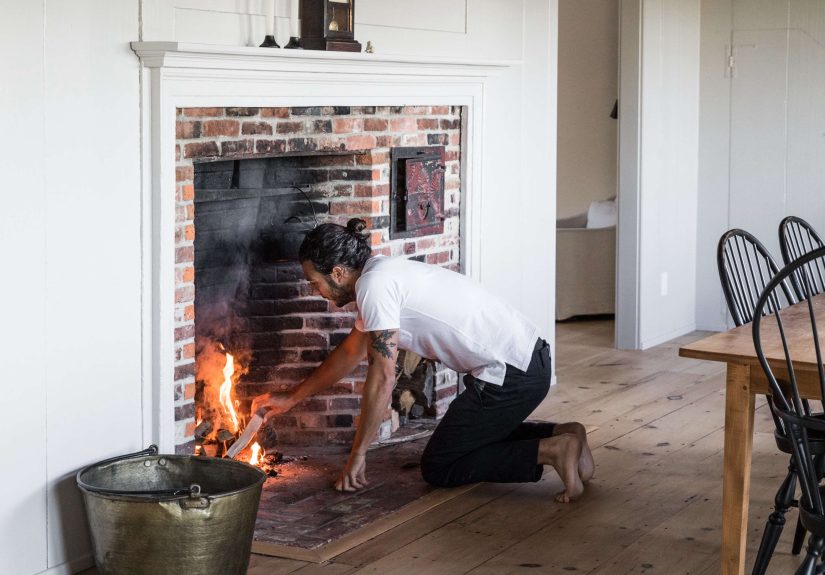
In the kitchen, copper pans hang from iron hooks fixed to timber rafters. Peg rails provide storage with Shaker-like efficiency. Original fireplaces, including cast iron doors, bring the hearth back to the center of the home. These choices work because they are useful, not theatrical. The room does not say, “Welcome to Colonial Theme Night.” It says, “Soup could happen here.”
The Smart Use of Color
The interior palette balances restraint and drama. Pale plaster and milk-painted walls keep the rooms bright, while darker trim adds definition. In a low-ceilinged antique Cape, this contrast helps the architecture read clearly without clutter. Dark doors and spindle-back seating connect to early American style, but the overall effect feels current because the palette is spare and the editing is strict.
This is a valuable lesson for anyone renovating an old house: historic character does not require covering every surface with antique objects. Sometimes the most respectful move is to create space around the original details so they can breathe.
Why Spruce Head, Maine Matters to the Design
Location is not background here; it is a co-author. Spruce Head is part of South Thomaston, located south of Rockland in Maine’s Midcoast region. The island is linked to a landscape of working wharves, lobster traps, spruce woods, narrow roads, summer visitors, and year-round fishing families. It is beautiful, yes, but not in a polished resort way. It is a place where the view may include lobster crates, pickup trucks, bait bags, skiffs, and someone who has been awake since an hour when only fishermen and overambitious bakers are functioning.
That working waterfront context gives the Cape its visual logic. Weathered materials make sense. Compact rooms make sense. Peg rails, dark paint, iron hooks, wool, linen, wood, and firelight make sense. A minimalist glass box might look impressive here for about twelve minutes, right until the fog rolled in and the house began to feel like it had arrived wearing the wrong shoes.
The Spruce Head Cape belongs to its site because it accepts Maine’s conditions instead of trying to outshine them. The house is humble enough for the landscape and strong enough to hold its own against it.
The Architecture of a Cape: Small House, Big Lessons
The Cape Cod house form originated in New England and was shaped by climate, available materials, and daily practicality. Early settlers adapted English building traditions to colder, stormier conditions. The steep roof helped shed snow and rain. The low profile reduced exposure to wind. The central chimney warmed adjacent rooms. The symmetrical facade made construction efficient and visually balanced.
In a full Cape, the front door typically sits in the center with windows arranged evenly on both sides. Smaller versions, such as half Capes and three-quarter Capes, often reflected budget and growth. A family might begin with a smaller structure and expand as money, children, or both arrived. This flexibility is part of why Capes spread across New England and remained beloved for centuries.
The 1754 Spruce Head Cape shows how adaptable the form still is. Its old rooms are intimate, but not cramped when furnished with discipline. Its low ceilings are cozy rather than limiting. Its preserved frame adds texture that no new build can instantly acquire. You can buy reclaimed beams, certainly, but you cannot rush 270 years of atmosphere. Time is the one luxury finish no showroom can ship in two weeks.
Interior Design Ideas Inspired by the 1754 Spruce Head Cape
You do not need to own an 18th-century house in coastal Maine to learn from this project. The design principles translate beautifully to newer homes, apartments, cabins, and even suburban spaces that currently suffer from what we might call “builder-grade beige fatigue.”
1. Let Architecture Lead
Before filling a room, study what is already there. Beams, windows, floorboards, doors, plaster texture, and ceiling height should guide the design. In the Spruce Head Cape, the old materials are not hidden behind furniture or busy accessories. They are the foundation of the room’s identity.
2. Choose Fewer, Better Pieces
Early American interiors did not rely on clutter. A Windsor settee, a simple table, a linen sofa, a dark chair, or a well-placed bench can do more than a room full of decorative objects. The key is proportion. Furniture should look like it belongs to the room, not like it wandered in from a luxury staging warehouse and is now quietly panicking.
3. Use Utility as Decoration
Peg rails, hanging pans, stacked firewood, baskets, hooks, and open shelves can be beautiful because they are useful. This is one of the great lessons of New England interiors: practicality often ages better than trendiness. A peg rail will not become embarrassing next season. A neon acrylic side table might need to think about its choices.
4. Embrace Imperfection
The floors do not need to be flawless. The walls do not need to look machine-made. The trim does not need to shout. Old houses teach us that character lives in slight irregularity. A room that is too perfect can feel airless; a room with honest texture feels human.
Old House Restoration: What This Project Gets Right
The Spruce Head Cape succeeds because it avoids two common traps: over-restoration and careless modernization. Over-restoration can make a house feel like a period film set where nobody is allowed to own a phone charger. Careless modernization can strip away the very features that made the house valuable in the first place.
Esteves took a middle path. He preserved what carried historic meaning, adjusted what needed to function better, and allowed the design to evolve. One major change was moving and rebuilding the main staircase, a practical intervention that improved the house without erasing its soul. That is the essence of sensitive adaptive reuse: respect the old structure, but do not pretend the people living there are reenactors waiting for the butter churn to come back into fashion.
For homeowners, the lesson is clear. Before renovating an old house, identify the irreplaceable elements. Original windows, fireplaces, flooring, paneling, doors, hardware, and framing may be worth saving even when they require patience. Modern systems can often be integrated quietly. The goal is not to make the house new. The goal is to help it keep living.
The “New New England” Aesthetic
New England style is often reduced to clichés: white clapboard, blue shutters, braided rugs, brass candlesticks, and perhaps a decorative anchor that has never met a boat. The Spruce Head Cape suggests something more interesting. The new New England is not about copying a catalog version of the past. It is about editing, preserving, and adding with intelligence.
This aesthetic is earthy but not rustic in a lazy way. It is historic but not fussy. It is minimal but not cold. It appreciates handmade objects, natural materials, old wood, dark paint, plaster, linen, iron, copper, and quiet geometry. It welcomes modern life without putting recessed lighting everywhere like the ceiling has broken out in tiny glowing pimples.
Most importantly, it respects place. In Maine, design works best when it acknowledges weather, work, salt air, darkness, and seasonal change. The Spruce Head Cape does not fight those realities. It turns them into atmosphere.
Experiences Inspired by “The New New England: A 1754 Cape on Spruce Head in Maine”
Spending time with a house like this, even through photographs and design reporting, changes the way you look at old spaces. It reminds you that a home does not need to be large to feel generous. In fact, smaller rooms often create a stronger sense of intimacy. A low-ceilinged kitchen with original windows can feel more memorable than an enormous open-plan room where the refrigerator is so far from the stove you may need trail mix for the journey.
The first experience this Cape evokes is slowness. Not laziness, but attention. You notice the grain of a floorboard. You notice how light lands on plaster. You notice the difference between a beam shaped by hand and a decorative beam installed because a mood board demanded “rustic vibes.” The house asks you to pay attention to materials, and in return it gives you calm.
The second experience is connection to place. Spruce Head is not just a scenic label. It is a working coastal community, and that matters. When you imagine returning to this Cape after walking along a road lined with spruce trees, lobster traps, weathered sheds, and glimpses of cold water, the interiors make emotional sense. The dark trim, iron hooks, copper pans, and old fireplaces feel like part of the same world outside the door.
The third experience is the pleasure of restraint. Modern homes often pressure us to keep adding: more storage, more lighting, more seating, more art, more clever devices, more things that beep for reasons nobody requested. This Cape argues for subtraction. Keep the useful. Keep the beautiful. Keep the original. Remove the rest. It is a surprisingly radical idea, especially in an era when even a toaster can have an app.
The fourth experience is family continuity. The Cape is part of a larger compound that includes the nearby Soot House, where Esteves lives with his family, while the restored Cape serves as a home for his mother. That arrangement gives the project warmth beyond aesthetics. The house is not a trophy. It is part of a living family landscape, with buildings in conversation across fieldstones. It brings to mind the old New England pattern of connected structures: big house, little house, back house, barn. Here, that tradition becomes personal, artistic, and contemporary.
The fifth experience is inspiration for real homeowners. You may not be able to relocate an 18th-century Cape to an island in Maine. Most of us have enough trouble relocating a sofa through a narrow hallway without questioning every decision we have ever made. But you can borrow the principles. Save what is authentic. Use natural materials. Choose colors that respond to the landscape. Make storage beautiful. Let rooms be cozy. Do not confuse luxury with excess.
Ultimately, the 1754 Cape on Spruce Head offers a deeply satisfying kind of design wisdom: a home becomes timeless not by ignoring change, but by changing carefully. It can hold history and still host dinner. It can preserve old windows and still welcome modern life. It can be modest and unforgettable at the same time. That is the quiet magic of this house, and perhaps the larger magic of Maine itself.
Conclusion: A Small Cape With a Large Design Lesson
The New New England: A 1754 Cape on Spruce Head in Maine is more than a house tour title. It is a philosophy. It shows how historic architecture can be renewed without being overwritten, how restraint can feel warmer than abundance, and how a house can belong fully to its landscape.
Anthony Esteves’s restoration succeeds because it honors the building’s original bones while allowing modern life to move through the rooms. The preserved hand-hewn frame, wide-plank floors, original windows, fireplaces, beadboard, and wainscoting give the Cape authenticity. The careful palette, edited furnishings, and practical updates give it freshness. Together, they create a home that feels old in the best way and new in the smartest way.
For anyone interested in Maine historic homes, Cape Cod architecture, coastal New England interiors, or old house restoration, this Spruce Head Cape is a masterclass in listening before changing. Sometimes the best design move is not to shout over the past, but to let it speak clearly, with a good fire going and maybe a copper pot or two hanging nearby for moral support.