Table of Contents >> Show >> Hide
- What Amazon’s New Hexagonal Drone Actually Is
- Why the Hexagonal Design Matters
- What the MK30 Can Do
- Why Amazon Thinks This Drone Changes the Delivery Business
- The Catch: A Better Drone Does Not Eliminate Real Problems
- The Experience of Amazon’s New Hexagonal Drone, From Checkout to Backyard
- Final Thoughts
Amazon has spent years trying to make drone delivery feel less like science fiction and more like a very impatient form of convenience. Its latest answer is the MK30, a compact Prime Air aircraft with a hexagonal layout, six propellers, fixed wings, and a very obvious mission: get small packages to customers fast without turning the neighborhood sky into a chaotic episode of a robot nature documentary.
If you have seen images of Amazon’s new hexagonal drone and thought, “That looks like a flying gadget from the future that also wants to deliver my toothpaste,” you are not entirely wrong. The MK30 is the company’s newest major Prime Air design, and it represents Amazon’s clearest attempt yet to fix the problems that have dogged drone delivery for years: noise, range, weather limitations, safety concerns, and the uncomfortable reality that people generally do not enjoy being buzzed by an airborne appliance before breakfast.
That is what makes this drone interesting. The MK30 is not just a shinier toy. It is Amazon’s latest serious bet on the future of last-mile delivery. It is quieter, built for a wider range of weather conditions, designed to reach more customers, and intended to work from Amazon’s broader fulfillment network rather than feeling like a side project parked out on the edge of town. In other words, this is not Amazon saying, “Look what we built.” It is Amazon saying, “Look what we think might actually scale.”
What Amazon’s New Hexagonal Drone Actually Is
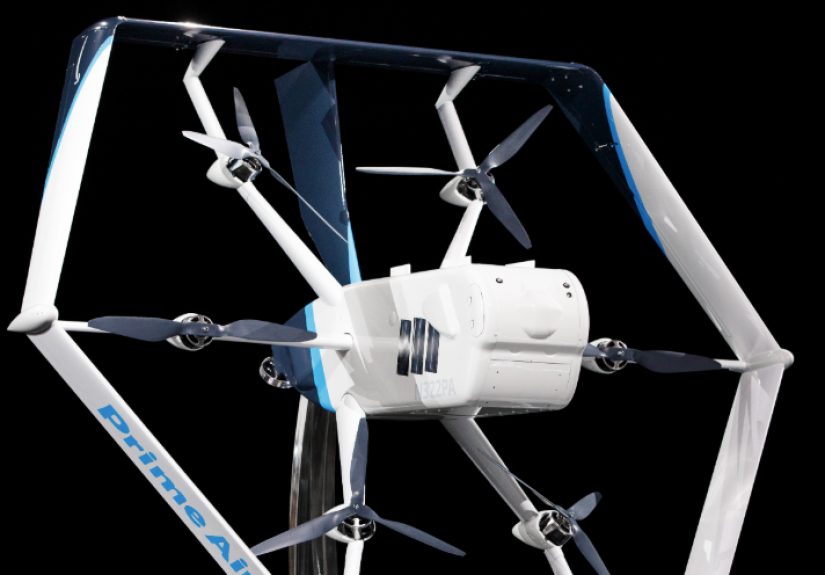
The drone most people are talking about is the Amazon MK30 drone, the newest widely deployed aircraft in the Prime Air drone program. Visually, it stands out because of its hexagonal structure. It has six propellers arranged around a central body, which gives it that unmistakable geometric look. It also combines vertical takeoff with wing-borne forward flight, meaning it can lift off like a multirotor and then cruise more efficiently once it is in motion. That design is a big reason Amazon believes it can go farther, fly smarter, and make its Amazon drone delivery service more practical.
Amazon has framed the MK30 as a full redesign rather than a minor update. Compared with earlier Prime Air aircraft, this version is smaller, lighter, and built with more refined “sense and avoid” technology. That matters because drone delivery only works if the drone can recognize obstacles, avoid people and property, and safely navigate real neighborhoods instead of idealized test maps where every backyard is perfectly tidy and no one ever leaves a trampoline in the wrong place.
The hexagonal delivery drone shape is also useful from a branding perspective. It looks distinct, futuristic, and easy to recognize in a crowded drone market. But the geometry is not just for show. Six rotors can help with lift, stability, and control, while the winged configuration makes the aircraft better suited to covering meaningful delivery distances. It is a practical design wrapped in a very sci-fi silhouette, which is a pretty classic Amazon move: engineering first, theater second, smile logo included.
Why the Hexagonal Design Matters
The phrase “hexagonal drone” sounds like marketing copy trying very hard to seem exciting, but in this case the shape really does tell you something important. Amazon did not build a little quadcopter and slap a delivery box on it. It built a six-propeller aircraft meant to survive the messy demands of real-world logistics. The hexagonal layout helps the MK30 look more stable, more capable, and more purpose-built than many of the smaller consumer drones people are used to seeing.
That matters because delivery drones have a tough image problem. To many consumers, they still feel like a novelty. To many regulators, they look like a risk. And to many neighbors, they sound like a leaf blower with ambition. Amazon clearly understands that if it wants people to trust drone delivery, the aircraft has to look less like a hobby machine and more like a serious transportation tool. The MK30’s design helps make that case.
There is also a practical urban and suburban angle here. Amazon has said the MK30 was designed with smaller backyards and denser residential areas in mind. That is a subtle but important point. Earlier drone delivery concepts often seemed better suited to wide-open land than actual neighborhoods. The new drone aims to fit into tighter delivery environments, which is exactly where Amazon needs it to work if same-day drone delivery is ever going to become more than a flashy pilot program.
What the MK30 Can Do
On paper, Amazon’s new drone is a notable step up from previous Prime Air models. The company says the MK30 can fly roughly twice as far as earlier versions, carry packages weighing up to five pounds, and complete deliveries in under an hour for eligible customers. That combination tells you almost everything about Amazon’s intended use case. This is not a drone for furniture, bulk grocery hauls, or your suspiciously large impulse buys at 1:12 a.m. It is for smaller, high-urgency items: household essentials, personal care products, office supplies, pharmacy orders, and other things customers want quickly enough to justify sending a robot through the sky.
Amazon has also emphasized the drone’s lighter noise footprint. Depending on which Amazon material you read, the company describes the MK30 as dramatically quieter than previous generations, with newly designed propellers reducing perceived noise by around half. That is not a small engineering footnote. It is one of the most important claims Amazon can make, because noise is one of the biggest barriers to public acceptance. A drone that saves ten minutes but irritates an entire neighborhood is not the future of convenience; it is just a louder problem.
Weather is another major improvement. Amazon says the MK30 is built to handle light rain and a wider range of conditions than earlier drones. That may sound boring until you remember how many delivery promises fall apart the moment the weather stops behaving. A drone service that only works on postcard-perfect days is more demo than infrastructure. If the MK30 can operate reliably in less-than-ideal conditions, Amazon moves closer to turning Prime Air into a real logistics layer rather than a headline generator.
Safety Is the Whole Game
Amazon has spent a great deal of time talking about safety, and that is not surprising. Any company trying to fly autonomous machines over homes, roads, pets, patios, and human beings needs to make safety the centerpiece of the story. The MK30 uses onboard detection and avoidance systems, and Amazon has said it performed rigorous testing and worked closely with the Federal Aviation Administration to prove the aircraft could safely navigate around obstacles and other air traffic.
One of the biggest milestones for Prime Air was FAA approval for operations beyond visual line of sight in College Station, Texas. That phrase sounds technical because it is technical, but the meaning is simple: it allows operators to fly drones farther without maintaining direct visual contact the whole time. For a business built around reaching more customers across wider areas, that approval is a very big deal. It is the difference between a limited demonstration and a service with room to grow.
Why Amazon Thinks This Drone Changes the Delivery Business
The real story behind Amazon’s new hexagonal drone is not the hardware itself. It is the strategy. Amazon is trying to integrate drone operations into its existing logistics system, including same-day facilities and fulfillment infrastructure. That matters because delivery only becomes scalable when it is woven into a broader network. Building one flashy drone site is a proof of concept. Linking drone launches to Amazon’s enormous retail machine is a business model.
This is why the MK30 feels more consequential than earlier Prime Air designs. It is meant to fit into Amazon’s operational rhythm. In Arizona, for example, Amazon has promoted access to tens of thousands of eligible items for customers in service areas. In Texas, it has highlighted fast delivery for pharmacy orders. That suggests the company is narrowing in on where drone delivery makes the most sense: small items, quick turnaround, high customer urgency, and short-distance fulfillment near metro areas.
There is also a bigger competitive angle. Retailers, tech companies, and logistics firms have all flirted with drone delivery, but Amazon has the advantage of already owning a massive order ecosystem. If it can make the economics and regulations work, it does not need to create demand for the service from scratch. People are already shopping there. The drone simply becomes another delivery option, tucked into checkout like express shipping with extra propellers.
The Catch: A Better Drone Does Not Eliminate Real Problems
Now for the part where the futuristic music fades a little. The MK30 may be more advanced, but drone delivery still faces familiar obstacles. Regulation remains complicated. Weather still matters. Noise complaints have not magically disappeared. And public trust is fragile, especially when residents feel like their neighborhood is doubling as a test lab for aviation software.
Some of the most revealing reporting on Prime Air has focused not on the drone’s specifications, but on how communities react once the novelty wears off. That is where the debate becomes more grounded. One person sees convenience. Another hears constant buzzing. One homeowner likes the innovation. Another wonders whether the sky above the backyard is slowly becoming a commercial lane. Amazon’s newer drone appears to have improved that equation, especially on noise, but it has not erased the tension entirely.
That tension is important because it shapes what success will actually look like. The future of Amazon drone technology will not be decided only by engineering wins. It will also depend on where the drones launch, how often they fly, how transparent Amazon is with local communities, and whether the service feels genuinely helpful instead of merely impressive. The MK30 solves several hardware problems. It does not solve the whole social contract.
The Experience of Amazon’s New Hexagonal Drone, From Checkout to Backyard
What does all of this mean in practice? The most interesting part of the MK30 story may be the human experience around it. For customers, the appeal is obvious. You place an order for a small item, select a delivery point, and instead of waiting all day for a van, a drone arrives in a much tighter window. There is something undeniably futuristic about that, but also something very ordinary in the best possible way. Amazon is not selling drone delivery as a stunt. It is selling it as a faster route to everyday essentials.
Imagine the customer side of the experience. You are not ordering a sectional sofa or a year’s supply of sparkling water. You are ordering something small and urgent enough to matter now: over-the-counter medicine, office supplies before a deadline, a forgotten household basic, or a last-minute personal care item. The drone shows up, descends into a designated drop area, releases the package, and moves on. No awkward missed-delivery note. No vague “arriving by 10 p.m.” limbo. No staring out the window like you are waiting for a very unreliable celebrity.
For Amazon, that experience is the whole promise of Prime Air. Speed is nice, but certainty is even better. The MK30 supports an idea Amazon has wanted for years: not just fast delivery, but fast delivery that feels targeted, efficient, and almost frictionless. If the company gets the service right, the drone becomes less of a spectacle and more of an invisible convenience layer. The weirdest thing about the future, after all, is that once it works, people stop calling it the future.
But there is another side to the experience, and it is just as important. Neighbors experience drone delivery differently from customers. They may not be getting the package, but they are definitely getting the sound. Even with a much quieter aircraft, repeated flights can change how a place feels. That is why Amazon’s improvements on noise and flight behavior matter so much. The MK30 is not just designed to please customers; it is designed to reduce friction with everyone else who did not ask to live next to an aviation experiment.
There is also the experience of trust. Most people do not care what a drone’s model number is. They care whether it seems safe, whether it respects their space, and whether it becomes an annoyance. That is why Amazon keeps emphasizing its detect-and-avoid systems, safety testing, weather screening, and regulatory approvals. Those details are not there for drone nerds alone. They are there because ordinary people need a reason to believe the machine above their yard knows what it is doing.
Then there is the experience from Amazon’s point of view, which is really the experience of logistics pressure. The company is trying to make the last mile faster, more efficient, and less expensive to serve over time. The MK30 represents a shot at building a delivery option for the narrow but valuable category of small, time-sensitive orders. If it works, Amazon gets a new competitive advantage. If it does not, the hexagonal drone becomes another very expensive reminder that the sky is harder to optimize than a warehouse aisle.
That is why the MK30 matters more than its futuristic shape might suggest. It sits at the intersection of convenience, regulation, neighborhood life, automation, and retail economics. It is a piece of aerospace engineering, yes, but it is also a test of how much modern consumers want speed, how much communities are willing to tolerate in exchange for convenience, and how far a company can push automation before the public asks for a little more quiet and a little less buzz.
Final Thoughts
Amazon’s new hexagonal drone is not just an eye-catching redesign. The MK30 is the clearest sign yet that Prime Air has moved beyond experimental hype and into a more practical phase. It is quieter, smarter, more weather-tolerant, and better aligned with Amazon’s broader delivery network. That does not mean drone delivery has fully arrived, and it certainly does not mean every neighborhood is about to become an air corridor for toothpaste and paper clips. But it does mean Amazon now has a more credible aircraft for the job.
If the MK30 succeeds, it will not be because it looks futuristic. It will be because it makes fast delivery feel normal, safe, and useful. And that is the real test. A good delivery drone should not just impress you. It should do its job so smoothly that, after a while, the strangest thing about it is how quickly you stopped thinking it was strange at all.

![18 Best Types of Charts and Graphs for Data Visualization [+ How to Choose]](https://corkopencoffee.org/wp-content/uploads/2026/05/18-best-types-of-charts-and-graphs-for-data-visualization-how-to-choose-qKM1PBYG-thumb.jpg)