Table of Contents >> Show >> Hide
- Why Titan Is One of the Most Remarkable Moons in the Solar System
- Titan’s Surface: Dunes, Rivers, Lakes, and Alien Shorelines
- What Might Be Hiding Under Titan’s Crust?
- Orbital Expansion: Why Titan Is Drifting Away from Saturn
- How Missions Turned Titan from Mystery to Target
- Why Titan Keeps Pulling Scientists Back In
- Experiencing Titan: A Long Thought Experiment About Standing on a Moon That Is Slowly Escaping
- Conclusion
If Saturn is the solar system’s show-off, Titan is the fascinating friend standing just offstage, wearing an orange haze and quietly doing the weirdest science in the room. It has rivers, lakes, seas, rain, dunes, seasons, and a thick atmosphere. That sounds suspiciously Earth-like until you remember the “water” is mostly methane and ethane, the temperature is cold enough to make a freezer look tropical, and the surface chemistry is basically a graduate seminar in organic molecules.
Titan matters because it sits at the intersection of planetary science, climate science, chemistry, and pure cosmic drama. It is Saturn’s largest moon, the second largest moon in the solar system, and one of the most compelling places scientists have ever studied. In recent years, Titan got an extra twist in its story: researchers found that its orbit is expanding faster than expected. In simple terms, Titan is slowly moving farther away from Saturn, and that surprising drift is forcing scientists to rethink how moons and giant planets evolve over billions of years.
This article explores what makes Titan extraordinary, what “orbital expansion” actually means, why researchers got excited about a moon moving away at a pace slower than a garden snail and yet shockingly fast by celestial standards, and why NASA’s Dragonfly mission could turn Titan from a favorite mystery into a full-blown scientific obsession.
Why Titan Is One of the Most Remarkable Moons in the Solar System
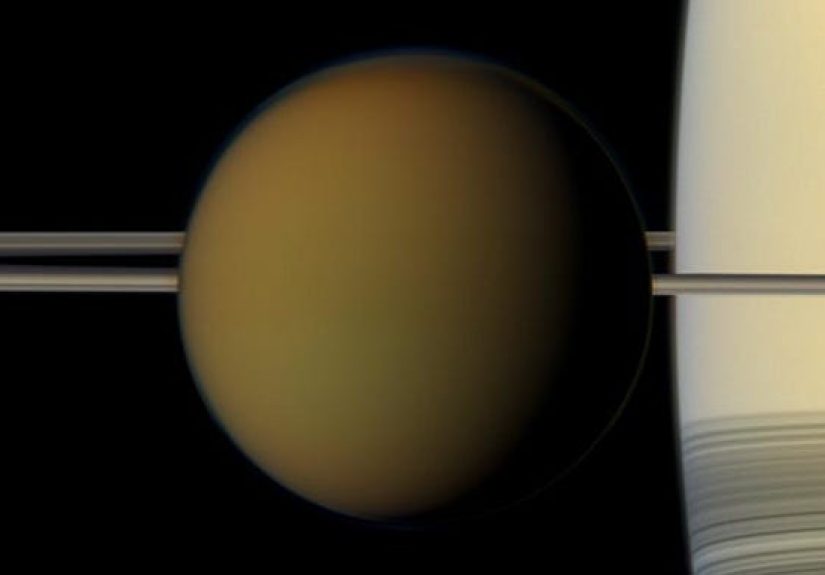
Titan is not just big. It is giant by moon standards. With a radius of about 1,600 miles, it is bigger than Earth’s moon and even larger than Mercury by diameter, though not by mass. It orbits Saturn at roughly 759,000 miles and takes 15 days and 22 hours to make one trip around the ringed planet. Like our own Moon, Titan is tidally locked, so the same face always looks toward Saturn. In other words, Titan has commitment issues in only one direction.
What really sets Titan apart is its atmosphere. It is the only moon in the solar system with a truly thick atmosphere, and that atmosphere is mostly nitrogen with a notable dose of methane. Surface pressure on Titan is actually greater than Earth’s, which means it is not some bare rock drifting in silence. It is a world with weather, haze, clouds, and a chemistry lab running in the sky 24 hours a day.
Titan Has an Earth-Like Weather Cycle, Just With Stranger Ingredients
Earth has a water cycle. Titan has a methane cycle. That one difference changes everything while also making Titan feel weirdly familiar. Methane and ethane can evaporate, condense into clouds, fall as rain, carve channels, and collect in lakes and seas. So when scientists describe Titan as Earth-like, they do not mean you should pack a hoodie and hiking boots. They mean the moon has active surface-atmosphere exchanges that resemble hydrology, only with hydrocarbons stepping into water’s role.
This is a big reason Titan keeps showing up in astrobiology conversations. It offers a natural laboratory where complex organic chemistry is happening at scale. Sunlight and energetic particles break apart molecules in the upper atmosphere, and those fragments recombine into a rich mix of organic compounds. Some settle onto the surface. Some participate in atmospheric reactions. All of it adds up to a world that may preserve clues about the kinds of chemistry that preceded life on early Earth.
There is one catch, and it is a frosty one. Titan’s surface temperature hovers around minus 290 degrees Fahrenheit. At that temperature, water behaves like rock. It is not flowing in streams or pooling in lakes. Instead, ice can act like bedrock, and methane becomes one of the major working fluids that shapes the landscape. It is the sort of place where geology and chemistry feel like they traded costumes.
Titan’s Surface: Dunes, Rivers, Lakes, and Alien Shorelines
Before the Cassini-Huygens mission, Titan was mostly known as a hazy orange mystery. Then the data arrived, and Titan transformed from “interesting blob” into one of the richest worlds in planetary science. Cassini revealed lakes and seas of liquid methane and ethane near the poles, broad dark dune fields near the equator, river channels, changing weather, and a landscape shaped by active processes rather than frozen stillness.
The polar regions are especially dramatic. Titan’s northern hemisphere contains large hydrocarbon seas, including Kraken Mare, a name that sounds fictional but is very real and appropriately intimidating. Radar observations confirmed that many of Titan’s dark polar patches were not optical tricks or wishful thinking; they were genuine liquid-filled depressions. That discovery alone made Titan historic, because it established the only known stable bodies of surface liquid beyond Earth.
Then there are the dunes. Titan’s equatorial regions host vast fields of long linear dunes made of dark hydrocarbon grains. NASA has described them in a way that makes them sound almost domestic: the material may resemble coffee grounds. That is adorable until you remember the “coffee grounds” are on a moon orbiting Saturn under a thick orange sky. These dunes also tell scientists that Titan’s winds, surface conditions, and sediment transport have been active over long timescales.
The Huygens probe, which landed on Titan in January 2005, gave researchers their first direct look from the surface of a moon in the outer solar system. During descent, it photographed branching channels and terrain that suggested flowing liquid had shaped the land. On the ground, it found a landscape that looked eerily familiar in structure but utterly alien in substance: rounded icy pebbles, a flattened plain, and the afterglow of a world where methane does some of the sculpting that water does on Earth.
What Might Be Hiding Under Titan’s Crust?
For years, one of the most exciting ideas about Titan was that it might hide a global subsurface ocean of liquid water, likely mixed with salts and ammonia, beneath its icy shell. Cassini gravity data and Huygens radio measurements supported that view, and it helped elevate Titan into the category of “ocean world,” one of the prime labels in modern planetary science.
But science loves a plot twist. A 2025 reanalysis argued that Titan may not have a fully global ocean after all. Instead, the interior may be slushier and more layered, with isolated pockets of liquid water rather than one huge continuous ocean. That does not make Titan less interesting. If anything, it makes the moon more complicated and scientifically richer. Instead of a clean textbook cross-section, Titan may be an interior mess of ice, slush, warmth, and localized chemistry.
That uncertainty matters for habitability. Liquid water is still one of the biggest markers scientists look for when assessing whether an environment could support life as we know it. If Titan has pockets of liquid water interacting with organics from above and rocky material from below, that is still a compelling setup. It just means the internal plumbing may be more eccentric than earlier models assumed.
Orbital Expansion: Why Titan Is Drifting Away from Saturn
Now for the phrase that sounds like a rock band and a physics exam had a child: orbital expansion. In Titan’s case, it simply means the moon’s orbit around Saturn is gradually getting larger over time. Titan is not about to pack up and leave the neighborhood tomorrow, but it is moving outward.
Why does that happen? Tidal interactions. Titan’s gravity pulls on Saturn. Saturn’s gravity pulls on Titan. Those forces create distortions, and the energy involved does not stay perfectly neat and orderly. Some of it gets dissipated through internal friction. When the timing of those interactions works a certain way, angular momentum can be transferred so that the moon migrates outward.
The Surprise Was the Speed
Scientists used Cassini data and found that Titan is moving away from Saturn at about 11 centimeters per year. That might sound laughably small until you compare it with older expectations. Standard theories had suggested Titan’s outward drift should be at most about 0.1 centimeter per year. So the observed rate was not just a little off. It was more than 100 times faster than expected.
That result changed the conversation. Suddenly Titan was not merely a moon with cool lakes. It was also a clue to Saturn’s internal behavior and the long-term evolution of the whole Saturnian system. If Titan is migrating outward this quickly, then Saturn must be dissipating tidal energy more efficiently than older models assumed, or the system must be hitting a resonance effect that boosts the process.
Resonance Locking: The Leading Explanation
One of the most important ideas in this story is resonance locking. Think of it as a timing match between Titan’s gravitational tug and natural oscillations inside Saturn. When those frequencies line up in the right way, Saturn can absorb and dissipate more energy than simple models predict. That extra energy loss can help drive Titan outward faster.
This is the kind of concept that sounds abstract until you realize what it means in plain English: Titan is not just orbiting Saturn. It is participating in a long, subtle energy exchange with the planet’s interior. The moon and the giant planet are effectively in a dynamic relationship, and Saturn’s internal structure may be leaving fingerprints on Titan’s orbit.
Later work on Titan’s tidal dissipation and spin state added more nuance, suggesting that Titan itself may also be dissipating energy significantly. That matters because orbital expansion is not only about where Titan is now. It is about how Titan got there, how fast its orbit has evolved over geologic time, and what that history says about both Titan and Saturn.
Why Orbital Expansion Matters Beyond Titan
This is not just a niche footnote for people who collect moon trivia. Titan’s fast outward migration may help explain why Saturn is tilted the way it is. Some studies have linked Titan’s migration to changes in Saturn’s spin-axis evolution, meaning the moon’s orbit could have influenced the planet’s present obliquity. That is a big deal. A moon may have helped shape how a giant planet leans in space.
More broadly, Titan’s orbital expansion gives scientists a valuable real-world test for theories about tides, planetary interiors, and moon formation. If old models underpredicted Titan’s migration by that much, then similar processes around other planets, exoplanets, or giant-moon systems may also need a second look.
How Missions Turned Titan from Mystery to Target
The Cassini-Huygens mission rewrote Titan science. Cassini orbited Saturn and repeatedly observed Titan through instruments that could pierce or work around its haze. Huygens detached, descended by parachute, and became the first probe to land in the outer solar system. Together, they gave us Titan not as a blurry orange marble but as a climate system, a geological world, and a chemistry experiment all in one.
The next big leap is Dragonfly, NASA’s rotorcraft mission to Titan. Scheduled for launch in July 2028 with arrival in late 2034, Dragonfly is designed to fly from site to site across Titan’s surface. That mobility is the mission’s superpower. Instead of studying one landing area like a stationary probe, Dragonfly is expected to hop across dunes and reach geologically interesting locations such as Selk Crater.
Dragonfly will not be a life-detection mission in the movie-poster sense. It is not flying to Titan to dramatically hold up a sign that says “Aliens confirmed.” Its real goal is more scientifically powerful: to investigate habitability, prebiotic chemistry, and the kinds of compounds and processes that may resemble the chemistry that came before biology on Earth. On Titan, that is more than enough excitement for one robot.
Why Titan Keeps Pulling Scientists Back In
Titan feels like several worlds at once. It is a moon, but it has the atmospheric complexity of a planet. It is freezing cold, yet its surface is active. It looks alien, yet many of its processes feel familiar. It may hold clues about early-Earth chemistry, but it also forces researchers to rethink ocean worlds, tidal physics, and planetary evolution.
Its orbital expansion only adds to the intrigue. A moon that is chemically rich, meteorologically dynamic, and geologically active would already earn a permanent place on every planetary scientist’s shortlist. Add the fact that it is migrating away from Saturn far faster than expected, and Titan stops being just another interesting moon. It becomes a system-level puzzle piece that could help explain Saturn’s past and sharpen theories about how giant planets and their moons coevolve.
Experiencing Titan: A Long Thought Experiment About Standing on a Moon That Is Slowly Escaping
Imagine arriving on Titan, not as a rushed probe but as a patient observer with time to absorb the place. The first thing you would notice is not silence, but thickness. Titan’s atmosphere would give the world a strange intimacy. Light would filter through orange haze, softening distances and muting the horizon. Saturn would loom larger in the sky than our Moon does from Earth, and the whole landscape would feel like a familiar dream rewritten in a colder language.
You would stand on ground where water is stone. That alone is enough to make the mind wobble a little. The pebbles underfoot could be water ice, rounded by ancient liquid flows, yet hard as rock in the deep cold. The air would be mostly nitrogen, the weather driven by methane, and the terrain shaped by liquids that on Earth belong in fuel tanks and chemistry labs. Titan would not feel like a dead ice ball. It would feel active, patient, and deeply strange.
If you visited one of the dune fields, the scene might look oddly desert-like. Ridges of dark material would stretch across the land in disciplined lines, as though a giant cosmic rake had been dragged across the equator. But the comparison would only get you so far. These would not be earthly sands warmed by sunlight. They would be organic grains in a place where the weak distant Sun barely lights the day. The familiarity would keep dissolving every time you tried to settle into it.
Now imagine reaching Titan’s polar lakes. The shore would not sparkle like a summer beach. It would lie under a dim sky with liquid methane and ethane resting in broad calm basins. The idea of a “sea” would suddenly expand in your mind. You would realize that a sea is not defined by Earth’s chemistry. It is defined by process: liquid collecting, moving, evaporating, raining, shaping land, and cycling through a world. Titan teaches that lesson beautifully.
Then comes the truly humbling part. While you stand there in this orange-lit stillness, Titan is not fixed. It is in motion in multiple ways at once. It circles Saturn. It keeps one face turned toward the planet. It rides through seasons that last more than seven Earth years. And over immense stretches of time, it is drifting outward, centimeter by centimeter, through orbital expansion. No human standing there would feel that motion directly. There would be no dramatic lurch, no cinematic pull. The drift would be invisible, and that makes it more profound.
Titan’s slow escape from Saturn is a reminder that some of the most important changes in the universe happen without spectacle. Mountains erode grain by grain. Orbits widen by centimeters per year. Interiors warm, cool, flex, and dissipate energy over ages far longer than human history. On Titan, you would feel small not because the landscape is loud, but because it is patient. The moon would teach scale the hard way.
And yet Titan would not feel cold in the emotional sense. It would feel generous to curiosity. Every scene would invite comparison. Every comparison would fail just enough to teach you something new. A beach that is not a beach. Rain that is not rain as we know it. Rocks that are frozen water. Seas that are liquid hydrocarbons. A moon that behaves a little like a planet. An orbit that quietly expands. Titan is the sort of place that makes science feel less like memorizing facts and more like learning a new way to see.
That may be the real experience Titan offers even from millions of miles away. It expands the imagination the same way its orbit expands around Saturn: slowly, steadily, and more powerfully than you expect at first glance.
Conclusion
Titan is one of the solar system’s great masterpieces of complexity. It is a nitrogen-rich moon with methane weather, hydrocarbon seas, organic chemistry, and a surface that looks hauntingly Earth-like while operating by very different rules. It may hide liquid water deep below, though the details of that interior are now under active debate. And on top of all that, Titan is moving away from Saturn faster than scientists once thought possible.
That combination is exactly why Titan remains irresistible. It is not just a destination. It is a test case for climate, chemistry, planetary interiors, tidal physics, and the long arc of orbital evolution. As Dragonfly moves toward launch, Titan is poised to become even more important. The moon already taught us that alien worlds can feel strangely familiar. Its orbital expansion adds a final elegant twist: even in the cold outer solar system, nothing truly stands still.