Table of Contents >> Show >> Hide
- 1. Giraffes Have the Same Number of Neck Bones as Humans
- 2. Their Hearts Work Like Heavy-Duty Industrial Pumps
- 3. Their Spots Are More Than Fashion
- 4. Their Tongues Look Like They Belong in a Fantasy Novel
- 5. Giraffes Barely Sleep
- 6. They Hum at Night
- 7. Baby Giraffes Enter the World With a Built-In Plot Twist
- 8. Their “Horns” Are Not Really Horns
- 9. One of the Wildest Giraffe Stories Involves a Real-Life Rescue Mission
- 10. Giraffes Are Famous, but They Have Also Faced a “Silent Extinction”
- More Giraffe Experiences: What These Giants Feel Like in Real Life
- Conclusion
Giraffes look like somebody built a horse, a crane, and a watercolor painting in the same workshop and then forgot to stop. They are instantly recognizable, ridiculously tall, and somehow still full of surprises. Most people know the basics: long neck, spotted coat, safari superstar. But once you look closer, giraffes stop being “those tall animals” and start looking like one of nature’s strangest engineering triumphs.
This article dives into the top 10 unusual facts and stories about giraffes, from their high-pressure cardiovascular system to their midnight humming, weirdly elegant births, and real conservation rescue missions. If you thought giraffes were just quiet leaf enthusiasts with exceptional posture, prepare to be pleasantly corrected.
1. Giraffes Have the Same Number of Neck Bones as Humans
Let’s begin with the fact that sounds fake, but isn’t. Giraffes and humans both have seven neck vertebrae. The difference is that giraffe vertebrae are massively elongated. So while your neck bones quietly mind their own business, a giraffe’s are out there doing skyscraper work.
This is one of the most unusual facts about giraffes because it completely flips the obvious assumption. You would think an animal with a neck that can peer over shrubs, treetops, and probably your life choices would have dozens of extra bones. Nope. Same count, bigger design.
The neck is not just for height, either. It helps giraffes browse on leaves other animals cannot reach, keep watch across open savannas, and compete with rivals in dramatic “necking” contests. In other words, the giraffe neck is part buffet tool, part lookout tower, part medieval weapon.
2. Their Hearts Work Like Heavy-Duty Industrial Pumps
If giraffes win the award for “most likely to make a cardiologist stare in disbelief,” it is well deserved. A giraffe’s head can rise roughly six meters above the ground, which means its heart has to pump blood uphill to the brain without causing disaster every time the animal lowers its head to drink.
That challenge has led to one of the most fascinating anatomical stories in the animal kingdom. Giraffes have very high blood pressure, thick heart muscle, and specialized systems in their neck and blood vessels that help regulate circulation. Their hearts are also impressively large, weighing around 25 pounds. In humans, that kind of pressure would be terrible news. In giraffes, it is Tuesday.
This is not just an interesting zoo fact. Scientists have studied giraffe cardiovascular biology because it may offer clues about human blood pressure, heart stiffness, and circulation problems. So yes, the world’s tallest mammal might also be quietly contributing ideas to future medicine. Not bad for an animal best known for eating leaves dramatically.
3. Their Spots Are More Than Fashion
Giraffe coats are beautiful, but they are not just decorative. Their spot patterns can help with camouflage, especially for calves, and researchers have also explored how the patches may help with temperature regulation. Some evidence suggests the darker patches are associated with blood vessel networks that help release excess heat.
That means giraffe spots may work like a built-in cooling system. Nature basically looked at a 19-foot animal standing in African heat and said, “We should probably install climate control.”
There is also a family story hidden in those markings. Research on wild giraffes has shown that some aspects of spot shape are inherited from mothers. In other words, giraffe calves do not just inherit height potential and dramatic eyelashes. They inherit their visual signature, too.
Even better, each giraffe’s markings are unique. No two patterns are exactly the same. That gives every giraffe a sort of natural ID card, which helps researchers track individuals in the wild and gives the species even more personality than it already had.
4. Their Tongues Look Like They Belong in a Fantasy Novel
A giraffe tongue can reach around 20 to 21 inches long, and it is often dark purple, blue-black, or nearly black. That color likely helps protect it from sun exposure while the animal feeds for long stretches every day. Since giraffes spend hours wrapping their tongues around branches and plucking leaves from thorny trees, a little built-in protection is a smart move.
And that is only part of the story. Giraffe tongues are prehensile, which means they can grip and manipulate food with surprising precision. Add thick saliva to the equation, and you get a feeding tool that can handle prickly acacia branches better than most people handle a grocery receipt.
This odd combination of length, color, toughness, and dexterity makes the giraffe tongue one of the most unusual animal adaptations on the planet. It is equal parts elegant and slightly ridiculous, which is honestly a very giraffe-like combination.
5. Giraffes Barely Sleep
Some animals hibernate. Some curl up for long afternoon naps. Giraffes, meanwhile, operate like they are permanently behind on sleep and pretending everything is fine.
In the wild, giraffes are among the land mammals that sleep the least. They may get by on as little as about 30 minutes of sleep a day, often in tiny naps rather than one long, luxurious snooze. This makes sense when you remember they are large prey animals living in places where lying down can make them vulnerable.
Giraffes can rest while standing, and when they do lie down for deeper sleep, they may curl their necks back and rest their heads on their bodies. It is a pose that looks both peaceful and mildly impossible. If yoga instructors could do that, they would never stop talking about it.
The short-sleep story also reveals something bigger about giraffe survival. Their whole lifestyle is shaped by alertness. Height helps them spot danger. Group behavior helps them stay aware. Even rest is handled with caution.
6. They Hum at Night
For years, people assumed giraffes were mostly silent. That made a certain amount of sense: long neck, unusual airway structure, not exactly your classic opera singer build. But recordings changed the story.
Researchers found that giraffes produce low-frequency humming sounds at night. Scientists are still learning what those vocalizations mean, but the discovery showed that giraffes do, in fact, have a quieter communication system than many people realized.
This is one of those stories that makes giraffes feel even stranger in the best possible way. The tallest land mammals on Earth spend the nighttime hours softly humming in the dark. That sounds like a detail invented by a children’s book author trying very hard to win an award, yet it is grounded in actual observation.
The exact function of the humming is still being explored. It may help maintain contact, communicate state or identity, or serve another social purpose. Whatever the answer turns out to be, it is a reminder that animals we think we know well can still keep wonderful secrets.
7. Baby Giraffes Enter the World With a Built-In Plot Twist
A giraffe birth is one of nature’s more shocking openings. Mothers usually give birth standing up, so the calf drops to the ground as it arrives. Then, often within about 30 minutes, that newborn is already trying to stand.
This sounds harsh until you understand the logic. Giraffe calves are born into a world full of predators, and they need to get moving fast. They are what biologists call precocial, meaning they are relatively well developed at birth. A baby giraffe is not tiny, helpless, and pink like a cartoon newborn. It is basically a wobbly mini-adult on stilts.
That first standing attempt is one of the most extraordinary stories in giraffe life. There is no gentle warm-up period. No long philosophical debate. Just gravity, urgency, and an almost immediate crash course in using absurdly long legs.
It is one of the clearest examples of how giraffe evolution has been shaped by survival pressure. The calf’s first day is not a soft launch. It is a speed run.
8. Their “Horns” Are Not Really Horns
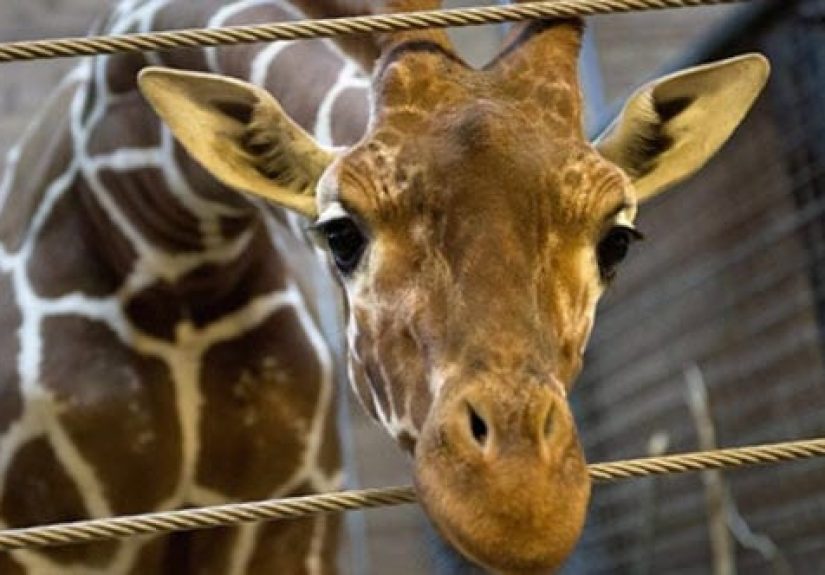
Those fuzzy knobs on a giraffe’s head are called ossicones, and they are different from true horns or antlers. At birth, they lie flat and are not yet fused to the skull, which helps protect both mother and calf during delivery. Later, they harden and become attached.
That alone is unusual enough, but it gets better. In males, ossicones can become more worn or bald at the tips from fighting. Mature males may also develop extra bony growths on the skull, making them look like they accidentally wandered out of a prehistoric concept sketch.
So the next time someone says giraffes have horns, you can politely say, “Actually, those are ossicones,” and enjoy the rare but satisfying thrill of being the most giraffe-informed person in the room.
9. One of the Wildest Giraffe Stories Involves a Real-Life Rescue Mission
Not all unusual giraffe stories are about anatomy. Some are about conservation, logistics, and human determination.
In Uganda, rare giraffes have been moved in carefully managed translocation operations to help create safer, more stable populations. These missions involved veterinarians, wildlife authorities, specially designed transport systems, and more planning than most people put into moving house.
One major effort moved Nubian giraffes from Murchison Falls National Park to Kidepo Valley National Park. The goal was to reduce risk and build additional strongholds for the population. The encouraging part is that calves were later observed in some of these new or reinforced populations, showing that relocation can support real recovery when it is done well.
There is something powerful about that story. Giraffes often seem calm, almost serene, but their future has depended on bold action. Behind the graceful silhouette is a species that has needed helicopters, field teams, research, and long-term planning just to keep walking across the landscape.
10. Giraffes Are Famous, but They Have Also Faced a “Silent Extinction”
This may be the most surprising giraffe fact of all: because giraffes are so recognizable, many people assume they are doing fine. For years, conservationists warned that this familiarity created a misleading sense of security.
Giraffe populations declined significantly across much of Africa, driven by habitat loss, fragmentation, poaching, and human expansion. Some scientists and conservation groups described the trend as a silent extinction because it received far less public attention than declines in elephants or rhinos.
There is some hope in the story, though. More recent surveys have suggested higher total numbers than earlier estimates, thanks partly to improved census work and conservation gains in some regions. That does not mean the problem is solved. It means giraffe conservation is complicated: some populations are improving, while others remain under serious threat.
That tension makes giraffes even more important to understand. They are not just icons of the African savanna. They are a conservation story still being written.
More Giraffe Experiences: What These Giants Feel Like in Real Life
Reading giraffe facts is one thing. Standing near giraffes, watching giraffes, or even just paying close attention to how they move is something else entirely. The experience is hard to forget because giraffes challenge your sense of proportion. Their legs seem too long. Their necks seem too high. Their movement looks too smooth for an animal that appears to have been assembled from leftover parts at the last minute.
One of the first things people notice when observing giraffes is how quiet they seem. Even in a zoo setting, they often move with a kind of floating calm. They do not stomp around like they need to prove anything. They simply stride past, as if being fifteen to nineteen feet tall is no big deal and everyone else is overreacting.
Then there is the feeding behavior. Seeing a giraffe use its tongue up close is unforgettable. It reaches, curls, wraps, and strips leaves with an almost hand-like precision. The contrast is hilarious and impressive at the same time. Here is this impossibly elegant animal, and suddenly its tongue is doing the work of a careful gardener and a lock pick.
Watching calves adds another layer. Young giraffes look like they are still negotiating with gravity. Their legs seem slightly too ambitious for the rest of their bodies. Yet within that awkwardness, you can already see the blueprint of the adult animal: alert eyes, patterned coat, and that unmistakable vertical confidence.
There is also a strange emotional effect giraffes have on people. They often trigger wonder more than fear. Lions look powerful. Rhinos look armored. Giraffes look improbable. They make people smile first and ask questions second. That charm may be part of why giraffes matter so much in public imagination, but it can also hide how biologically complex they are and how vulnerable some populations have become.
Perhaps the strongest experience connected to giraffes is the realization that they are both familiar and mysterious. We recognize them instantly, yet many people do not know they hum at night, sleep very little, have specialized blood-pressure systems, or may be divided into multiple distinct species. The more you learn, the stranger and more impressive they become.
In that way, giraffes reward curiosity. They are not just tall mammals with spots. They are a living lesson in evolution, adaptation, and survival. They remind us that the natural world does not always build creatures in tidy, predictable ways. Sometimes it creates a leaf-eating giant with a dark tongue, fuzzy ossicones, a huge heart, and a nighttime hum, and somehow that design works beautifully.
Conclusion
Giraffes are more than the tallest animals on land. They are full of unusual adaptations, surprising behaviors, and unforgettable stories. From their human-like vertebrae count and extreme blood pressure to their purple tongues, inherited spots, tiny naps, and conservation rescue missions, giraffes prove that being iconic and being weird can absolutely happen at the same time.
If there is one takeaway from these unusual facts about giraffes, it is this: the closer you look, the more extraordinary they become. Giraffes are not a simple safari cliché. They are a masterpiece of odd design, quiet resilience, and evolutionary problem-solving on a very tall scale.