Table of Contents >> Show >> Hide
- Why Before-and-After Presidential Photos Fascinate Americans
- From Painted Portraits to White House Photo Ops
- Presidents Whose Before-and-After Images Tell the Biggest Stories
- Abraham Lincoln: from frontier lawyer to wartime monument
- Theodore Roosevelt: exuberance before office, restlessness after it
- Franklin D. Roosevelt: confidence, charm, and the visible toll of crisis
- Harry S. Truman: the man who went home
- Ronald Reagan: the polished communicator and the quieter final chapter
- Bill Clinton: youthful political prodigy to seasoned global elder
- George W. Bush: from campaign confidence to private reinvention
- Barack Obama: cool composure before office, reflective calm after it
- Jimmy Carter: the gold standard of post-presidential imagery
- What These Presidential Photos Really Reveal
- A Longer Reflection on the Experience Behind These Images
- Conclusion
- SEO Tags
There are few American photo genres more irresistible than the presidential before-and-after. Give people a fresh-faced candidate, a stern inaugural portrait, and a later image with deeper lines, grayer hair, and the kind of expression that says, “I have seen the briefing memo, and I would like to lie down.” It is history, vanity, power, stress, mythmaking, and public memory all rolled into one frame.
But these images are more than a national hobby. They reveal how the presidency changes the men who hold it, and how the country chooses to remember them once the motorcades stop, the campaign music fades, and the suits somehow look less invincible. For early presidents, the story is told through painted portraits and early photographic experiments. For modern presidents, it unfolds across official White House photography, press images, presidential libraries, and the visual flood of the television and digital age.
This is what makes U.S. presidents before and after they served in office such a fascinating topic. The images are not just about aging. They are about war, scandal, grief, exhaustion, reinvention, legacy, and sometimes the surprisingly cheerful second act known as post-presidency. Some men left office diminished. Others looked freer, warmer, and oddly relieved, as if someone had finally taken the nuclear codes out of their jacket pocket.
Why Before-and-After Presidential Photos Fascinate Americans
Americans love visual shortcuts, and presidential photo comparisons offer one of the clearest ones around. In a single side-by-side, viewers think they can see the cost of leadership. A younger face suggests ambition, momentum, and possibility. A later face suggests burden, consequence, and history settling in. Whether the difference comes from age alone, nonstop scrutiny, world events, or the simple fact that nobody looks twenty-five forever, the visual effect is powerful.
These comparisons also flatter our sense that we understand the job better than we actually do. A “before” image says, “Here is a man trying to win power.” An “after” image says, “Here is a man who knows what power costs.” That is catnip for readers, history lovers, and anyone who has ever looked at an old photo and thought, “Wow, adulthood was not playing around.”
There is also a storytelling advantage. A presidential portrait is never just a face. It carries a whole era with it. Abraham Lincoln’s gauntness evokes civil war. Franklin Roosevelt’s later images call up depression and global conflict. Harry Truman’s post-presidency photos feel more like a hometown return than an imperial exit. Jimmy Carter’s later years suggest that leaving office does not necessarily mean leaving public life. In other words, the pictures work because the history is already hiding behind the eyes.
From Painted Portraits to White House Photo Ops
Early presidents had portraits, not paparazzi
When readers look for photos of presidents before and after office, the first historical twist is this: for many early presidents, there are no true “before office” photographs at all. George Washington, John Adams, Thomas Jefferson, James Madison, and several of their successors were preserved through painted portraits, engravings, and later reproductions. Their visual story depends on artists, not camera lenses. That means the earliest presidents often appear more curated than candid, more symbolic than spontaneous.
Even so, those portraits matter. They were meant to project authority, seriousness, and a version of presidential character that the young republic wanted to honor. A portrait of Washington is never just a likeness. It is practically a national mood board. Over time, official portrait collections in the White House and major museum archives helped standardize how presidents would be remembered visually.
Photography changed the presidency forever
Once photography arrived, the record became sharper and more revealing. Suddenly, presidents could be seen rather than interpreted. The camera captured texture, age, posture, and fatigue in a way paint often softened. By the nineteenth century, the presidency started to look more modern because it could finally be photographed as modern life unfolded.
That shift mattered. A president was no longer just a heroic painted figure hanging above a mantel. He could be seen on inauguration day, in campaign materials, with family, at a desk, on a train platform, or in later life when the office no longer controlled the angle of the jawline. By the twentieth century, official photographers, news agencies, and presidential libraries created an enormous visual archive. From that point on, the before-and-after comparison became less an art-history exercise and more a brutally honest national pastime.
Presidents Whose Before-and-After Images Tell the Biggest Stories
Abraham Lincoln: from frontier lawyer to wartime monument
Lincoln is one of the most striking examples of how the presidency can seem to change a face in real time. Images of the younger Lincoln show a tall, lean politician with humor in his expression and the awkward ease of a self-made man still climbing. By the end of his presidency, the familiar deep-set eyes, sharper cheekbones, and grave expression had turned him into something almost sculptural. The Civil War did not merely define Lincoln’s presidency; it defined the public memory of his face.
Part of Lincoln’s visual power comes from contrast. Before the White House, he looked ambitious and unusually photogenic for a man often described as plain. During his presidency, he began to look like the embodiment of national strain. If the beard added dignity, the eyes added tragedy. Lincoln’s images remind us that presidential aging is not always about wrinkles. Sometimes it is about history pressing down so hard that the whole face seems to change shape.
Theodore Roosevelt: exuberance before office, restlessness after it
Theodore Roosevelt looked energetic before he ever reached the White House. The early images match the legend: the athletic reformer, war hero, and political hurricane who seemed constitutionally incapable of sitting still. While in office, Roosevelt’s photographs projected command and kinetic confidence. He did not look trapped by the presidency so much as supercharged by it.
After office, Roosevelt still refused to become decorative furniture. His post-presidential life included writing, speaking, traveling, and even a punishing expedition in South America that left him physically battered. That makes his later photos especially compelling. They show a man who never truly retired into softness. Roosevelt’s “after” period was not a quiet fadeout. It was a sequel with danger, notebooks, and enough motion to make a modern communications team beg for a rest day.
Franklin D. Roosevelt: confidence, charm, and the visible toll of crisis
Franklin Roosevelt entered national leadership with a polished ease that translated beautifully on camera. He understood the importance of public image and helped define what modern presidential presence could look like. Early photos and portraits show a leader who was composed, genial, and carefully managed in presentation.
Later images, especially near the end of World War II, carry a much heavier feeling. Roosevelt still projects authority, but the visible toll is harder to ignore. When people talk about a president seeming older than the calendar suggests, FDR is one of the clearest examples. The Great Depression and global war were not abstract pressures. They seem etched into the final visual record. His before-and-after story is not only about age. It is about how enormous events can become visible on the body of a single leader.
Harry S. Truman: the man who went home
Truman’s visual story has a different flavor. Before high office, photos of the young Truman show a serious Midwestern figure, tidy and alert, with the look of a man who valued duty more than drama. During the presidency, that seriousness hardened. By the time he left office, he carried the face of someone who had lived through decisions that historians would debate for generations.
Yet Truman’s post-presidency images are remarkable because they feel so grounded. He returned to Independence, Missouri, and his later photos often look less like the imagery of a retired ruler and more like that of a citizen-statesman back in familiar territory. That modesty became part of his legend. In an era when former presidents often become global brands, Truman’s after-office images still feel refreshingly human. No dramatic reinvention. No celebrity glow-up. Just history, glasses, and Missouri.
Ronald Reagan: the polished communicator and the quieter final chapter
Before the presidency, Reagan had already mastered the camera. As an actor and public speaker, he understood angles, timing, expression, and how to project ease. His presidential photos reflect that fluency. He rarely looked uncomfortable with being watched. If some presidents appear to wrestle with the lens, Reagan seems to greet it like an old business partner.
After office, his images gradually shifted in tone. There were speeches, public events, honors, and ceremonial moments, but the later years also became associated with withdrawal from public life after his Alzheimer’s diagnosis. That gives Reagan’s before-and-after record unusual poignancy. He began as a master of performance and public communication, then moved into a stage of life defined by memory and distance. The visual transition is subtle at first, then deeply affecting.
Bill Clinton: youthful political prodigy to seasoned global elder
Clinton’s early images are almost unfairly effective. As a young politician, he looked bright, fast, and relentlessly ambitious, the kind of person who probably finished your sentence and then won the room anyway. His presidency added the standard visual markers of age, but it never erased his talent for projecting warmth and vitality.
Post-presidency, Clinton’s look changed from campaign-energy magnetism to a more seasoned, elder-statesman presence. The change matched his new role. Memoirs, speaking engagements, global charitable work, and the long project of shaping legacy replaced daily White House combat. His later images often show a man who is still intensely public, but no longer trying to win Tuesday’s news cycle. That distinction matters. Many presidents leave office still famous; fewer successfully shift from political operator to historical figure. Clinton’s photos show that transition happening on his face.
George W. Bush: from campaign confidence to private reinvention
George W. Bush’s early political images carried a deliberate informality. He looked approachable, direct, and comfortable with a less polished style than some predecessors. During the presidency, particularly in the years after 9/11, that ease was replaced by a heavier visual seriousness. Even when smiling, he often looked like someone carrying a permanent background briefing in his head.
His post-presidency images tell a different story. Bush largely stepped back from constant partisan battle, returned to Texas, and became associated with a quieter life that included painting. That last detail matters because it changed the visual narrative around him. A former president taking up oil painting sounds like the plot of a prestige cable comedy, but it also signaled a real shift from executive command to personal reflection. In before-and-after terms, Bush’s images suggest not just aging, but reorientation.
Barack Obama: cool composure before office, reflective calm after it
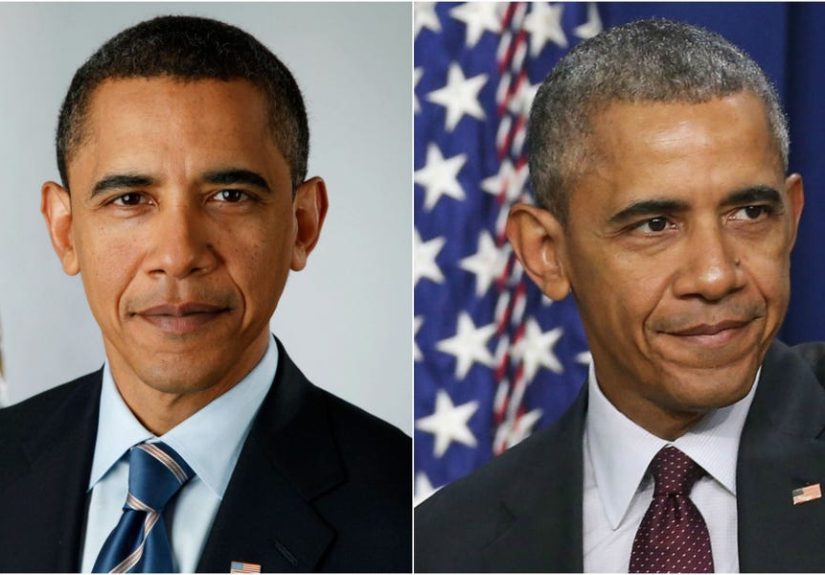
Obama entered the national stage with one of the most instantly recognizable visual identities in modern politics. Before the presidency, he appeared youthful, sharply composed, and unusually photogenic in a way that modern media amplified endlessly. The campaign and White House years added gray hair quickly enough to become its own running cultural joke. The face stayed familiar, but the contrast between early campaign photos and later presidential images is undeniable.
After leaving office, Obama’s images changed again. The expression often seems looser, more reflective, and less burdened by the daily choreography of governing. He remained active in public life and in planning his presidential center, but the visual tone softened. In office he often looked measured because he had to. After office he often looked measured because he chose to. That is a subtle but important difference, and the photos capture it beautifully.
Jimmy Carter: the gold standard of post-presidential imagery
Before the White House, Carter looked like what he was: a disciplined, serious Southerner with the careful bearing of a naval officer turned politician. His presidential years added weight to his face and a wearier cast to the smile, partly because his single term was politically difficult and publicly demanding.
But Carter’s later images may be the most remarkable of any modern former president. Instead of fading into ceremonial obscurity, he built a hugely respected post-presidency centered on humanitarian work, diplomacy, election monitoring, public service, and the Carter Center. In photo terms, Carter’s “after” years do something unusual. They do not merely show survival after office. They show purpose after office. His later face looked older, of course, but also clearer somehow, as if the burden of presidency had given way to a different kind of mission.
What These Presidential Photos Really Reveal
The most useful thing about comparing U.S. presidents before and after office photos is that the images resist simple clichés. Yes, presidents often look older after serving. No, that does not prove the office alone did all the work. Cameras change. Lighting changes. Grooming changes. Illness, war, family loss, scandal, and the natural passage of years all matter too. A photograph can suggest a theory, but history gives it context.
Still, the visual pattern is hard to dismiss. The presidency seems to intensify whatever was already there. A disciplined face becomes sterner. A charismatic face becomes more controlled. A restless face becomes more tired. And occasionally, after office, some of that pressure lifts. Former presidents sometimes look more approachable, more eccentric, or more fully themselves. That may be the biggest revelation of all. The “after” photo is not always the sad one. Sometimes it is the freer one.
A Longer Reflection on the Experience Behind These Images
Spend enough time looking at presidential before-and-after photos, and the experience becomes less like scrolling through old portraits and more like reading a silent national diary. At first, you notice the obvious stuff: the gray hair, the lines around the mouth, the stiffer posture, the smile that became more careful. But after a while, the details feel bigger than vanity. You start noticing how each presidency leaves its own visual fingerprint.
Some presidents appear to age into gravity. Others age into caution. A few age into softness, which can be surprisingly moving. A man who once looked like a machine built for campaigns later appears as a grandfather, a memoirist, or a private citizen trying to reclaim a life that the office borrowed for several years. That transformation says something important about the American presidency. It is not just a job people do. It is an identity the country imposes on them, then slowly peels away once their term ends.
There is also a strange intimacy in these photos. Presidents are among the most public people in the world, yet before-and-after comparisons make them look deeply human. You are not seeing legislation, poll numbers, or diplomatic cables. You are seeing time. You are seeing what responsibility looks like when it settles into the face. You are seeing how public life can compress youth, amplify confidence, sharpen fear, and eventually replace ambition with remembrance. It is history without a caption yelling at you.
That is why the best presidential photo archives feel richer than trivia galleries. They let viewers watch the office change from abstraction into biography. A younger Roosevelt seems impatient to act. A later Truman looks like he knows exactly what action can cost. Carter’s later images do not simply show an ex-president getting older; they show a man who redirected public life into service. Obama’s later pictures suggest release without disappearance. George W. Bush’s post-presidential imagery suggests introspection rather than endless rebuttal. These are not cosmetic differences. They are emotional and historical ones.
And maybe that is the deeper reason these comparisons keep working for readers. They do not merely answer the question, “Did the presidency age him?” They ask a more interesting question: “Who did he become after the presidency was done with him?” Sometimes the answer is a more weathered version of the same man. Sometimes it is a reinvention. Sometimes it is a return home. Sometimes it is a legacy campaign dressed in a more relaxed suit. In nearly every case, the after-office image tells us that leaving power is its own chapter, not just an epilogue.
So yes, the photos are fascinating because they show presidents before and after office. But the real hook is bigger. They show Americans what leadership looks like before the consequences arrive, what it looks like after history has had its say, and what remains once the motorcade is gone. That is not just a visual comparison. It is a very American way of asking whether power changes a person, and whether character survives the change.
Conclusion
U.S. Presidents Before and After They Served In Office: Photos is more than a visually satisfying topic for history lovers. It is a revealing study in how power, pressure, time, and public memory shape the men who enter and leave the White House. From painted portraits of early presidents to modern White House photography and presidential-library archives, the visual record shows that the presidency does not affect everyone in the same way. Some faces harden, some soften, and some seem to carry an entire era in a single expression.
The best before-and-after presidential images remind us that leadership is not just measured in speeches, laws, or election maps. It also lives in posture, demeanor, and the long shadow that public service leaves behind. In that sense, every presidential photo pair tells two stories at once: who the man was when he reached for the office, and who he became after the office reached back.