Table of Contents >> Show >> Hide
- A Small Invitation With a Big Signal
- Why Veterans and SaaS Are a Better Match Than People Think
- What Veterans Actually Had Access to at SaaStr Annual 2020
- The 2020 Twist Nobody Planned For
- Why the Invitation Mattered Even More in 2020
- The Bigger Ecosystem Around Veteran Talent
- What Veterans Could Gain From a SaaStr-Style Event
- This Was Never About Charity
- Why the 2020 Invitation Still Deserves Attention Today
- Experiences Related to “Veterans Come As Our Guests to 2020 SaaStr Annual”
Sometimes the most meaningful invitations are the shortest ones. SaaStr’s message to U.S. veterans ahead of its 2020 Annual was refreshingly direct: come as our guests. No maze of fine print, no dramatic violin soundtrack, no “please circle back with procurement.” Just a clear offer to attend at no cost as part of the organization’s inclusion effort. In a tech world that often talks a big game about opportunity, this was a practical move that put access first.
And that matters, because SaaStr Annual is not just another conference where people collect tote bags and pretend they will definitely read the white paper later. It has long been one of the biggest gatherings in B2B software, bringing together founders, operators, investors, and revenue leaders who are all trying to answer the same giant question: how do you grow smarter, faster, and with fewer expensive mistakes?
For veterans working in SaaS, exploring a move into tech, or building companies of their own, that kind of room matters. It is where tactics meet opportunity. It is where mentorship stops being an abstract virtue and becomes a calendar invite. And in 2020, when economic uncertainty hit hard and many veterans were navigating career transitions in a chaotic market, the gesture carried even more weight.
A Small Invitation With a Big Signal
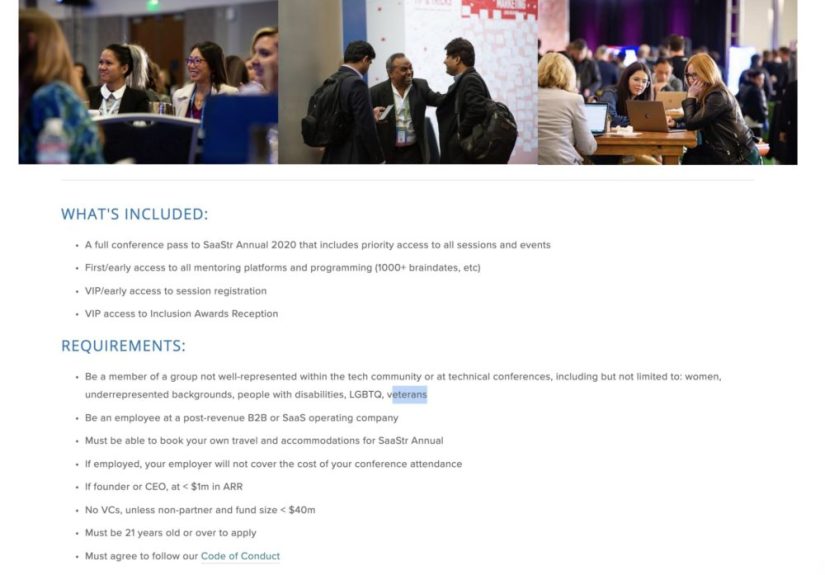
The original 2020 message was simple: all U.S. veterans could attend SaaStr Annual as guests at no cost. The post also made an important distinction. If a veteran already had the budget to attend, SaaStr encouraged them to buy a regular ticket and leave the sponsored spots for others who could use the help more. That detail was smart. It kept the program generous without turning it into a free-for-all.
More importantly, it signaled that veterans were not being treated as an afterthought or a ceremonial sidebar. They were being recognized as valuable members of the SaaS community. That is exactly the right frame. Veterans are already in software sales, customer success, security, product operations, infrastructure, leadership, and entrepreneurship. The invitation did not “create” their place in tech. It acknowledged it.
SaaStr’s broader inclusion language reinforces that point. The organization has said it wants its events and community to recognize people of different backgrounds, including military service. That is not just morally good. It is strategically good. Software companies build better when they include people who know how to operate under pressure, lead teams, learn complex systems quickly, and make decisions when conditions are less than adorable.
Why Veterans and SaaS Are a Better Match Than People Think
Leadership travels well
Veterans often enter civilian careers with experience managing people, handling mission-critical processes, and staying calm when plans go sideways. In SaaS, those skills show up everywhere. A customer success leader handling churn risk, a sales manager coaching a distributed team, a founder navigating a rough quarter, and an operations lead untangling a cross-functional mess all rely on the same basic traits: discipline, accountability, communication, and follow-through.
Tech loves to romanticize chaos, but real growth companies do not scale on vibes alone. They scale on execution. Veterans understand execution.
Systems thinking is not optional in software
Military experience often involves working within large, interconnected systems where timing, process, and role clarity matter. SaaS companies may move faster and wear better hoodies, but they still run on systems. Product affects sales. Sales affects onboarding. Onboarding affects retention. Retention affects net revenue. Revenue affects hiring. One weak link can throw the whole machine off balance.
That is one reason veterans can be especially strong in operational roles. They are often trained to see the full picture instead of treating every problem like an isolated emergency. In software, that is not just helpful. It is gold.
Adaptability is the whole game
Military careers involve constant change: new teams, new environments, new responsibilities, new constraints. The modern SaaS market is not exactly known for holding still either. Business models shift. products evolve. AI changes workflows. Budgets tighten. Go-to-market strategies get rewritten. Veterans are often more prepared for that level of motion than people assume, because they have already lived through versions of it under far higher stakes.
What Veterans Actually Had Access to at SaaStr Annual 2020
The 2020 invitation was not just about letting people watch from the back row. SaaStr’s wider inclusion program has emphasized real access: full passes, priority registration, mentorship opportunities, and early entry to networking systems that often fill up fast. For the 2020 “Annual at Home” version later that year, SaaStr’s no-cost inclusion passes included full access to sessions and content, early session registration, early Braindate registration, first access to mentorship tools, and first access to hundreds of VCs during VC Day.
That is a big deal. A free ticket is nice. A free ticket paired with structured access is useful. Those are not the same thing. Conferences create the most value when attendees can actually get into the rooms, meetings, and conversations that move careers and companies forward. SaaStr seemed to understand that.
The event itself also offered the kinds of sessions veterans could immediately apply. Early workshop previews for 2020 included topics such as compensation negotiation, cross-functional product launches, go-to-market strategy, sales and marketing alignment, SDR team building, and how to build a best-in-class marketing team at different stages of growth. In other words: not fluff. Not “manifest your funnel.” Real operating material.
The 2020 Twist Nobody Planned For
Of course, 2020 had other ideas. The original SaaStr Annual plan pointed to a March 10–12 event in the San Jose and greater SF Bay Area. Then the pandemic rearranged basically everything on earth, including the conference calendar. Later that year, SaaStr shifted its flagship gathering into a fully digital “Annual at Home” experience on September 2–3, 2020.
That pivot changed the shape of the opportunity, but not necessarily its value. In fact, for some veterans, it may have expanded it. Digital access removes travel costs, reduces friction for people in transition, and makes it easier to attend while balancing family, work, or relocation. SaaStr positioned the online event as an immersive two-day experience, with a reported 50,000-plus cloud and SaaS experts, 1,000-plus VCs, more than 50 speakers, and thousands of Braindates and one-on-one meetings.
That means the original spirit of the invitation survived the year’s chaos. The venue changed, but the door stayed open.
Why the Invitation Mattered Even More in 2020
The timing was not random. Veteran employment took a hit during the pandemic era. Federal labor data showed the jobless rate for all veterans rose to 6.5% in 2020, while veterans who served during the post-9/11 period saw a 7.3% unemployment rate. In plain English: a lot of people who had already served their country were facing a rougher civilian labor market right when industries were being shaken like a snow globe.
Against that backdrop, opening a major SaaS event to veterans was more than a nice public gesture. It was a practical intervention. It created a pathway into hiring conversations, learning opportunities, and startup networks during a year when many traditional routes were harder to navigate.
This is where conference access can become career infrastructure. A veteran exploring a tech transition does not just need inspiration. They need language for translating military experience into business value. They need proof that other veterans have made the jump. They need exposure to what modern SaaS jobs actually look like. And sometimes they need one warm introduction that turns “I wonder if I belong here” into “I have an interview next week.”
The Bigger Ecosystem Around Veteran Talent
SaaStr’s 2020 invitation also fits into a much larger American push to connect veterans with business ownership, technical training, and meaningful employment. The Small Business Administration’s Office of Veterans Business Development supports veterans and military families through training, counseling, capital access, and contracting opportunities. The VA’s Veteran Entrepreneur Portal points veteran-owned and service-disabled veteran-owned businesses toward start, fund, and grow resources. The D’Aniello Institute for Veterans and Military Families at Syracuse runs entrepreneurship programs, and Bunker Labs has built a strong community for veteran and military spouse founders who want to launch and scale companies.
That matters because veterans are not just candidates for jobs. Many are builders of businesses. Census data shows veteran-owned employer businesses remain a meaningful part of the U.S. economy, with the professional, scientific, and technical services category representing a particularly important share. Translation: the overlap between veterans and knowledge-based business is real, not theoretical.
And on the tech-training side, the pathways are getting clearer. Microsoft’s Software and Systems Academy helps transitioning service members and veterans move into in-demand technical roles such as cloud administration, cybersecurity operations, and cloud development. Salesforce’s military programming and fellowship efforts offer hands-on experience, learning, and networking for transitioning service members, veterans, and military spouses. Hiring Our Heroes continues to connect military-connected talent with employers through hiring events, fellowships, digital programs, and upskilling opportunities.
Seen in that context, SaaStr’s message to veterans was part of an emerging truth: the tech economy works better when it stops treating veteran talent like a hidden bonus feature and starts treating it like a strategic asset.
What Veterans Could Gain From a SaaStr-Style Event
For aspiring founders
A veteran building a startup could use an event like SaaStr Annual to pressure-test a product idea, learn fundraising norms, compare go-to-market approaches, and meet investors without relying on pure cold outreach. Early-access matching and VC programming are especially valuable because they reduce randomness. That matters if you are trying to make every conversation count.
For operators already in tech
Veterans working in revenue, support, partnerships, operations, or product could use the event as a force multiplier. Workshops on negotiation, marketing structure, team design, and cross-functional launches are exactly the kinds of lessons that help people move from solid performer to strong leader.
For people transitioning into civilian careers
This may be the biggest category of all. Events like SaaStr help veterans decode the software industry fast. You learn the language. You see the job titles. You hear what companies reward. You discover that “mission planning,” “process improvement,” and “team leadership” do not need to be hidden behind corporate buzzwords to be relevant. They just need to be translated clearly.
That translation piece is often the difference between getting overlooked and getting hired. Employers may not automatically understand military experience, but many absolutely value the skills once they are explained in the language of business outcomes.
This Was Never About Charity
The best way to look at “Veterans Come As Our Guests to 2020 SaaStr Annual” is not as a charitable favor. It was ecosystem design. It was a recognition that access can change who gets seen, who gets heard, and who gets hired. It was also a recognition that veterans bring an enormous amount of value into software, whether they arrive as founders, operators, sellers, builders, or future leaders.
That is why the invitation still feels relevant beyond 2020. The idea behind it has aged well. Open the room. Lower the friction. Give people real access to mentors, learning, and decision-makers. Then let talent do the rest.
Frankly, that is a pretty solid growth strategy for an industry that claims to love efficiency.
Why the 2020 Invitation Still Deserves Attention Today
Years later, the offer still says something useful about what strong tech communities should do. They should not wait for talent to magically find them. They should build explicit pathways. They should understand that representation is not only about who is on stage, but also about who gets into the room, into the workshop, into the mentor queue, and into the investor meeting.
SaaStr’s veteran invitation worked because it combined gratitude with opportunity. It did not reduce veterans to symbolism. It pointed them toward an event built around learning, connection, and growth. In a business climate where everyone claims to value resilience and leadership, opening the gates to people who have practiced both is not just respectful. It is smart.
And maybe that is the cleanest takeaway of all. A veteran guest pass to a major SaaS conference is not some side note in the story of tech. It is part of the story of who gets to shape what comes next.
Experiences Related to “Veterans Come As Our Guests to 2020 SaaStr Annual”
What does an invitation like this feel like on a human level? For many veterans, the experience is bigger than the ticket itself. It starts with the quiet reality of transition: you leave a world where rank, mission, and role are clear, then enter one where everyone says things like “pipeline hygiene” and “product-led growth” as if they were born in a spreadsheet. A no-cost invitation to a major SaaS event can be the moment the fog starts to lift.
Imagine the experience of a veteran who has spent years leading teams, solving logistical problems, and making decisions with incomplete information. On paper, that person has serious ability. In civilian hiring, though, paper can be rude. Job descriptions ask for software backgrounds, revenue ownership, certifications, and industry language the veteran may not have yet. Walking into a SaaStr-style environment changes the equation. Suddenly, they are surrounded by people discussing customer acquisition, onboarding, retention, and scaling. Instead of hearing abstract advice, they see how companies actually work.
There is also the emotional experience of recognition. Veterans often hear “thank you for your service,” which is kind, but not always useful. An invitation that says, “Come join us, learn with us, meet people, build something,” lands differently. It says your service is respected, and your future matters too. That is a much more practical form of appreciation.
For veterans already working in tech, the experience can be validating in a different way. Maybe they are in sales and trying to break into leadership. Maybe they are in operations and want to move closer to strategy. Maybe they are in customer success and wondering whether they belong in rooms full of founders and VCs. Attending a conference with workshops, mentorship, and high-level conversations helps close that confidence gap. It reminds them that they are not entering a foreign planet. They are entering an industry that still runs on trust, execution, adaptability, and leadership under pressure.
Then there is the founder experience, which may be the most electric of all. A veteran entrepreneur often brings grit, mission focus, and a practical bias toward getting things done. But startups are still lonely. A SaaStr-type event can create that rare feeling of momentum: one meeting sharpens the pitch, another reframes the product, a third introduces a potential customer, and suddenly the business feels less like an isolated idea and more like a company with a path. That kind of progress is hard to measure on a badge scanner, but it is real.
The most powerful part of the experience, though, may be the shift in identity. Veterans do not stop being veterans when they enter tech. They add to the identity. Founder. Operator. Seller. Builder. Investor-ready entrepreneur. An invitation like the one tied to 2020 SaaStr Annual helps make that next identity visible. It creates a bridge between past service and future growth. And for many people, that bridge is exactly what makes the next chapter possible.