Table of Contents >> Show >> Hide
- First, what does “interstellar space” mean here?
- The moment Voyager 2 crossed the line
- The evidence: what the instruments “felt” at the heliopause
- Why Voyager 2’s crossing mattered more than “Voyager 1 did it first”
- What Voyager 2 taught us about the solar system’s border
- How a 1970s spacecraft keeps talking to Earth
- So… what happens next?
- Frequently asked questions
- Experience: what it feels like to live through Voyager 2’s interstellar milestone (about )
- Conclusion
Imagine driving so far past the last gas station that even the idea of a gas station becomes folklore.
That’s basically what Voyager 2 didexcept the “car” is a 1977 spacecraft, the “road” is the solar system’s outer frontier,
and the “Are we there yet?” takes 16+ hours to reach home at the speed of light.
On November 5, 2018, Voyager 2 crossed the outer boundary of the Sun’s protective bubble and entered
interstellar spacethe region between stars where the Sun no longer calls the shots.
The moment was historic for a simple reason: for only the second time ever, a human-made object stepped outside the heliosphere.
The even cooler reason? Voyager 2 still had a working plasma instrument, letting scientists “feel” the border in a way its twin, Voyager 1, couldn’t.
First, what does “interstellar space” mean here?
“Interstellar space” sounds like a place where the soundtrack instantly becomes dramatic and everything sparkles.
In reality, it’s more like crossing a weather frontsubtle at a glance, wildly important in the data.
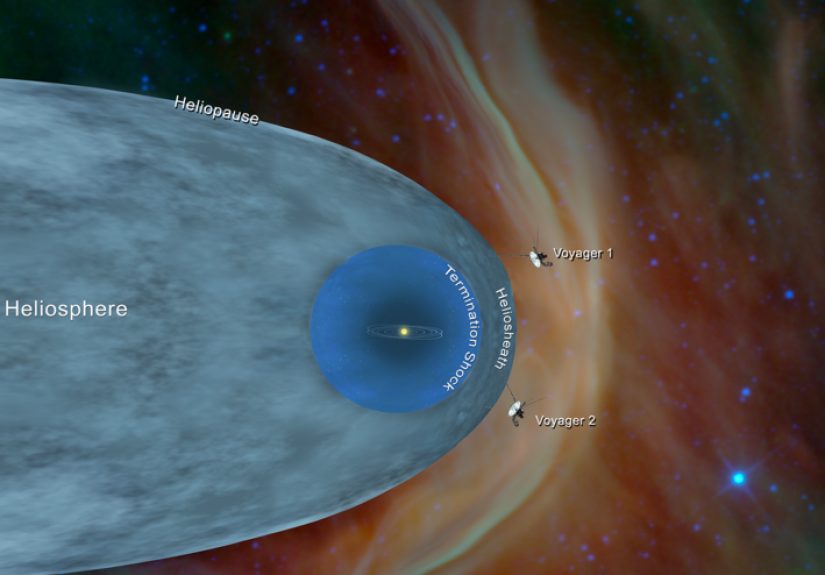
The Sun’s bubble: the heliosphere
The Sun constantly blows out a stream of charged particles called the solar wind.
That outflow inflates a vast magnetic “bubble” known as the heliosphere, which stretches far beyond Pluto.
Inside the bubble, the solar wind dominates: it shapes magnetic fields, guides particles, and helps shield the planets from a lot of high-energy radiation.
The edge of the bubble: the heliopause
As the solar wind pushes outward, it eventually meets the surrounding material in our galaxythe interstellar medium.
The boundary where the Sun’s solar-wind plasma gives way to interstellar plasma is called the heliopause.
Cross it, and you’re no longer in the Sun’s protective “weather system.” You’re in the neighborhood between stars.
One important nuance: crossing the heliopause doesn’t mean Voyager 2 has left the Sun’s gravity behind.
It’s still gravitationally bound to the solar system for a long, long time.
“Interstellar space” in this story is about the plasma and magnetic environment, not the legal paperwork of cosmic real estate.
The moment Voyager 2 crossed the line
Voyager 2 launched on August 20, 1977 and spent the next decade doing the kind of planetary sightseeing
most spacecraft only daydream about: Jupiter, Saturn, Uranus, and Neptune.
After those flybys, it kept goingbecause space doesn’t have a “return to sender” label.
By late 2018, Voyager 2 was over 11 billion miles from Earth, traveling through the heliosheath
(a turbulent outer region where the solar wind slows and gets messy).
Then, on November 5, its instruments registered changes consistent with a clean exit from the heliosphere.
How do you confirm a boundary you can’t see?
You don’t look for a “Welcome to Interstellar Space” sign. You look for a patternmultiple instruments telling the same story:
the solar wind fades, interstellar particles take over, and the plasma properties change.
Voyager 2’s strength is that it carried a whole toolkit for this detective work.
The evidence: what the instruments “felt” at the heliopause
1) Plasma Science Experiment: the solar wind basically… stopped
The most convincing clue came from Voyager 2’s Plasma Science Experiment (PLS).
Inside the heliosphere, PLS measures the solar wind’s speed, density, temperature, and flow.
On November 5, 2018, Voyager 2 saw a steep decline in solar-wind flowand afterward, it essentially stopped detecting solar wind in its surroundings.
That’s like walking out of a windy stadium tunnel and realizing the crowd noise is gone. Something major changed.
2) Energetic particle detectors: heliospheric particles dropped, cosmic rays rose
Voyager 2 also carried instruments that count energetic particles.
Near the crossing, measurements showed heliospheric particles (those tied to the Sun) plummeting,
while cosmic rays (high-energy particles from beyond the solar system) increased and stayed elevated.
This “swap” is exactly what you’d expect when you step out of the Sun’s bubble and into a region shaped by the galaxy at large.
3) Magnetometer: a boundary with personality
Magnetic fields don’t just sit still in space like wallpaper. They twist, compress, and form barriers.
Voyager 2’s magnetometer data helped map a strange reality near the heliopause:
instead of a simple, uniform edge, the boundary appears structuredmore like a shoreline with currents than a perfectly drawn circle.
4) Plasma waves: measuring density by listening to space “ring”
Voyager’s Plasma Wave Subsystem (PWS) can detect plasma oscillationswaves that reveal electron density.
After Voyager 2 crossed the heliopause, the plasma environment beyond it proved significantly denser than inside,
consistent with long-standing predictions.
The first reported electron density measurement in the interstellar medium for Voyager 2 was around 0.039 particles per cubic centimeter,
and the jump across the boundary was about a 20× increase compared with typical outer-heliosphere values.
Why Voyager 2’s crossing mattered more than “Voyager 1 did it first”
Voyager 1 crossed the heliopause in 2012, making headlines as the first spacecraft in interstellar space.
But there was a catch: Voyager 1’s plasma instrument had stopped working decades earlier.
Scientists had strong evidence of the crossingespecially from energetic particles and plasma-wave databut Voyager 2 gave them something extra:
a direct, working plasma sensor at the boundary.
That meant a more complete picture of the heliopause as a physical place:
not just “particles changed,” but “here’s how the plasma itself behaves when the Sun’s influence ends.”
What Voyager 2 taught us about the solar system’s border
The interstellar plasma is colder and denser than the heliosphere’s plasma
One big takeaway is that the heliosphere really is a distinct environment:
inside, the plasma tends to be hotter and more rarefied; outside, the plasma is cooler and denser.
Voyager 2’s measurements supported this contrast and helped validate models of how the heliosphere interacts with the surrounding galaxy.
The heliopause isn’t a perfect sphere
If the heliosphere were a simple bubble, Voyager 1 and 2 would have crossed at similar distances in a neat, symmetrical way.
Instead, they crossed in different directions and at different distancesevidence that the heliosphere is shaped by
solar activity and the external pressure and magnetic field of the interstellar medium.
There’s a “transition zone” beyond the boundary
Another subtle finding: stepping past the heliopause doesn’t necessarily put you instantly into calm, undisturbed interstellar conditions.
Data suggest a perturbed region just beyond the heliospherelike stepping from a house into a windy porch before you reach the quiet street.
That zone is scientifically valuable because it’s where solar influence and interstellar conditions negotiate control.
How a 1970s spacecraft keeps talking to Earth
Voyager 2 runs on a radioisotope power system (not solar panelsthere’s not enough sunlight out there to make that practical).
Over time, that power slowly declines. As watts become precious, engineers turn off heaters and instruments one by one
to keep the most valuable measurements alive as long as possible.
Communication is handled through NASA’s Deep Space Network, and the signal is famously faint.
Voyager’s transmitter is roughly comparable to a household light bulb in power, and by the time it reaches Earth
across billions of miles, it’s the cosmic equivalent of whispering across a continent during a thunderstorm.
Instrument triage: choosing what stays on
Power management has become the mission’s long game.
In late September 2024, the mission turned off Voyager 2’s plasma science instrument to save power,
and in March 2025, Voyager 2’s low-energy charged particle instrument was powered down as well.
As of these updates, Voyager 2 has continued operating key instruments like the magnetometer and plasma wave subsystem,
with the cosmic ray subsystem expected to be shut off in 2026 to extend overall mission life.
The headline here isn’t “they turned things off.” It’s “they made 47-year-old hardware keep doing frontier science.”
That’s not just engineeringit’s endurance storytelling, told in watts and workarounds.
So… what happens next?
Voyager 2 will keep traveling outward at roughly a few astronomical units per year,
sampling the very local interstellar medium as long as its power and systems allow.
Even after contact ends, the spacecraft itself will continuesilent, steady, carrying a record of Earth’s existence
like a message in a bottle drifting on a galactic ocean.
Why this matters to the rest of us (besides being incredibly cool)
-
Space-weather insight: Understanding how the heliosphere blocks and filters cosmic radiation helps refine
models relevant to astronauts, spacecraft electronics, and long-duration missions. - Heliophysics reality check: Voyager data tests and improves our best simulations of the Sun’s influence in space.
-
Blueprint for future interstellar probes: Every lesson about boundary regions, plasma behavior, and operations at extreme distance
informs what the next generation of missions should carryand how they should be built.
Frequently asked questions
Did Voyager 2 leave the solar system?
It left the heliosphere (the Sun-dominated plasma bubble), which is why we say it entered interstellar space.
But it has not “exited” the solar system in the sense of escaping the Sun’s gravitational influence.
How did scientists know the crossing date?
Because multiple instruments detected the characteristic signatures of the heliopause around November 5, 2018:
the solar wind dropped away, interstellar particle populations changed, and plasma properties beyond the boundary matched expectations.
Why does the heliopause move?
The Sun’s activity changes on an approximately 11-year cycle, affecting solar wind pressure.
The heliosphere can “breathe” in responseexpanding or contractingwhile also being shaped by the interstellar environment around it.
Experience: what it feels like to live through Voyager 2’s interstellar milestone (about )
Most space moments arrive with fireworks: a rocket launch, a bright streak, a dramatic landing video.
Voyager 2’s entry into interstellar space arrived more like a quiet notificationexcept the notification took half a day to reach your phone,
your phone was a room-sized antenna array, and the “ping” was a faint radio whisper from beyond the Sun’s protective bubble.
For scientists, the experience is part suspense thriller, part patience marathon. There’s no joystick, no live camera feed,
no “zoom in on the border.” Instead, there are plots: the solar-wind speed sliding downward, particle counts flipping,
magnetic field lines behaving like they’ve walked into a new neighborhood.
You imagine teams huddled around screens and printouts, not because they’re nostalgic, but because the data is the only window.
When the graphs agreewhen the instruments tell the same story from different anglesit feels like hearing multiple witnesses
describe the same event with eerie consistency. That’s when a boundary becomes real.
For engineers, it’s equal parts pride and problem-solving. Voyager 2 is old enough to have a respectable retirement plan,
yet it still needs careful tending: power budgets, heater decisions, instrument schedules, and commands written with the care of a surgeon.
Every watt saved is a few more months of science. Every instrument that stays on is one more chapter from a place we’ve never visited before.
It’s hard not to admire the “keep it alive” creativitylike repairing a classic car while it’s already halfway to another country,
and you can only send instructions by mail… to the future.
For everyone watching from Earth, the experience is surprisingly personal. Voyager is the rare science story that makes you feel
both tiny and powerful at the same time. Tiny, because interstellar space is vast beyond normal comprehension.
Powerful, because a craft built with 1970s technology is still teaching us something new about the galaxy.
People celebrate it in all sorts of human ways: teachers building heliosphere models out of balloons and flashlights;
space fans staying up to watch press briefings; writers turning a boundary crossing into a metaphor for resilience;
kids drawing “space maps” where Voyager is a brave little dot heading into the unknown.
And then there’s the emotional punch of the Golden Record ideathis tiny archive of Earth’s sounds and images,
riding along on a spacecraft that has literally outlived its original mission by decades.
Voyager 2 entering interstellar space isn’t just an astronomy headline; it’s a reminder that exploration can be quiet,
data-driven, and still deeply moving. The spacecraft doesn’t need to “arrive” anywhere spectacular to matter.
Sometimes the most unforgettable journeys are the ones that keep goingpatientlylong after everyone expected them to stop.
Conclusion
Voyager 2’s entry into interstellar space on November 5, 2018, wasn’t just a milestone in distanceit was a milestone in understanding.
It confirmed that the heliopause is a real, measurable border where the Sun’s influence gives way to the interstellar medium,
and it delivered rare, direct plasma observations that help scientists model the cosmic environment protecting our planets.
Nearly half a century after launch, Voyager 2 is still doing what great explorers do best: going farther than planned,
learning more than expected, and making the unknown feel a little more like home.